Latest Developments, January 23

In the latest news and analysis…

Spring cleaning
Human Rights Watch has released the latest edition of its “annual review of human rights practices around the globe” which this year has a special focus on the Arab Spring.
“The United States and some European allies could make an enormous contribution to ending torture in the Arab world by coming clean about their own records of complicity in torture as part of their fight against terrorism. Western governments should punish those responsible for ordering or facilitating torture and end the use of diplomatic assurances as a fig leaf to justify sending suspects to countries where they risk torture.”

Deadly mining protest
The Oaxaca Study Action Group reports that two people were shot, one of them fatally, in the course of a protest against a Canadian-owned mine in southern Mexico.
“San José del Progreso, located 50 km south of Oaxaca City, has been a flash point for violence since an alliance of local environmentalists and farmers occupied the gold and silver mine in early 2009. Despite widespread resistance and an ongoing conflict that already claimed the lives of two people in summer 2010, Fortuna Silver began commercial operation of the mine last September. As the installations are located in an arid valley, smooth operation is heavily dependent on water access to process the ore. The contamination of the scarce resource is among the main concerns of the mining opponents, many of whom grow vegetables for a living and rely on clean water for irrigation.”

Rubik on life support
The Tax Justice Network gleefully reports that Switzerland’s Rubik plan to preserve its famous banking secrecy is on the verge of collapsing as EU objections to Swiss tax deals with Britain and Germany intensify.
“TJN’s position is unambiguous: these deals are weak, immoral, and even silly – and they undermine international attempts to tackle tax evasion. Both Germany and Britain should swallow their pride, withdraw from the deals, and put their diplomatic effort into pushing through the EU’s enhanced Savings Tax Directive – suitably extended to Switzerland.”

Maximum wage
The Guardian’s George Monbiot calls for a nationwide UK maximum wage to rein in corporate executive pay, which he describes as “a form of institutionalised theft, arranged by a kleptocratic class for the benefit of its members.”
“I’m not talking about ratios or relative earnings. Various bodies have proposed that there should be a fixed ratio of the top earnings within a company to either the median or lowest salaries. But as a report on this issue by the New Economics Foundation shows, the first measurement quickly becomes complex and opaque, the second creates an incentive to contract out the lowest paid work. I’m talking about an absolute maximum, applied nationwide.”

Drones and America
The Brookings Institution’s Peter Singer looks at the impact that America’s increasing reliance on drone strikes is having on its own democracy, quite apart from any death and destruction caused in distant countries.
“We must now accept that technologies that remove humans from the battlefield, from unmanned systems like the Predator to cyberweapons like the Stuxnet computer worm, are becoming the new normal in war.
And like it or not, the new standard we’ve established for them is that presidents need to seek approval only for operations that send people into harm’s way — not for those that involve waging war by other means.
Without any actual political debate, we have set an enormous precedent, blurring the civilian and military roles in war and circumventing the Constitution’s mandate for authorizing it.”

Drones and Pakistan
News Pakistan reports on Pakistani cricketer turned politician Imran Khan’s take on the impact US drone strikes are having on the ground in his country.
“Imran Khan, the chief of the Pakistan Tehreek-e-Insaf (PTI), has urged the United States to stop drone strikes in Pakistan, claiming that they were killing many innocent people.
He observed that each bomb that killed terrorists also killed many people who might be related to the terrorists but were not involved in militancy.
In his view this collateral damage creates more Jihadis than it kills, he said this while interviewing with CNN.”

Proceed with caution
New York University’s Alex Evans and David Steven argue that despite growing enthusiasm for Sustainable Development Goals ahead of the Rio+20 summit, there is a lack of clarity regarding their contours and timeframe.
“The question of which countries would be covered by SDGs is a minefield. With any set of SDGs likely to be universal rather than applicable only to developing countries, major political challenges would arise. The MDGs demanded relatively little of OECD governments: all that was asked of them was aid, and relatively small amounts of it at that. A more comprehensive set of post-2015 Goals, on the other hand, would need to look ‘beyond aid’ – entailing changes to domestic policies in sensitive areas like migration, trade, intellectual property, or energy policy. The vexed issue of ‘common but differentiated responsibilities’ would certainly arise along the way – perhaps bedevilling post-2015 discussions as it already has the Doha round and the UNFCCC climate process (though an optimist might argue that a universal approach could help debate to move past the rigid and outdated typology of ‘developed’ and ‘developing’ countries).”

Migrant myths
The Observer’s Barbara Ellen writes that new statistics undermine traditional narratives about immigrants and “benefits tourism.”
“This could be a chance to start a new kind of immigration debate, one that doesn’t centre on: ‘What are they taking from us?’ Rather, it might ask: ‘What are they giving us?’ Even: ‘Do we expect too much, too soon, of migrants? Should we break the habit of a lifetime and get off their backs?’
For too long, there’s been a bizarre cultural climate of putting migrants under unfair pressure to perform instantly. It’s as if they’re expected to be supermen and women, breezily starting multinational companies the moment they arrive… in a foreign country, sometimes homeless, and with a new language to master.”

Latest Developments, January 13

In the latest news and analysis…

Violent hemisphere
The Washington Post reports on a new study suggesting 45 of the world’s 50 most violent cities are located in the Western Hemisphere, many of them caught up in the tension between an insatiable American market and prohibition policies.
“[Honduras’s] San Pedro Sulla tallied 159 homicides per 100,000 residents last year, followed by [Mexico’s] Ciudad Juarez, with 148 killings per 100,000. Both cities are major operational and strategic distribution points along the billion-dollar drug pipeline that funnels narcotics to consumers in the United States.”

Apple opens up
Reuters reports Apple has made public its “closely guarded” list of global suppliers in the face of criticism over perceived indifference to worker abuses.
“The audit conducted by Apple of suppliers found a number of violations, among them breaches in pay, benefits and environmental practices in plants in China, which figured prominently throughout the 500-page report Apple issued.
Other violations unearthed included dumping wastewater onto a neighboring farm, using machines without safeguards, testing workers for pregnancy and falsifying pay records.”

German banks vs. financial transaction tax
Bloomberg reports that Germany’s banks have expressed their opposition to a tax on financial transactions in the euro zone.
“ ‘If a financial-transaction tax cannot be introduced internationally, you have to do without it,’ Hans Reckers, managing director of Germany’s VOeB association of public banks, said in an e-mailed statement today. ‘We firmly oppose the creation of tax haven in the EU.’

The European Commission in September suggested a tax of 0.1 percent on equity and bond transactions and 0.01 percent on derivatives, which it said could raise 55 billion euros ($70 billion) a year. European Union finance ministers are due to discuss the levy in March.”

Diminishing solidarity
Le Monde reports on the contentious debate over whether a financial transaction tax, if one is ever adopted, would have much in common with Robin Hood.
“The NGO Oxfam worries about the change in [French President] Nicolas Sarkozy’s position, noting that he had said at the G20 summit in early November ‘a significant portion, the majority or the totality of the revenue must go to development.’ But he has since changed his mind, according to Oxfam’s Luc Lamprière: ‘His reference to the European Commission directive is a bad sign since it calls for the tax to ‘progressively replace national contributions to the EU budget,’ leaving the idea of financing development and the fight against climate change as a mere footnote.’ ” (Translated from the French)

Rio+20 agenda
The International Institute for Environment and Development’s Emily Benson grades the just-released draft agenda for the Rio+20 summit, finding it stronger on sentiment than specifics.
“Mention is made to ‘innovative instruments of finance’ for building green economies and reference is made to public procurement, fiscal reform, the removal of subsidies that undermine sustainable development, all of which the [Green Economy] Coalition has been promoting. It calls for International Financial Institutions to ‘review their programmatic strategies to ensure the provision of better support to developing countries for the implementation of sustainable development’. This is all encouraging stuff. However, the text steps rather delicately around the question not only of how much the transition is going to cost, but how we are going to leverage additional funds. From our past experience of Rio 1992 we know that governments alone will not be able to pay for the transition so we need to think a lot more creatively about how to leverage additional finance. So, the question we would like to see tackled in the next draft is:  How are we going to kick-start the finance of a green and fair economy in order to create long-term investor confidence?”

Burma beware
The Institute of Development Studies’ Gabriele Köhler argues Myanmar must be wary, as it opens up to the world beyond Asia, of the West’s conquering friendship.
“We can hope that the west’s sudden enthusiasm stems from genuine support for peace and the rights of the population. But in reality, the change in stance probably has at least as much to do with pursuit of their own national interests. For several decades, US and European sanctions have kept western businesses out of Burma, while firms from Thailand, Singapore, India and especially China eagerly exploited the country’s natural gas, hydropower potential and gemstones.
History has shown time and again that popular movements for civil liberties, democracy and human rights are often hijacked by a drive to introduce neoliberal capitalism or prise open a country to foreign investors.”

Carbon fixation
The Land Institute’s Stan Cox argues that current schemes to reduce carbon emissions could actually make it harder for future generations to provide for themselves.
“To value everything in terms of carbon and treat the myriad benefits of ecologically sound agriculture as mere byproducts of climate protection is to invite all kinds of threats to soil and food. Perhaps the most menacing threats are those posed by connecting food and soil more tightly to global capital markets through carbon-trading schemes and tying them more closely to volatile energy markets by putting already fragile soils to work growing biofuels.

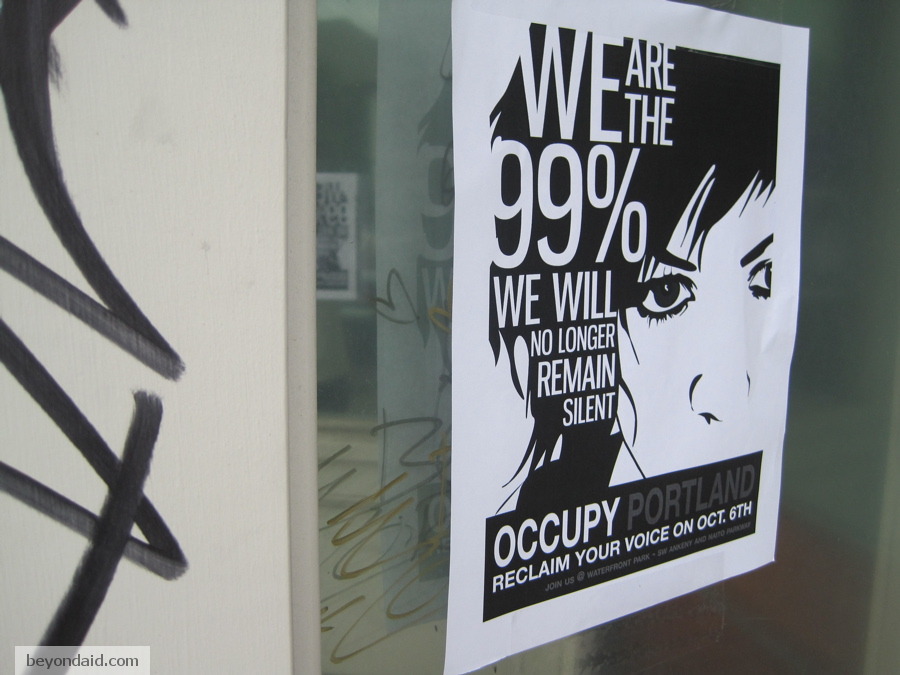
Occupying Occupy
Author and blogger Carne Ross warns that the appropriation of Occupy slogans, by mainstream politicians and crockery shops, has begun.
“As the ‘68-ers manifestly failed to do, Occupy must move from words to action, for relying on the platform of words will see the ground cut from under our feet. In contrast to the ease with which they can steal the words of Occupy, the [Newt] Gingrich’s of this world will not be able to appropriate actions consonant with the ideals of Occupy for this would be to enact Occupy’s sought revolution.  And that won’t happen in a century of Sundays.”

Latest Developments, January 11

In the latest news and analysis…

Rio+20 leak
The Guardian reports a leaked agenda for June’s Rio+20 conference suggests countries will be called upon to agree to 10 new sustainable development goals but overall, the meeting promises to be much less ambitious than the original earth summit.
“Unlike the 1992 earth summit when over 190 heads of state set in motion several legally binding environment agreements, leaders this time will not be asked to sign any document that would legally commit their countries to meeting any particular targets or timetables. Instead, they will be asked to set their own targets and work voluntarily towards establishing a global green economy which the UN believes will reduce poverty and slow consumption.”

Transforming governance
The Inter Press Service reports on growing calls for radical changes in global governance in order to address issues such as poverty and environmental destruction.
“ ‘We need to have a “constitutional moment” in world politics, akin to the major transformative shift in governance after 1945 that led to the establishment of the United Nations and numerous other international organisations,’ said Frank Biermann of VU University Amsterdam and director of the Earth System Governance Project.

Transforming international governance will be challenging since nation-states are almost entirely concerned with their own short-term interests, [Biermann] acknowledges. However, countries give up some of their power when they join the World Trade Organisation.
‘We ought to be able to do this for the protection of the planet and act as a community of nations,’ he said.”

Guardians of the future
The University of East Anglia’s Rupert Read argues that true democracy must take into account the interests of future generations, and to that end, he proposes the integration of  “guardians” into Britain’s existing parliamentary system.
“The members of this body would be selected by sortition, as is current practice for jury service, in order to ensure independence from present-day party political interests.
The Guardians would have a power of veto over legislation that were likely to have substantial negative effects for society in the future, the right to review major administrative decisions which substantially affected future people and the power to initiate legislation to preserve the basic needs and interests of future people.”

Immigration assistance
The Center for Global Development’s Michael Clemens argues the US, by tweaking its immigration policies, could provide significant assistance to earthquake-ravaged Haiti without spending any money or increasing the number of immigrants coming to its shores.
“First, the administration could reverse the current ban on Haitian participation in the U.S.’s largest employment-based visa program, the H-2 temporary low-skill work visa. All Haitians are currently ineligible to receive these visas. If even a few thousand Haitians at a time participated in that program over the next decade, it would generate more money for Haitian families than the entire U.S. infrastructure reconstruction allocation for Haiti. Fiscal cost: zero. It would even generate net positive U.S. tax revenue. Effect on Americans’ jobs: none. Removing the ban on Haiti would simply allow employers already seeking laborers to draw from Haiti instead of being limited to the 53 currently-eligible countries like Guatemala and Mexico.”

Acting together
Norwegian development and environment minister Erik Solheim argues “poverty is about politics” and its solutions lie beyond aid.
“As Norway’s minister for both the environment and development since 2007, I meet with other countries’ ministers with both portfolios, and it has come as a shock to see how the two groups lead such separate lives. Each has its own important agenda, its own analysis of the challenges ahead, its own strategic plans, and literally its own language. While each recognizes the importance of the other’s agenda, unless they talk and act together, neither group’s goals will be achieved.

We must be careful not to fool ourselves into believing that the MDGs can be achieved through development aid alone. The wider politics of poverty must be placed at the top of the international agenda, along with the three factors most critical to development: climate, conflict, and capital.”

Western corruption
Inuka Kenya Trust’s John Githongo argues rich countries have fallen behind their “developing” counterparts in terms of awareness of and mobilization against high-level corruption.
“We live in an increasingly multipolar world where graft is concerned. It’s the turn of the developing world to watch how the west handles fraud and corruption at the highest levels in their corporate and other sectors. I would like to argue that the organic youth-heavy movements in the west, such as Occupy Wall Street, are part of this shift, except the “c” word isn’t being used – yet. This is a pointer to what I predict the fight against corruption will look like in 2012.”

Social cohesion
Oxfam’s Duncan Green issues a “fuzzword alert” over social cohesion and critiques the treatment given to the term in a new Organisation for Economic Co-operation and Development report.
“Whenever a new idea becomes popular like this, the danger is that instead of looking afresh at what it contributes to our understanding of development, we just recycle our existing set of ideas and say ‘because of complexity/ social cohesion/ climate change, you should do exactly what we’ve being saying all along’. I think the OECD is in danger of going down that road in this report – building social capital, supporting social mobility, and promoting social inclusion are fine, but they were standard demands long before anyone started talking about cohesion. The more interesting question is what we should be doing that’s additional or different because of a social cohesion ‘lens’, and I didn’t find that here.”

Southeast Asian exceptionalism
Alpha International Consulting’s Seth Kaplan uses the example of Southeast Asia to question orthodox thinking on the prerequisites for economic development.
“Indonesia, for instance, reduced poverty from 60 percent in 1970 to 22 percent in 1984. Vietnam reduced it from 58 percent in 1993 to 14 percent in 2008.
Yet, the region does not meet the standard model for economic success, at least as defined by the World Bank and the rest of the Western development community. Governments have historically not been held in check by elections. Corruption is widespread. Governance has rated low on most indicators.”

Latest Developments, December 14

In the latest news and analysis…

Leaving Iraq
Reuters reports on celebrations in the Iraqi city of Fallujah to mark the departure of US troops.
“Many Iraqis await the U.S. withdrawal with relief and hopes for a better future, despite fears that sectarian tensions bubbling beneath the surface will return just as Iraq struggles to end years of war and violence.
Overall violence in Iraq has dropped sharply since the dark days of sectarian slaughter in 2006-07, but bombings and killings remain common.
‘After the Americans leave we want to see a united Iraq, we do not want disputes,’ Hameed Jadou, a Sunni cleric, told the crowds. ‘Whoever says this is an Iraqi Sunni, Shi’ite, Kurdish, or Turkman, is using the terms brought by the occupier.’”

Vulture funds
A UN human rights expert is urging the Channel Island of Jersey to prevent “vulture funds” from using its courts to sue heavily indebted poor countries.
“‘‘Vulture funds’ unfairly deprive poor countries of the gains from international debt relief efforts meant for the improvement of delivery of basic social services such as safe drinking water, health care, education, and housing,’ Mr. Lumina said. ‘The international community must not accept this immoral and unfair deprivation of scarce financial resources from the world’s poorest countries.’
In April 2010, the United Kingdom Parliament passed the Debt Relief (Developing Countries) Act to restrict the ability of ‘vulture funds’ to sue heavily indebted poor countries in UK courts, a favourite jurisdiction. However, the Act does not apply to UK Crown Dependencies and Overseas Territories such as Jersey, Guernsey, the British Virgin Islands and Cayman islands.
This loophole has allowed US ‘vulture fund’ FG Capital Management (formerly FG Hemisphere) to sue the Democratic Republic of Congo (DRC) in Jersey’s courts for $100 million of debt obligations, reportedly bought for just 3.3 per cent of their value according to British media reports.”

Sweet Home Alabama
Human Rights Watch has released a report on Alabama’s new immigration act that, in the word’s of one of the legislation’s sponsors, “attacks every aspect of an illegal alien’s life.”
“Under the Beason-Hammon Act, unauthorized immigrants are prohibited from entering into ‘business transactions’ with the state. An unauthorized immigrant who tries to do so is committing a Class C felony, punishable by 1 to 10 years in prison and up to $15,000 in fines. As a result, state and local agencies have declared that unauthorized immigrants cannot sign up for water and other utilities, live in the mobile homes they own, or renew licenses for their own small businesses.

While every country has the authority to regulate the entry of immigrants into its territory, to deport those who have made an unauthorized entry, and to enforce its immigration laws against those no longer authorized to remain, international law requires that everyone is entitled to fundamental human rights by virtue of their humanity, Human Rights Watch said.”

Tough talk
The UN News Centre reports on Secretary General Ban Ki-moon’s description of the current imbalances in access to food, electricity, sanitation and healthcare around the world.
“This is not equitable. It is not sustainable. Nor can we live with deteriorating ecosystems. Science tells us that we are approaching, and increasingly over-stepping certain planetary boundaries. This, too, is not sustainable,” he said.

Making others rich
Al Jazeera reports on how the cocoa industry treats those who actually produce the beans required to make chocolate.
“The price of this important commodity may have been dropping in recent weeks, but suppliers, buyers and manufacturers will all still make billions of dollars. It’s the farmers of West Africa that will lose out, as they continue to live in poverty.”

Access to medicines
Daniele Dionisio of the European Parliament Working Group on Innovation, Access to Medicines and Poverty-Related Diseases argues for doing away with a controversial clause in a key intellectual property agreement that will be up for debate at this week’s World Trade Organization conference.
“The non-violation nullification of benefits (hereinafter non-violation or NV) provision allows World Trade Organization members to bring disputes to the WTO, which are based on the loss of an expected benefit caused by another member’s action, even if such action does not constitute violation of a WTO agreement.

WTO developing members would be put at risk should the NV clause be allowed in the [Agreement on Trade-Related Aspects of Intellectual Property Rights (TRIPS)] agreement. As a result, these countries might face pressures to reverse already enacted policies or measures under the threat of NV claims.
NV complaints could be used to threaten developing members’ use of flexibilities laid down in the TRIPS agreement. As regards access to medicines, the implementation of TRIPS flexibilities by developing members under Articles 30 or 31 (i.e., to grant compulsory licenses or CLs) could be charged with keeping patent owners from their legitimate or reasonable expectations. And it would come as no surprise should members claim that price cuttings of medicines under CLs deprive them of foreseen patent protection benefits.”

Sustainable development
The Overseas Development Institute’s Jonathan Glennie argues it is essential for development and environmental agendas, which he believes are growing apart, to be brought together again at next year’s Rio+20 conference.
“The idea of sustainable development goals, first floated by the Colombian government and seemingly gathering momentum as Rio+20 approaches, could be a way of embedding the concept into international dialogue, as well as binding together disparate processes such as Busan, Durban and the MDGs.
Countries in the north are tempted to give in to vested interests and protect the dirty economy, as Canada appears to be doing by pulling out of the Kyoto protocol. Rio could be the arena to remind them that a green economy will be better for jobs and growth, as well as the planet, if they only have the vision to look beyond the dangerous comforts of the growth model with which we have so far been stuck.”

Democratic hopes and fears
In an interview with Jeune Afrique, the French Institute of International Relations’ Thierry de Montbrial discusses the prospect of an “Islamist counterrevolution” in North Africa and the West’s fickle attitude toward democracy.
“This rise of Islamists was perfectly predictable. Westerners have a contradictory attitude – they want democracy but often reject its consequences – and are naïve because establishing democracy takes time. That said, I don’t think the Islamists, in the Maghreb, are looking for confrontation. They’ll want to have good relations with the West, while trying to transform society slowly through social pressure.” (Translated from the French)

Latest Developments, November 7

In the latest news and analysis…

Energy governance
Former NATO secretary general Javier Solana and the ESADE Center for Global Economy and Geopolitics’ Ángel Saz-Carranza make the case for a system of global energy governance, arguing that neither an unregulated market nor current multilateral institutions are up to the task.
“Owing mainly to its environmentally negative externalities, an unregulated energy market is not a useful governing mechanism, because it is unable to internalize the environmental costs. It has been calculated that the most contaminating energy sources would have to pay a 70% tax to reflect their negative externalities.
A substantial lack of information in this field is another reason why the free market doesn’t work. Often, as with the properties of a gas reserve, for example, information is technically difficult to obtain. In addition, governments consider natural resources to be strategic and don’t release information about them. Finally, time frames related to energy are usually long: centuries for environmental effects or decades for investments to pay off. Thus, energy must be governed through a system of cooperation and regulation.”

Covert war
The Bureau of Investigative Journalism’s Pratap Chatterjee argues the CIA must prove that two Pakistani boys, aged 12 and 16, who were killed last week in a drone strike posed an imminent threat to US security or else it is guilty of murder.
“Over 2,300 people in Pakistan have been killed by such missiles carried by drone aircraft such as the Predator and the Reaper, and launched by remote control from Langley, Virginia. Tariq and Waheed brought the known total of children killed in this way to 175, according to statistics maintained by the organisation I work for, the Bureau of Investigative Journalism.”

First, do no harm
The University of London’s Donna Dickenson writes about the recent discovery that American researchers intentionally infected hundreds of Guatemalans with syphilis in the 1940s, and she warns against ethical complacency today as more and more clinical drug trials are conducted in poor countries.
“In fact, one should view the Guatemalan study, with its incontrovertible horrors, as an extreme example of the biggest ethical problems in research today. Now, as then, richer developed countries are able to put pressure on weaker, poorer ones.
A report in 2010 revealed that foreign citizens made up more than three-quarters of all the subjects in clinical trials conducted by US firms and researchers. The US Food and Drug Administration inspected only 45 of these sites, about 0.7 per cent. There is no suggestion that Third World patients are deliberately being made ill when research is outsourced – unlike in the Guatemalan case – but that does not attenuate the inherent vulnerability of populations lacking basic medical care or experiencing epidemics.”

Investment agreements
The Guardian reports on bilateral investment treaties and how their investor-state dispute mechanism is a powerful and increasingly popular tool for transnational corporations to sue governments whose policies threaten their profits.
“There is growing concern among legal experts and the countries hit by these legal cases that the investment regime, made up of a patchwork of bilateral investment treaties and multilateral agreements, favours corporations over the public interest, puts sovereignty at stake, is chronically lacking in transparency and accountability and has been mis-sold to many developing countries that only realise exactly what they have signed up for when they get sued.

In the last 15 years multinational corporations have increasingly recognised the potential of the ISDM, and this area of law – in which lawyers and arbitrators can command fees of $500 an hour and more – has seen a rapid expansion. A UN report in 2010 noted that 57% of all known cases have been brought in the last five years, with growing numbers of law firms opening large, dedicated sections.”

Affordable medicine
Intellectual Property Watch reports the Medicines Patent Pool, whose goal is to improve access to effective HIV/AIDS treatments in poor countries, has responded to criticism of a deal it signed with a major pharmaceutical company earlier this year.
“The Pool said in its response that the Gilead deal is not a template for the future, and that it includes more countries in its scope than any other HIV licence to date. The response also details how the licence does not undermine flexibilities contained within the World Trade Organization Agreement on Trade-Related Aspects of Intellectual Property Rights (TRIPS). It also seeks to address concerns related to production of generic products in India and elsewhere.”

Ethical oil
Nobel laureates Jody Williams and Desmond Tutu argue one of their own, US President Barack Obama, will take “one of the single most disastrous decisions of his presidency concerning climate change and the very future of our planet” if he approves construction of the Keystone XL pipeline that would transport oil from Canada’s controversial “tar sands” to the Gulf of Mexico.
“The claim that Alberta’s fossil fuels are “ethical” because Canada is a friend is a specious ploy aimed at perpetuating the world’s addiction to fossil fuels. There is no such thing as ethical fossil fuel, regardless of geographical origin. The ethical choice is to move as quickly as possible away from fossil fuels, period.”

Roadmap for sustainable development
The UNDiplomatic Times’s Bhaskar Menon calls for a specific course of action to be mapped out at next year’s Rio+20 summit in order to actually undertake the radical changes needed to achieve sustainable development.
“The [UN] secretary-general’s report submitted earlier this year to the committee preparing for the [Rio+20] conference noted that to succeed in ‘fundamentally shifting consumption and production patterns onto a more sustainable path’, public policy would have to extend ‘well beyond “getting prices right”’.
However, it did not say what specific policy measures would be necessary. Indeed, nowhere in the massive body of documentation the United Nations has produced since it convened the first Environment Conference in 1972 can we find a single analysis of that issue.”