
Latest Developments, March 7

In the latest news and analysis…

Kony 2012 reaction
In response to the controversy over a viral video calling for action against Lord’s Resistance Army leader Joseph Kony, This is Africa’s Angelo Opi-aiya Izama argues the sins of which the film has been accused are all too common.
“Critics of Invisible Children are also likely to be critics of foreign aid and by extension the place of Western charities in the mis-education of western publics about the realities of Africa. The real danger of the game-show type ‘pornography of violence’ that Invisible Children has made so appealing also has a dangerous hold on policy types in Washington DC whose access to information and profiles of issues is as limited.
Recent examples of the impact of evangelizing NGO’s can be seen from the distortions of the Save Darfur Coalition to a recent mining ban in the DRC under the guise of saving hapless Africans. The simplicity of the “good versus evil”, where good is inevitably white/western and bad is black or African, is also reminiscent of some of the worst excesses of the colonial era interventions. These campaigns don’t just lack scholarship or nuance. They are not bothered to seek it.”

The business of nuclear weapons
Inter Press Service reports on a new study that shines light on the financial world’s links to nuclear arms and calls for a “global campaign for nuclear weapons divestment.”
“In a foreword to the report, Nobel Peace Prize winner Desmond Tutu Writes, ‘No one should be profiting from this terrible industry of death, which threatens us all.’
The South African peace activist has urged financial institutions to do the right thing and assist, rather than impede, efforts to eliminate the threat of radioactive incineration, pointing out that divestment was a vital part of the successful campaign to end apartheid in South Africa.
The same tactic can – and must – be employed to challenge man’s most evil creation: the nuclear bomb, he added.”

A different world
Intellectual Property Watch reports that a “collegium of scientists, philosophers and former heads of state” has issued an appeal for global governance.
“During a press conference, collegium representatives presenting the appeal described weakened international organisations unable to reach agreements or ‘imposing essential global regulations.’ They presented the concept of shared sovereignty, and called for redefined territorial jurisdictions to introduce a ‘justice system with global reach,’ and to strengthen the principle of international security, including ‘a duty toward future generations and the biosphere.’ ”

Playing with food
Wired Science reports on new evidence supporting claims that commodity speculation is driving up global food prices and increasing the risk of a dangerous bubble.
“In their ideal form, commodity markets should contain ‘70 percent commercial hedgers and 30 percent speculators. The speculators are there to provide liquidity. In the summer of 2008, it was discovered that it’s now 70 percent speculation and 30 percent commercial,’ said Michael Greenberger, former director of the [US Commodity Futures Trading Commission]’s Division of Trading and Markets. ‘Now reports are coming out that it’s 85 percent speculation and 15 percent commercial. You have markets dominated by people with no real interest in the economics of supply and demand, but who are taking advantage of bets authored by Wall Street that prices will go up.’ ”

Sarkozy’s right turn
The Guardian reports that French President Nicolas Sarkozy has declared there are “too many foreigners” in the country.
“The French president is already under attack by religious leaders and from within his own party for veering to the right and stoking anti-Muslim sentiment by forcing the marginal topic of halal meat into the centre of his campaign. He has now vowed to cut immigration by half and limit state benefits for legal migrants.
‘Our system of integration is working increasingly badly, because we have too many foreigners on our territory and we can no longer manage to find them accommodation, a job, a school,’ he said in a three-hour appearance on a TV politics debate show.”

Losing doctors
Time’s Matt McAllester writes that the funneling of doctors from poor countries to rich is not the only kind of  “brain drain” the former are facing.
“The medical brain drain from poor countries gets a fair amount of attention in international health circles, and initiatives both private and public are trying to resolve the shortage of doctors. The teaching hospital in Lusaka where Desai trained, for example, is one of 13 sub-Saharan medical schools receiving support from a United States-financed $130 million program to generate more and better graduates. The Global Fund to Fight AIDS, Tuberculosis and Malaria provided money to Zambia’s ministry of health to recruit and retain doctors. Western aid agencies, many financed by donors like Bill and Melinda Gates, have also hired local doctors at higher salaries. But apparent solutions can create further problems; many of the doctors hired by aid agencies are doing research. They don’t see patients. Frustrated public health officials in Zambia and other developing countries call this the ‘internal brain drain.’ ”

Post-Cold War hubris
The seeds of “the social (and antisocial) grassroots demonstrations that are mushrooming in affluent Western societies” lay in the collapse of the USSR, according to Sergei Karaganov of Russia’s National Research University Higher School of Economics.
“First, social inequality has grown unabated in the West over the last quarter-century, owing in part to the disappearance of the Soviet Union and, with it, the threat of expansionist communism. The specter of revolution had forced Western elites to use the power of the state to redistribute wealth and nurture the growth of loyal middle classes. But, when communism collapsed in its Eurasian heartland, the West’s rich, believing that they had nothing more to fear, pressed to roll back the welfare state, causing inequality to rise rapidly. This was tolerable as long as the overall pie was expanding, but the global financial crisis in 2008 ended that.”

No going back
University of London PhD student Aaron Peters argues against a return to “statist capitalism” as a solution to the current economic crisis.
“[Andrew] Kliman’s concern is that the ‘left’ will over time adopt an underconsumptionist position. For those passionate about ecological sustainability and not simply reducing human beings to units capable of economic maximisation this is of grave concern.
Not only are high levels of growth an undesirable goal and an utterly insufficient rubric for assessing the ‘common wealth’, it is also simply not possible to return to the annualized GDP growth of the post-war ‘golden age’.”

Latest Developments, January 19

In the latest news and analysis…

Politics of inequality
Oxfam’s Caroline Pearce writes about the NGO’s new report that suggests inequality is on the rise in the majority of G20 countries.
“Crucially, what the report does not find is any link between particular stages of development and levels of or changes in inequality, casting doubt on those who argue that inequality is an inevitable stage along the way to development. Rather, inequality is a matter of political choices, and now the onus is on the G20 to make the right ones. According to new data from the new Standardized World Income Inequality Database, just four G20 countries (Korea, Brazil, Mexico and Argentina) have reduced income inequality in the last 20 years (see chart), and some with only modest levels of growth. Even these are not unambiguous success stories: in three, initial inequality was so high that decades’ more progress would still be necessary to bring them to levels seen in, for example, Pakistan, let alone in a country like Sweden. The exception is Korea, which grew to high-income status while reducing already comparatively low levels of income inequality. The others, along with the rest of the G20 club, face serious challenges in living up to G20 promises about ‘inclusive growth’.”

Millennium Consumption Goals
The UK Youth Climate Coalition’s Casper ter Kuile wonders how the world’s power brokers, who are about to hold their annual get-together in Davos, will respond to the new inequality data.
“The data also reveals that unlike the G20, in most low-income countries, inequality is falling, and levels of inequality are converging towards those of the G20. Perhaps time to revisit that idea of Millennium Consumption Goals? Or set up The Spirit Level reading groups in the Swiss mountains?”

Hedge fund human rights
The Independent reports hedge funds holding large amounts of Greek debt are going to try to protect their finances via the European Court of Human Rights.
“The funds have baulked at the idea of negotiating a settlement with the indebted country. Now, in a move likely to anger millions of Greeks facing austerity measures, fund managers are considering a fight against what they believe would be a violation of human rights law, arguing that their rights to property would be infringed by a write-down of Greek debt.”

Aboriginal rights
The Globe and Mail reports a prominent First Nations leader is calling for constitutional clarification on the rights of Canada’s indigenous people in the wake of the recent Attawapiskat crisis that drew attention to water and housing issues in Aboriginal communities.
“Many first nations leaders say the key to resolving all of these matters is an equitable sharing of resource rights, not just on reserves, but across all of their traditional lands. And, for the most part, the provinces and territories have control over those resources, whether it is diamonds in Ontario, oil in Alberta or minerals in Manitoba.”

Economics of place
On the heels of the US government’s announcement that Haitians will now be eligible to apply for temporary H-2 work visas, the Center for Global Development’s Michael Clemens writes about his first encounter with the economic significance of one’s place of birth.
“My interest in labor mobility as a poverty reduction tool dates to my boyhood, when I spent a summer in Mexico. I was astonished to discover that the man who fixed our toilet in Mexico City earned just a small fraction of what a man doing an identical job in the United States would earn. How could that be? How could location matter so much more than talent, effort, or character?”

Credit inequality
PIMCO’s Mohamed El-Erian argues the world economy has “a nasty plumbing problem” which is leading to dangerous inequality in access to credit.
“From every angle, the extremity of this state of affairs – in which those with access to credit do not need it, and those who do cannot get it – is highly problematic. If left unattended, it leads to a gradual, and then accelerated, renewed deleveraging of the economic system, with the highest first-round costs – a longer unemployment and growth crisis – borne disproportionately by those least able to suffer them. In the next round, as the system slowly implodes, even those with healthy balance sheets would be impacted, accelerating their disengagement from a deleveraging world economy.
All of this slows social mobility, tears already-stretched safety nets, worsens inequality, and accentuates genuine concerns about the functioning and sustainability of today’s global economic system.”

Responsible capitalism
Ekklesia’s Jonathan Bartley argues the changes to the economic system being advocated by political leaders fall well short of the “fundamental” reforms that are needed.
“Responsible capitalism is an oxymoron akin to ‘well-mannered war’ or ‘friendly famine’. But to begin to acknowledge that, the values of the system itself must be questioned not just the ethical or regulatory framework in which it operates.”

Horizontal accountability
¥OURWORLD’s Reinier van Hoffen offers his thoughts on how to improve democracy, using as his starting point a recent Beyond Aid article that argued finding serious solutions to global problems such as climate change and world hunger will require a system of democratic governance that transcends states.
“However, he also acknowledges that such a centralization of power will have some repercussions and challenges that he does not dwell on in his article. I want to take it from there and while agreeing with his analysis about the state in its current shape, I have a sense that the solutions are to be found in the opposite direction and not necessarily require a replacement of the political representation model that underpins the state. It rather requires a transformation of it, renewing the social contract it requires to function properly. Firstly the focus should not be on the power structure but rather on the power base. Secondly, the means by which a new form of governance has to come into existence is by a transformation of the current governance structure.”

Latest Developments, January 18


In the latest news and analysis…

H-2 eligibility
The Associated Press reports that the US government has decided for the first time to include Haiti in a program that would allow some low-skilled workers to obtain temporary visas.
“U.S. Citizen and Immigration Services announced Tuesday that Haiti was among more than 55 countries eligible for the H-2A and H-2B visas.
Both Florida senators and six U.S. representatives from the state last month asked Secretary of State Hillary Rodham Clinton and Homeland Security Secretary Janet Napolitano to extend the visas to Haiti. The Florida delegation said money sent home by Haitians with those visas was vital to the Caribbean country’s ongoing efforts to recover from a catastrophic earthquake in 2010.”

The C word
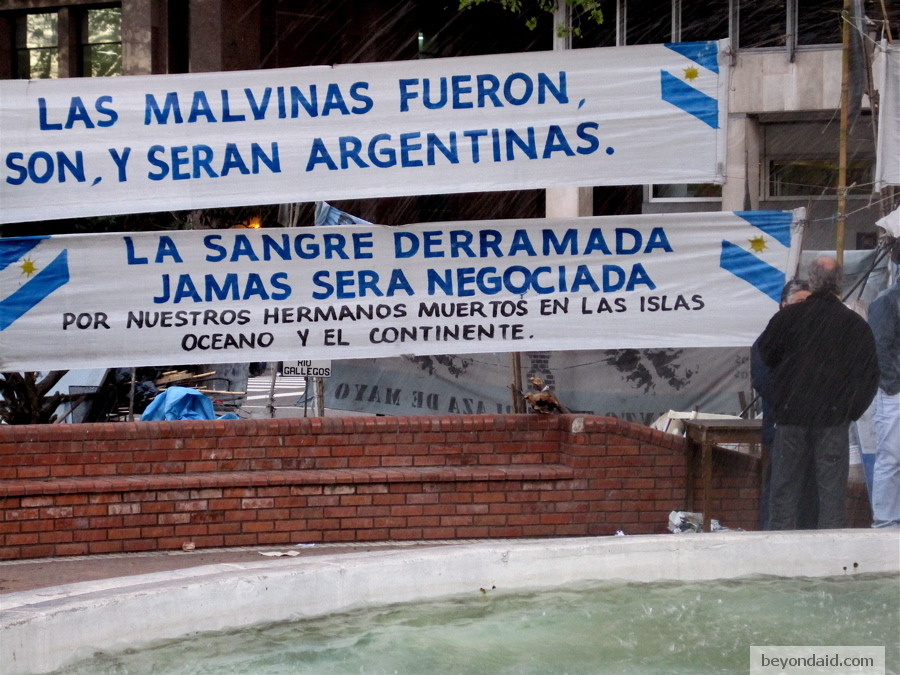
The Guardian reports on the escalating tensions between London and Buenos Aires that saw British Prime Minister David Cameron accuse Argentina of holding a “colonialist attitude” toward the Falkland Islands, a longtime British colony.
“Hector Timerman, [Argentina’s] foreign minister, described Britain as ‘a synonym for colonialism.’ He was quoted by Reuters as saying: ‘Evidently at a time when only scraps of colonialism linger, Great Britain … has decided to rewrite history.’ ”

The war within
Former US secretary of labour Robert Reich argues the current “crisis of capitalism” is the result of a lopsided conflict between consumers and investors on the one hand, and workers and citizens on the other.
“And since most of us occupy all four roles, the real crisis centres on the increasing efficiency by which we as consumers and investors can get great deals, and our declining capacity to be heard as workers and citizens.

As a result, consumers and investors are doing increasingly well but job insecurity is on the rise, inequality is widening, communities are becoming less stable and climate change is worsening. None of this is sustainable over the long term but no one has yet figured out a way to get capitalism back into balance. Blame global finance and worldwide corporations all you want. But save some of your blame for the insatiable consumers and investors inhabiting almost every one of us, who are entirely complicit.”

Irreconcilable differences
The Overseas Development Institute’s Claire Melamed argues the current consensus over bringing development and environment agendas closer together may be short-lived.
“But there is a danger to this approach – exemplified in the call for SDGs to also tackle ‘sustainable consumption and production patterns’.  This gets to the heart of what makes the whole issue of sustainability so politically toxic.  Sustainable consumption patterns would almost certainly mean some people on the planet consuming less so others could consume more.  Similarly on production – if developing countries are going to grow, and if technology doesn’t ride to the rescue, it’s at least possible that ‘sustainable’ might mean the rich world producing less.”

Immoral economy
Columbia University’s Jeffrey Sachs argues there are four ways in which self-interest, which is the very foundation of capitalism, “fails to support the common good.”
“Second, it can easily turn into unacceptable inequality. The reasons are legion: luck; aptitude; inheritance; winner-takes-all-markets; fraud; and perhaps most insidiously, the conversion of wealth into power, in order to gain even greater wealth.
Third, self-interest leaves future generations at the mercy of today’s generation. Environmental unsustainability is a gross inequality of wellbeing across generations rather than across social classes.”

Misguided journey
The University of Ottawa’s Nipa Banerjee gives a harsh assessment of the state of the international development industry in the wake of last month’s summit in Busan.
“The pre-Busan evaluations and Busan discussions clearly reflect a misguided journey of the Western-centric donors who are running the wheels of a self-serving aid industry. While some of the non-traditional non-Eurocentric donors, such as China, Brazil, and India, represented themselves in Busan, they took rather low-profile positions, with none officially joining the OECD’s Development Assistance Committee, in endorsement of the self-reproducing development support industries. Most of these new donors had once been roped into a monstrous global aid industry and well experienced the fruitlessness of spending time in delving into reams of paperwork, policy papers, development programming, and evaluations, nursing the illusions of effective aid.”

Multilateral failures
Writer James Denselow reviews a pair of new books on global revolution, including the latest by Carne Ross whom he describes as a former diplomat “transformed into a thinking man’s neo-anarchist.”
“The nation-state represents an archaic and ill-fitting answer to multifaceted non-localized issues, brought on by the pressures of globalisation and climate change. From flu-epidemics, to the spread of rioting, he carefully plots the ways in which our interconnectedness has led to problems which require global cooperation to solve. Yet the best efforts at multilateral cooperation have yet to deliver the answers. Ross parallels the enormous rhetoric of the 2005 G8’s promise to ‘make poverty history’ with the reality of its ‘utter failure’ to do so with a shortfall in pledges of $20 billion.”

Blue helmet blues
The Inter Press Service speaks to a number of experts about the evolving role of UN peacekeeping and the reputational hits such missions have taken in recent years.
“ ‘In the Congo, the U.N. is not exactly neutral, going after militias on behalf of the government,’ says Sean Maloney, a professor at the Royal Military College in Kingston Ontario.

Maloney told IPS the impartial style of peacekeeping as represented by Canadians serving as U.N. soldiers and keeping armed Greek and Turkish-speaking people at bay in Cyprus in the 1970s was rendered ‘obsolete’ starting in the 1990s.
‘We are going to see more interventions. They will be more coercion-style interventions (like the NATO mission in Afghanistan where Canada had upwards of 3,000 soldiers) that will be siding with one side or another,’ adds Maloney, describing himself as pro-military and ‘libertarian’.”

Latest Developments, January 17

In the latest news and analysis…

Resource nationalism
British consulting group Maplecroft has added “resource nationalism” in some of the world’s poorest countries to the latest edition of its annual Political Risk Atlas, which identifies potential problems around the globe for businesses and investors.
“Potential actions by governments can include nationalising an entire industry. For example, in August 2011, Venezuela’s President Hugo Chavez announced his intention to nationalise the country’s gold industry. Likewise in Guinea in 2010, the state sought a renegotiation of contracts, saying it would become a minority shareholder in all mining contracts. Comparable events have occurred in 2011 in other parts of South America and Africa and are likely to be repeated, especially if a global economic slowdown begins to cut into government tax revenues.”

Fueling hunger
The Center for Global Development’s Kimberly Ann Elliott welcomes the end of billions in US subsidies for biofuels but laments the fact that “advanced biofuels that are not food-based are still not available.”
“For developing countries, that means that corn-based ethanol will remain the major biofuel in the United States, diverting a third or more of the corn crop and keeping upward pressure on food prices. The elimination of the blenders’ credit will do little to change that because, while the subsidy bolstered producer profitability when corn prices spiked in 2008 and again last year, it was not a major factor driving demand for ethanol. The congressional mandate requiring that biofuels be blended into gasoline put a floor under the market, which encouraged investment.  Thus, actual production has exceeded the mandated level in every year because oil prices have been high enough to make ethanol competitive.”

Sins of emission
Mongabay reports on an Atlanta-based company that emits more greenhouse gases than Finland and owns the top three facilities on the US Environmental Protection Agency’s list of the top 100 sources of emissions in the country.
“For its part, Southern Company told the Atlanta Journal-Constitution that their emissions are ‘indicative’ of their power plants ‘being among the nation’s largest generators of electricity,’ adding that, ‘Southern Company complies with all environmental regulations and supports transparency in emissions reporting. The company is a leader in environmental research, development and implementation.’ Southern company serves around 4 million people. In 2014 the corporation is opening a new coal plant in Mississippi that will reportedly capture 60 percent of its greenhouse gas emissions.
According to its records Southern Company spent over $8 million in lobbying the U.S. government last year. A profile of the company on OpenSecrets.org, run by nonpartisan Center for Responsive Politics, reads ‘Southern has been one of the biggest proponents for electricity deregulation” and “gives most of its money to Republicans.’ ”

Re-assigning blame
The New School for Social Research’s Tarak Barkawi is perplexed by the use of the word “inhuman” to describe a video apparently showing US marines urinating on the dead bodies of Taliban fighters in Afghanistan.
“For senior US officials to help purvey accusations of the worst kind against the US military – as inhuman – makes little sense. While offering assurances that they will clean house, they should strongly distance themselves from the notion that this is a peculiarly US issue. Iraqis, Afghans, Americans and others have been mutilating each others’ corpses for some years now.
Such officials ought to remember also that these are the kinds of things that happen in the wars they are themselves directing. As the Japanese officer quoted above remarked, “it is the war that forces us to do the killing”.
For the rest of us in the liberal-minded citizenry, we would do well to recall that wars are initiated and sustained by leaders and governments, and by the powerful interests and passions that back them.
To vent frustration for this situation by easy condemnation of some young enlisted marines is a bit like pissing on corpses.”

Corporate charity
The Overseas Development Institute’s Jonathan Glennie asks if “big company charity” is really better for the poor than “transforming core business practices” would be.
“In Western Union’s case, the big issue is transaction charges. There is a strong case that simply giving money to the poor (especially women) is the best way to help them out of poverty. So, without doubting the good work being done by Western Union, is spending through a foundation more effective than simply reducing the transaction charge and letting poor people purchase the things they know they need, such as better food, drugs or schooling?

Fundamentally, we should be wary of applauding corporates for charitable giving which, generally speaking, is concerned as much with PR as development outcomes, and is essentially funded by the taxpayer or consumer anyway.”

Demanding justice
Oxfam’s Farah Karimi argues “changing the division of power” in the world is necessary to ensure everyone has access to land, food, water and other essential but increasingly scarce resources.
“There is a third challenge, besides increased scarcity and shrinking political space: the current governance gap. The old governance system dominated by Western industrialized countries is in decay, while a new system that reflects the new global power relations isn’t yet functioning. Of course the G20 has emerged– but key issues such as poverty, justice and sustainable development don’t really feature on the G20’s agenda. The power and impact of globally operating companies is growing, enhancing the need for global governance. But the G20 doesn’t at all succeed in addressing vital global challenges or guaranteeing global goods.”

That which shall not be named
Intellectual Property Watch reports on a speech by World Health Organization head Margaret Chan, in which she praised the global body for its “consistent ability” to forge agreements on fair IP rules, though as the article goes on to say, the issue of counterfeit medicines has been particularly problematic.
“Chan did not directly mention the issue of counterfeit and substandard medical products by name, perhaps because of the difficulty in finding acceptable words by which to refer to it. The issue of “substandard/spurious/falsely-labelled/falsified/counterfeit medical products” – as it has been dubbed by member states in an effort to appease all sides – has been controversial at WHO in recent years. But members managed to agree in October on a new mechanism for addressing the issue.”

Latest Developments, January 11

In the latest news and analysis…

Rio+20 leak
The Guardian reports a leaked agenda for June’s Rio+20 conference suggests countries will be called upon to agree to 10 new sustainable development goals but overall, the meeting promises to be much less ambitious than the original earth summit.
“Unlike the 1992 earth summit when over 190 heads of state set in motion several legally binding environment agreements, leaders this time will not be asked to sign any document that would legally commit their countries to meeting any particular targets or timetables. Instead, they will be asked to set their own targets and work voluntarily towards establishing a global green economy which the UN believes will reduce poverty and slow consumption.”

Transforming governance
The Inter Press Service reports on growing calls for radical changes in global governance in order to address issues such as poverty and environmental destruction.
“ ‘We need to have a “constitutional moment” in world politics, akin to the major transformative shift in governance after 1945 that led to the establishment of the United Nations and numerous other international organisations,’ said Frank Biermann of VU University Amsterdam and director of the Earth System Governance Project.

Transforming international governance will be challenging since nation-states are almost entirely concerned with their own short-term interests, [Biermann] acknowledges. However, countries give up some of their power when they join the World Trade Organisation.
‘We ought to be able to do this for the protection of the planet and act as a community of nations,’ he said.”

Guardians of the future
The University of East Anglia’s Rupert Read argues that true democracy must take into account the interests of future generations, and to that end, he proposes the integration of  “guardians” into Britain’s existing parliamentary system.
“The members of this body would be selected by sortition, as is current practice for jury service, in order to ensure independence from present-day party political interests.
The Guardians would have a power of veto over legislation that were likely to have substantial negative effects for society in the future, the right to review major administrative decisions which substantially affected future people and the power to initiate legislation to preserve the basic needs and interests of future people.”

Immigration assistance
The Center for Global Development’s Michael Clemens argues the US, by tweaking its immigration policies, could provide significant assistance to earthquake-ravaged Haiti without spending any money or increasing the number of immigrants coming to its shores.
“First, the administration could reverse the current ban on Haitian participation in the U.S.’s largest employment-based visa program, the H-2 temporary low-skill work visa. All Haitians are currently ineligible to receive these visas. If even a few thousand Haitians at a time participated in that program over the next decade, it would generate more money for Haitian families than the entire U.S. infrastructure reconstruction allocation for Haiti. Fiscal cost: zero. It would even generate net positive U.S. tax revenue. Effect on Americans’ jobs: none. Removing the ban on Haiti would simply allow employers already seeking laborers to draw from Haiti instead of being limited to the 53 currently-eligible countries like Guatemala and Mexico.”

Acting together
Norwegian development and environment minister Erik Solheim argues “poverty is about politics” and its solutions lie beyond aid.
“As Norway’s minister for both the environment and development since 2007, I meet with other countries’ ministers with both portfolios, and it has come as a shock to see how the two groups lead such separate lives. Each has its own important agenda, its own analysis of the challenges ahead, its own strategic plans, and literally its own language. While each recognizes the importance of the other’s agenda, unless they talk and act together, neither group’s goals will be achieved.

We must be careful not to fool ourselves into believing that the MDGs can be achieved through development aid alone. The wider politics of poverty must be placed at the top of the international agenda, along with the three factors most critical to development: climate, conflict, and capital.”

Western corruption
Inuka Kenya Trust’s John Githongo argues rich countries have fallen behind their “developing” counterparts in terms of awareness of and mobilization against high-level corruption.
“We live in an increasingly multipolar world where graft is concerned. It’s the turn of the developing world to watch how the west handles fraud and corruption at the highest levels in their corporate and other sectors. I would like to argue that the organic youth-heavy movements in the west, such as Occupy Wall Street, are part of this shift, except the “c” word isn’t being used – yet. This is a pointer to what I predict the fight against corruption will look like in 2012.”

Social cohesion
Oxfam’s Duncan Green issues a “fuzzword alert” over social cohesion and critiques the treatment given to the term in a new Organisation for Economic Co-operation and Development report.
“Whenever a new idea becomes popular like this, the danger is that instead of looking afresh at what it contributes to our understanding of development, we just recycle our existing set of ideas and say ‘because of complexity/ social cohesion/ climate change, you should do exactly what we’ve being saying all along’. I think the OECD is in danger of going down that road in this report – building social capital, supporting social mobility, and promoting social inclusion are fine, but they were standard demands long before anyone started talking about cohesion. The more interesting question is what we should be doing that’s additional or different because of a social cohesion ‘lens’, and I didn’t find that here.”

Southeast Asian exceptionalism
Alpha International Consulting’s Seth Kaplan uses the example of Southeast Asia to question orthodox thinking on the prerequisites for economic development.
“Indonesia, for instance, reduced poverty from 60 percent in 1970 to 22 percent in 1984. Vietnam reduced it from 58 percent in 1993 to 14 percent in 2008.
Yet, the region does not meet the standard model for economic success, at least as defined by the World Bank and the rest of the Western development community. Governments have historically not been held in check by elections. Corruption is widespread. Governance has rated low on most indicators.”