
Latest Developments, June 6

In the latest news and analysis…

Asymmetric agreement
Inter Press Service reports that not everyone thinks Central America has done well for itself in the recently negotiated free trade agreement with the European Union:

“ ‘Central America obtained meagre access quotas for agricultural products such as sugar, textiles, beef and rice,’ whereas the EU ‘gained full opening of Central American markets for a wide range of key agricultural and industrial goods, such as dairy products, vehicles, medicines and machinery,’ [the Mesoamerican Initiative on Trade, Integration and Sustainable Development (CID)] says in a communiqué.
Moreover, on intellectual property, CID questions the major concessions granted to the EU in terms of protected geographical designations, patents and copyright: in the area of services, the bloc was granted complete access in the fields of finance, transport and energy, among others.
Meanwhile, ‘Central America has yielded ground in terms of workers’ rights and environmental protection compared with other treaties,’ since ‘the agreement with the EU does not provide for penalties for those who infringe these rights for the sake of commercial interests,’ says CID.”

Genetically modified lawsuit
Agence France-Presse reports on the suit brought by 5 million Brazilian farmers against US agribusiness giant Monsanto over crop royalties:

“ ‘Monsanto gets paid when it sell the seeds. The law gives producers the right to multiply the seeds they buy and nowhere in the world is there a requirement to pay (again). Producers are in effect paying a private tax on production,’ said lawyer Jane Berwanger.
In April, a judge in the southern Brazilian state of Rio Grande do Sul, Giovanni Conti, ruled in favor of the producers and ordered Monsanto to return royalties paid since 2004 or a minimum of $2 billion.
Monsanto appealed and a federal court is to rule on the case by 2014.
In the meantime, the US company said it was still being paid crop royalties.”

Democracy, Walmart-style
The Associated Press reports that despite allegations of bribery in Mexico and “unprecedented dissent against key executives,” all of Walmart’s board members were re-elected:

“With descendants of Walmart’s founder owning about 50 percent of Walmart’s shares, activist shareholders had little chance of voting out the board members. But the numbers, particularly when excluding the Walton family and other insiders, show a more staggering loss of confidence.

The vote came after a story by The New York Times published in April said the world’s largest retailer allegedly failed to notify law enforcement after finding evidence that officials authorized millions of dollars in bribes in Mexico to get speedier building permits and other favors. [CEO Mike] Duke was head of Walmart’s international business at the time of the probe in 2005, and [Lee] Scott was CEO. It’s not clear what board members like Walton knew.”

Drone warning
The Guardian reports that a former top CIA official has warned that America’s  indiscriminate drone policy is dangerous to the US as well as innocent bystanders:

“ ‘We have gone a long way down the road of creating a situation where we are creating more enemies than we are removing from the battlefield. We are already there with regards to Pakistan and Afghanistan,’ [Robert Grenier, who headed the CIA’s counter-terrorism center from 2004 to 2006] said.

‘I am very concerned about the creation of a larger terrorist safe haven in Yemen,’ Grenier said.”

War on Mexicans
SF Weekly’s Michael Lacey writes about the potential consequences of the US Supreme Court’s expected ruling in favour of Arizona’s controversial Senate Bill 1070, which “forces all police officers to ascertain immigration status whenever a cop interacts with a brown person”:

“Like the pre-Civil War era of free and slave states, America is about to divide along color lines.
Six states already have a version of Arizona’s bill and are awaiting the ruling for implementation. In all, 16 states filed amicus briefs urging the Supreme Court to support S.B. 1070.
Where once we depended upon the federal government to protect minorities from firehoses and segregated schoolhouses named Booker T. Washington or George Washington Carver, this month the Supreme Court is poised to tell us how far local cops can go to detain brown people.”

Transparent motives
Swiss National Councillor Isabelle Chevalley asks why Australian mining companies go to Africa when their continent still has large uranium reserves:

“The director of Australian mining company Paladin Energy answered, saying: ‘Australians and Canadians have become too aware of uranium mining’s problems. Now we have to go to Africa.’ At least the answer is clear.
Let’s open our eyes and demand transparency on the origin of the uranium we use in our power plants!” (Translated from the French.)

A little respect
Kwani? founding editor Binyavanga Wainaina takes issue with the West’s continued condescension towards Africa:

“If your spouse has arrived in Kenya and does not have a job, soon he or she will be fully networked and earning lots of pounds/euros/dollars, making sure the babies of Africa are safe, making sure the animals of Africa are kept safely away from Africans, making sure the African woman is kept well-shielded from the African man, making sure the genitals of Africa are swabbed, rubbered and raised into a place called awareness. Because you are a good person, who believes in multiculturalism, and that politicians are evil.”

CSR substance and spin
Oxfam’s Erinch Sahan writes on the difficulty of separating fact from fiction when virtually every large company claims to treat corporate social responsibility as a “core” concern:

“Frustrated that I can’t get beyond the online PR spin, I’ve taken to asking them questions like ‘when push-comes-to-shove, and it’s costly to be responsible, who wins the fight, your buying manager or your corporate responsibility team?’ The answer, unfortunately, is almost always ‘buying’.

The side of the business that is concerned with product quality is usually the first side to buy into the business case to act responsibly. This is because long-term supplier relationships are good for quality and usually good for development. But the performance of the buyers, who hold real sway in these companies, is measured on profit margin, so they need to get the lowest price and usually drive who the company does business with.”
Latest Developments, May 8

In the latest news and analysis…

Big deal
Inter Press Service reports that closed-door talks are set to resume around the multilateral Trans-Pacific Partnership – potentially the biggest trade deal ever signed by the US – with major implications for global health.
“While U.S. global health policy has seen significant strengthening over the past five years, passage of the TPP ‘would start rolling this back,’ warns Peter Maybarduk, director of the Access to Medicines Program at Public Citizen, a consumer advocacy group here.
Worldwide over the past 10 years, prices for HIV-related medicines, for instance, have fallen by 99 percent, largely driven by competition from generic drugs. While the fight against generics by large pharmaceutical interests has largely shifted away from the WTO, Maybarduk suggests, the TPP agreement signals the next iteration of that effort.
‘The TPP could well be the worst that we have seen,’ Maybarduk says. ‘Not only does it run contrary to the U.S.’s own pledges on global AIDS work, but the TPP will set the template for the entire Asia- Pacific region. That could have an impact on half of the world’s population.’ ”

Tackling overfishing
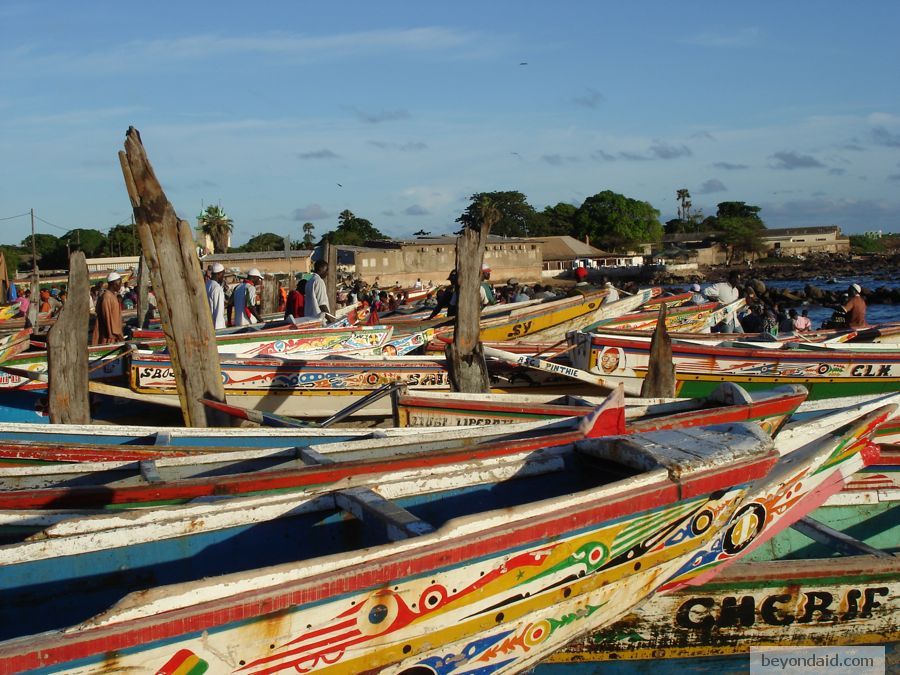
The Guardian reports that Senegal’s new government has revoked the fishing licenses of 29 foreign trawlers.
“Hunger is growing in Senegal and other Sahelian countries, but much of the catch by the foreign fleets ends up in Britain and the EU after being exported from ports like Las Palmas in the Canary Islands. Local fishing industry leaders in Senegal, Cape Verde, Mauritania and elsewhere say catches from inshore fishing have been decimated in the past 10 years because of overfishing. In addition, many other ‘pirate’ trawlers operate illegally in west African waters, further decimating stocks.
‘Senegal’s only resource is the sea,’ said Abdou Karim Sall, president of the Fishermen’s Association of Joal and the Committee of Marine Reserves in West Africa. ‘Unless something changes there will be a catastrophe for livelihoods, employment and food security.’ ”

Financial services hype
Juraj Dobrila University’s Milford Bateman argues that the “financial inclusion agenda” promoted by the World Bank is “nonsense.”
“First, as ever, there is the overarching effort to try to get the poor to uncritically accept the tools the rich have used to acquire their great wealth and become powerful. Finance is one of these tools. By claiming that helping the poor to ‘manage their money better’ will rapidly lead to economic and social benefits, the promoters of the financial inclusion agenda hope the poor will abandon any possible interest in supporting the collective capabilities and initiatives that history shows have massively empowered them. I would include here trade unions, social movements, strongly regulated labour markets, universal healthcare, public sector employment, a ‘developmental state’ and, most of all, the programmed redistribution of wealth and power.”

Islamophobia
The East London Communities Organisation’s Muhammad Abdul Bari writes that Europe’s “counter-jihad movement” poses a serious threat to the continent’s communal harmony.
“It is disheartening that a continent that had learnt many lessons in such a hard way, after the devastation of the two World Wars, and which prides itself in equality and human rights, is allowing itself to be influenced by the forces of intolerance and hate. It is now open season to malign Muslims because of their religious and cultural practices. Yet Muslim immigrants arriving after the war joined in the effort to rebuild the economies of war-torn Europe in the 1950s. In almost every field of life, Muslims have been an integral part of the European tapestry. Muslims are today at home in Europe, have been contributors to its past and are stakeholders in its future.
Yet the language and rhetoric used by the Far Right and the level of political expediency in mainstream European politics is mind boggling. The hate mongers are apparently succeeding in swapping a racist agenda for an Islamophobic one. The lacklustre response from European leaders has paved the way for anti-Muslim bigotry to move closer to the mainstream.”

Bribery’s cost
In a letter to the Wall Street Journal, Global Financial Integrity’s Clark Gascoigne argues that the sort of bribery Wal-Mart is alleged to have committed in Mexico is neither victimless nor unavoidable.
“Environmental regulations exist for many reasons—to protect the health, safety and well-being of the community. If environmental laws were circumvented to build a new Wal-Mart supercenter too close to an important watershed, for example, drinking water could be contaminated and people could become sick or die.

While bribery is pervasive in Mexican society, it is very difficult for small businesses and local residents to escape paying up. They don’t carry the weight needed to change an entire society. However, a major company like Wal-Mart—with the promise of bringing thousands of jobs to local Mexican communities—has the leverage needed to say no to corruption and still conduct business. The company, apparently, chose not to do that.”

Immigration targeting
The Globe and Mail reports on concerns that Canada’s immigration policy is moving away from 50 years of trying to remove race and national origin from the equation.
“Overall it would be a mistake, says [Dalhousie University’s Howard Ramos], to conceive of the uneven outcomes for different immigrant groups as evidence that immigration was failing.
‘Immigrants in Canada have a high degree of integration. This [language] policy doesn’t reflect that success at all. It’s creating a problem where I don’t necessarily think a problem exists,’ he says. ‘The points system was introduced to correct the injustices of focusing on culture and language too heavily. It was a society and a time that was much more ethnocentric – and I don’t think it’s a time we should try and return to.’ ”

Democracy undone
Inter Press Service reports on some of the problems bilateral investment treaties pose for governments wishing to implement sound public policy.
“ ‘Foreign investors may challenge, in an international arbitration process, any change in law and policy to protect the environment and public health, to promote social or cultural goals, or to grapple with financial or economic crises. However, it is impossible to predict the outcome with any precision because each will depend in large part on the composition of the arbitral tribunal deciding the case, which consists of three highly-paid individuals, typically specialized in commercial rather than public law,’ [according to the International Institute for Sustainable Developments Nathalie Bernasconi].

‘A lack of transparency, unpredictability and conflicts of interest have simply become unacceptable. This discontent has led countries like Australia to disfavor investor-state dispute settlement entirely and others to terminate their investment treaties.
‘Watching these developments, countries like Brazil, which never ratified any of its investment treaties, must count themselves lucky,’ she added.”

Latest Developments, May 3

In the latest news and analysis…

Toothless embargoes
Oxfam has released a new report that shows countries under arms embargoes have imported over $2.2 billion in weapons and ammunition since 2000.
“This figure shows the extent to which states have been flagrantly flouting the 26 UN, regional or multilateral arms embargoes in force during this period. Oxfam is calling on the international community to put an end to decades of irresponsible arms deals which devastate people’s lives by agreeing a set of legally binding laws when diplomats meet to draw up a new Arms Trade Treaty in July 2012. Oxfam wants to see the new treaty place strict, unambiguous and legal obligations on states to control the global trade in arms.”

Protecting domestic workers
Human Rights Watch commends Uruguay for becoming the first country to ratify the international Domestic Workers Convention.
“The treaty, which extends core labor rights to an estimated 50 to 100 million domestic workers, will come into legal force when it is ratified by two countries.

The convention requires governments to provide domestic workers with labor protections equivalent to those of other workers, including for working hours, minimum wage coverage, overtime compensation, daily and weekly rest periods, social security, and maternity protection. It also includes specific protections for children, requiring governments to establish a minimum age for domestic work and ensuring that domestic work by children above that age does not interfere with their education.”

$300M allegation
CBC reports that a former executive with Canadian engineering giant SNC-Lavalin has been accused of using shell companies to pay the Gadhafi family more than $300 million.
“CBC has no proof of the substance of the allegations contained in the “poison pen” email, nor any evidence it relates in any way to the allegations [Riadh] Ben Aissa now faces in Switzerland.
Ben Aissa is also the executive who hired Cyndy Vanier, the Canadian consultant who is sitting in a Mexican jail. She is accused of plotting to smuggle Saadi Gadhafi — who had a long history of directing billions of dollars in construction projects to Ben Aissa – out of Libya last fall.

What is clear is that that the December email — amid media reports of Vanier’s arrest — sparked a cascade of internal company audits, revelations of missing millions and three high-profile resignations within the company, including that of Ben Aissa prior to his arrest.”

Military pact
Inter Press Service reports on opposition to a new agreement between the US and the Philippines on increased military cooperation.
“ ‘It is terribly discouraging that the Philippine government cannot figure out a truly healthy relationship with the U.S. – that is, a relationship that allows the Philippines to forge meaningful relationships with America as well as with its neighbours, including China,’ Gina Apostol, the author of a novel on the Philippine elite’s relationship with the U.S. military, told IPS.
‘We are too stuck on our historical relationship with America, even though it has been patently disgraceful and traumatic.’ ”

NGO accountability
The Center for Global Development’s Vijaya Ramachandran and Julie Walz discuss the recently published independent assessment of the US government’s response to Haiti’s 2010 earthquake.
“The report makes passing references to the lack of beneficiary and local involvement, the large number of NGOs operating in the country, and the fact that many organizations came to Haiti with no previous experience in disaster management.  Yet it states that “due to time and resource constraints, we were unable to explore these topics in great detail.”  Also, the report says that “no clear baseline or reporting mechanism was established” for NGOs receiving USAID funding.  These are big issues for the USG – especially if NGOs and private contractors continue to be the main channels through which the money is being disbursed.  The USG must look at various options to increase accountability—from easily-accessible quarterly reports to the standard accounting framework offered by the International Aid Transparency Initiative.”

Cluster bomb bill
Earl Turcotte, who led the Canadian delegation during the negotiation of the Convention on Cluster Munitions, says his country’s proposed legislation concerning the banned weapons is “the worst of any country” that has ratified the treaty.
“The Harper government is seeking exceptions that, among other things, will allow a Canadian commander of a multinational force to authorize or order forces outside the convention to use, acquire, possess, import or export cluster munitions.
As well, Canadian pilots or artillery personnel can use, acquire, possess or move cluster munitions while on secondment or attachment to outside states. Canadian Forces can also transport non-party state cluster munitions on Canadian carriers.
The legislation further proposes blanket exceptions that permit Canadian Forces to, in their words, ‘aid, abet, conspire, counsel and assist non-party State forces’ to carry out or escape from acts prohibited to convention states.”

Gods & consumers
Author Homero Aridjis writes that he was not surprised to hear that Wal-Mart was accused of paying $24 million worth of bribes in Mexico, given the histories of the company and his country.
“Walmart already had a history of controversial behavior in Mexico. Most notably, in November 2004, despite widespread opposition, the company opened a 72,000-square-foot store within the boundaries of the 2,000-year-old city of Teotihuacán, which features the Pyramids of the Sun and the Moon (“the place where men became gods” — or consumers?). Walmart has also built a supermarket on forested land in the resort town of Playa del Carmen, in Quintana Roo — though the permit for the building later turned out to have been granted for another site, on the island of Cozumel. The question now is who allows this, and in exchange for what?”

Legal hype
The University of Virginia’s Brandon Garrett argues that the growing number of companies being prosecuted under the Foreign Corrupt Practices Act does not necessarily mean that corporate accountability is thriving in America.
“Most of these FCPA cases are self-reported by the corporation itself — not uncovered by intrepid police-work. They should not make us think prosecutors now have enough resources to take on major corporations. After all, corporations routinely spend hundreds of millions of dollars on FCPA investigations and defense costs; prosecutors can hardly command such resources. Foreign corporations now pay the largest FCPA fines, and my data from the past decade shows that foreign corporations pay larger fines across a whole range of crimes.”

Latest Developments, May 2

In the latest news and analysis…

May Day
The Christian Science Monitor offers an overview of May Day demonstrations around the world.
“In Argentina, small explosion went off outside the EU headquarters in Buenos Aires before dawn, breaking a few windows, but there were no injuries and no one was arrested.
Earlier, thousands of workers protested in the Philippines, Indonesia, Taiwan and other Asian nations, demanding wage hikes. They said their take-home pay could not keep up with rising food, energy and housing prices and school fees.
An unemployed father of six set himself on fire in southern Pakistan in an apparent attempt to kill himself because he was mired in poverty, according to police officer Nek Mohammed.”

Food price fear
The Financial Times reports that “industry experts” are predicting food prices will continue to rise over the next two years, though “the surge is unlikely to mirror” the 2007-08 crisis that saw rioting in cities around the world.
“The cost of wheat and rice, the two most important agricultural commodities for global food security because of their status as a staple for billions of people in southern Asia and sub-Saharan Africa, remains stable thanks in large part to bumper crops over the past few years.

Instead, the main concern centres on the price of oilseeds, such as soyabeans, rapeseed and canola, and corn.”

Short-lived peace
The Bureau of Investigative Journalism provides a roundup of US drone strikes in Pakistan, Yemen and Somalia during April.
“CIA drone strikes were on hold for most of the month in Pakistan, as Islamabad continued to insist that the US end the strikes after eight years of bombing.

On April 29 the pause ended when a drone attacked a former school in Miranshah, North Waziristan. Up to six alleged ‘foreign’ militants reportedly died. Pakistan condemned the attack in particularly strong terms, describing it as ‘in total contravention of international law and established norms of interstate relations.’ ”

Unmanned outlaws
Amnesty International’s Tom Parker contests the Obama administration’s claims that drones kill 40 militants for every civilian casualty and that their use is legal.
“In short, we know that [White House counterterrorism adviser John] Brennan’s 40-to-1 metric was, at best, wrong and, at worst, a deliberate falsehood.
We know that drones do kill militants but they also kill innocent civilians.
We know that they kill both of them outside the framework of any recognized international law.
We also know that yesterday’s speech, which masqueraded as an exercise in transparency, was in fact anything but.”

Wal-Mart vote
The New York Times reports that New York City’s pension funds have announced their intention to vote against five Wal-Mart directors seeking re-election at next month’s annual shareholder meeting, due to an alleged bribery cover-up in Mexico.
“ ‘In its relentless drive for profit and expansion, Wal-Mart has paid millions to settle charges that it violated child labor laws and exploited immigrants,’ [New York City comptroller John C. Liu] said Monday, in announcing the decision to vote against the company’s directors. ‘Now we learn that not only did Wal-Mart allegedly bribe its way through Mexico, but may have tried to cover up the corruption. A select few Wal-Mart executives may benefit in the short term, but the company, its share owners and everyone else lose in the long run.’ ”

Geography of domination
Columbia University’s Hamid Dabashi pleads for the US and its allies to step back and give former UN Secretary General Kofi Annan a chance to find a diplomatic resolution to the violence in Syria.
“[Annan] is the only one in a position to give the ruling regime (not just Bashar al-Assad) a way out of this bloody cul de sac. Unconditional surrender should never be the ruling paradigms in these or any other conflict resolution – not because Gaddafi then or Assad now deserves a face-saving strategy, but because Libyan and Syrian people need it for their future.
What ultimately prevents that possibility is not just the quagmire of violence in Syria. It is the imaginative geography of world politics that has historically written Asia, Africa, and Latin America out of the vital decisions affecting the globe. The US and EU have assumed disproportionate power of decision-making in global affairs and the UN is simply a diplomatic extension of their warmongerings. It is that grotesque geography of imperial domination that must be once and for all dismantled for the world determined to liberate itself, to begin to see itself.”

Agrarian crisis
The Research Foundation for Science, Technology and Ecology’s Vandana Shiva argues the orthodox understanding of the economic concept of productivity lies at the root of today’s agricultural, ecological and unemployment crises.
“An artificial ‘production boundary’ was created to measure Gross Domestic Product (GDP). The production boundary defined work and production for sustenance as non-production and non-work – ‘if you produce what you consume, then you don’t produce’. In one fell swoop, nature’s work in providing goods and services disappeared. The production and work of sustenance economies disappeared, the work of hundreds of millions of women disappeared.

The false measure of productivity selects one output from diverse outputs – the single commodity to be produced for the market, and one input from diverse inputs – labour.”

Change of diet
In a Q&A with Inter Press Service, Worldwatch Institute’s Danielle Nierenberg calls for “a restructuring of the entire food system.”
“Factory farming or concentrated operations, this agricultural system really started here in the U.S. and in Europe, (and) is now spreading to the Philippines, Sub-Saharan Africa, South Asia. The environmental, public health and animal welfare impact of this is really extreme. You have huge amounts of waste that can’t be utilised by farmlands, surface fertiliser is becoming toxic waste, there’s tropical water pollution, surface water pollution.

We really need to make sure that agriculture is something that sustains and not just some extractive industry.”

Insouciance of war
Author Daniel Richler laments the extent to which people living in a “nation at war” can be almost totally unaffected by the horrors playing out on distant battlefields.
“Is it arrogant to feel this way? To want, in one of these moments, the hockey crowd with their plastic mugs of beer and their popcorn standing for the troops, the families in attendance along the ‘Highway of Heroes’ or others at a policeman’s funeral not to stand, in silence, hands over their hearts in postures received from the movies, to wail inconsolably and furiously – and to riot, damn it, for lost lives rather than a sports result? That would bust the cliché – once, at least, before that scene, too, of thousands outraged at war’s stupidity became a standard part of the war story’s tired repertoire and was repeated, again.”

Latest Developments, April 15

In the latest news and analysis…

Ocampo out
Reuters reports that former Colombian finance minister Jose Antonio Ocampo has dropped out of the race to become the next World Bank president, leaving only two candidates “in an unprecedented challenge to U.S. control of the global development institution”.
“With the board of the World Bank to meet on Monday to pick a new president, Ocampo said he hoped emerging-market nations would rally behind Nigerian Finance Minister Ngozi Okonjo-Iweala in a race that he said had turned highly political.

While Kim is still the favorite to win the World Bank presidency due to backing from the United States and European countries, a rigorous challenge from developing countries could put them in a stronger position to extract concessions.”

Bad diet
The Guardian reports on new research suggesting the fertilizers used to provide people in wealthy countries with their meat-heavy diets are contributing substantially to climate change.
“It’s arguably the most difficult challenge in dealing with climate change: how to reduce emissions from food production while still producing enough to feed a global population projected to reach 9 billion by the middle of this century.
The findings, by Eric Davidson, director of the Woods Hole Research Centre in Massachusetts, say the developed world will have to cut fertiliser use by 50% and persuade consumers in the developed world to stop eating so much meat.”

Fallujah’s legacy
Inter Press Service reports on the high number of birth defects in Fallujah, the scene of heavy fighting between US forces and Iraqi insurgents in the last decade.
“According to a study released by the Switzerland-based International Journal of Environmental Research and Public Health in July 2010, ‘the increases in cancer, leukaemia and infant mortality and perturbations of the normal human population birth sex ratio in Fallujah are significantly greater than those reported for the survivors of the A-Bombs at Hiroshima and Nagasaki in 1945.’

Other than the white phosphorus, many point to depleted uranium (DU), a radioactive element which, according to military engineers, significantly increases the penetration capacity of shells. DU is believed to have a life of 4.5 billion years, and it has been labelled the ‘silent murderer that never stops killing.’ Several international organisations have called on NATO to investigate whether DU was also used during the Libyan war.

SNC-Lavalin raid
The Globe and Mail reports that Canadian police have raided the headquarters of scandal-ridden engineering giant SNC-Lavalin, though the reasons for the action have not been disclosed.
“Friday’s raid was the second time in six months that RCMP officials have descended with search warrants on the company, which gained an international reputation as one of the world’s leading engineering firms but is now grappling with scandals, executive departures, questions about its business ethics and allegations of involvement in a plot to help a son of Moammar Gadhafi escape from Libya.

Investigations into SNC’s conduct are under way in Canada, Bangladesh, India, Mexico and Libya. SNC has also conducted an internal probe into allegations that $56-million in improper payments went to commercial agents to help secure construction contracts in unnamed countries.”

Extractive land grabs
The Gaia Foundation’s Teresa Anderson writes about a new study that suggests the oil, gas and mining industries are increasingly responsible for so-called land grabs in poor countries.
“The extractive industries have grown significantly in the last 10 years, due to changes in consumption patterns, and a throwaway culture where regular technology upgrades are considered the norm. In the last 10 years, exploration budgets have increased nine-fold, from 2 billion to 18 billion dollars.

Today, copper extraction requires the removal of 10 times as much earth as 100 years ago. A single gold wedding ring requires 20 tonnes of earth. Technological developments have enabled extraction from hard-to-reach deposits, as seen with the development of hydraulic fracturing or ‘fracking’ for shale gas deposits. In South Africa, a consortium of international investors has applied for the rights to drill for shale gas for a section covering around 10 per cent of the country’s surface.”

Aid measurement
The Overseas Development Institute’s Jonathan Glennie and Annalisa Prizzon make the case for “aid as a proportion of the economy” as a new way of classifying countries.
“The 0.7% target is an important symbol, but it can obscure the focus on what’s really important, which is not the proportion of donor income given in aid, but the proportion of the recipient economy depending on it. High levels of aid, while sometimes necessary in the short term, are increasingly viewed as antithetical to development in the longer term.”

Drone coverage
Fairness and Accuracy in Reporting’s Peter Hart takes issue with American media coverage of the Pakistani parliament’s recent  vote for an end to US drone strikes.
“The Washington Post’s account of this news included this curious observation:
‘From Washington’s perspective, the debate in Parliament was a healthy exercise in democracy but one that is unlikely to affect the drone war. The military leaders of both nations see the drones as efficient and effective in eliminating hard-core Islamic militants that plague both the U.S. and Pakistani armies.’
I know that the Post is merely conveying ‘Washington’s perspective,’ but let’s think about this for a second. A sign of a healthy democracy is one where civilian political leadership has no power over the military–either in its own country or a nominal ally launching air attacks on its soil?”


Bottoming out
ECONorthwest’s Ann Hollingshead asks “at what point does the ‘race to the bottom’ bottom out” when it comes to international tax competition.
“While [the Cato Institute’s Dan Mitchell] argues tax competition through tax evasion in havens has fostered lower tax rates worldwide, he has also reckoned that ‘only a tiny minority’ of people who keep their money in havens ‘are escaping onerous tax burdens.’ First of all, I would be interested to see where Mitchell got that statistic because no one knows how much money is deposited in havens, let alone its origins. Such information isn’t publicly available. That’s actually the whole point. And secondly, and more importantly, I’m unclear on how such a ‘tiny minority’ of oversees deposits could drive international tax policy to such an extent that the average corporate tax rates have dropped by more than half in thirty years.”