Latest Developments, May 8

In the latest news and analysis…

Big deal
Inter Press Service reports that closed-door talks are set to resume around the multilateral Trans-Pacific Partnership – potentially the biggest trade deal ever signed by the US – with major implications for global health.
“While U.S. global health policy has seen significant strengthening over the past five years, passage of the TPP ‘would start rolling this back,’ warns Peter Maybarduk, director of the Access to Medicines Program at Public Citizen, a consumer advocacy group here.
Worldwide over the past 10 years, prices for HIV-related medicines, for instance, have fallen by 99 percent, largely driven by competition from generic drugs. While the fight against generics by large pharmaceutical interests has largely shifted away from the WTO, Maybarduk suggests, the TPP agreement signals the next iteration of that effort.
‘The TPP could well be the worst that we have seen,’ Maybarduk says. ‘Not only does it run contrary to the U.S.’s own pledges on global AIDS work, but the TPP will set the template for the entire Asia- Pacific region. That could have an impact on half of the world’s population.’ ”

Tackling overfishing
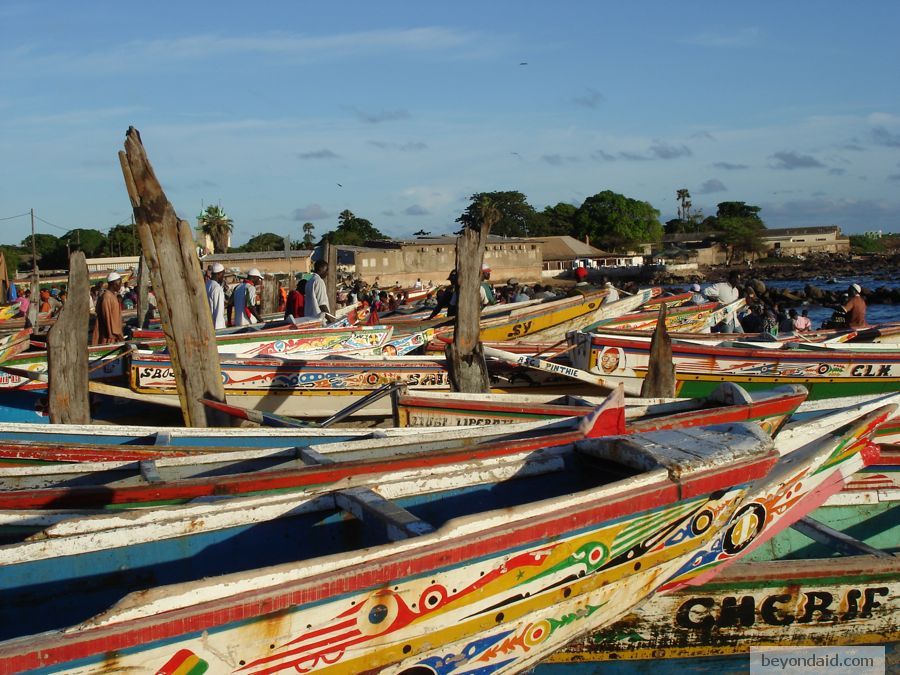
The Guardian reports that Senegal’s new government has revoked the fishing licenses of 29 foreign trawlers.
“Hunger is growing in Senegal and other Sahelian countries, but much of the catch by the foreign fleets ends up in Britain and the EU after being exported from ports like Las Palmas in the Canary Islands. Local fishing industry leaders in Senegal, Cape Verde, Mauritania and elsewhere say catches from inshore fishing have been decimated in the past 10 years because of overfishing. In addition, many other ‘pirate’ trawlers operate illegally in west African waters, further decimating stocks.
‘Senegal’s only resource is the sea,’ said Abdou Karim Sall, president of the Fishermen’s Association of Joal and the Committee of Marine Reserves in West Africa. ‘Unless something changes there will be a catastrophe for livelihoods, employment and food security.’ ”

Financial services hype
Juraj Dobrila University’s Milford Bateman argues that the “financial inclusion agenda” promoted by the World Bank is “nonsense.”
“First, as ever, there is the overarching effort to try to get the poor to uncritically accept the tools the rich have used to acquire their great wealth and become powerful. Finance is one of these tools. By claiming that helping the poor to ‘manage their money better’ will rapidly lead to economic and social benefits, the promoters of the financial inclusion agenda hope the poor will abandon any possible interest in supporting the collective capabilities and initiatives that history shows have massively empowered them. I would include here trade unions, social movements, strongly regulated labour markets, universal healthcare, public sector employment, a ‘developmental state’ and, most of all, the programmed redistribution of wealth and power.”

Islamophobia
The East London Communities Organisation’s Muhammad Abdul Bari writes that Europe’s “counter-jihad movement” poses a serious threat to the continent’s communal harmony.
“It is disheartening that a continent that had learnt many lessons in such a hard way, after the devastation of the two World Wars, and which prides itself in equality and human rights, is allowing itself to be influenced by the forces of intolerance and hate. It is now open season to malign Muslims because of their religious and cultural practices. Yet Muslim immigrants arriving after the war joined in the effort to rebuild the economies of war-torn Europe in the 1950s. In almost every field of life, Muslims have been an integral part of the European tapestry. Muslims are today at home in Europe, have been contributors to its past and are stakeholders in its future.
Yet the language and rhetoric used by the Far Right and the level of political expediency in mainstream European politics is mind boggling. The hate mongers are apparently succeeding in swapping a racist agenda for an Islamophobic one. The lacklustre response from European leaders has paved the way for anti-Muslim bigotry to move closer to the mainstream.”

Bribery’s cost
In a letter to the Wall Street Journal, Global Financial Integrity’s Clark Gascoigne argues that the sort of bribery Wal-Mart is alleged to have committed in Mexico is neither victimless nor unavoidable.
“Environmental regulations exist for many reasons—to protect the health, safety and well-being of the community. If environmental laws were circumvented to build a new Wal-Mart supercenter too close to an important watershed, for example, drinking water could be contaminated and people could become sick or die.

While bribery is pervasive in Mexican society, it is very difficult for small businesses and local residents to escape paying up. They don’t carry the weight needed to change an entire society. However, a major company like Wal-Mart—with the promise of bringing thousands of jobs to local Mexican communities—has the leverage needed to say no to corruption and still conduct business. The company, apparently, chose not to do that.”

Immigration targeting
The Globe and Mail reports on concerns that Canada’s immigration policy is moving away from 50 years of trying to remove race and national origin from the equation.
“Overall it would be a mistake, says [Dalhousie University’s Howard Ramos], to conceive of the uneven outcomes for different immigrant groups as evidence that immigration was failing.
‘Immigrants in Canada have a high degree of integration. This [language] policy doesn’t reflect that success at all. It’s creating a problem where I don’t necessarily think a problem exists,’ he says. ‘The points system was introduced to correct the injustices of focusing on culture and language too heavily. It was a society and a time that was much more ethnocentric – and I don’t think it’s a time we should try and return to.’ ”

Democracy undone
Inter Press Service reports on some of the problems bilateral investment treaties pose for governments wishing to implement sound public policy.
“ ‘Foreign investors may challenge, in an international arbitration process, any change in law and policy to protect the environment and public health, to promote social or cultural goals, or to grapple with financial or economic crises. However, it is impossible to predict the outcome with any precision because each will depend in large part on the composition of the arbitral tribunal deciding the case, which consists of three highly-paid individuals, typically specialized in commercial rather than public law,’ [according to the International Institute for Sustainable Developments Nathalie Bernasconi].

‘A lack of transparency, unpredictability and conflicts of interest have simply become unacceptable. This discontent has led countries like Australia to disfavor investor-state dispute settlement entirely and others to terminate their investment treaties.
‘Watching these developments, countries like Brazil, which never ratified any of its investment treaties, must count themselves lucky,’ she added.”

Latest Developments, May 4

In the latest news and analysis…

80 years
Agence France-Presse reports that the chief prosecutor in the Charles Taylor trial is recommending the former Liberian president, who was found guilty by the Special Court for Sierra Leone in The Hague last week, be sentenced to 80 years in prison.
“The prosecutor said the term would be fair given Taylor’s role in arming and aiding rebels who killed and mutilated thousands in neighbouring Sierra Leone during the 1991-2001 civil war, one of the most brutal conflicts in modern history.

Taylor, Liberia’s president from 1997 to 2003, had dismissed the charges as ‘lies’ and claimed to be the victim of a plot by ‘powerful countries.’ ”

Playing for time
Intellectual Property Watch reports that Switzerland is pushing for the World Health Organization to delay this month’s planned negotiations on a mechanism for funding research and development into diseases that predominantly impact poor people.
“The proposal calls for ‘informal, in-depth consultations with Member States on the appropriateness and feasibility of the recommendations contained in the report, in particular concerning a globally binding instrument on research and development, together with the funding implications of such an instrument.’

The recommendation to proceed to negotiations for a binding instrument on R&D came from an in-depth two-year process under the Consultative Expert Working Group on research and development.”

Rational migration
The UN News Centre reports on the launch of a new study into the impacts of European immigration and border policies on the human rights of migrants.
“The year-long study, which will begin with a three-day trip to Brussels, will examine the EU directives as well as national policies in place with respect to visa regimes and border control, and will assess interception practices on land and sea, detention conditions, returns, and readmission.

‘Although migration to and from the European region is not a new phenomenon, since the 1990s the region has witnessed a sharp increase in migration movements,” [UN Special Rapporteur on the human rights of migrants, François Crépeau] said, calling for the international community “to embrace a new, balanced discourse on migration based on equal rights, non-discrimination and dignity, as well as on reality.’ ”

Extinction woes
Mother Jones reports that a new meta-analysis of recent scientific research suggests that high levels of species extinction are as dangerous as global warming for humans.
“Studies in the past 20 years have demonstrated that more biologically diverse ecosystems are more productive. So there’s growing concern that the very high rates of modern extinctions from habitat loss, overharvesting, pollution, biological invasions, human overpopulation, and other human-caused environmental changes will diminish nature’s ability to provide goods and services important to all life (ours too)… like food, clean water, and a stable climate. ”

Saving independent journalism
On World Press Freedom Day, the Columbia Journalism Review reproduces part of a recent Rebecca MacKinnon talk, in which the Internet freedom activist identifies iPhone apps, social media privacy policies and intellectual property legislation as serious threats to independent journalism and democracy.
“The problem with apps is that they give the companies that run the platforms that deliver content to their devices an opportunity to censor and discriminate against certain content—not only when governments require it, but also for business reasons, or for no clear reason.

News and media companies that do care about the future of journalism and democracy must not turn a blind eye to Apple’s arbitrary censorship. The point is not that they should avoid Apple apps and their relationships with Apple. The point is that since the law and the constitution are apparently useless against private censorship and discrimination, the only way to get Apple to operate in a democracy-compatible manner is if Apple’s customers, business partners, and investors insist on it.”

Colonial borders
Washington State University’s Peter Chilson writes that the current troubles in Mali are traceable, in part, to the arbitrary borders France imposed on its former West African colonies.
“Over the years I’ve spent a lot of time on Koulouba, working in the archive on the palace grounds, which houses Mali’s oldest colonial documents, papers the French failed to destroy or take with them at independence in 1960. In those archives, and others across the region, I figured out that the French left behind no paperwork to legally justify the borders that frame the eight countries of French West Africa, all former colonies, with Mali at the center. There is no evidence that any official, French or African, actually walked the political lines to clearly lay them out at independence. This is a big part of what brings us to this mess, a Mali that has no clear government leadership and whose very shape is now stamped with a question mark.”

A questionable choice
The Overseas Development Institute’s Jonathan Glennie argues that British Prime Minister David Cameron, as the leader of a rich country, is “not very” qualified to take the lead on establishing successors to the Millennium Development Goals.
“To date there is no evidence of any understanding on his part of the problems facing developing countries.
His only credential, and the reason he got the job, is that his government has demonstrated a commitment to aid increases, which are wrongly seen as a proxy for commitment to poverty reduction. Those calling for ever more aid should congratulate themselves that one outcome of their efforts is the leader of a rightwing Conservative-led government which is implementing structural adjustment at home being given a starring role in deciding the future of development for the next 15 years.”

Transnational justice
Al Jazeera asks if justice is really served when transnational corporations reach out-of-court settlements over alleged rights abuses committed abroad.
“Unlikely to get any redress in Peru, the victims sued Monterrico in the UK, with the help of British law firm Leigh Day and Co, alleging that the company had been complicit in the affair.
But though their prospects looked good, the case was settled by Monterrico last year just before it came to trial. It meant the victims did get some compensation – but the wider problems they were fighting to reveal were never aired in open court.
The case is an interesting example of a growing trend. Multinational companies are increasingly likely to respond to legal challenges in this way. The settlement costs can be high but usually they are far less than they would be after a negative verdict. And more importantly it gives the companies – and their lawyers – control of the public debate.”

Latest Developments, May 3

In the latest news and analysis…

Toothless embargoes
Oxfam has released a new report that shows countries under arms embargoes have imported over $2.2 billion in weapons and ammunition since 2000.
“This figure shows the extent to which states have been flagrantly flouting the 26 UN, regional or multilateral arms embargoes in force during this period. Oxfam is calling on the international community to put an end to decades of irresponsible arms deals which devastate people’s lives by agreeing a set of legally binding laws when diplomats meet to draw up a new Arms Trade Treaty in July 2012. Oxfam wants to see the new treaty place strict, unambiguous and legal obligations on states to control the global trade in arms.”

Protecting domestic workers
Human Rights Watch commends Uruguay for becoming the first country to ratify the international Domestic Workers Convention.
“The treaty, which extends core labor rights to an estimated 50 to 100 million domestic workers, will come into legal force when it is ratified by two countries.

The convention requires governments to provide domestic workers with labor protections equivalent to those of other workers, including for working hours, minimum wage coverage, overtime compensation, daily and weekly rest periods, social security, and maternity protection. It also includes specific protections for children, requiring governments to establish a minimum age for domestic work and ensuring that domestic work by children above that age does not interfere with their education.”

$300M allegation
CBC reports that a former executive with Canadian engineering giant SNC-Lavalin has been accused of using shell companies to pay the Gadhafi family more than $300 million.
“CBC has no proof of the substance of the allegations contained in the “poison pen” email, nor any evidence it relates in any way to the allegations [Riadh] Ben Aissa now faces in Switzerland.
Ben Aissa is also the executive who hired Cyndy Vanier, the Canadian consultant who is sitting in a Mexican jail. She is accused of plotting to smuggle Saadi Gadhafi — who had a long history of directing billions of dollars in construction projects to Ben Aissa – out of Libya last fall.

What is clear is that that the December email — amid media reports of Vanier’s arrest — sparked a cascade of internal company audits, revelations of missing millions and three high-profile resignations within the company, including that of Ben Aissa prior to his arrest.”

Military pact
Inter Press Service reports on opposition to a new agreement between the US and the Philippines on increased military cooperation.
“ ‘It is terribly discouraging that the Philippine government cannot figure out a truly healthy relationship with the U.S. – that is, a relationship that allows the Philippines to forge meaningful relationships with America as well as with its neighbours, including China,’ Gina Apostol, the author of a novel on the Philippine elite’s relationship with the U.S. military, told IPS.
‘We are too stuck on our historical relationship with America, even though it has been patently disgraceful and traumatic.’ ”

NGO accountability
The Center for Global Development’s Vijaya Ramachandran and Julie Walz discuss the recently published independent assessment of the US government’s response to Haiti’s 2010 earthquake.
“The report makes passing references to the lack of beneficiary and local involvement, the large number of NGOs operating in the country, and the fact that many organizations came to Haiti with no previous experience in disaster management.  Yet it states that “due to time and resource constraints, we were unable to explore these topics in great detail.”  Also, the report says that “no clear baseline or reporting mechanism was established” for NGOs receiving USAID funding.  These are big issues for the USG – especially if NGOs and private contractors continue to be the main channels through which the money is being disbursed.  The USG must look at various options to increase accountability—from easily-accessible quarterly reports to the standard accounting framework offered by the International Aid Transparency Initiative.”

Cluster bomb bill
Earl Turcotte, who led the Canadian delegation during the negotiation of the Convention on Cluster Munitions, says his country’s proposed legislation concerning the banned weapons is “the worst of any country” that has ratified the treaty.
“The Harper government is seeking exceptions that, among other things, will allow a Canadian commander of a multinational force to authorize or order forces outside the convention to use, acquire, possess, import or export cluster munitions.
As well, Canadian pilots or artillery personnel can use, acquire, possess or move cluster munitions while on secondment or attachment to outside states. Canadian Forces can also transport non-party state cluster munitions on Canadian carriers.
The legislation further proposes blanket exceptions that permit Canadian Forces to, in their words, ‘aid, abet, conspire, counsel and assist non-party State forces’ to carry out or escape from acts prohibited to convention states.”

Gods & consumers
Author Homero Aridjis writes that he was not surprised to hear that Wal-Mart was accused of paying $24 million worth of bribes in Mexico, given the histories of the company and his country.
“Walmart already had a history of controversial behavior in Mexico. Most notably, in November 2004, despite widespread opposition, the company opened a 72,000-square-foot store within the boundaries of the 2,000-year-old city of Teotihuacán, which features the Pyramids of the Sun and the Moon (“the place where men became gods” — or consumers?). Walmart has also built a supermarket on forested land in the resort town of Playa del Carmen, in Quintana Roo — though the permit for the building later turned out to have been granted for another site, on the island of Cozumel. The question now is who allows this, and in exchange for what?”

Legal hype
The University of Virginia’s Brandon Garrett argues that the growing number of companies being prosecuted under the Foreign Corrupt Practices Act does not necessarily mean that corporate accountability is thriving in America.
“Most of these FCPA cases are self-reported by the corporation itself — not uncovered by intrepid police-work. They should not make us think prosecutors now have enough resources to take on major corporations. After all, corporations routinely spend hundreds of millions of dollars on FCPA investigations and defense costs; prosecutors can hardly command such resources. Foreign corporations now pay the largest FCPA fines, and my data from the past decade shows that foreign corporations pay larger fines across a whole range of crimes.”

Latest Developments, May 2

In the latest news and analysis…

May Day
The Christian Science Monitor offers an overview of May Day demonstrations around the world.
“In Argentina, small explosion went off outside the EU headquarters in Buenos Aires before dawn, breaking a few windows, but there were no injuries and no one was arrested.
Earlier, thousands of workers protested in the Philippines, Indonesia, Taiwan and other Asian nations, demanding wage hikes. They said their take-home pay could not keep up with rising food, energy and housing prices and school fees.
An unemployed father of six set himself on fire in southern Pakistan in an apparent attempt to kill himself because he was mired in poverty, according to police officer Nek Mohammed.”

Food price fear
The Financial Times reports that “industry experts” are predicting food prices will continue to rise over the next two years, though “the surge is unlikely to mirror” the 2007-08 crisis that saw rioting in cities around the world.
“The cost of wheat and rice, the two most important agricultural commodities for global food security because of their status as a staple for billions of people in southern Asia and sub-Saharan Africa, remains stable thanks in large part to bumper crops over the past few years.

Instead, the main concern centres on the price of oilseeds, such as soyabeans, rapeseed and canola, and corn.”

Short-lived peace
The Bureau of Investigative Journalism provides a roundup of US drone strikes in Pakistan, Yemen and Somalia during April.
“CIA drone strikes were on hold for most of the month in Pakistan, as Islamabad continued to insist that the US end the strikes after eight years of bombing.

On April 29 the pause ended when a drone attacked a former school in Miranshah, North Waziristan. Up to six alleged ‘foreign’ militants reportedly died. Pakistan condemned the attack in particularly strong terms, describing it as ‘in total contravention of international law and established norms of interstate relations.’ ”

Unmanned outlaws
Amnesty International’s Tom Parker contests the Obama administration’s claims that drones kill 40 militants for every civilian casualty and that their use is legal.
“In short, we know that [White House counterterrorism adviser John] Brennan’s 40-to-1 metric was, at best, wrong and, at worst, a deliberate falsehood.
We know that drones do kill militants but they also kill innocent civilians.
We know that they kill both of them outside the framework of any recognized international law.
We also know that yesterday’s speech, which masqueraded as an exercise in transparency, was in fact anything but.”

Wal-Mart vote
The New York Times reports that New York City’s pension funds have announced their intention to vote against five Wal-Mart directors seeking re-election at next month’s annual shareholder meeting, due to an alleged bribery cover-up in Mexico.
“ ‘In its relentless drive for profit and expansion, Wal-Mart has paid millions to settle charges that it violated child labor laws and exploited immigrants,’ [New York City comptroller John C. Liu] said Monday, in announcing the decision to vote against the company’s directors. ‘Now we learn that not only did Wal-Mart allegedly bribe its way through Mexico, but may have tried to cover up the corruption. A select few Wal-Mart executives may benefit in the short term, but the company, its share owners and everyone else lose in the long run.’ ”

Geography of domination
Columbia University’s Hamid Dabashi pleads for the US and its allies to step back and give former UN Secretary General Kofi Annan a chance to find a diplomatic resolution to the violence in Syria.
“[Annan] is the only one in a position to give the ruling regime (not just Bashar al-Assad) a way out of this bloody cul de sac. Unconditional surrender should never be the ruling paradigms in these or any other conflict resolution – not because Gaddafi then or Assad now deserves a face-saving strategy, but because Libyan and Syrian people need it for their future.
What ultimately prevents that possibility is not just the quagmire of violence in Syria. It is the imaginative geography of world politics that has historically written Asia, Africa, and Latin America out of the vital decisions affecting the globe. The US and EU have assumed disproportionate power of decision-making in global affairs and the UN is simply a diplomatic extension of their warmongerings. It is that grotesque geography of imperial domination that must be once and for all dismantled for the world determined to liberate itself, to begin to see itself.”

Agrarian crisis
The Research Foundation for Science, Technology and Ecology’s Vandana Shiva argues the orthodox understanding of the economic concept of productivity lies at the root of today’s agricultural, ecological and unemployment crises.
“An artificial ‘production boundary’ was created to measure Gross Domestic Product (GDP). The production boundary defined work and production for sustenance as non-production and non-work – ‘if you produce what you consume, then you don’t produce’. In one fell swoop, nature’s work in providing goods and services disappeared. The production and work of sustenance economies disappeared, the work of hundreds of millions of women disappeared.

The false measure of productivity selects one output from diverse outputs – the single commodity to be produced for the market, and one input from diverse inputs – labour.”

Change of diet
In a Q&A with Inter Press Service, Worldwatch Institute’s Danielle Nierenberg calls for “a restructuring of the entire food system.”
“Factory farming or concentrated operations, this agricultural system really started here in the U.S. and in Europe, (and) is now spreading to the Philippines, Sub-Saharan Africa, South Asia. The environmental, public health and animal welfare impact of this is really extreme. You have huge amounts of waste that can’t be utilised by farmlands, surface fertiliser is becoming toxic waste, there’s tropical water pollution, surface water pollution.

We really need to make sure that agriculture is something that sustains and not just some extractive industry.”

Insouciance of war
Author Daniel Richler laments the extent to which people living in a “nation at war” can be almost totally unaffected by the horrors playing out on distant battlefields.
“Is it arrogant to feel this way? To want, in one of these moments, the hockey crowd with their plastic mugs of beer and their popcorn standing for the troops, the families in attendance along the ‘Highway of Heroes’ or others at a policeman’s funeral not to stand, in silence, hands over their hearts in postures received from the movies, to wail inconsolably and furiously – and to riot, damn it, for lost lives rather than a sports result? That would bust the cliché – once, at least, before that scene, too, of thousands outraged at war’s stupidity became a standard part of the war story’s tired repertoire and was repeated, again.”

Latest Developments, May 1

In the latest news and analysis…

Drone admission
The Washington Post reports the Obama administration has, for the first time, “formally acknowledged” its use of drones to conduct targeted killings abroad.
“[White House counterterrorism adviser John] Brennan’s speech was also noteworthy, however, for what he withheld. He did not disclose how many people have been killed, list all the locations where armed drones are being flown or mention the administration’s increasing reliance on ‘signature’ strikes, which allow the CIA to fire missiles even when it doesn’t know the identities of those who could be killed.

Brennan cited respect for the ‘sovereignty’ of other countries, even though a CIA drone strike in Pakistan on Sunday came just weeks after that country’s Parliament voted unanimously to demand that such operations end.
In a question-and-answer session, Brennan declined to discuss the use of signature strikes, which are based on intelligence showing suspicious behavior rather than confirmation of the location of someone on the CIA or military target list.”

May Day test
Reuters says that protests planned for May 1 will provide a “crucial test” of ongoing support for the Occupy movement in the United States.
“Dozens of actions are planned across the country, though there is some skepticism over how many people will turn out and whether it will spell Occupy’s resurgence. The event was first billed as a ‘General Strike,’ but organized labor declined to sign on to that call.

‘If you look closely at movements, they don’t follow a sort of straight trajectory upwards. They stumble, fall, have reverses – sometimes, they’re crushed,’ [former journalist Chris Hedges] said. But Hedges cautioned that writing off Occupy based on the success of May Day would be ‘short-sighted.’ ”

Swiss arrest
The Wall Street Journal reports on the latest legal troubles for Canadian engineering giant SNC-Lavalin, as a former executive has been arrested in Switzerland over his dealings in North Africa where he helped his ex-employers “win billions of dollars in projects” from Libya’s deposed Gadhafi regime.
“SNC is under investigation by Canada’s Royal Canadian Mounted Police, which executed a search warrant against the company on April 13, raiding its Montreal headquarters. The World Bank temporarily debarred a unit of the company as it investigates alleged corruption in a project it funded in Bangladesh. S&P lowered its outlook on the firm earlier this month, citing, among other things, the scandals engulfing the company.”

International justice
The Guardian’s George Monbiot argues that by punishing only “crimes committed by vassal states,” international law fails ordinary people everywhere.
“The bid for power, oil and spheres of influence that Bush and Blair launched in Mesopotamia, using the traditional camouflage of the civilising mission; the colonial war still being fought in Afghanistan, 199 years after the Great Game began; the global policing functions the great powers have arrogated to themselves; the one-sided justice dispensed by international law. All these suggest that imperialism never ended, but merely mutated into new forms. The virtual empire knows no boundaries. Until we begin to recognise and confront it, all of us, black and white, will remain its subjects.”

Media death
Arizona State University’s G. Pascal Zachary points to a recent photo of a dead African boy on the front page of the New York Times as the latest evidence of a double standard in the way American news media display death.
“The disturbing photo might seem appropriate — unless one considers that the children killed by, for instance, American drone attacks in Yemen or Pakistan, never receive similar photographic display. So even on the narrow grounds of newsworthiness, the contradictions are evident and ample: for mysterious ‘reasons,’ dead Africans can be displayed in lavish fashion — this photo of this dead boy was in color! — while death inflicted by Americans cannot be displayed. Neither are the deaths experienced by Americans in combat suitable for front page photographic treatment (or inside the paper either).

This sort of Western bias against Africans remains unconscious, embedded in a set of corrosive meta-narratives that deserve critical engagement with a goal of, someday, replacing them with tropes that do not demean and diminish Africans under the guise of promoting sympathy for them.”

Beyond 0.7%
The Overseas Development Institute’s Jonathan Glennie contends that the ongoing dispute over the Falklands/Malvinas is “a much bigger test of the UK’s commitment to development” than is its willingness to allot 0.7% of GDP to aid.
“The reason the Malvinas issue is felt so keenly across Latin America is that it is a reminder of Britain’s history of economic imperialism in the region. The role Britain played in extracting resources and wealth from Latin America over the past two centuries, with little benefit to the local population, is well known, even if it is the Spanish who are most associated with colonialism. As [Argentinian foreign minister Hector] Timerman puts it: ‘We have 21st-century challenges, and Argentina is still fighting against a 19th-century power.’ Of course, British people have next to no knowledge of this, just as they know little of their imperial history in general.”

Eating plants
The University of the Basque Country’s Michael Marder argues that new evidence suggesting plants communicate with each other and form memories raises questions that lead us to the “final frontiers of dietary ethics.”
“The ‘renewable’ aspects of perennial plants may be accepted by humans as a gift of vegetal being and integrated into their diets.
But it would be harder to justify the cultivation of peas and other annual plants, the entire being of which humans devote to externally imposed ends. In other words, ethically inspired decisions cannot postulate the abstract conceptual unity of all plants; they must, rather, take into account the singularity of each species.”

Export processing zones
The Guardian’s John Vidal writes that foreign corporations operating in Bangladesh’s Chittagong export development zone are treated “royally” while providing questionable social and economic returns.
“Bangladesh has a deep energy crisis, with demand massively outsripping supply, yet companies in the zone get cheap, reliable power, as well as generous 10-year tax holidays, freedom from red tape, duty-free imports, immunity from national laws, cheap labour and low rents. In Chittagong, companies pay just $2.20 monthly to rent a square metre of space, and I was told that the annual rent paid to the Bangladesh government by all the factories on the giant site was just $4m a year.

Their critics say [EDZs] favour the export market rather than the domestic market, exploit poor countries, and allow relaxed environmental and safety standards.”