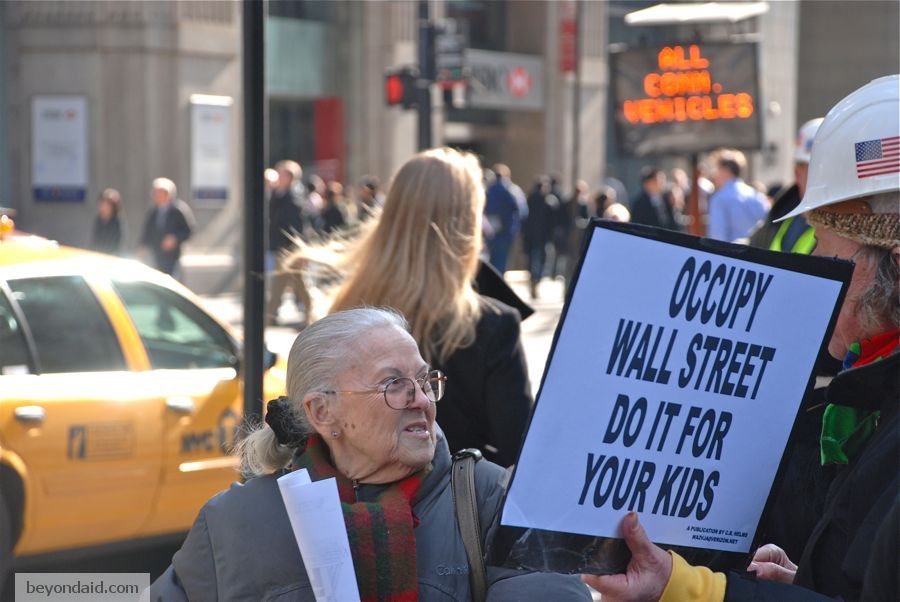
Latest Developments, March 19

In the latest news and analysis…

Arms stats
The Stockholm International Peace Research Institute has released new statistics indicating the international arms trade increased by 24 percent in 2007-2011 compared to previous five-year period, with the usual suspects still dominating the market.
“The five biggest suppliers of major conventional weapons in the period 2007– 11 were the United States, Russia, Germany, France and the United Kingdom. The USA and Russia remained by far the largest exporters, accounting for 30 per cent and 24 per cent of all exports, respectively. The top 5 suppliers accounted for 75 per cent of exports of major conventional weapons in the period 2007–11, compared with 78 per cent for the same five suppliers in the period 2002–2006.”

Apple dividend
KPCC’s Mike DeBord suggests Apple’s decision to reduce its cash surplus by paying its shareholders a quarterly dividend is both morally and strategically questionable.
“So when you think about it, Apple’s cash hoard has really come from extracting profits from its Asian contract manufacturers, who support Apple’s 30-plus profit margins by slashing their own; and by extracting profits from the likes of Verizon and AT&T, who have to subsidize customer purchases of ex-pen-sive iPhones. For the moment, Foxconn and American’s biggest wireless providers are willing to accept a redistribution of wealth from their balance sheets to Apple’s. But you have to wonder how long that will last — especially if people like [ValueWalk’s Paul] Shea are right and the post-Jobs Apple shifts its focus from product innovation to the care and feeding of shareholders (more than 70 percent of who are big institutional investors and hedge funds).”

Grim forecast
In a blog post announcing the release of a new environmental outlook to 2050, the Organisation for Economic Co-operation and Development’s Patrick Love writes that “we’re all doomed.”
“The [greenhouse gas] mitigation actions pledged by countries in the 2010 Cancún Agreements at the UN Climate Change Conference will not be enough to prevent the global average temperature from exceeding the 2C threshold, unless very rapid and costly emission reductions are realised after 2020.
Projections like these are probably familiar to most people interested in environmental issues, but other figures in the book may prove more of a shock, notably concerning health. We may be damaging the environment, but it’s killing us. Today, unsafe water kills more people than all forms of violence, but air pollution is set to become the world’s top environmental cause of premature mortality, overtaking dirty water and lack of sanitation.”

Dam guidelines
The Guardian reports that new voluntary guidelines for assessing the impacts of large hydroelectric dams are gathering support from corporations, while critics cry “greenwash.”
“Zachary Hurwitz, policy programme coordinator at International Rivers, said the protocol could create opportunities for dam builders to make sustainability claims while potentially undermining legislative and civil society-led efforts to hold them accountable for the social and environmental impacts of their projects.
‘There are ways to better regulate dam building,’ he said. ‘It is by the legislative process, through harmonising-upwards country regulatory systems in order to truly come to a global binding standard, with the ability to penalise developers.’ ”

Trayvon Martin
GlobalGrind.com’s Michael Skolnik writes about last month’s fatal shooting of an African-American teenager in a Florida gated community, arguing that “the rights I take for granted [as a white American] are only valid if I fight to give those same rights to others.”
“I got a lot of emails about Trayvon.  I have read a lot of articles.  I have seen a lot of television segments.  The message is consistent.  Most of the commentators, writers, op-ed pages agree.  Something went wrong.  Trayvon was murdered.  Racially profiled. Race. America’s elephant that never seems to leave the room. But, the part that doesn’t sit well with me is that all of the messengers of this message are all black too.  I mean, it was only two weeks ago when almost every white person I knew was tweeting about stopping a brutal African warlord from killing more innocent children.  And they even took thirty minutes out of their busy schedules to watch a movie about dude.  They bought t-shirts.  Some bracelets. Even tweeted at Rihanna to take a stance.  But, a 17 year old American kid is followed and then ultimately killed by a neighborhood vigilante who happens to be carrying a semi-automatic weapon and my white friends are quiet.  Eerily quiet. Not even a trending topic for the young man.”

Abolishing tax havens
The UN Millennium Campaign’s Charles Abugre writes that corrupt government officials are not the main culprits behind illicit capital flight from Africa, an estimated 65-70 percent of which is attributable to “commercial activities, especially through trade mis-pricing of goods”.
“Africa is experiencing economic growth, and for the increasing wealth to be channelled to public services, development and the achievement of the millennium development goals by 2015, it is urgent the problem of tax havens as a conduit for illicit outflows is addressed. The high-level panel set up by the African Union, the African Development Bank and the UN Economic Commission for Africa, and chaired by former South African president Thabo Mbeki, is a significant step forward – and testifies to the importance of this issue for Africa’s development. The ball is now in the court of the rich countries.”

A world bank
It is time for the US to give up its unwritten right to appoint World Bank presidents in favour of a more open, meritocratic process, according to François Bourguignon, Nicholas Stern and Joseph Stiglitz, all of whom held senior positions at the bank in the past.
“The developed countries have declared the importance of an ‘open, transparent and merit-based process’ many times. They have recognised the importance of trust, credibility and collaboration in overcoming global challenges, particularly that of poverty. Yet when the moment comes for decision, they cannot resist the temptation to perpetuate the monopoly. This is not only hypocritical, it also destroys the trust and spirit of collaboration needed to manage the profound problems facing the world.”

Lundins fight back
The Local reports the sons of Lundin Group founder Adolf Lundin have responded to allegations their company consists of “opportunistic, dictator-hugging businessmen” who show little regard for human rights in their search for natural resources.
“The allegations refer to alleged human rights abuses in connection with oil exploration in southern Sudan between 1997 and 2003.
Magnus Elving of the International Prosecution Chamber in Stockholm (Internationella åklagarkammaren i Stockholm) is investigating claims made in a report entitled “Unpaid Debt” framed by an umbrella group named the European Coalition on Oil in Sudan (ECOS) and present in 2010.
The report alleges that Sudanese troops, in collaboration with militias, attacked and drove away the civilian population in areas where companies could drill for oil.”

Latest Developments, March 9

In the latest news and analysis…

Bad food
The Guardian reports that a UN food expert has said what people eat, in both rich and poor countries, is leading to a “public health disaster” that requires action from the world’s governments.
“The solutions offered by agribusiness of more hi-tech or fortified foods cannot solve the problems, which are systemic, according to [UN special rapporteur on the right to food, Olivier] De Schutter.
But since this view is in effect an attack on the major economic interests of the west, the question is how the rapporteur thinks change can be brought about. For De Schutter, the UN agencies that have influence over policy in the area of food and health are where they were with tobacco in the 1980s. At the UN high-level summit on non-communicable disease in New York last September, the US blocked tougher wording on goals to combat the epidemics of obesity, diabetes and heart disease in order to protect their agrifood companies.”

Growing hate
Reuters reports that a new Southern Poverty Law Center study has found “hate groups” are on the rise in the US.
“The center counted 1,018 hate groups in the United States last year, up from 1,002 in 2010. The number of groups have been increasing since 2000, when the center counted 602.
[The center’s Mark] Potok said it was hard to gauge how many Americans are members of hate groups, but estimated the number was between 200,000 and 300,000 people.

The law center also found the number of groups specifically targeting gays and lesbians rose to 27 in 2011 from 17 in 2010, and the number of anti-Muslim groups jumped to 30 from 10.
But the number of so-called “nativist extremist” groups who harass people they suspect of being illegal immigrants appeared to be in decline. The number of those groups dropped to 184 in 2011 from 319 the year before.”

Odious contracts
The Center for Global Development’s Kimberly Ann Elliott makes the case for “preemptive contract sanctions” as a new way for policy makers to apply additional pressure on “illegitimate” regimes.
“The informal group of Western and Arab states known as ‘Friends of Syria’ should declare that the Assad regime is illegitimate and that contracts signed after the date of the declaration would be unenforceable in the courts of those countries. The broader the group, the more legitimate and politically credible the declaration would be, but the U.S. and UK are the critical players because of the role that the international financial centers in New York and London play in world commerce.”

World Bank, USA
The Wall Street Journal reports the next World Bank president will be a 12th consecutive American, but it will not be Columbia University’s Jeffrey Sachs who recently launched a public campaign for the position.
“Since World Bank President Robert Zoellick confirmed his departure three weeks ago, no serious people have doubted that the U.S. would maintain its hold on the job – even if they wished for a truly merit-based process that cast aside nationality. Created after World War II, the World Bank has always had an American as president while a European has led the IMF. The combined shares of U.S. and European nations in each organization make it nearly impossible for a candidate from another background to break the unwritten, informal agreement.”

Women making laws
There is “little correlation” between the number of women in a country’s parliament and that country’s performance on other traditional development indicators, according to Manuela Picq who has just wrapped up a stint as visiting professor and research fellow at Amherst College.
“Women’s presence in politics signifies neither a cultural pattern unique to Europe nor is it a monopoly of a presumably more civilised West. Many non-European societies do as well or better, proving the universality of women participation in politics as well as the inadequacy of claims to export women agency.
Politically powerful countries are not leading global trends when it comes to women presence in politics. In fact, indicators show that it is often quite the contrary, meaning that the US and Europe cannot invoke women’s rights when attempting to justify political, economic or military interventions.”

Free-trade blinders
Harvard University’s Dani Rodrik warns against “fetishizing globalization simply because it expands the economic pie.”
“To pass judgment on redistributive outcomes, we need to know about the circumstances that cause them.

If we do not condone redistribution that violates widely shared moral codes at home, why should we accept it just because it involves transactions across political borders?”

Respecting plants
The University of the Basque Country’s Michael Marder argues that public indifference to a “seismic change” in the field of botany is symptomatic of humanity’s unthinking domination of plants, as well as the further entrenching of English as an “imperial language.”
“Just as, up to and including the age of Descartes and Spinoza, no one took philosophy and other fields of inquiry seriously unless the treatises were written in Latin, so the contemporary production of what counts as credible (or, at the very least, effective) knowledge adheres to the gold standard of English and translation into English.
This is not to say that we should be nostalgic for arcane Latin locutions that carried with them a different set of hegemonic traits superimposed, for instance, onto plants. Rather, we ought to realise that rethinking human relation to plants is not only a matter of ethics, but also of survival, for all species, kingdoms and the planet as a whole.”

Good intentions
The New York Times’ Eduardo Porter writes that Western campaigns to end child labour in poor countries can have unfortunate unintended consequences.
“In Sialkot, Pakistan, a 1997 program to stop children from stitching soccer balls misfired even though the program replaced some of families’ lost income and helped children enter school. Moving stitching from homes to centers that could be easily monitored made it more difficult for the mostly female work force to work. One report said family incomes dropped by 20 percent.”

Latest Developments, March 6

In the latest news and analysis…

Costly loophole
ActionAid has released a report on the potential impacts of UK government plans to open a “huge new tax loophole” by watering down regulations discouraging the use of tax havens.
“This loophole will make it much easier for UK-based global businesses to avoid taxes in the developing countries they operate in, at an estimated cost of £4 billion a year. Some of the poorest countries in the world, with minimal public services, will be losing vital revenues they could be investing in healthcare and education, keeping them more dependent on foreign aid.”

DR Congo’s missing revenues
Voice of America reports that anti-corruption investigators cannot locate $70 million that mining companies say they have paid to the Congolese government, but these corporations may be short-changing the government by a “far greater” amount.
“Mining companies may be hiding some of their income and thus paying less tax than they should. [The Extractive Industries Transparency Initiative’s Jeremy] Dumba said he knew of cases where this may have been happening.
He said for example there’s the case of a company that exported 400,000 tons of minerals.  They should have paid 2 percent tax on that, but their tax declaration came to much less, indicating that they hadn’t declared all their income.”

Global poverty numbers
The Brookings Institution’s Laurence Chandy and Homi Kharas argue that the World Bank’s latest poverty figures contain too many discrepancies to be taken “at face value.”
“The World Bank’s global poverty estimates extend over nearly three decades, with its earliest estimates provided for the year 1981. Throughout this period, the global headcount (based on the $1.25 poverty line) has been dominated by three population groups: Sub-Saharan Africa, India and China. These three account for a remarkably constant three-quarters of the world’s poor—a share which has never deviated by more than three percentage points on either side. Yet poverty estimates for each of the three suffer from glaring problems: insufficient survey data, flawed surveys, and faulty PPP conversions, respectively. If we cannot believe the poverty estimates for Sub-Saharan Africa, India and China, then we cannot believe the World Bank’s global estimates, and we must admit that our knowledge of the state of global poverty is glaringly limited.”

The UK’s 44%
British MP Diane Abbott calls for an examination of the “underlying reasons” for the UK’s 44 percent unemployment among young black people, a rate more than double that of their white peers.
“Some people will be antagonised by any discussion of the fact that spiralling unemployment is hitting black people hardest. They may think it a price worth paying for cutting back on public spending. Or they may argue that it doesn’t matter what colour you are. But the more unequal a society, the more unstable it is. And inequality with a racial dimension risks creating a time bomb. The immediate response to last summer’s riots was (quite correctly) a call to restore order. But these figures are not irrelevant. Policymakers cannot afford to ignore black unemployment.”

Françafrique lives
Former French ambassador to Senegal, Jean-Christophe Rufin, writes that the end of France’s neocolonial activities in Africa, promised by Nicolas Sarkozy during his presidential candidacy in 2006, has not materialized.
“French interventionism in Africa has rarely been stronger than during the last five years. Featuring a military rescue for Chad’s Idriss Déby, support for Mauritania’s coup leader Mohamed Ould Abdel Aziz, an electoral helping hand for Gabon’s Ali Bongo, armed intervention in Côte d’Ivoire, support for the transition in Guinea, armed operations against Al-Qaeda in Niger, to say nothing of the intervention in Libya, the past five years have been marked by all-out French activism, covert or overt, on the African continent.” (Translated from the French.)

Pacification program
International NGO veteran Rick Arnold argues the new partnership linking the Canadian International Development Agency, World Vision and Barrick Gold in Peru has more to do with pacification than development.
“As [Andean Coordinator of Indigenous Organizations’ Miguel] Palacin is strongly suggesting, World Vision-Canada should focus its efforts on Canada. It should join with other organizations working to bring about needed legislation at home to hold Canadian mining companies responsible for damages done abroad.”

Moral calculus
In a Q&A with the Atlantic, Oxford University’s Nick Bostrom reaches a controversial conclusion in weighing the value of current and future generations.
“Well suppose you have a moral view that counts future people as being worth as much as present people. You might say that fundamentally it doesn’t matter whether someone exists at the current time or at some future time, just as many people think that from a fundamental moral point of view, it doesn’t matter where somebody is spatially—somebody isn’t automatically worth less because you move them to the moon or to Africa or something. A human life is a human life. If you have that moral point of view that future generations matter in proportion to their population numbers, then you get this very stark implication that existential risk mitigation has a much higher utility than pretty much anything else that you could do. There are so many people that could come into existence in the future if humanity survives this critical period of time—we might live for billions of years, our descendants might colonize billions of solar systems, and there could be billions and billions times more people than exist currently. Therefore, even a very small reduction in the probability of realizing this enormous good will tend to outweigh even immense benefits like eliminating poverty or curing malaria, which would be tremendous under ordinary standards.”

Raging against cupcakes
Exasperated by the theme of several International Women’s Day events, the Overseas Development Institute’s Claire Melamed asks when cupcakes became the “international symbol of womankind.”
“Why does this fetishisation of cupcakes make me so annoyed?  Cupcakes are just so twee-ly, coyly, ‘ooh no I really shouldn’t’-ly, pink and fluffily, everything that I think feminism is not.  It’s feminism-lite, feminism as consumption and ‘me time’ (grr), rather than feminism as power and politics and equal pay.”

World Bank track record
Columbia University’s Jeffrey Sachs gives a stinging historical account of the World Bank, as he continues to make his case for becoming its 12th consecutive American, male president.
“From the Bank’s establishment until today, the unwritten rule has been that the US government simply designates each new president: all 11 have been Americans, and not a single one has been an expert in economic development, the Bank’s core responsibility, or had a career in fighting poverty or promoting environmental sustainability. Instead, the US has selected Wall Street bankers and politicians, presumably to ensure that the Bank’s policies are suitably friendly to US commercial and political interests.

For too long, the Bank’s leadership has imposed US concepts that are often utterly inappropriate for the poorest countries and their poorest people.”

Latest Developments, March 5

In the latest news and analysis…

Justifying targeted killings
Talking Points Memo provides an excerpt of US Attorney General Eric Holder’s speech in which he explains the thinking behind the current administration’s growing habit of eliminating perceived threats extrajudicially.
“Some have called such operations ‘assassinations.’ They are not, and the use of that loaded term is misplaced. Assassinations are unlawful killings. Here, for the reasons I have given, the U.S. government’s use of lethal force in self defense against a leader of al Qaeda or an associated force who presents an imminent threat of violent attack would not be unlawful — and therefore would not violate the Executive Order banning assassination or criminal statutes.

Some have argued that the President is required to get permission from a federal court before taking action against a United States citizen who is a senior operational leader of al Qaeda or associated forces. This is simply not accurate. “Due process” and “judicial process” are not one and the same, particularly when it comes to national security. The Constitution guarantees due process, not judicial process.”

Drones in the Philippines
American University’s Akbar Ahmed and Frankie Martin argue last month’s US drone strike in the southern Philippines – the first in Southeast Asia – has the potential to “further enflame” a conflict that has killed an estimated 120,000 over the past four decades.
“By unleashing the drones, the US has pushed the conflict between centre and periphery in the Philippines in a dangerous direction. If there is one lesson we can learn from half a millennium of history it is this: weapons destroy flesh and blood, but cannot break the spirit of a people motivated by ideas of honour and justice.
Instead, the US and Manila should work with the Muslims of the Philippines to ensure full rights of identity, development, dignity, human rights and self-determination. Only then will the security situation improve and the Moro permitted to live the prosperous and secure lives they have been denied for so long; and only then will the Philippines be able to become the Asian Tiger it aspires to be.”

Kiobel expanded
Bloomberg reports the US Supreme Court has expanded the scope of a human rights and corporate liability case involving Nigerian plaintiffs and oil giant Shell.
“When the justices heard arguments in the Shell case last week, they focused on whether the Alien Tort Statute allowed suits against corporations. Several justices, including Samuel Alito, suggested during the argument that they were more interested in considering contentions that the law can’t be applied overseas.
A ruling on the so-called extraterritoriality issue would potentially impose more sweeping limits on lawsuits, shielding corporate officers as well as the companies themselves.”

Beyond Kiobel
The Castan Centre for Human Rights Law’s Joanna Kyriakakis presents an overview of the issues at play in the Kiobel case, as well as future avenues for corporate liability advocates should the Supreme Court rule in Shell’s favour.
“Comments by plaintiff lawyer, Paul Hoffman, in a panel conversation the day after the hearing indicate that, whatever the outcome in this case, they will continue to pursue corporations implicated in human rights abuses through US judicial avenues. One option already noted would be to litigate individual corporate executives. In many respects, this option may be less appealing to the business world.”

Rich get richer
UC Berkeley’s Emmanuel Saez presents new figures suggesting these are good times for America’s “one percent”.
“In 2010, average real income per family grew by 2.3% but the gains were very uneven. Top 1% incomes grew by 11.6% while bottom 99% incomes grew only by 0.2%. Hence, the top 1% captured 93% of the income gains in the first year of recovery. Such an uneven recovery can help explain the recent public demonstrations against inequality. It is likely that this uneven recovery has continued in 2011 as the stock market has continued to recover. National Accounts statistics show that corporate profits and dividends distributed have grown strongly in 2011 while wage and salary accruals have only grown only modestly. Unemployment and non-employment have remained high in 2011.”

In defense of social unrest
In a Q&A with Inter Press Service, former UN Conference on Trade and Development head Rubens Ricupero speaks approvingly of how “dissatisfaction” drives history.
“I hope this movement demanding change will modify not only the internal economies of countries, in the sense of moving away from that market fundamentalism, but that it will also change the institutions that have represented that fundamentalist spirit.
And in order for that to happen, the central role has to be played by people around the world – not only in the (developing) South – who are aware of the problem, that it is not possible to continue with an organisation that foments the growth of inequality.”

World Bank non-leadership
Following close on the heels of Columbia University economist Jeffrey Sachs’s open application to become the next World Bank president, New York University’s William Easterly spells out how he would not run the international financial institution.
“I would not lead the World Bank by perpetuating the technocratic illusion that development is something ‘we’ do to ‘them.’ I would not ignore the rights of ‘them.’ If the New York Times should happen to report on the front page that a World Bank-financed project torched the homes and crops of Ugandan farmers, I would not stonewall the investigation for the next 165 days, 4 hours, 37 minutes, and 20 seconds up to now.”

Development gospel
Aid on the Edge of Chaos’s Ben Ramalingam argues the World Bank must stop being a “Development Church” that promotes economic dogma if its client countries are ever going to be “intellectually in the driver’s seat.”
“[Former World Bank staffer David] Ellerman argues that in the face of these Official Views, adverse opinions and critical reasoning tend to give way to authority, rules and bureaucratic reasoning shaped by the hierarchies within the organisation. Moreover, these Official Views “short-circuit” and bypass the active learning capability of national and local actors, and substitute the authority of external agencies in its place.”

Latest Developments, March 4

In the latest news and analysis…

Sachs for president
Columbia University’s Jeffrey Sachs makes the case for why he should become the 12th consecutive American man to serve as president of the World Bank.
“In Latin America, Eastern Europe, Africa and Asia, I’ve been a trusted problem-solver for heads of state and impoverished villagers. My good fortune to see the world through the eyes of others, during 30 years working on some of the world’s most vexing problems, has helped me understand various regions’ challenges and the need for tailored solutions. There are reasons why what works well in the United States might not work in Nigeria, Ethiopia or India.”

Assessing Sachs
The Guardian explores Jeffrey Sachs’s CV in light of his declared desire to become World Bank president.
“But Sachs’s role in development hasn’t always been uncontentious. As a consultant in the late 1980s and early 1990s while an academic at Harvard, he advised Poland, then Russia, on their economic reforms. The strategy adopted by the Kremlin, under the tutelage of the IMF and the US treasury, involved a headlong dash towards privatisation and liberalisation that became known as ‘shock therapy’.
The consequences were disastrous, enriching a tiny coterie of oligarchs who bought up public assets on the cheap, and driving Russia towards defaulting on its debts.
However, Sachs now disowns the extreme policies for which many have since blamed him.”

Escalation concerns
In an interview with Al-Jazeera, the UN high commissioner for human rights, Navi Pillay, expresses her opposition to arming Syria’s rebels.
“ ‘Any kind of provision of military equipment to the opposition, in my view, will escalate the violence and not lead to the goal we are trying to achieve,’ Pillay explains.
‘I think that countries should be focusing their energy on achieving a peaceful resolution here, and to ensure that the root causes are addressed … and supplying arms to a few individuals is not going to help that situation … As I see it, it’s not the role of outsiders to arm one group or the other.’ ”

Polio protest
McClatchy Newspapers reports a group of American humanitarian NGOs is alleging the CIA’s use of a fake immunization scheme to locate Osama Bin Laden has set back the fight against polio in Pakistan, which had the highest number of cases in the world last year.
“ ‘The CIA’s use of the cover of humanitarian activity for this purpose casts doubt on the intentions and integrity of all humanitarian actors in Pakistan, thereby undermining the international humanitarian community’s efforts to eradicate polio, provide critical health services and extend life-saving assistance during times of crisis, like the floods seen in Pakistan over the last two years,’ the coalition of aid agencies, InterAction, wrote in its letter to CIA director David Petraeus.”

Affordable medicines on trial
Intellectual Property Watch reports on a case set to be heard by India’s Supreme Court later this month, which could have massive repercussions on global health.
“For access to medicine campaigners, Novartis’s legal action could threaten the availability of affordable medicines for the world’s poorest patients. For the pharmaceutical company, the protection of massive R&D investment and innovation is on the line.

‘What is at stake goes far beyond the only granting of a patent for this anticancer drug. This legal challenge aims in fact at weakening a legitimate and invaluable public health clause of the Indian law, Section 3(d), which intends to limit the multiplication of patents on trivial changes to existing medicines, a common practice by multinational pharmaceutical companies known as “evergreening”, ’ said Patrick Durisch, the health programme coordinator of the Berne Declaration.”

Poverty falling
The Economist reports on new World Bank figures suggesting poverty is “declining everywhere,” though primarily in China.
“If you exclude China, the numbers are less impressive. Of the roughly 1.3 billion people living on less than $1.25 a day in 2008, 1.1 billion of them were outside China. That number barely budged between 1981 and 2008, an outcome that Martin Ravallion, the director of the bank’s Development Research Group, calls ‘sobering’.”

The war over women’s health
The New York Times’ Nicholas Kristof lays out the process, which he describes as “bordering on state-sanctioned rape,” that women in Texas must now go through before having an abortion.
“Under a new law that took effect three weeks ago with the strong backing of Gov. Rick Perry, she first must typically endure an ultrasound probe inserted into her vagina. Then she listens to the audio thumping of the fetal heartbeat and watches the fetus on an ultrasound screen.
She must listen to a doctor explain the body parts and internal organs of the fetus as they’re shown on the monitor. She signs a document saying that she understands all this, and it is placed in her medical files. Finally, she goes home and must wait 24 hours before returning to get the abortion.”

Selling globalization
Monthly Review’s Michael Yates looks at how inequality and globalization fuel each other.
“Incomes do not just flow from poorer to richer households but from lesser to greater businesses (this latter phenomenon is part of what [Eric] Schutz calls “the business power structure”). Large firms, a small number of which dominate many markets, are best situated to expand globally, and as they do, they become more powerful economically and politically. This power permits them to increase the rate of exploitation of labor, again especially in the Global South, as they can both utilize modern labor process control techniques better than their smaller rivals and exert political pressure more effectively. Their growing and almost total control of mass media creates a modern propaganda system that shapes the culture in a thoroughly pro-capitalist manner, forging a climate in which it is difficult for people to escape being bombarded with the idea that there is no alternative to the terrible things that have been happening to them. Governments are increasingly seen as incapable of doing anything except getting out of the way of the capitalist juggernaut.”