Latest Developments, March 27

In the latest news and analysis…

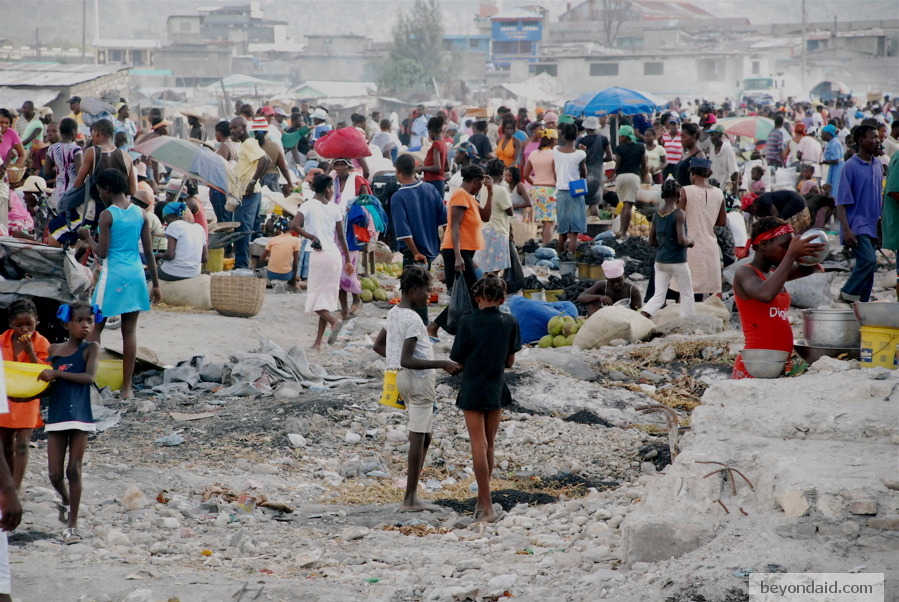
Red Cross hotel
The Center for Economic and Policy Research questions Red Cross priorities as the humanitarian organization considers building a luxury hotel and conference center on Port-au-Prince land it bought with Haiti earthquake relief funds.
“Considering the hundreds of people who have recently been forcibly evicted – with some recently having been burned out of their camps in suspicious arsons – couldn’t this be space that the Red Cross could offer them, rather than using it for a commercial venture that might not even be viable?
The Red Cross’ post-quake spending and use of funds, as the largest NGO operating in Haiti, has been controversial almost since the beginning. News that some ‘funds donated by national Red Cross agencies for quake recovery’ – much of which almost certainly came from individuals who believed their money would be used for emergency relief – might instead be used for a risky commercial venture (and one that caters to NGO’s and tourists) could provoke more controversy.”

Mosque outreach
The American Civil Liberties Union reports it has obtained documents indicating the FBI used a “mosque outreach” program to gather intelligence on American Muslim groups and their members “without any suspicion of wrongdoing.”
“The documents also show that the FBI categorized information about American Muslims’ First Amendment-protected and other entirely innocuous activities, as well as mosque locations, as ‘positive intelligence’ and disseminated it to agencies outside the FBI. As a result, the agency wrongly and unfairly cast a cloud of suspicion over innocent groups and individuals based on their religious beliefs and associations, and placed them at risk of greater law enforcement scrutiny as potential national security threats. None of the documents indicate that the FBI told individuals interviewed that their information and views were being collected as intelligence and would be recorded and disseminated.”

Suspicious skin
The Global Post reports a German court has ruled that certain police can use the colour of a person’s skin as justification for demanding to see identification.
“However, judges ruled that skin color was reasonable grounds on which to carry out ID checks, since the train route in question is often used by illegal immigrants to enter Germany. Since police cannot check every passenger’s papers, they must select which people to ID based on their ‘border policing experience,’ the judgment said.
The officers are therefore allowed to make their choice ‘according to external appearance’ and without concrete grounds for suspicion, Agence France Presse reported.”

Drug talk
Former Mexican foreign minister Jorge Castañeda writes that the “failed war on drugs” will loom large in discussions at next month’s Summit of the Americas in Colombia.
“Recently inaugurated Guatemalan President Otto Pérez Molina, together with [Colombian President Juan Manuel] Santos and other heads of state, question today’s punitive, prohibitionist approach, owing to its enormous costs and meager results, and propose a different strategy: legalization.
Obama sent Vice President Joe Biden to Mexico and Central America a few weeks ago to forestall this trend, and he may have partly succeeded. Nevertheless, whereas only a smattering of political leaders and intellectuals advocated legalization in the past, nowadays officials are coming ‘out of the closet’ on drugs in droves. Those who used to say that they favored a debate on the issue now support legalization; those who opposed it now accept the need for debate; and those who continue to oppose legalization do so on moral, rather than rational, grounds.”

Crying foul
UN special rapporteur on the right to food, Olivier De Schutter, argues the international community must look at the big picture and get serious about accountability if sustainable development is to become a reality.
“What are framed as development policies often end up doing very little to help the most marginalised communities, and sometimes end up harming them. Meanwhile, the effects of genuine development policies can easily be overridden by industrial and infrastructural projects, trade agreements, and other external factors that tip the balance against small-scale farmers and fishers. It is therefore essential to be able to cry foul when missing policies, misguided policies, or the sum total of policies, work against sustainable development.”

Talk is cheap
Inter Press Service reports on a group of legal experts who are looking to hold world leaders to the promises they make at June’s Rio+20 sustainable development summit.
“ ‘We are really tired of declarations,’ Antonio Herman Benjamin, judge of the Supreme Court of Brazil, told an international gathering of legal experts here Monday. Despite some progress made since the 1992 Earth Summit held in Rio de Janeiro, Brazil, most governments have failed to fulfil their obligations.
As a result, the court has launched a new initiative to promote role of law in advancing sustainable development. It is known as the World Congress on Justice, Governance and Law for Environmental Stability.
The Congress’s scores of members from around the world include senior judges, prosecutors, legal scholars, auditors and development experts. They plan to focus on the problems and obstacles that hinder the implementation of multilateral environmental agreements.”

Immigration detention
Author Edwige Danticat writes in the New York Times that new US immigration guidelines recommend the bare minimum of human rights for detainees, more than 110 of whom have died in custody since 2003.
“The new [Immigration and Customs Enforcement] guidelines are not perfect. They do not offer, for example, alternatives to jail-like detention, even for unaccompanied minors, the elderly, the disabled or pregnant women. But they are a step forward. In addition to medical care, safe water and limited recreation, they also require that staff members not perform strip searches on detainees of the opposite sex and that detainees not be used for medical experiments or for clinical trials without informed consent. They will crack down on sexual assault by staff members, contract personnel or other detainees and suggest that victims of sexual abuse be given access to emergency medical treatment.”

Good intentions
Northeastern University’s Aziza Ahmed argues we must “interrogate the consequences of advocacy efforts,” however noble the cause may appear.
“First, anti-sex trafficking activism has an extremely negative impact on HIV programs. Sex workers are highly vulnerable to contracting HIV. A key victory for anti-sex trafficking organizations was the insertion of the anti-prostitution loyalty oath (APLO) into the US Leadership Act for HIV/Aids, TB, and malaria. This provision requires that organizations agree to oppose prostitution and sex trafficking. The APLO has the effect of disempowering sex worker organizations who refuse to sign on, shutting health services for sex workers, and alienating sex workers from public health programs.”
Latest Developments, February 28

In the latest news and analysis…

Corporate immunity
The Huffington Post reports that the US Supreme Court looks set to decide that corporations should not be held liable for human rights violations committed overseas. “The Court was hearing oral argument in Kiobel v. Royal Dutch Petroleum, which was brought under a founding-era law, commonly called the Alien Tort Statute, that allows foreign nationals to bring civil lawsuits in U.S. federal courts ‘for a tort only, committed in violation of the law of nations or a treaty of the United States.’ The 12 Nigerian plaintiffs contend that Shell Oil’s parent company aided and abetted the Nigerian government in its torture and extrajudicial killing of environmental and human rights protesters resisting Shell’s operations in Nigeria in the 1990s.
The Alien Tort Statute says nothing about what types of defendants — corporate, individual, state — may be sued. In the past year, the four appeals courts to take on the issue of corporate liability have divided 3-to-1 in favor of those bringing the lawsuits. But Tuesday’s oral argument reinforced the relevancy of another aspect of all these decisions: their partisan nature. Save one defection from each side, every Democrat-appointed judge held for corporate liability, and every Republican appointee found for corporate immunity.”

Nuclear dysfunction
Former Australian foreign minister Gareth Evans argues the international community has lost its momentum on nuclear disarmament and calls for the G20 to take up the file.
“With its foreign ministers meeting in Mexico this month to discuss broader global governance issues, the G-20 is beginning to move beyond a narrow economic focus. That is to be welcomed. Economic destruction causes immense and intolerable human misery. But there are only two global threats that, if mishandled, can destroy life on this planet as we know it. And nuclear weapons can kill us a lot faster than CO2 can.”

Latin American legalization
Ralph Espach of the Center for Naval Analyses writes that Mexican, Colombian and Guatemalan leaders are discussing, over US objections, the possibility of legalizing the drug trade within their region.
“It is easy to see why. The drug war has been a disaster for the Latin American countries fighting it, especially Mexico, and Central Americans’ suspicion that legalization could be less painful and costly is reasonable. Whether or not legalization would in fact be a good thing for Central America, the situation is desperate enough that they must at least consider their options.”

Reverse colonization
Africa is a Country’s Buefixe takes exception to the tone of recent media reports on the changing relationship between debt-ridden Portugal and its booming former colony Angola.
“Then there is the quote from the foreign investment lawyer, Tiago Caidado Guerreiro, who says that ‘we’re being colonized after 500 years by them,’ referring to investments by Angolans in the Portuguese economy. True, wealthy, politically powerful Angolans have been buying up parcels of Portuguese companies, but that does not equal colonization, not by a long shot. Angolans are not, for example, creating settler colonies in Portugal, or changing the nature and character of local institutions of education, government and culture.”

Olympic sweatshops
just-style reports on new measures announced by organizers of the London Olympics following the discovery of labour abuses at factories making Olympic products.
“[London Organising Committee of the Olympic Games and Paralympic Games] will publish the names and locations of factories in China and the UK covering over 70% of the licensed products produced for London 2012, with a focus on licensees that still have production remaining.
It will make information about employment rights, based on national laws and LOCOG’s ethical code, available in Chinese and English, and establish a Chinese language hotline so that workers who feel they are being treated unfairly can either call or text to complain about their treatment.
It will also provide training for some of the workers in the various Olympic supply chains to make them more aware of their rights.”

Patent bullying
Bloomberg reports a US judge has dismissed a lawsuit brought by a group of American organic farmers against agribusiness giant Monsanto regarding patents for genetically modified seeds.
“ ‘[U.S. District Judge Naomi Reice Buchwald’s] decision to deny farmers the right to seek legal protection from one of the world’s foremost patent bullies is gravely disappointing,’ Daniel Ravicher, a lawyer for the plaintiffs, said in an e-mail. ‘Her belief that farmers are acting unreasonable when they stop growing certain crops to avoid being sued by Monsanto for patent infringement should their crops become contaminated maligns the intelligence and integrity of those farmers.’ ”

General Electric’s tax bill
Citizens for Tax Justice alleges that General Electric paid “at most 2.3 percent” in US federal income taxes on $81.2 billion in profits over the last decade.
“[Citizens for Tax Justice’s Bob] McIntyre noted that GE has yet to pay even that paltry 2.3 percent. In fact, at the end of 2011, GE reports that it has claimed $3.9 billion in cumulative income tax reductions on its tax returns over the years that it has not reported in its shareholder reports — because it expects the IRS will not approve these ‘uncertain’ tax breaks, and GE will have to give the money back.
GE is one of 280 profitable Fortune 500 companies profiled in ‘Corporate Taxpayers and Corporate Tax Dodgers, 2008-2010.’ The report shows GE is one of 30 major U.S. corporations that paid zero – or less – in federal income taxes in the last three years.”

Post-aid landscape
The Overseas Development Institute’s Jonathan Glennie makes the case for a diminished role for the OECD’s development assistance committee (DAC) that would better reflect the world’s shifting power relations.
“Rather than seeking to be a global broker of development co-operation, which was never going to work in a newly balanced world, the OECD should just be a club of particularly rich countries, and should meet with clubs comprising other countries to bash out agreements. Such debtors’ or recipients’ clubs have long been needed to balance the power of the DAC or the Paris Club (which manages sovereign debts), and may now emerge.”

Latest Developments, January 13

In the latest news and analysis…

Violent hemisphere
The Washington Post reports on a new study suggesting 45 of the world’s 50 most violent cities are located in the Western Hemisphere, many of them caught up in the tension between an insatiable American market and prohibition policies.
“[Honduras’s] San Pedro Sulla tallied 159 homicides per 100,000 residents last year, followed by [Mexico’s] Ciudad Juarez, with 148 killings per 100,000. Both cities are major operational and strategic distribution points along the billion-dollar drug pipeline that funnels narcotics to consumers in the United States.”

Apple opens up
Reuters reports Apple has made public its “closely guarded” list of global suppliers in the face of criticism over perceived indifference to worker abuses.
“The audit conducted by Apple of suppliers found a number of violations, among them breaches in pay, benefits and environmental practices in plants in China, which figured prominently throughout the 500-page report Apple issued.
Other violations unearthed included dumping wastewater onto a neighboring farm, using machines without safeguards, testing workers for pregnancy and falsifying pay records.”

German banks vs. financial transaction tax
Bloomberg reports that Germany’s banks have expressed their opposition to a tax on financial transactions in the euro zone.
“ ‘If a financial-transaction tax cannot be introduced internationally, you have to do without it,’ Hans Reckers, managing director of Germany’s VOeB association of public banks, said in an e-mailed statement today. ‘We firmly oppose the creation of tax haven in the EU.’

The European Commission in September suggested a tax of 0.1 percent on equity and bond transactions and 0.01 percent on derivatives, which it said could raise 55 billion euros ($70 billion) a year. European Union finance ministers are due to discuss the levy in March.”

Diminishing solidarity
Le Monde reports on the contentious debate over whether a financial transaction tax, if one is ever adopted, would have much in common with Robin Hood.
“The NGO Oxfam worries about the change in [French President] Nicolas Sarkozy’s position, noting that he had said at the G20 summit in early November ‘a significant portion, the majority or the totality of the revenue must go to development.’ But he has since changed his mind, according to Oxfam’s Luc Lamprière: ‘His reference to the European Commission directive is a bad sign since it calls for the tax to ‘progressively replace national contributions to the EU budget,’ leaving the idea of financing development and the fight against climate change as a mere footnote.’ ” (Translated from the French)

Rio+20 agenda
The International Institute for Environment and Development’s Emily Benson grades the just-released draft agenda for the Rio+20 summit, finding it stronger on sentiment than specifics.
“Mention is made to ‘innovative instruments of finance’ for building green economies and reference is made to public procurement, fiscal reform, the removal of subsidies that undermine sustainable development, all of which the [Green Economy] Coalition has been promoting. It calls for International Financial Institutions to ‘review their programmatic strategies to ensure the provision of better support to developing countries for the implementation of sustainable development’. This is all encouraging stuff. However, the text steps rather delicately around the question not only of how much the transition is going to cost, but how we are going to leverage additional funds. From our past experience of Rio 1992 we know that governments alone will not be able to pay for the transition so we need to think a lot more creatively about how to leverage additional finance. So, the question we would like to see tackled in the next draft is:  How are we going to kick-start the finance of a green and fair economy in order to create long-term investor confidence?”

Burma beware
The Institute of Development Studies’ Gabriele Köhler argues Myanmar must be wary, as it opens up to the world beyond Asia, of the West’s conquering friendship.
“We can hope that the west’s sudden enthusiasm stems from genuine support for peace and the rights of the population. But in reality, the change in stance probably has at least as much to do with pursuit of their own national interests. For several decades, US and European sanctions have kept western businesses out of Burma, while firms from Thailand, Singapore, India and especially China eagerly exploited the country’s natural gas, hydropower potential and gemstones.
History has shown time and again that popular movements for civil liberties, democracy and human rights are often hijacked by a drive to introduce neoliberal capitalism or prise open a country to foreign investors.”

Carbon fixation
The Land Institute’s Stan Cox argues that current schemes to reduce carbon emissions could actually make it harder for future generations to provide for themselves.
“To value everything in terms of carbon and treat the myriad benefits of ecologically sound agriculture as mere byproducts of climate protection is to invite all kinds of threats to soil and food. Perhaps the most menacing threats are those posed by connecting food and soil more tightly to global capital markets through carbon-trading schemes and tying them more closely to volatile energy markets by putting already fragile soils to work growing biofuels.

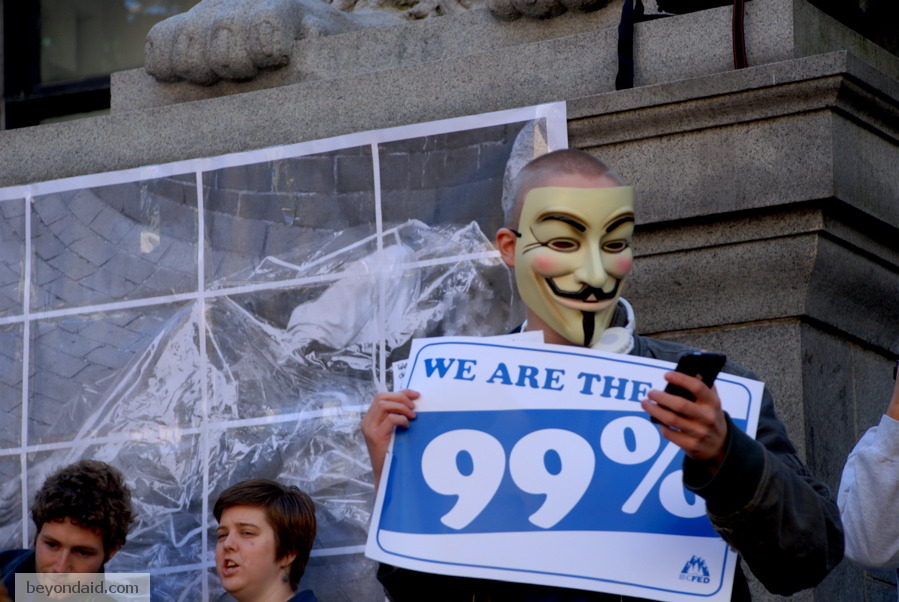
Occupying Occupy
Author and blogger Carne Ross warns that the appropriation of Occupy slogans, by mainstream politicians and crockery shops, has begun.
“As the ‘68-ers manifestly failed to do, Occupy must move from words to action, for relying on the platform of words will see the ground cut from under our feet. In contrast to the ease with which they can steal the words of Occupy, the [Newt] Gingrich’s of this world will not be able to appropriate actions consonant with the ideals of Occupy for this would be to enact Occupy’s sought revolution.  And that won’t happen in a century of Sundays.”

Latest Developments, November 22

In the latest news and analysis…

Mining tax precedent
Australia’s proposed 30 percent tax on the country’s mining industry, which is “being eyed by other resource nations in South America and Africa,” has passed the parliament’s lower house by 73 votes to 71.
“[Prime Minister Julia] Gillard wants the new tax on mining profits to pay for a company tax cut and boost pensions, helping to spread the benefits of Australia’s resources boom to other parts of the economy struggling with the global downturn.
‘This is a way in which all Australians share in the bounty of the mining boom,’ Treasurer Wayne Swan told parliament.”

Surging investor-state lawsuits
A new Institute for Policy Studies report indicates that the number of lawsuits brought before international tribunals by oil, gas and mining companies against “governments seeking to increase the benefits of those resources for their own people” has risen sharply along with commodity prices in recent years.
“Under free trade agreements and bilateral investment treaties, foreign investors have the right to file such “investor-state” lawsuits in international tribunals to demand compensation for government actions that reduce their profits.
This newly updated edition of “Mining for Profits” finds that at the most frequently used tribunal, the International Center for Settlement of Investment Disputes (ICSID), 43 of 137 pending “investor-state” cases are related to oil, mining, or gas. By contrast, one year ago there were only 32 such cases and 10 years ago there were only 3.”

Transparency not enough
A new report by the University of British Columbia’s Philippe Le Billon argues  initiatives to improve governance of the extractive industries tend not to go far enough.
“Among other priorities, transparency initiatives should demand higher disaggregation of information disclosed by extractive companies and host governments. Transparency requirements should extend beyond revenues to licensing, contracts, physical resource flows, and other production factors, as well as to public expenditure. Extractives transparency initiatives also need to integrate elements of the tax justice and tax evasion agendas in order to expand their relevance to the effort to reduce illicit financial flows.”

Accessible innovation
Intellectual Property Watch reports on a conference marking the 10th anniversary of the Doha Declaration on Trade-Related Aspects of Intellectual Property Rights (TRIPS) and Public Health, which addressed the question of how to encourage innovation while keeping medicines accessible to the world’s poor.
“‘The sustainability of access at the end of the day is going to come back to the issue how you finance R&D,’ [James Love, director of Knowledge Ecology International] said. Love argued that it is essential to de-link the prices of medicines and the development of new medicines in order to fulfil ‘the promise of Doha’ and access to medicines for all.”

Supply and demand
Agence France-Presse reports on a new World Wildlife Fund assessment of the palm oil market which suggests that, despite improvements, companies are not doing enough to ensure the oil they buy comes from sustainable sources.
“Palm plantations are considered one of the biggest threats to rainforests in countries like Malaysia and Indonesia — the source of 85 percent of world palm oil supply — as virgin forests are typically cleared to make way for them.

The scorecard focuses on major companies in Europe, Australia and Japan, the world’s biggest palm oil markets.
About 5.2 million tonnes of certified sustainable palm oil was produced last year — roughly 10 percent of world supply — but only 56 percent was purchased, the WWF said.”

Unsustainable food
The International Institute for Environment and Development uses the example of ketchup to illustrate how unsustainable the global food industry is.
“Analysis of the steps involved in processing ketchup – from farming the tomatoes through to packaging – to transporting and retailing that symbol of American mass consumerism reveals an alarming fact. To produce it requires a mind-boggling 150 separate processes, across several continents, according to research cited in a new book by the International Institute for Environment and Development.
It’s just one small part of a ‘staggeringly inefficient’ food system according to the new book Virtuous Circles. When the overall energy costs for producing food are taken into account – including farm machinery, transportation, processing and packaging – ‘the modern food system consumes between ten and fifteen calories of fossil fuel energy for every calorie of food energy (nutrition) produced.’”

Just say no (to the war on drugs)
The Overseas Development Institute’s Jonathan Glennie argues wealthy, recreational drug-consuming countries need to renounce the war on drugs in order to “save west Africa from a fate worse than Mexico.”
“Clearly an end to prohibition will not end the problems created by the war on drugs at a stroke, nor the problems created by drugs themselves. The gangs that are now so powerful in Colombia, Mexico and elsewhere engage in many types of crime including people trafficking and kidnapping. But one of their largest sources of income would be decimated, as prices fall in a regulated market.
Insiders are more hopeful than ever that an end to global prohibition is possible within a decade. Both Barack Obama and David Cameron, the leaders of two of the most important drug-consuming nations in the world, are on the record in their opposition to the war on drugs before they were elected. If they followed through on their promise of a rethink they could go down in history as the leaders that began one of the most important global policy shifts of our time.”

Symbolic justice
Princeton University’s Richard Falk writes about past and present efforts to address the double standard of victors’ justice that has been the international norm since the end of World War II through “societal efforts to bring at large war criminals to symbolic justice.”
“The existence of double standards is part of the deep structure of world politics. It is even given constitutional status by being written into the Charter of the United Nations by allowing the five permanent members of the UN Security Council, that is the winners in 1945, to exercise a veto over any decision affecting the peace and security of the world, thereby exempting the world’s most dangerous states, being the most militarily powerful and expansionist, from any obligation to uphold international law.”

Latest Developments, October 17

In the latest news and analysis…

Supreme moment for Alien Tort
The Associated Press reports the US Supreme Court has agreed to use a suit brought by Nigerian plaintiffs against Royal Dutch Shell to decide if corporations can be held liable in the US for alleged human rights violations committed abroad.
“The justices said they will review a federal appeals court ruling in favor of Shell. The case centers on the 222-year-old Alien Tort Statute that has been increasingly used in recent years to sue corporations for alleged abuses abroad.
Other cases pending in U.S. courts seek to hold accountable Chiquita Brands International for its relationship with paramilitary groups in Colombia; Exxon and Chevron for abuses in Indonesia and Nigeria, respectively, and several companies for their role in apartheid in South Africa.”

Drone growth
TomDispatch’s Nick Turse refers to military documents, press reports and “other open source information” to estimate the US is currently using at least 60 bases around the world for its drone operations, but he anticipates that number will increase as America’s reliance on unmanned aircraft grows.
“Earlier this year, an analysis by TomDispatch determined that there are more than 1,000 U.S. military bases scattered across the globe — a shadowy base-world providing plenty of existing sites that can, and no doubt will, host drones.  But facilities selected for a pre-drone world may not always prove optimal locations for America’s current and future undeclared wars and assassination campaigns.  So further expansion in Africa, the Middle East, and Asia is a likelihood.”

LRA love
Premiere Networks talk show host Rush Limbaugh slammed US President Barack Obama’s decision to send American troops to Uganda to fight the Lord’s Resistance Army, accusing him of wanting to “to wipe out Christians in Sudan” until additional information gave him pause.
“Is that right? The Lord’s Resistance Army is being accused of really bad stuff? Child kidnapping, torture, murder, that kind of stuff? Well, we just found out about this today. We’re gonna do, of course, our due diligence research on it. But nevertheless we got a hundred troops being sent over there to fight these guys — and they claim to be Christians.”

Thinktank transparency
Guardian columnist George Monbiot argues that thinktanks “are the means by which corporations and the ultra-rich influence public life without having to reveal their hand” and calls on them to disclose their sources of funding.
“The public sector is now so transparent that we have a right to read the private emails of climate scientists working for a state-sponsored university. The private sector is so opaque that we have no idea on whose behalf the people who appear every day on the BBC, using arguments that look suspiciously like corporate propaganda, are speaking.”

G20 inaction
Responding to the communiqué released at the end of last week’s meeting of G20 finance ministers in Paris, Global Financial Integrity has expressed disappointment at the apparent absence of any comprehensive vision for increasing the transparency and accountability of the world’s financial system.
“The Finance Minister’s communiqué fails to mention country-by-country reporting, automatic exchange of tax information, disclosure of beneficial ownership, or strengthening anti-money-laundering laws,” according to GFI director Raymond Baker. “These measures are key to creating global economic development, and financial stability. What we have here are piecemeal fixes to a systemic problem.”

Money on the mind
Author Dan Hind argues that people need to understand fundamental concepts, such as what money is, in order to have the “reasonable conversation” the established order fears more than riots.
“The problems we face are complicated, it’s true, but they are not as complicated as some would like to make out. We will begin to see how to solve them when we have a clear understanding of the fundamentals of social organisation, including the origins and nature of money.
It is an understanding that those who are currently powerful would rather we didn’t have. After all, as another great American ironist, Walter Karp, put it, “usurped power is only secure as long as it remains unregarded”. For too long, the banks have shaped the laws of economic exchange in private. Even in the midst of a debt crisis their privilege has so far evaded our understanding. It is time that it became the object of our steady and patient attention.”

Locals vs multinationals
Al Jazeera is airing a film entitled How to Stop a Multinational which focuses on the efforts of three activists who have successfully taken on a Canadian mining company in the Argentinian Andes and are now turning their attention to a Chinese one.
“Historically, this region’s never had enough water, so when a mining company comes to use 1,000 litres of water per second, we risk becoming a ghost town, disappearing, because it doesn’t make sense to stay in a town without water, and I don’t want to leave,” according to activist Gabriela Romano.
“I was born here, I love this land, and I will defend it.”

Legalize or die
The Globe and Mail’s Neil Reynolds argues for the legalization of cannabis, opiates, cocaine and “most other drugs” in order to stem the illegal trade’s growing violence in the Americas (15,000 deaths last year in Mexico alone), though he concedes that no country can go it alone.
“Assuming some international consensus for repeal, though, Canada has a number of retail models to contemplate. Assuming a government monopoly, it could regulate the drug trade through government-owned outlets (“beer and liquor stores”). Assuming a regulated industry, it could exploit existing pharmaceutical emporiums (“drugstores”). Assuming a more free-market approach, it could use corner-store outlets (“smoke shops”). All these establishments sell lots of government-regulated drugs already – most of them, when you think about it, for medical purposes of one kind or another.”