Latest Developments, February 7

In the latest news and analysis…

French exit strategy
Reuters reports that France is calling for UN peacekeepers to take over from the “African-led military mission” in Mali by April:

“According to diplomats at the United Nations, the Security Council is looking at adopting a resolution at the end of February or early March to replace the current African mission under the United Nations.
It would then take 45-60 days to ‘re-hat’ them as U.N. forces, which would involve a reduction of their number, the diplomats said.

French sources said the exact role of French troops in Mali under a U.N. mandate would have to be defined.”

Alternative Mining Indaba
The Daily Maverick’s Rebecca Davis writes that South Africa’s annual mining mega-convention, the Mining Indaba, is being accused of “deliberately excluding any potentially oppositional voices, like those of civil society or – crazy idea – miners”:

“A venture now in its fourth year, the [Alternative Mining Indaba] aims to give voice to mining’s critics, and members of mining-affected communities. Made up of a collective of NGOs and faith-based organisations, the impetus for the initiative came from Tanzania, where mining communities complained of toxic effects on health. ‘For 18 years the Mining Indaba has been meeting and talking about dividing up mineral resources, but there is no representation of people that live in these areas and are most seriously inconvenienced,’ Mandla Hadebe, programme manager for the Economic Justice Network, told the Daily Maverick.
The group of protestors carried signs bearing the words ‘Remember the slain of Marikana’, ‘No To Tax Dodgers’, and ‘If It’s Not Okay In Canada, It’s Not Okay In Africa!’ ”

Sharing the wealth
Bloomberg reports that Zambia’s state-controlled investor is calling on foreign mining companies such as Vedanta and Glencore to contribute higher dividends:

“Zambia, Africa’s biggest copper producer, privatized its mining industry between 1996 and 2001, maintaining minority stakes ranging from 10 percent to 21 percent in the companies, which it holds through ZCCM. The degree to which the country benefits from its copper resources has become a point of political contention, with the government accusing mining companies of avoiding as much as $2 billion a year in tax.
ZCCM wants the companies in which it has shareholdings to alter their dividend policies to improve transparency and increase payouts, [ZCCM CEO Mukela] Muyunda said in the Jan. 31 interview. He said dividends are the last priority for some companies, and this ‘doesn’t work for us.’ ”

Missed opportunity
Global Witness argues the European Commission’s proposed new legislation on financial crime does not go far enough in two key areas:

“Criminals currently find it easy to abuse European companies to hide their identity and therefore their assets. ‘Who owns and controls European companies should not be secret,’ said Robert Palmer, campaigner at Global Witness. ‘The names of the ultimate, beneficial, owners should be made public.’ A European Commission study found that public registries of the beneficial owners of companies would be more cost effective than other options.
Instead, under the Commission’s proposal, companies will only be required to know themselves who their ultimate owners are. This will be of limited help.

The proposal does not do enough to tackle professionals that facilitate tax evasion. ‘The Commission proposal allows bankers, lawyers and accountants who facilitate tax evasion to get away with it. They should face money laundering charges for this insidious activity which costs developing countries billions every year’ said Alex Marriage, Policy and Outreach Analyst at [the European Network on Debt and Development].”

Open secret
Gawker’s Adrian Chen tears into some of America’s most respected news organizations for decisiding not to report on a drone base in Saudi Arabia for more than a year after learning about it:

“In the case of the Saudi drone base, the Times and the Post weren’t protecting a state secret: They were helping the CIA bury an inconvenient story.
Reading the Times and Post stories on the Saudia Arabia drone base used by the CIA to assassinate American cleric Anwar al-awlaki in Yemen, one is left with the impression that its existence had become known for the first time today. In fact, the Times of London reported 18 months ago that the CIA was ‘launching daily missions with unmanned Predator aircraft from bases in Saudi Arabia, Oman, Djibouti and the United Arab Emirates.’ ”

Not budging
Inter Press Service reports that the World Bank is standing by its forestry policies despite both internal and external criticism:

“ ‘The allocation of large logging concessions, millions of hectares, to mostly foreign companies is still the prevailing model in many countries in the Congo Basin to manage forests,’ Susanne Breitkopf, a Washington-based senior political adviser on forest and climate with Greenpeace International, told IPS, referring to the vast tropical rainforests that cover six countries in Central Africa.
‘That clashes with local use by communities, and economically the local communities are not benefitting from this. As it turns out, these are often low-paid, low-quality jobs without contracts. In the Democratic Republic of Congo, we found that over time local communities are often poorer than when the companies arrive.’ ”

History matters
Based on his experiences at last month’s World Economic Forum, Columbia University’s Joseph Stiglitz writes that the global financial crisis has reduced the West’s power but has not necessarily changed how the rest of the world feels towards it:

“In response to one development expert’s heartfelt despair that unfair trade treaties and unfulfilled promises of aid have cost the developed countries their moral authority, [a mining company executive from a developing country] retorted: ‘The West never had any moral authority.’ Colonialism, slavery, the splintering of Africa into small countries, and a long history of resource exploitation may be matters of the distant past to the perpetrators, but not so to those who suffered as a result.”

Force majeure
Mining.com reports that uranium supplies are under threat due to a huge storm in Kazakhstan and unrest in the Sahel:

“State-owned Kazatomprom has since reported that operation of the affected uranium mines has been halted, and that repair of the power transmission lines could take anywhere between one to five months. Analysts estimate that the power outage could lead to a shortfall in uranium supply of up to 21 million pounds.

Areva’s two uranium operations in Niger have an estimated total output of 10.9 million pounds of uranium this year, much of which could be disrupted if conflict spreads from Mali to Niger, where France has already taken the precaution of dispatching special forces soldiers and helicopters.”


Latest Developments, January 31

In the latest news and analysis…

Blue helmet talks
Reuters reports that, following the French military’s capture of northern Mali’s principal towns, the UN Security Council looks set to discuss the deployment of peacekeepers:

“Secretary-General Ban Ki-moon had resisted U.N. peacekeepers becoming embroiled in an offensive combat mission but the recapture of the main Malian towns has made a deployment less risky. The Security Council is due to discuss the possibility soon, U.N. diplomats said on Wednesday.
“This development is extremely positive and I want this initiative to be carried through,” [French Defence Minister] Jean-Yves Le Drian told France Inter radio.”

Lockdown
In its newly released World Report 2013, Human Rights Watch criticizes America’s enthusiasm for depriving individuals of their freedom:

“The US incarcerates more people than any other country. Practices contrary to human rights principles, such as the death penalty, juvenile life-without-parole sentences, and solitary confinement are common and often marked by racial disparities. Increasing numbers of non-citizens are held in immigration detention facilities although many are not dangerous or at risk of absconding. Federal prosecutions for illegal entry and reentry have escalated.

As of 2010, the US maintained the world’s largest incarcerated population, at 1.6 million, and the world’s highest per capita incarceration rate, at 500 inmates per 100,000 residents.”

Development fail
The Toronto Star reports that one Canadian NGO is having second thoughts about its participation in a federal government program that pairs up civil society organizations and mining companies for overseas development projects:

“ ‘Would we try it again? Probably not,’ Rosemary McCarney, [Plan Canada’s] president, said in an interview with the Toronto Star. ‘It’s upsetting to donors. People are mad. The reality is that working with any mining company is going to be a problem. There are going to be (employee) strikes and spills. Is it worth the headache? Probably not.’

[The Canadian International Development Agency] is giving Plan $5.6 million over five years to run an educational program in Burkina Faso. Iamgold, which operates a gold mine in the West African country, pledged another $1 million per year to the project. Plan has also committed $1 million. ”

Outsourcing radiation
Yale Environment 360 reports on concerns over Australian-based Lynas Corporation’s shipping of rare earths from Australia, where they are mined, to Malaysia for processing:

“The plant lies in an industrial zone atop reclaimed swampland, just 12 miles from Kuantan, a city of 600,000. The chief worry is that the rare earth elements are bound up in mineral deposits with the low-level radioactive element thorium, exposure to which has been linked to an increased risk of developing lung, pancreatic, and other cancers.

The [Institute for Applied Ecology] study faults a Lynas plan to dispose of wastewater through an open channel rather than a closed pipeline; a refusal by the company to disclose what the plant’s exact chemical byproducts will be; and a temporary waste storage facility that the institute predicts will cause radioactive leakage ‘even under normal operating conditions.’ ”

Treeckle down
The Guardian reports that the World Bank’s own evaluators say the billions it has invested in forestry over the last decade have helped commercial loggers more than poor people:

“The World Bank funded 345 major forestry projects in 75 countries in the decade to July 2011. The [Independent Evaluation Group] panel, which visited many of the projects and interviewed hundreds of people, criticised the bank strongly for:
• Continuing to support industrial logging.
• Not involving communities in decision-making.
• Assuming that benefits would accrue to the poor rather than the rich and powerful.
• Paying little attention to rural poverty.”

Good and bad murder
Foreign Policy’s Micah Zenko writes that the current US administration fiercely opposes extrajudicial killings, except for the kind that it carries out routinely in places like Pakistan and Yemen:

“The Obama administration deserves credit for strongly endorsing an extension of the mandate of the U.N. special rapporteur of extrajudicial, summary, or arbitrary executions, and for repeatedly fighting to include language in General Assembly resolutions that specifically condemn extrajudicial killings of members of the lesbian, gay, bisexual, and transgender community. Obama administration officials have also been willing to discuss targeted killings with the special rapporteurs, albeit in general terms. However, as the current mandate-holder, Christopher Heyns, observed after a two-day ‘interactive dialogue’ with U.S. officials in June: ‘I don’t think we have the full answer to the legal framework, we certainly don’t have the answer to the accountability issues. My concern is that we are dealing here with a situation that creates precedents around the world.’ This is exactly what his predecessors observed and warned about over the past ten years.”

Defining sustainability
Inter Press Service reports on concerns over the lack of guidelines in the “sustainable investment sector”:

“One significant point of concern among some environmentalists, for instance, is that investment funds will look to strengthen their ‘green’ credentials by choosing to invest in alternatives to fossil fuels – the biofuel products that to a great degree are fuelling the purchases of massive swaths of arable land across parts of Africa by Western corporations.

‘Investment is necessary, but only if investment criteria are first vetted by local communities, to incorporate labour, environmental and social concerns. Given that no such standards exist, and given that corporate accountability remains a major difficulty, this is extremely problematic,’ [according to the Oakland Institute’s Anuradha Mittal].”

Social contract sans frontières
UK shadow secretary for international development Ivan Lewis MP claims to lay out an “ambitious vision for a progressive post-2015 development framework”:

“Ultimately, the new framework must be developed through an authentic and equal partnership. Gone are the days when G8 governments could impose their views on the rest of the world.

Trade, jobs, migration, the cost of living, the impact of climate change, our security are all profoundly affected by factors beyond our borders. One Nation: One World is our best and only route to fairness and prosperity in the future. But our values mean globalisation must work for the many not the few and we have a particular duty to reassure people that we understand the insecurity this rapid change is creating. In the 21st century to be a British patriot is to be an internationalist.”

Latest Developments, January 24

In the latest news and analysis…

Uranium lockdown
Reuters reports that France is sending “special forces and equipment” to Niger to protect uranium mines operated by French state-owned nuclear giant Areva:

“Areva has been mining uranium in Niger for more than five decades and provides much of the raw materials that power France’s nuclear power industry, the source of 75 percent of the country’s electricity.

The military source confirmed a report in weekly magazine Le Point that special forces and equipment would be sent to Areva’s uranium production sites in Imouraren and Arlit, but declined to go into further details.”

Mali blue helmets
Foreign Policy reports that US ambassador to the UN Susan Rice has “quietly floated” the idea of a UN peacekeeping force in Mali once France’s military offensive ends:

“Rice made the remarks in a closed-door session of the U.N. Security Council on Tuesday evening, though she noted that the Obama administration had not yet officially decided to back a force of blue helmets.

Rice said that the original U.N. plan — which envisioned the Malian army as the ‘tip of the spear’ in a military offensive against the Islamists — is no longer viable, according to an official present at the meeting. She said the mission would likely shift from a combat mission to a stabilization mission, requiring a long-term strategy to hold territory and build up local institutions. French combat forces are unlikely to remain in Mali to do that job. ‘We need to be open to a blue-helmeted operation,’ she said, according to another official at the meeting.”

More drones
The Los Angeles Times reports that the past few days have seen a “significant escalation” of US drone strikes in Yemen:

“The flurry of strikes in Yemen comes as the administration is considering codifying a set of procedures and policies governing how targeted killings are carried out — how militants are added to kill lists, who reviews the evidence and which government agencies get a say. The so-called counter-terrorism playbook is not yet complete, an official said this week.

It is impossible to verify whether all those killed were Al Qaeda militants, as some news reports from the region have suggested.”

Big waste
The UN is calling for an end to practices – by consumers, retailers and governments – that lead to a third of the world’s food being wasted:

“ ‘In industrialized regions, almost half of the total food squandered, around 300 million tons annually, occurs because producers, retailers and consumers discard food that is still fit for consumption,’ said FAO’s Director-General, José Graziano da Silva. ‘This is more than the total net food production of Sub-Saharan Africa, and would be sufficient to feed the estimated 870 million people hungry in the world.’
In Europe and North America, the average waste per consumer is between 95 and 115 kilograms per year, while consumers in sub-Saharan Africa, south and Southeast Asia each throw away only six to 11 kilograms annually.”

Human safaris
Survival International is celebrating an Indian Supreme Court order banning tourists from a road that cuts through a tribal reserve in the Andaman Islands:

“Survival has been campaigning for many years for the road through the Jarawa tribe’s reserve to be closed. It first alerted the world that tour operators were treating the Jarawa like animals in a zoo in 2010. Survival, and Andaman organization Search, had called for tourists to boycott the road.

The latest court order comes a year after the world was shocked by an international exposé of Jarawa women being forced to dance in exchange for food.”

Exporting emissions
Inter Press Service reports that environmentalists are looking to US President Barack Obama’s handling of the country’s coal reserves as a test of the commitment to tackling climate change he expressed in his inauguration speech:

“ ‘The big story out of the United States is the expansion of the country’s coal export – this is the biggest domestic threat to the climate,’ Kelly Mitchell, a campaigner with Greenpeace, an environment watchdog, told IPS.
‘Contrasted with the country’s great successes over the last couple of years in moving away from coal use, we’re now seeing risk of those emissions moving offshore.’

‘There is a little hypocrisy in this situation. The U.S. is moving forward to reduce emissions while at the same time the federal government is allowing a huge uptick in exports. That means we’re not living up to our responsibility to address the climate problem.’ ”

Accidental hostilities
Former NATO secretary general Javier Solana and the Eurasia Group’s Ian Bremmer lay out the two principal reasons they fear the prospect of “attacks in cyberspace” between nations in the years ahead:

“ First, unlike the structure of Cold War-era ‘mutually assured destruction,’ cyber weapons offer those who use them an opportunity to strike anonymously. Second, constant changes in technology ensure that no government can know how much damage its cyber-weapons can do or how well its deterrence will work until they use them.
As a result, governments now probe one another’s defenses every day, increasing the risk of accidental hostilities. If John Kerry and Chuck Hagel are confirmed as US secretaries of state and defense, respectively, the Obama administration will feature two prominent skeptics of military intervention. But high levels of US investment in drones, cyber-tools, and other unconventional weaponry will most likely be maintained.”

Differing views
The Guardian reports that the CEO of the world’s second-biggest brewing company has argued that “business can fix” Africa’s problems, a view not shared by everyone in the audience:

“Speaking at the World Economic Forum in Davos, at a session called De-Risking Africa, alongside the Nigerian and South African presidents, [SABMiller’s Graham] Mackay insisted that throwing the continent’s markets open to more investment would boost growth.
‘Trust in economic growth to solve the problems of the continent,’ Mackay said. ‘Economic growth comes from the private sector: business will fix it, if it’s allowed to.’

But Paul Kagame, of Rwanda, stressed that Africans had to trust themselves – not outsiders – to solve their problems. Speaking from the audience, he said: ‘For me, the major problem I see is that Africa’s story is written from somewhere else, and not by Africans themselves.’ ”

Latest Developments, July 25

In the latest news and analysis…

RIP Atta Mills
The BBC offers an obituary of Ghanaian President John Atta Mills who died suddenly and has been replaced by his vice-president, John Mahama:

“Mr Atta Mills described himself as a social democrat who leaned broadly on independence leader Kwame Nkrumah’s idea of social welfare.
But he pitched a more inclusive and less polarising political platform than both Mr Nkrumah and [former president Jerry] Rawlings.
Once in power he started an austerity programme and presided over the country’s first commercial oil production, promising that – unlike some African countries – his government would spend the newfound oil revenue responsibly.”

African justice
Agence France-Presse reports that Senegal and the African Union are proposing the establishment of a special court in Senegal to try former Chadian president Hissène Habré:

“After four days of talks in Dakar, a draft agreement was drawn up between the AU and Senegalese government on the ‘creation of extraordinary African chambers within the Senegalese court structure,’ said Amadou Baal, director of the justice minister’s office.
The chambers will have four sections to handle instruction, investigations, trials, and appeals, and will consist of Senegalese and other African judges.
Baal said the proposal was still subject to final approval.
Senegal pledged Friday to put Habre on trial, after the Hague-based International Court of Justice ruled that it must submit his case to its competent authorities for prosecution if it does not extradite him.”

Unfriendly skies
The Washington Post reports on UN concerns that Somalia’s skies “have become so congested with drones” that public safety is at risk:

“In a recently completed report, U.N. officials describe several narrowly averted disasters in which drones crashed into a refu­gee camp, flew dangerously close to a fuel dump and almost collided with a large passenger plane over Mogadishu, the capital.
Although U.N. investigators did not directly pin the blame for the mishaps on the United States, the report noted that at least two of the unmanned aircraft appeared to be U.S.-manufactured and suggested that Washington had been less than forthcoming about its drone operations in Somalia.”

Unsatisfactory draft
Reuters reports that there is much unhappiness over the first draft of the Arms Trade Treaty that is meant to be finalized by week’s end, with one critic saying it currently has “more holes than a leaky bucket”:

“[Oxfam’s Anna] Macdonald listed several criticisms. He said the range of weapons in the draft treaty needed to be expanded, particularly to include ammunition; the rules governing risk assessments that countries must do before authorizing an arms sale needed to be tightened; and the whole treaty needed to be broadened to cover the entire global arms trade and not just illicit transactions.”

Strings attached
The Guardian reports that activists in the US and India are criticizing conditions attached to American AIDS funding, which they say marginalize sex workers:

“International organisations that receive funds through the President’s emergency plan for Aids relief (Pepfar) must sign an “anti-prostitution pledge” prohibiting them from doing anything that could be perceived as supporting sex work. Activists say this has weakened the already underfunded response to the HIV epidemic among some of the most vulnerable communities.

US organisations that receive Pepfar money are no longer bound by the pledge, after successfully taking the government to court on the basis that the conditions attached to funding violate first amendment rights. But organisations outside the US are still required to sign it.”

Ogoniland pollution
The Financial Times reports that communities in Nigeria’s delta region are saying the government and foreign oil companies have done little since a UN report called last year for “the world’s most wide-ranging and long-term oil clean-up exercise ever undertaken”:

“Earlier this year, Shell employed a local contractor to clean up the site of the 1970 well blowout [at Boobanade]. It says the work was inspected by the environmental regulator and signed off as satisfactory. But on a visit to the site in June, patches of oil residue could be seen in the soil. In one spot, fresh crude was bubbling up. [Local resident Fyneface] Farah says the remediation work was not satisfactory and that independent experts should be called to verify what was done. ‘We still cannot plant anything there and the water table is contaminated,’ Mr Farah says. ‘There is still not enough action – that is the truth.’ ”

East African energy
Think Africa Press asks who will benefit from East Africa’s apparently imminent oil and gas bonanza:

“Much of the coastal offshore drilling in Tanzania, Kenya and Mozambique is occurring in areas suffering from poor soil, low water tables and geographical isolation, and in regions in which many residents struggle to find employment. Whether discoveries of valuable natural resources will help or hinder these communities remains to be seen.
Indeed, as a consultant for USAID and the UN Development Programme explained, there are no baseline studies of the communities along the Tanzanian and Kenyan coasts, and if there has been any community consultation, it has gone undocumented.”

UN as enabler
Human Rights Watch asks how the UN can “stop itself from supporting” those who violate human rights:

“For many years, sometimes unknowingly and sometimes it seems because it chose to look the other way, the United Nations has provided assistance, money or logistical support to armies or police forces involved in abuses and serious human rights violations.

For the world organization to demonstrate it’s serious about ending support to abusive forces, it should lead by example and adopt stringent standards for itself. The organization needs to aggressively implement its ‘due diligence’ policy, properly fund it, and impose it where it counts – on the ground – even if it ruffles some feathers. The U.N. reputation is at stake, as much as the very mission its founders envisioned when they engraved in its charter to ‘reaffirm faith in fundamental human rights.’ ”

Latest Developments, January 18


In the latest news and analysis…

H-2 eligibility
The Associated Press reports that the US government has decided for the first time to include Haiti in a program that would allow some low-skilled workers to obtain temporary visas.
“U.S. Citizen and Immigration Services announced Tuesday that Haiti was among more than 55 countries eligible for the H-2A and H-2B visas.
Both Florida senators and six U.S. representatives from the state last month asked Secretary of State Hillary Rodham Clinton and Homeland Security Secretary Janet Napolitano to extend the visas to Haiti. The Florida delegation said money sent home by Haitians with those visas was vital to the Caribbean country’s ongoing efforts to recover from a catastrophic earthquake in 2010.”

The C word
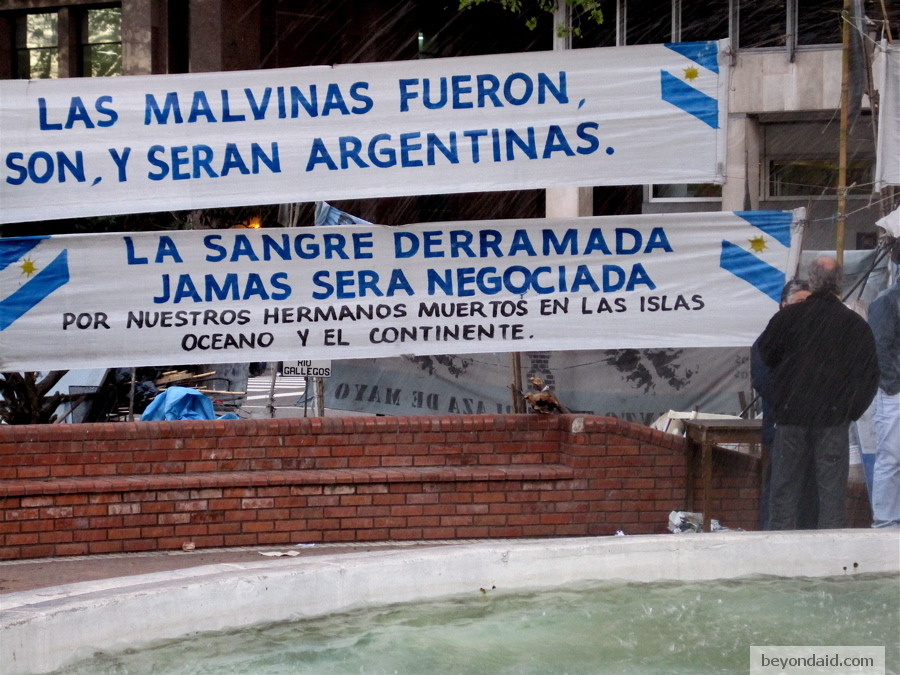
The Guardian reports on the escalating tensions between London and Buenos Aires that saw British Prime Minister David Cameron accuse Argentina of holding a “colonialist attitude” toward the Falkland Islands, a longtime British colony.
“Hector Timerman, [Argentina’s] foreign minister, described Britain as ‘a synonym for colonialism.’ He was quoted by Reuters as saying: ‘Evidently at a time when only scraps of colonialism linger, Great Britain … has decided to rewrite history.’ ”

The war within
Former US secretary of labour Robert Reich argues the current “crisis of capitalism” is the result of a lopsided conflict between consumers and investors on the one hand, and workers and citizens on the other.
“And since most of us occupy all four roles, the real crisis centres on the increasing efficiency by which we as consumers and investors can get great deals, and our declining capacity to be heard as workers and citizens.

As a result, consumers and investors are doing increasingly well but job insecurity is on the rise, inequality is widening, communities are becoming less stable and climate change is worsening. None of this is sustainable over the long term but no one has yet figured out a way to get capitalism back into balance. Blame global finance and worldwide corporations all you want. But save some of your blame for the insatiable consumers and investors inhabiting almost every one of us, who are entirely complicit.”

Irreconcilable differences
The Overseas Development Institute’s Claire Melamed argues the current consensus over bringing development and environment agendas closer together may be short-lived.
“But there is a danger to this approach – exemplified in the call for SDGs to also tackle ‘sustainable consumption and production patterns’.  This gets to the heart of what makes the whole issue of sustainability so politically toxic.  Sustainable consumption patterns would almost certainly mean some people on the planet consuming less so others could consume more.  Similarly on production – if developing countries are going to grow, and if technology doesn’t ride to the rescue, it’s at least possible that ‘sustainable’ might mean the rich world producing less.”

Immoral economy
Columbia University’s Jeffrey Sachs argues there are four ways in which self-interest, which is the very foundation of capitalism, “fails to support the common good.”
“Second, it can easily turn into unacceptable inequality. The reasons are legion: luck; aptitude; inheritance; winner-takes-all-markets; fraud; and perhaps most insidiously, the conversion of wealth into power, in order to gain even greater wealth.
Third, self-interest leaves future generations at the mercy of today’s generation. Environmental unsustainability is a gross inequality of wellbeing across generations rather than across social classes.”

Misguided journey
The University of Ottawa’s Nipa Banerjee gives a harsh assessment of the state of the international development industry in the wake of last month’s summit in Busan.
“The pre-Busan evaluations and Busan discussions clearly reflect a misguided journey of the Western-centric donors who are running the wheels of a self-serving aid industry. While some of the non-traditional non-Eurocentric donors, such as China, Brazil, and India, represented themselves in Busan, they took rather low-profile positions, with none officially joining the OECD’s Development Assistance Committee, in endorsement of the self-reproducing development support industries. Most of these new donors had once been roped into a monstrous global aid industry and well experienced the fruitlessness of spending time in delving into reams of paperwork, policy papers, development programming, and evaluations, nursing the illusions of effective aid.”

Multilateral failures
Writer James Denselow reviews a pair of new books on global revolution, including the latest by Carne Ross whom he describes as a former diplomat “transformed into a thinking man’s neo-anarchist.”
“The nation-state represents an archaic and ill-fitting answer to multifaceted non-localized issues, brought on by the pressures of globalisation and climate change. From flu-epidemics, to the spread of rioting, he carefully plots the ways in which our interconnectedness has led to problems which require global cooperation to solve. Yet the best efforts at multilateral cooperation have yet to deliver the answers. Ross parallels the enormous rhetoric of the 2005 G8’s promise to ‘make poverty history’ with the reality of its ‘utter failure’ to do so with a shortfall in pledges of $20 billion.”

Blue helmet blues
The Inter Press Service speaks to a number of experts about the evolving role of UN peacekeeping and the reputational hits such missions have taken in recent years.
“ ‘In the Congo, the U.N. is not exactly neutral, going after militias on behalf of the government,’ says Sean Maloney, a professor at the Royal Military College in Kingston Ontario.

Maloney told IPS the impartial style of peacekeeping as represented by Canadians serving as U.N. soldiers and keeping armed Greek and Turkish-speaking people at bay in Cyprus in the 1970s was rendered ‘obsolete’ starting in the 1990s.
‘We are going to see more interventions. They will be more coercion-style interventions (like the NATO mission in Afghanistan where Canada had upwards of 3,000 soldiers) that will be siding with one side or another,’ adds Maloney, describing himself as pro-military and ‘libertarian’.”