Latest Developments, January 23

In the latest news and analysis…

Spring cleaning
Human Rights Watch has released the latest edition of its “annual review of human rights practices around the globe” which this year has a special focus on the Arab Spring.
“The United States and some European allies could make an enormous contribution to ending torture in the Arab world by coming clean about their own records of complicity in torture as part of their fight against terrorism. Western governments should punish those responsible for ordering or facilitating torture and end the use of diplomatic assurances as a fig leaf to justify sending suspects to countries where they risk torture.”

Deadly mining protest
The Oaxaca Study Action Group reports that two people were shot, one of them fatally, in the course of a protest against a Canadian-owned mine in southern Mexico.
“San José del Progreso, located 50 km south of Oaxaca City, has been a flash point for violence since an alliance of local environmentalists and farmers occupied the gold and silver mine in early 2009. Despite widespread resistance and an ongoing conflict that already claimed the lives of two people in summer 2010, Fortuna Silver began commercial operation of the mine last September. As the installations are located in an arid valley, smooth operation is heavily dependent on water access to process the ore. The contamination of the scarce resource is among the main concerns of the mining opponents, many of whom grow vegetables for a living and rely on clean water for irrigation.”

Rubik on life support
The Tax Justice Network gleefully reports that Switzerland’s Rubik plan to preserve its famous banking secrecy is on the verge of collapsing as EU objections to Swiss tax deals with Britain and Germany intensify.
“TJN’s position is unambiguous: these deals are weak, immoral, and even silly – and they undermine international attempts to tackle tax evasion. Both Germany and Britain should swallow their pride, withdraw from the deals, and put their diplomatic effort into pushing through the EU’s enhanced Savings Tax Directive – suitably extended to Switzerland.”

Maximum wage
The Guardian’s George Monbiot calls for a nationwide UK maximum wage to rein in corporate executive pay, which he describes as “a form of institutionalised theft, arranged by a kleptocratic class for the benefit of its members.”
“I’m not talking about ratios or relative earnings. Various bodies have proposed that there should be a fixed ratio of the top earnings within a company to either the median or lowest salaries. But as a report on this issue by the New Economics Foundation shows, the first measurement quickly becomes complex and opaque, the second creates an incentive to contract out the lowest paid work. I’m talking about an absolute maximum, applied nationwide.”

Drones and America
The Brookings Institution’s Peter Singer looks at the impact that America’s increasing reliance on drone strikes is having on its own democracy, quite apart from any death and destruction caused in distant countries.
“We must now accept that technologies that remove humans from the battlefield, from unmanned systems like the Predator to cyberweapons like the Stuxnet computer worm, are becoming the new normal in war.
And like it or not, the new standard we’ve established for them is that presidents need to seek approval only for operations that send people into harm’s way — not for those that involve waging war by other means.
Without any actual political debate, we have set an enormous precedent, blurring the civilian and military roles in war and circumventing the Constitution’s mandate for authorizing it.”

Drones and Pakistan
News Pakistan reports on Pakistani cricketer turned politician Imran Khan’s take on the impact US drone strikes are having on the ground in his country.
“Imran Khan, the chief of the Pakistan Tehreek-e-Insaf (PTI), has urged the United States to stop drone strikes in Pakistan, claiming that they were killing many innocent people.
He observed that each bomb that killed terrorists also killed many people who might be related to the terrorists but were not involved in militancy.
In his view this collateral damage creates more Jihadis than it kills, he said this while interviewing with CNN.”

Proceed with caution
New York University’s Alex Evans and David Steven argue that despite growing enthusiasm for Sustainable Development Goals ahead of the Rio+20 summit, there is a lack of clarity regarding their contours and timeframe.
“The question of which countries would be covered by SDGs is a minefield. With any set of SDGs likely to be universal rather than applicable only to developing countries, major political challenges would arise. The MDGs demanded relatively little of OECD governments: all that was asked of them was aid, and relatively small amounts of it at that. A more comprehensive set of post-2015 Goals, on the other hand, would need to look ‘beyond aid’ – entailing changes to domestic policies in sensitive areas like migration, trade, intellectual property, or energy policy. The vexed issue of ‘common but differentiated responsibilities’ would certainly arise along the way – perhaps bedevilling post-2015 discussions as it already has the Doha round and the UNFCCC climate process (though an optimist might argue that a universal approach could help debate to move past the rigid and outdated typology of ‘developed’ and ‘developing’ countries).”

Migrant myths
The Observer’s Barbara Ellen writes that new statistics undermine traditional narratives about immigrants and “benefits tourism.”
“This could be a chance to start a new kind of immigration debate, one that doesn’t centre on: ‘What are they taking from us?’ Rather, it might ask: ‘What are they giving us?’ Even: ‘Do we expect too much, too soon, of migrants? Should we break the habit of a lifetime and get off their backs?’
For too long, there’s been a bizarre cultural climate of putting migrants under unfair pressure to perform instantly. It’s as if they’re expected to be supermen and women, breezily starting multinational companies the moment they arrive… in a foreign country, sometimes homeless, and with a new language to master.”
Latest Developments, January 18


In the latest news and analysis…

H-2 eligibility
The Associated Press reports that the US government has decided for the first time to include Haiti in a program that would allow some low-skilled workers to obtain temporary visas.
“U.S. Citizen and Immigration Services announced Tuesday that Haiti was among more than 55 countries eligible for the H-2A and H-2B visas.
Both Florida senators and six U.S. representatives from the state last month asked Secretary of State Hillary Rodham Clinton and Homeland Security Secretary Janet Napolitano to extend the visas to Haiti. The Florida delegation said money sent home by Haitians with those visas was vital to the Caribbean country’s ongoing efforts to recover from a catastrophic earthquake in 2010.”

The C word
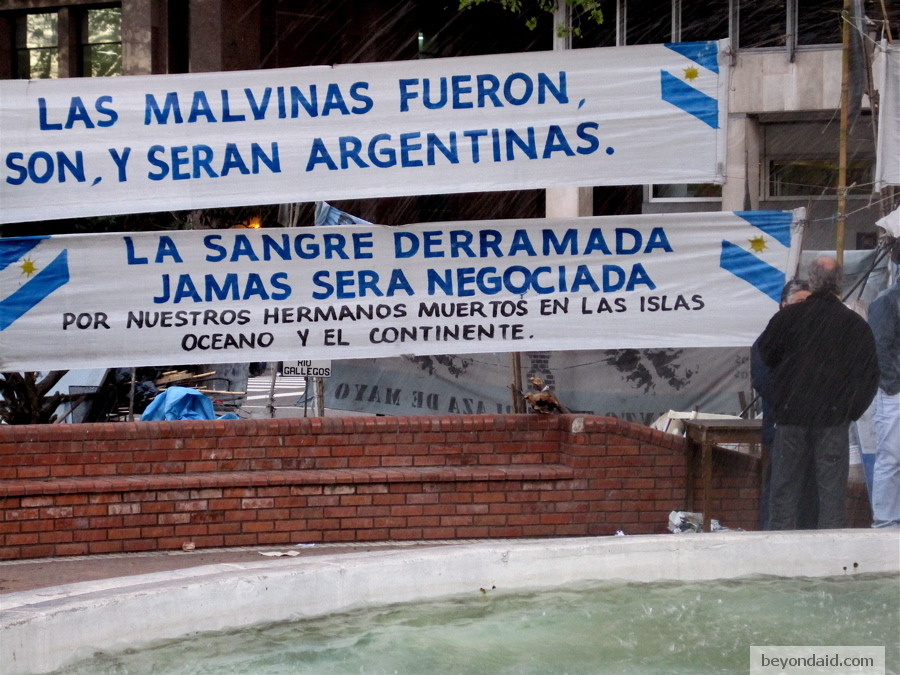
The Guardian reports on the escalating tensions between London and Buenos Aires that saw British Prime Minister David Cameron accuse Argentina of holding a “colonialist attitude” toward the Falkland Islands, a longtime British colony.
“Hector Timerman, [Argentina’s] foreign minister, described Britain as ‘a synonym for colonialism.’ He was quoted by Reuters as saying: ‘Evidently at a time when only scraps of colonialism linger, Great Britain … has decided to rewrite history.’ ”

The war within
Former US secretary of labour Robert Reich argues the current “crisis of capitalism” is the result of a lopsided conflict between consumers and investors on the one hand, and workers and citizens on the other.
“And since most of us occupy all four roles, the real crisis centres on the increasing efficiency by which we as consumers and investors can get great deals, and our declining capacity to be heard as workers and citizens.

As a result, consumers and investors are doing increasingly well but job insecurity is on the rise, inequality is widening, communities are becoming less stable and climate change is worsening. None of this is sustainable over the long term but no one has yet figured out a way to get capitalism back into balance. Blame global finance and worldwide corporations all you want. But save some of your blame for the insatiable consumers and investors inhabiting almost every one of us, who are entirely complicit.”

Irreconcilable differences
The Overseas Development Institute’s Claire Melamed argues the current consensus over bringing development and environment agendas closer together may be short-lived.
“But there is a danger to this approach – exemplified in the call for SDGs to also tackle ‘sustainable consumption and production patterns’.  This gets to the heart of what makes the whole issue of sustainability so politically toxic.  Sustainable consumption patterns would almost certainly mean some people on the planet consuming less so others could consume more.  Similarly on production – if developing countries are going to grow, and if technology doesn’t ride to the rescue, it’s at least possible that ‘sustainable’ might mean the rich world producing less.”

Immoral economy
Columbia University’s Jeffrey Sachs argues there are four ways in which self-interest, which is the very foundation of capitalism, “fails to support the common good.”
“Second, it can easily turn into unacceptable inequality. The reasons are legion: luck; aptitude; inheritance; winner-takes-all-markets; fraud; and perhaps most insidiously, the conversion of wealth into power, in order to gain even greater wealth.
Third, self-interest leaves future generations at the mercy of today’s generation. Environmental unsustainability is a gross inequality of wellbeing across generations rather than across social classes.”

Misguided journey
The University of Ottawa’s Nipa Banerjee gives a harsh assessment of the state of the international development industry in the wake of last month’s summit in Busan.
“The pre-Busan evaluations and Busan discussions clearly reflect a misguided journey of the Western-centric donors who are running the wheels of a self-serving aid industry. While some of the non-traditional non-Eurocentric donors, such as China, Brazil, and India, represented themselves in Busan, they took rather low-profile positions, with none officially joining the OECD’s Development Assistance Committee, in endorsement of the self-reproducing development support industries. Most of these new donors had once been roped into a monstrous global aid industry and well experienced the fruitlessness of spending time in delving into reams of paperwork, policy papers, development programming, and evaluations, nursing the illusions of effective aid.”

Multilateral failures
Writer James Denselow reviews a pair of new books on global revolution, including the latest by Carne Ross whom he describes as a former diplomat “transformed into a thinking man’s neo-anarchist.”
“The nation-state represents an archaic and ill-fitting answer to multifaceted non-localized issues, brought on by the pressures of globalisation and climate change. From flu-epidemics, to the spread of rioting, he carefully plots the ways in which our interconnectedness has led to problems which require global cooperation to solve. Yet the best efforts at multilateral cooperation have yet to deliver the answers. Ross parallels the enormous rhetoric of the 2005 G8’s promise to ‘make poverty history’ with the reality of its ‘utter failure’ to do so with a shortfall in pledges of $20 billion.”

Blue helmet blues
The Inter Press Service speaks to a number of experts about the evolving role of UN peacekeeping and the reputational hits such missions have taken in recent years.
“ ‘In the Congo, the U.N. is not exactly neutral, going after militias on behalf of the government,’ says Sean Maloney, a professor at the Royal Military College in Kingston Ontario.

Maloney told IPS the impartial style of peacekeeping as represented by Canadians serving as U.N. soldiers and keeping armed Greek and Turkish-speaking people at bay in Cyprus in the 1970s was rendered ‘obsolete’ starting in the 1990s.
‘We are going to see more interventions. They will be more coercion-style interventions (like the NATO mission in Afghanistan where Canada had upwards of 3,000 soldiers) that will be siding with one side or another,’ adds Maloney, describing himself as pro-military and ‘libertarian’.”

Latest Developments, January 11

In the latest news and analysis…

Rio+20 leak
The Guardian reports a leaked agenda for June’s Rio+20 conference suggests countries will be called upon to agree to 10 new sustainable development goals but overall, the meeting promises to be much less ambitious than the original earth summit.
“Unlike the 1992 earth summit when over 190 heads of state set in motion several legally binding environment agreements, leaders this time will not be asked to sign any document that would legally commit their countries to meeting any particular targets or timetables. Instead, they will be asked to set their own targets and work voluntarily towards establishing a global green economy which the UN believes will reduce poverty and slow consumption.”

Transforming governance
The Inter Press Service reports on growing calls for radical changes in global governance in order to address issues such as poverty and environmental destruction.
“ ‘We need to have a “constitutional moment” in world politics, akin to the major transformative shift in governance after 1945 that led to the establishment of the United Nations and numerous other international organisations,’ said Frank Biermann of VU University Amsterdam and director of the Earth System Governance Project.

Transforming international governance will be challenging since nation-states are almost entirely concerned with their own short-term interests, [Biermann] acknowledges. However, countries give up some of their power when they join the World Trade Organisation.
‘We ought to be able to do this for the protection of the planet and act as a community of nations,’ he said.”

Guardians of the future
The University of East Anglia’s Rupert Read argues that true democracy must take into account the interests of future generations, and to that end, he proposes the integration of  “guardians” into Britain’s existing parliamentary system.
“The members of this body would be selected by sortition, as is current practice for jury service, in order to ensure independence from present-day party political interests.
The Guardians would have a power of veto over legislation that were likely to have substantial negative effects for society in the future, the right to review major administrative decisions which substantially affected future people and the power to initiate legislation to preserve the basic needs and interests of future people.”

Immigration assistance
The Center for Global Development’s Michael Clemens argues the US, by tweaking its immigration policies, could provide significant assistance to earthquake-ravaged Haiti without spending any money or increasing the number of immigrants coming to its shores.
“First, the administration could reverse the current ban on Haitian participation in the U.S.’s largest employment-based visa program, the H-2 temporary low-skill work visa. All Haitians are currently ineligible to receive these visas. If even a few thousand Haitians at a time participated in that program over the next decade, it would generate more money for Haitian families than the entire U.S. infrastructure reconstruction allocation for Haiti. Fiscal cost: zero. It would even generate net positive U.S. tax revenue. Effect on Americans’ jobs: none. Removing the ban on Haiti would simply allow employers already seeking laborers to draw from Haiti instead of being limited to the 53 currently-eligible countries like Guatemala and Mexico.”

Acting together
Norwegian development and environment minister Erik Solheim argues “poverty is about politics” and its solutions lie beyond aid.
“As Norway’s minister for both the environment and development since 2007, I meet with other countries’ ministers with both portfolios, and it has come as a shock to see how the two groups lead such separate lives. Each has its own important agenda, its own analysis of the challenges ahead, its own strategic plans, and literally its own language. While each recognizes the importance of the other’s agenda, unless they talk and act together, neither group’s goals will be achieved.

We must be careful not to fool ourselves into believing that the MDGs can be achieved through development aid alone. The wider politics of poverty must be placed at the top of the international agenda, along with the three factors most critical to development: climate, conflict, and capital.”

Western corruption
Inuka Kenya Trust’s John Githongo argues rich countries have fallen behind their “developing” counterparts in terms of awareness of and mobilization against high-level corruption.
“We live in an increasingly multipolar world where graft is concerned. It’s the turn of the developing world to watch how the west handles fraud and corruption at the highest levels in their corporate and other sectors. I would like to argue that the organic youth-heavy movements in the west, such as Occupy Wall Street, are part of this shift, except the “c” word isn’t being used – yet. This is a pointer to what I predict the fight against corruption will look like in 2012.”

Social cohesion
Oxfam’s Duncan Green issues a “fuzzword alert” over social cohesion and critiques the treatment given to the term in a new Organisation for Economic Co-operation and Development report.
“Whenever a new idea becomes popular like this, the danger is that instead of looking afresh at what it contributes to our understanding of development, we just recycle our existing set of ideas and say ‘because of complexity/ social cohesion/ climate change, you should do exactly what we’ve being saying all along’. I think the OECD is in danger of going down that road in this report – building social capital, supporting social mobility, and promoting social inclusion are fine, but they were standard demands long before anyone started talking about cohesion. The more interesting question is what we should be doing that’s additional or different because of a social cohesion ‘lens’, and I didn’t find that here.”

Southeast Asian exceptionalism
Alpha International Consulting’s Seth Kaplan uses the example of Southeast Asia to question orthodox thinking on the prerequisites for economic development.
“Indonesia, for instance, reduced poverty from 60 percent in 1970 to 22 percent in 1984. Vietnam reduced it from 58 percent in 1993 to 14 percent in 2008.
Yet, the region does not meet the standard model for economic success, at least as defined by the World Bank and the rest of the Western development community. Governments have historically not been held in check by elections. Corruption is widespread. Governance has rated low on most indicators.”

Latest Developments, November 14

In the latest news and analysis…

Aid Transparency Index
Publish What You Fund has released its first Aid Transparency Index, in which the list of donor countries that performed ‘poorly’ includes the US, Canada, Australia, Germany, France, Spain, Italy, Japan and Norway.
“In the course of the research, a number of countries provided worrying examples of how poor reporting can distort perceptions of whether aid is well spent:
• Almost the only information available about one of France’s biggest aid beneficiaries, Cote d’Ivoire, related to a project commemorating 20 years of research into chimpanzees
• Greece provided no information about its current aid activities, but an annual report from 2009 included pictures of a half-built block of flats in Serbia as evidence of an ‘implemented project’
• Austria is the fourth biggest recipient of Austrian Development Agency aid according to the government’s database of ‘agreed contracts’”

Mining and inequality
Yao Graham of Third World Network-Africa argues booming profits for mining companies are not translating into comparable increases in revenues for the African countries in which they operate.
“The case of Zambia, for which copper makes up about 80 per cent of export earnings, is a good illustration of the asymmetry of power and benefits between mining companies on the one hand and African states on the other. Zambia levies a derisory 0.6 per cent royalty on copper in some cases.
In 2004, with copper prices averaging $2,868 US per tonne, it earned $8 million US in budget revenue from 400,000 tonnes of copper exported by foreign mining companies. This is a mere fraction of the $200 million US it earned in 1992, before privatization, from the same volume and similar price of copper. In the meantime, with the quadrupling of copper prices between 2002 and 2008, firms operating in Zambia such as the Canadian company First Quantum Minerals, have seen sharp jumps.”

Derailing Doha
The Fairtrade Foundation’s Aurelie Walker presents 10 pieces of evidence to support her contention that the World Trade Organization’s so-called Doha Development Round of negotiations has seen the marginalization of the very countries it was supposed to help.
“The WTO has failed to live up to its promises over the past decade, which reveals a wider systemic problem in the global community. True and lasting solutions to global economic problems can only come when the model of global competitiveness between countries becomes one of genuine cooperation.”

Planetary patriotism
California State University, Sacramento’s Angus Wright discusses the obstacles and necessary conditions to addressing global environmental challenges.
“The secret we seek is what inspires humans to act positively and creatively in the face of huge challenges. As humanity faces the environmental crisis, this is its greatest challenge: How do we elicit the kind of collective and individual action and creativity that will be needed?
I think previous experience implies that it cannot be fear alone, nor opportunity alone, nor persuasion alone, nor organisation alone, but a blend of these elements, with much else. We have been able to lump these things together successfully in the past in something called patriotism – a powerful force for good and ill – and now we need something like a planetary patriotism. But no planetary patriotism can be built without acknowledging and dealing with the major things that divide us as well as the challenge that must unite us. Putting on a happy face won’t cut it.”

Sustainable Development Goals
The Overseas Development Institute’s Claire Melamed argues that truly sustainable development will require more than simply coming up with eco-focused counterparts to the Millennium Development Goals.
“If economic growth is to be truly green, developing countries will need to leapfrog over much of our recent history of technological development and have immediate access to the kind of shiny new technologies that are still prohibitively expensive in much of the rich world.
This is possible – with dramatic changes to intellectual property laws, and with the kind of subsidies that until now have been reserved exclusively for the wealthiest farmers.  Neither are particularly likely, and this is just a taster of the huge changes in policy in almost every country if ‘sustainable development’ is to become a reality. We might even have to broach the subject of how more growth in one country might mean less in another.”

Seeming green
The Copenhagen Consensus Center’s Bjørn Lomborg argues political rhetoric about greening economies does not correspond to what is currently feasible in the real world.
“Danish politicians – like politicians elsewhere – claim that a green economy will cost nothing, or may even be a source of new growth. Unfortunately, this is not true. Globally, there is a clear correlation between higher growth rates and higher CO2 emissions. Furthermore, nearly every green energy source is still more expensive than fossil fuels, even when calculating pollution costs.”

Drones and literature
Reuters’ Myra MacDonald argues a recent short story about drone strikes in Pakistan is illustrative of a narrative she considers both problematic and increasingly important.
“We will return to the short story later, but first step back a bit and consider that the narrative gaining traction, at least in urban Punjab, is that the people of the tribal areas have been radicalised by American drone attacks.  Pakistan’s rising political star, Imran Khan, attracted tens of thousands to a rally in Lahore last month with a version of this narrative. Stop the drones, and the Tehrik-e-Taliban Pakistan (TTP), or Pakistani Taliban, can be engaged in peace talks to end a wave of bombings across Pakistan.”

Philanthropy and facts
In his overview of current trends in philanthropy, Oxfam’s Duncan Green suggests the Arab Spring and networks are hot, while the State and analysis are not at the ongoing Bellagio Initiative Summit.
“I don’t attend many discussions where I find myself wishing for fewer stories, and more analysis, but this was one of them – more NGO than the NGOs when it comes to substituting heart-warming anecdotes for academic rigour.”