Latest Developments, May 16

In the latest news and analysis…

State of the planet
Agence France-Presse summarizes the World Wildlife Federation’s new Living Planet Report, which says high-income countries have five times the ecological footprint of their poorer counterparts.
“The survey, compiled every two years, reported an average 30 percent decrease in biodiversity since 1970, rising to 60 percent in the hardest-hit tropical regions.

The decline has been most rapid in lower income countries, ‘demonstrating how the poorest and most vulnerable nations are subsidising the lifestyles of wealthier countries,’ said WWF.”

Libyan deaths
Human Rights Watch has released a new report about the 72 civilian deaths it says were caused by NATO strikes in Libya last year.
“The number of civilian deaths from NATO air strikes in Libya was low given the extent of the bombing and duration of the campaign, Human Rights Watch said. Nevertheless, the absence of a clear military target at seven of the eight sites Human Rights Watch visited raises concerns of possible laws-of-war violations that should be investigated.

NATO asserts that it cannot conduct post-operation investigations into civilian casualties in Libya because it has no mandate to operate on the ground. But NATO has not requested permission from Libya’s transitional government to look into the incidents of civilian deaths and should promptly do so, Human Rights Watch said.
‘The overall care NATO took in the campaign is undermined by its refusal to examine the dozens of civilian deaths,’ [HRW’s Fred] Abrahams said.”

Corporate power
The Guardian reports on a legal dispute between a UK hedge fund and an Indian state-controlled coal company, which has some observers asking if the “terms of trade and investment are skewed” in a way that harms poor countries and poor people.
“ ‘What this case really illustrates is how far global trade and investment rules have gone in increasing the power and influence of companies,’ said Ruth Bergan, co-ordinator for the Trade Justice Movement. ‘Under bilateral investment treaties, companies have been given the right to sue states, not in national courts, whether in host or home countries, but in international arbitration centres, based at the International Chamber of Commerce, the World Bank, and a handful of other often highly secretive centres.’ ”

Terror double-standard
The Atlantic’s John Hudson suggests US ambivalence toward assassinations of Iranian nuclear scientists is evidence of America’s “flexible definition” of terrorism.
“The Obama administration is moving to delist an Iranian dissident group from the State Department terrorism list, which, as recently as January, reportedly detonated a magnetic bomb under the car of an Iranian scientist. Perhaps unintentionally, the message the move would send appears to be: This activity is OK as long as it’s against Iran.”

Rio+20 deadlock
Inter Press Service reports that two weeks of preparatory talks for next month’s Rio+20 summit have “failed to reach consensus on a global plan of action.”
“ ‘Let us be frank,’ the [UN Conference on Sustainable Development] secretary general Sha Zukang said, ‘the negotiating text is a far cry from the focused political document called for by the general assembly.’ Zukang said the objective should be to arrive in Rio ‘with at least 90% of the text ready, and only the most difficult 10% left to be negotiated there at the highest political levels’.
However, a statement released by a coalition of international NGOs warned that Rio+20 ‘looks set to add almost nothing to global efforts to deliver sustainable development’. ‘Too many governments are using or allowing the talks to undermine established human rights and agreed principles such as equity, precaution and polluter pays,’ it said.”

Western gender problems
UC Santa Barbara’s Hilal Elver argues that a recent Foreign Policy issue on the plight of women around the world failed to acknowledge that gender equality does not exist in Western countries either.
“Anthropologists use the term ‘native informants’ to identify the witness of insiders. Giving a platform to Muslim women writers critical of Islam has also become a very popular tactic in Europe. These commentators claim to speak from bitter experience about how Islam is bad for women. This makes the European public feel comfortable when they adopt public policies against Islamic practices.

FP only pointed to the United States as a good example, how Secretary of State Hillary Clinton works on women’s issues while shaping US foreign policy. I am sure she has many things to say about the United States, if FP would ask, about the relevance of her gender to her unsuccessful presidential campaign. But, this is not what readers seem to care about. It would have been much more impressive and acceptable if such critical issues were presented not only for selected adversary countries and cultures, and if there was not exhibited such bias and partisanship.”

Show trial
The University of Ottawa’s Peter Showler writes about the lack of “sincerity” during a parliamentary investigation into the Canadian government’s proposed changes to national refugee laws.
“[The proceedings] became more show trial than law making. The witnesses called by the Conservatives repeated their versions of the government storyline: Canada is inundated with bogus refugees; we need fast decisions to get rid of the fraudulent claimants; they come here for welfare, not protection; putting smuggled passengers in prison for a year is the only way to stop the smugglers who are evil. The Conservative members rarely asked real questions of their witnesses. They repeated the government litanies about Canada’s generosity and burdens on the Canadian taxpayer followed by ‘would you agree?’

There is an awful, disembodied sensation in watching a show trial. It is the sensation of observing a slow-motion accident through a plate-glass window. Something horrible and inevitable is happening and there is nothing you can do to stop it. You realize the outcome has been decided already. The proceedings became a theatre piece where everyone played their part.”
Latest Developments, March 27

In the latest news and analysis…

Red Cross hotel
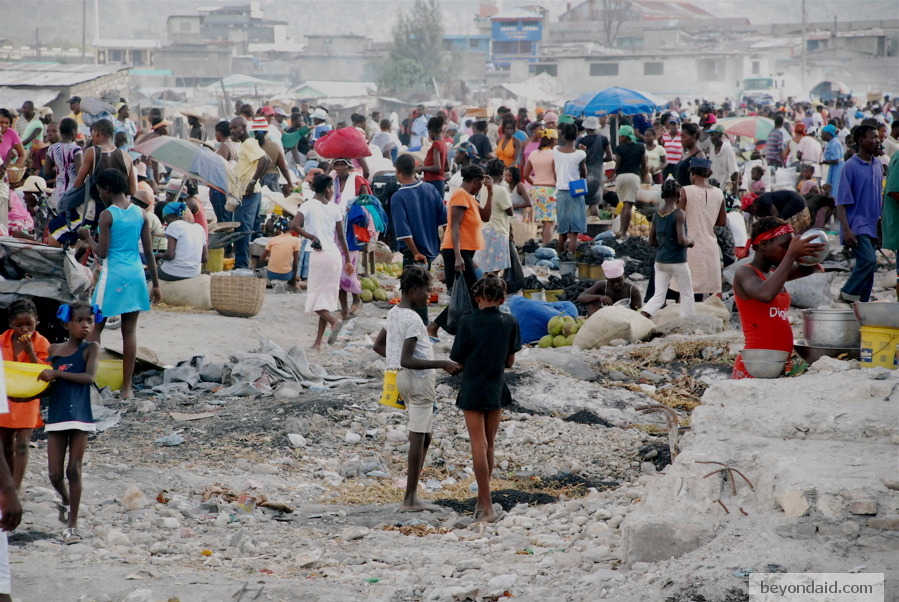
The Center for Economic and Policy Research questions Red Cross priorities as the humanitarian organization considers building a luxury hotel and conference center on Port-au-Prince land it bought with Haiti earthquake relief funds.
“Considering the hundreds of people who have recently been forcibly evicted – with some recently having been burned out of their camps in suspicious arsons – couldn’t this be space that the Red Cross could offer them, rather than using it for a commercial venture that might not even be viable?
The Red Cross’ post-quake spending and use of funds, as the largest NGO operating in Haiti, has been controversial almost since the beginning. News that some ‘funds donated by national Red Cross agencies for quake recovery’ – much of which almost certainly came from individuals who believed their money would be used for emergency relief – might instead be used for a risky commercial venture (and one that caters to NGO’s and tourists) could provoke more controversy.”

Mosque outreach
The American Civil Liberties Union reports it has obtained documents indicating the FBI used a “mosque outreach” program to gather intelligence on American Muslim groups and their members “without any suspicion of wrongdoing.”
“The documents also show that the FBI categorized information about American Muslims’ First Amendment-protected and other entirely innocuous activities, as well as mosque locations, as ‘positive intelligence’ and disseminated it to agencies outside the FBI. As a result, the agency wrongly and unfairly cast a cloud of suspicion over innocent groups and individuals based on their religious beliefs and associations, and placed them at risk of greater law enforcement scrutiny as potential national security threats. None of the documents indicate that the FBI told individuals interviewed that their information and views were being collected as intelligence and would be recorded and disseminated.”

Suspicious skin
The Global Post reports a German court has ruled that certain police can use the colour of a person’s skin as justification for demanding to see identification.
“However, judges ruled that skin color was reasonable grounds on which to carry out ID checks, since the train route in question is often used by illegal immigrants to enter Germany. Since police cannot check every passenger’s papers, they must select which people to ID based on their ‘border policing experience,’ the judgment said.
The officers are therefore allowed to make their choice ‘according to external appearance’ and without concrete grounds for suspicion, Agence France Presse reported.”

Drug talk
Former Mexican foreign minister Jorge Castañeda writes that the “failed war on drugs” will loom large in discussions at next month’s Summit of the Americas in Colombia.
“Recently inaugurated Guatemalan President Otto Pérez Molina, together with [Colombian President Juan Manuel] Santos and other heads of state, question today’s punitive, prohibitionist approach, owing to its enormous costs and meager results, and propose a different strategy: legalization.
Obama sent Vice President Joe Biden to Mexico and Central America a few weeks ago to forestall this trend, and he may have partly succeeded. Nevertheless, whereas only a smattering of political leaders and intellectuals advocated legalization in the past, nowadays officials are coming ‘out of the closet’ on drugs in droves. Those who used to say that they favored a debate on the issue now support legalization; those who opposed it now accept the need for debate; and those who continue to oppose legalization do so on moral, rather than rational, grounds.”

Crying foul
UN special rapporteur on the right to food, Olivier De Schutter, argues the international community must look at the big picture and get serious about accountability if sustainable development is to become a reality.
“What are framed as development policies often end up doing very little to help the most marginalised communities, and sometimes end up harming them. Meanwhile, the effects of genuine development policies can easily be overridden by industrial and infrastructural projects, trade agreements, and other external factors that tip the balance against small-scale farmers and fishers. It is therefore essential to be able to cry foul when missing policies, misguided policies, or the sum total of policies, work against sustainable development.”

Talk is cheap
Inter Press Service reports on a group of legal experts who are looking to hold world leaders to the promises they make at June’s Rio+20 sustainable development summit.
“ ‘We are really tired of declarations,’ Antonio Herman Benjamin, judge of the Supreme Court of Brazil, told an international gathering of legal experts here Monday. Despite some progress made since the 1992 Earth Summit held in Rio de Janeiro, Brazil, most governments have failed to fulfil their obligations.
As a result, the court has launched a new initiative to promote role of law in advancing sustainable development. It is known as the World Congress on Justice, Governance and Law for Environmental Stability.
The Congress’s scores of members from around the world include senior judges, prosecutors, legal scholars, auditors and development experts. They plan to focus on the problems and obstacles that hinder the implementation of multilateral environmental agreements.”

Immigration detention
Author Edwige Danticat writes in the New York Times that new US immigration guidelines recommend the bare minimum of human rights for detainees, more than 110 of whom have died in custody since 2003.
“The new [Immigration and Customs Enforcement] guidelines are not perfect. They do not offer, for example, alternatives to jail-like detention, even for unaccompanied minors, the elderly, the disabled or pregnant women. But they are a step forward. In addition to medical care, safe water and limited recreation, they also require that staff members not perform strip searches on detainees of the opposite sex and that detainees not be used for medical experiments or for clinical trials without informed consent. They will crack down on sexual assault by staff members, contract personnel or other detainees and suggest that victims of sexual abuse be given access to emergency medical treatment.”

Good intentions
Northeastern University’s Aziza Ahmed argues we must “interrogate the consequences of advocacy efforts,” however noble the cause may appear.
“First, anti-sex trafficking activism has an extremely negative impact on HIV programs. Sex workers are highly vulnerable to contracting HIV. A key victory for anti-sex trafficking organizations was the insertion of the anti-prostitution loyalty oath (APLO) into the US Leadership Act for HIV/Aids, TB, and malaria. This provision requires that organizations agree to oppose prostitution and sex trafficking. The APLO has the effect of disempowering sex worker organizations who refuse to sign on, shutting health services for sex workers, and alienating sex workers from public health programs.”

Latest Developments, February 22

In the latest news and analysis…

Somalia strikes
The Bureau of Investigative Journalism estimates US military strikes have killed up to 162 people, including as many as 59 civilians, in Somalia since 2007.
“The total number of casualties may be higher.  Some reports simply state ‘many killed’, and other attacks may be unrecorded.

Though the Bureau has striven to untangle confused reporting of western military activity in Somalia, much remains opaque – something the US seems keen to see continue.”

Indigenous walkout
Intellectual Property Watch reports that the International Indigenous Forum has withdrawn from UN talks on rights governing genetic resources and traditional knowledge, a move that “calls into question the legitimacy of the negotiations.”
“As the ‘titleholders, proprietors and ancestral owners of traditional knowledge that is inalienable, nonforfeitable and inherent to the genetic resources that we have conserved and utilized in a sustainable manner within our territories,’ the group feels that ‘the discussion on intellectual property rights and genetic resources should include Indigenous Peoples on equal terms with the States since the work will directly impact our lives, our lands, our territories and resources.’
As a consequence, they said they decided ‘unanimously, to withdraw our active participation in the work developed by this Committee until the States change the rules of procedure to permit our full and equitable participation at all levels of the IGC.’
Under the current rules of procedures, Indigenous Peoples have observer status at the IGC. They can make proposals to the negotiations but those proposals have to be endorsed by at least one delegation to be taken into account.”

Rejecting consensus
Former French prime minister Michel Rocard argues the unrealistic quest for consensus is condemning international negotiations to failure and June’s Rio+20 summit will likely be no exception.
“Of course, there is a chance that the world will recognize its quandary at Rio. If a majority of the countries present dares to declare that demanding consensus is equivalent to enforcing paralysis, and if they insist upon following the voting procedures enshrined in the UN Charter, we could see enormous progress.
Global warming and economic crisis are threatening international security. This alone justifies referring these issues to the UN General Assembly, which, unlike the Security Council, knows no veto power. A strong declaration and a call for binding measures to address these issues would then be possible.”

Unfair fight
Agence France-Presse reports most victims of corporate abuses in Nigeria lack the resources to obtain restitution.
“In October, a Nigerian tribal king filed a lawsuit in a US court on behalf of his people against oil giant Shell, seeking $1 billion in compensation for extensive pollution that sickened the population and damaged their lands.
The plaintiffs said they decided to file the suit in a US court because of Shell’s history of a ‘culture of impunity’ and ‘disregard’ for the Nigerian judicial process.
They note that the Shell has refused to comply with a 2005 order to end gas flaring in the Iwherekan community or to pay a 2006 judgment to pay $1.5 billion to the Ijaw Aborigines for damages caused by decades of pollution.”

Too big to jail
Former IMF chief economist Simon Johnson argues American banks will continue to engage in “fundamental and systemic breaches of the rule of law” until their top executives face real penalties for such behaviour.
“Top bankers want to make a lot of money. They also want to stay out of prison. Political leaders can huff and puff as much as they want, but, without a credible threat of poverty and time behind bars, bankers have no reason to comply with the law.”

War machine
Al Jazeera’s Marwan Bishara writes about the damage caused by “the militarisation of the Arab Spring in Libya” and the sense of inevitability that led up to it.
“In late 2010, France and Britain decided to stage a war game titled Operation: Southern Mistral. It would involve thousands of military personnel and hardware from both countries. The scenario envisioned the two longtime military rivals joining forces for a bombing campaign against an imaginary southern dictator. The simulated war was condoned by a fictitious UN Security Council resolution and was scheduled to begin on March 21 of 2011. Well, the actual bombing of Libya began on March 19. This is surely a coincidence. But it does highlight the French and British mindsets and why no serious diplomatic effort got off the ground. The bombers were already on the runway.”

Immigration doublespeak
CNN.com’s LZ Granderson argues the American discourse around “securing the border” is really about something quite different from homeland defense.
“[National security]’s a part, but the larger truth is that nonwhite people will be the majority in this country by 2040 and this browning of America scares the hell out of a lot of people, particularly some white people. The thinking goes that if the country can deport the Mexicans who are illegally here and stop new ones from coming in, maybe that trend will slow down or even reverse.
That sentiment is at the core of the racial profiling laws started in Arizona and is at the core of the entire illegal immigration conversation. It’s a clumsy attempt to talk about race without mentioning race so as not to appear racist.
But the dialogue is transparent because if it was really about ‘securing the border,’ the facts suggest Canada would be a big part of the conversation and not just an afterthought.”

Interventionary diplomacy
Princeton University’s Richard Falk argues that a group foreigners currently being detained in Egypt do not work for “genuine NGOs” but rather, “informal government organisations” that are “overtly political.”
“In the end, Egypt, along with other countries, is likely to be far better off if it prohibits US IGOs from operating freely within its national territorial space, especially if their supposed mandate is to promote democracy as defined and funded by Washington. This is not to say that Egyptians would not be far better off if the [Supreme Council of the Armed Forces] allowed civilian rule to emerge in the country and acted in a manner respectful of human rights and democratic values.”

Latest Developments, February 21

In the latest news and analysis…

Perpetual growth
The Guardian reports on a new UN-commissioned study that argues the international community needs to take “dramatic action” if it wants to “avert a collapse of civilisation.”
“ ‘The rapidly deteriorating biophysical situation is more than bad enough, but it is barely recognised by a global society infected by the irrational belief that physical economies can grow forever and disregarding the facts that the rich in developed and developing countries get richer and the poor are left behind.
‘The perpetual growth myth … promotes the impossible idea that indiscriminate economic growth is the cure for all the world’s problems, while it is actually the disease that is at the root cause of our unsustainable global practices’, [the authors] say.”

Plundering Somalia
Inter Press Service reports on a new paper criticizing international policy towards Somalia, with one of the authors suggesting this week’s London summit on the country’s future “seeks mainly to rally public opinion around more violence, more intervention, and more counterterrorism options” rather than promoting a holistic approach to problem solving.
“[Global Policy Forum’s James] Paul said the violence-prone naval approach [to halting piracy] has not worked, because it ignores the illegal foreign fishing and toxic waste dumping that is taking place off the Somali coast.
The fishing and dumping provokes the piracy and has led ordinary Somalis to approve the piracy as a legitimate form of national defence.
But powerful members of the Security Council, notably the U.S. and the UK, have blocked any action on fishing and dumping.
‘They pretend that there is no information about the matter, even while their naval fleets are closely monitoring the movement of all ships in Somali waters,’ Paul said. ‘So much for root causes and holistic approaches. Violence is virtually the only option allowed onto the table in London.’ ”

UN responsibility
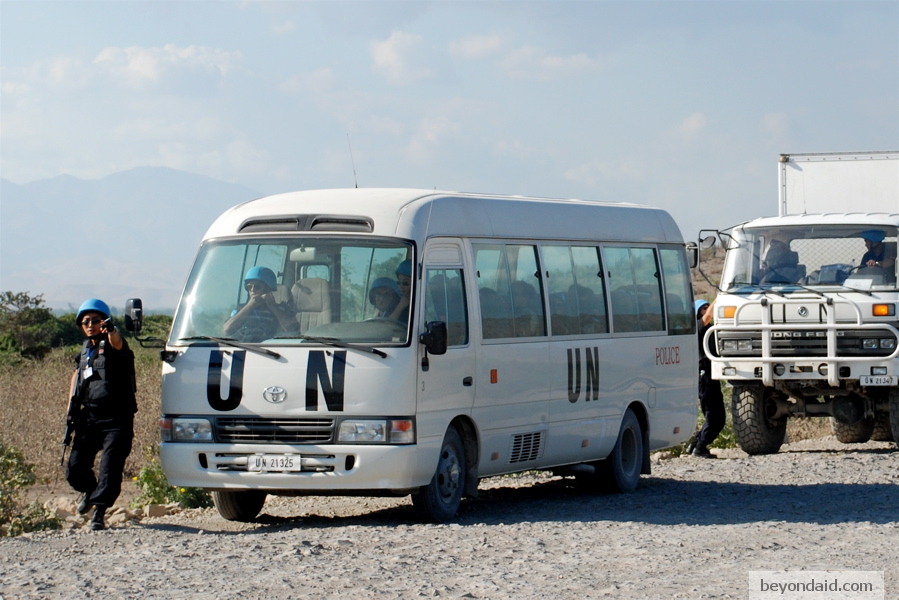
The New Media Advocacy Project’s Abby Goldberg writes about a legal petition that calls on the UN peacekeeping mission in Haiti to compensate and apologize to victims of a deadly cholera outbreak thought to have been caused by UN personnel.
“If the petition is successful, it will be the first case in history in which the UN takes legal responsibility for harm caused by their personnel.

The UN must consider the legal request and how to respond, not only for Haitians, but also for the success of peacekeeping operations globally. This case is about Haiti, but it is also about the UN and a changing world. As one of the lawyers who filed the case said, ‘there is a difference between immunity and impunity. Impunity cannot be tolerated.’ The UN can, and must, do better.”

Emission friction
Oxfam’s Duncan Green is baffled by widespread international opposition to the EU’s plan to charge airlines flying in and out of Europe for their carbon emissions, given that three-quarters of the greenhouse gases taxed would come from European and American carriers.
“The main objection to the EU’s policy is that it applies to air-miles clocked up outside European airspace. But the vast majority of emissions captured by the EU [Emission Trading Scheme] scope are from EU and US operators.  By implication, if India and others genuinely want developed countries to act to cut GHG emissions it would seem against their own interest to try to block the EU ETS, because obviously the EU would never apply it just to its own carriers – so if they were to be successful they’d also prevent us doing something about the large majority of emissions from EU/US carriers.”

Re-inventing the World Bank
Former World Bank executive Ana Palacio says the debate over the US monopoly on the institution’s presidency is “legitimate,” but thinks the organization requires far more significant reforms.
“Just as reconstruction finance gave way to development lending over the course of the Bank’s history, its current focus on banking operations should be reconsidered, as the organization’s main source of added value now lies in its formidable potential as a center of knowledge and a coordinator of international policies.

Today, the international community should look for a World Bank president who is attuned to ordinary people’s growing refusal to tolerate glaring global inequalities, and who understands that development is more than GDP growth. Such a leader, regardless of his or her country of origin, will reinvent the World Bank for the century ahead.”

Universal energy
The Steps Centre’s Rob Byrne and Jim Watson highlight the argument that the world’s poor should not be required to take a low-carbon approach to achieving universal energy access.
“[Practical Action’s Teodoro] Sanchez estimates that half the world’s energy-poor could switch to cooking on sustainable biomass and half to liquefied petroleum gas. Furthermore, half could access electricity from diesel generators while the other half do so from renewable sources. If these plans were implemented, he argues, the increase in global CO2 emissions would be less than 2% above 2005 levels.
If the world takes climate change seriously, this increase could easily be absorbed by cuts in industrialised country emissions and further action to slow emissions growth in the rapidly developing countries (especially China). The cost of this up to 2030 would be about $570bn (including capacity building and institutional costs); less than 3% of the estimated global energy investments needed during the same period.”

Questioning development
And, finally, a piece from last week by the Latin American Center of Social Ecology’s Eduardo Gudynas who argues sustainability will require a profound questioning of the concept of development and a recognition of the rights of nature. 
“The social and environmental crisis is so serious that it is now time to put aside minor adjustments and reforms, and instead address the root causes of resistance to the idea of development. We must adopt an approach whereby the term ‘sustainable development’ no longer requires the suffix ‘development’. The civil society programme in Rio+20 should not focus simply on fixing the superficial problems of development: it is necessary to look for alternatives to the entire body of ideas about development.

If sustainable development strengthens its demands for change, it must abandon the traditional idea of development and thus break with the anthropocentric ethics that are characteristic of Western cultural tradition.”

Latest Developments, February 9

In the latest news and analysis…

Accountability deficit
The School of Oriental and African Studies’ Michael Jennings argues there are few consequences for international NGOs that fail to deliver on their humanitarian promises or, in some cases, do actual harm to the people they have pledged to help.
“The question of accountability has often looked to how NGOs answer to donors or to the national governments of countries in which they are operating. From a financial or legal perspective, this makes perfect sense. NGOs should account for the money they spend as contracted agents of donors. And they should, of course, be working within the parameters of national regulatory frameworks and laws (although the fact that NGOs themselves often sit on the committees that draw up such regulatory systems is troubling).

The best NGOs do think about how they can be accountable to the communities and individuals with whom they work. But the issue is too important to be left to self-regulation. Development interventions involve change, and change can result in profoundly negative outcomes for some or many. Unintended as these negative consequences may be, those affected should be afforded a better means to hold to account development actors.”

Mining profits
Bench Marks Foundation’s John Capel writes that calls for increased investment in Africa rarely incorporate a discussion of “how this investment should be undertaken,” a shortcoming the Alternative Mining Indaba seeks to rectify.
“We believe there is a role for independent monitoring and evaluation and a role for community monitoring to hold mining corporations accountable.
But to do so we need independent funds to capacitate communities to engage with mining houses on a level playing field. To back this up we need an independent grievance mechanism, independent of the company, supported by an independent fund contributed to by mining corporations. It must be quick and easy to use, bring redress, be able to hold corporations accountable and must address any adverse impacts on communities.”

Arms control
The Inter Press Service reports on the continuing campaign for stricter controls on international weapons sales ahead of next week’s pre-negotiation meeting regarding the Arms Trade Treaty which is supposed to be finalized later this year.
“ ‘There is more control on the selling of bananas than there is on conventional arms,’ said Zobel Behalal, peace and conflicts advocacy officer for CCFD-Terre Solidare, a French-based Catholic NGO.
‘For us, this is a true scandal because states can do what they want without taking into account the impact on civilian populations,’ he told IPS.”

Immunity lost
Agence France-Presse reports Iraqi officials want to rein in private security contractors whose large number “negatively impacts the security situation in the country.”
“The firms ‘have to understand that … they don’t have free (movement) in the country. They have to follow the instruction, they have to hold the permit, a valid permit, and they are not allowed to violate the Iraqi laws.’
‘They are not exempted as before, and they are not getting any sort of immunity,’ [government spokesman Ali al-Dabbagh] said.
‘We do need them, definitely, we do need them, (and) we are not going to stop them, but definitely, we will limit their work,’ Dabbagh said.”

Living wage
The Phnom Penh Post reports on a push to quadruple the wages of Cambodian garment workers.
“[Asia Floor Wage] coordinator Anannya Bhattacharjee said the $281 calculation was based on a worker’s monthly nutritional needs according to figures obtained from governments and international institutions.
She added that such an increase would rely to some extent on clothing brands and retailers paying more for the finished product.
‘There is enough money in the global supply chain for brands to pay Cambodian manufacturers enough so that garment workers can earn that,’ she said.”

Down the toilet
A new World Wildlife Fund report suggests American consumers are contributing to the destruction of Indonesia’s rain forests by buying certain brands of toilet paper.
“In recent years, APP has greatly expanded into the U.S. tissue market, including through Paseo and Livi tissue products. Oasis Brands, which markets Paseo, announced in 2011 that Paseo had become the fastest-growing brand of toilet paper in the U.S.  Paseo and Livi are also marketed as ‘away-from-home’ products used in public restrooms in restaurants, office buildings, schools and hotels.”

Universal joy
The Center for Global Development’s Charles Kenny responds to Japanese calls to make happiness one of the Rio+20 Sustainable Development Goals with a more American plea to focus on the “right to pursue happiness.”
“Most differences in life satisfaction poll answers are due to inherited characteristics, while less than 3 percent can be explained by socioeconomic status, education, income, marital status, and religious commitment combined.  As I suggest in this CGD Essay, for a society to maximize average happiness poll answers, its most effective course would probably be to put everyone on an antidepressant-ecstasy cocktail and (given the strong genetic component of happiness poll answers) add in chemical sterilization for the naturally unhappy.  Is that really what we want out of a new round of Millennium Development Goals?”

Geography of trade
Drew University’s Fred Curtis and Rutgers’s David Ehrenfeld argue the end of globalization – or at least its considerable reduction – is nigh but they see as many opportunities as problems in the inevitable transition to more localized life.
“It is now critical for economic planners, laypersons and governments to recognise that long-term energy and climate realities will impose limits on the global movement of goods. Trade pacts, like the US-Korea Free Trade Agreement, and business models, like Walmart with its transoceanic supply chains, will make less sense as the foundations of global trade are undermined. This is not the result of either ideology or policy. Only when we accept these realities can we design and rebuild less vulnerable patterns of production and trade throughout the world. Nearly every country has existing examples of sound, regional development that can be used as models.”