
Latest Developments, March 8

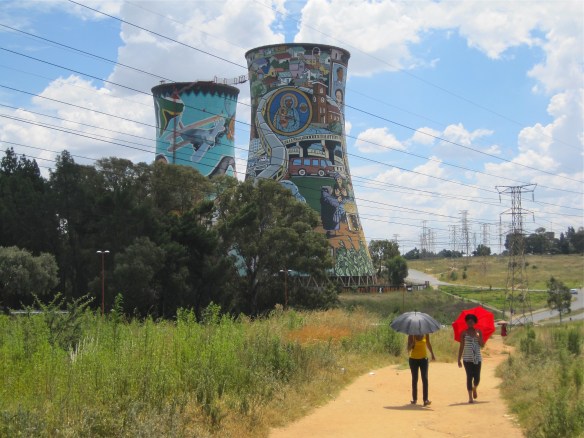
Parasols

In the latest news and analysis…

Working women
To mark International Women’s Day, the Globe and Mail highlights countries, including a number of African ones, that are leaders in certain areas of gender equality:

“Egypt, where the World Economic Forum says the gender wage gap is 18 cents – so women can expect to earn 82 cents for every dollar a man gets.
(Canadian women, by comparison, can expect to earn about 73 cents, placing us 35th in the ranking.)

Rwanda. In the African country, as of February, women held 45 of the 80 seats in Parliament. By comparison, in Canada, which ranks 45th in the Inter-Parliamentary Union study, men outnumber women in Parliament by a ratio of 3 to 1.

Burundi. According the World Economic Forum, 92 per cent of female citizens in Burundi have paid work – compared with 88 per cent of men.”

Notable abstention
Inter Press Service reports that the US has opted not to vote on whether or not the World Bank should help fund a controversial mining mega-project in Mongolia:

“In abstaining, the U.S. representative cited concerns over the potential environmental consequences and an inadequate impact study of the mine plan.
The Oyu Tolgoi mine, a 12-billion-dollar project, is looking to massively expand copper-and-gold extraction in the South Gobi Desert. Its parent company, the London-based Rio Tinto, is currently fielding funding proposals from multiple international investors, including the World Bank Group.”

Democracy’s price
The Canadian Press reports that Export Development Canada, a government-owned entity that provides political risk insurance to its corporate clients, may ask the people of Arab Spring countries to compensate Canadian companies for business disruptions resulting from the overthrow of dictators:

“A number of Canadian companies, including oil firm Suncor Energy and SNC-Lavalin, the engineering firm, operate in the Middle East, but the EDC would not name the countries involved or the firms who made claims.

[EDC’s Ken] Kember said paying out claims does not end the story for the EDC, adding the agency often attempts to reclaim losses from the governments involved.

Much-needed debate
Now that “the architect of Barack Obama’s aggressive drone policy” has cleared the last hurdle to becoming the new head of the CIA, Time’s Michael Crowley considers what good came out of the confirmation process:

“The focus on the extremely narrow question of targeting American citizens may have been misplaced. But good questions were raised along the way about expanded presidential power, the drawbacks of heavy reliance on drones, and whether it’s time to reassess the basic legal framework governing the war against al Qaeda, its allies, and other terrorist groups.”

April-ish troop withdrawal
Reuters reports that a day after French President Francois Hollande set a new date for his country to begin withdrawing troops from Mali, Defense Minister Jean-Yves Le Drian spoke of a more fluid timeline on a visit to the West African nation:

“ ‘We are in the last phase, the most decisive phase,’ Le Drian said. ‘This phase entails some very violent combat. When the liberation of the whole country is complete, then we will hand over responsibility to African forces.’
President Francois Hollande said on Wednesday that France would start to draw down its forces in Mali from April, a month later than previously forecast.”

Questionable company
The Council on Hemispheric Affairs’ Frederick Mills explores alleged links between the recipient of a World Bank loan and a series of murders in the Bajo Aguán Valley of Honduras:

“With regard to the money trail, the Bird Report indicates that the World Bank, the Inter-American Development Bank, the Central American Bank for Economic Integration, and a number of other institutions have made loan commitments to the Dinant Corporation. This corporation is owned by Miguel Facusse, who runs one of the three big African Palm Oil plantations in the area. This is important because the Bird Report links a security firm (called Orion Private Security Corporation) in the pay of Dinant and at least one other agribusiness to some of the acts of violence against campesinos associated with several vicitimized coop organizations. These lenders have an ethical obligation to further research and reevaluate any loan commitments to questionable agribusinesses that are alleged to engage in murder for hire and other notorious crimes.”

Fortress Europe
In a piece for Africa is a Country, Serginho Roosblad looks at the contrast between China’s and Europe’s current attitudes toward migrants from Africa:

“[Ian] Goldin, the former Director of Development Policy at the World Bank and now Director at the Oxford Martin School paints a clear picture for Europe: ‘I predict that in 2030, Europe will be saying desperately: “we want more Africans”.’ A pretty grim picture for those political leaders in Europe who in recent years have been working hard to build the European fortress.
A lot of the analysis and facts Goldin presents about the economic dawn of Europe are not new. However the connection he draws between the liberal economic policies that have enabled free flow of people and goods in Europe for the economic good of the continent and the liberal politicians that have drafted these policies while also being the ones responsible for the strict immigration laws might be the most interesting.”

Existential risks
Cambridge University’s Martin Rees draws attention to “the downside risks of powerful new cyber, bio, and nanotechnologies”:

“A few individuals, via error or terror, could ignite a societal breakdown so quickly that government responses would be overwhelmed.

In a media landscape saturated with sensational science stories, end-times Hollywood productions, and Mayan warnings of apocalypse, it may be hard to persuade the public that potential catastrophes could arise as unexpectedly as the 2008 financial crisis did – and with a far greater impact. Existential risks receive disproportionately little serious attention. Some suggested scenarios can be dismissed, but we should surely try to assess which ones cannot – and study how to mitigate them.”
Latest Developments, March 7

In the latest news and analysis…

Drone filibuster
The Washington Post reports that US Senator Rand Paul has ended a nearly 13-hour speech aimed at raising questions about American policy on extrajudicial killings:

“Paul said he was ‘alarmed’ by a lack of definition for who can be targeted by drone strikes. He suggested that many colleges in the 1960s were full of people who may have been considered enemies of the state.
‘Are you going to drop . . . a Hellfire missile on Jane Fonda?’ he asked at one point.
Repeatedly, Paul suggested that his cause was not partisan and not meant as a personal attack on the president — only on his drone policy.

‘I would be here if it were a Republican president doing this,’ Paul added. ‘Really, the great irony of this is that President Obama’s opinion on this is an extension of George Bush’s opinion.’ ”

New timetable
The BBC reports that France’s president, François Hollande, has said some of the 4,000 French troops currently in Mali will pull out next month:

“France had initially said that troop numbers would decrease from March if all went according to plan.
On Wednesday, Mr Hollande said that the ‘final phase’ of the French intervention ‘will last through March and from April there will be a decrease in the number of French soldiers in Mali as African forces will take over, supported by the Europeans’.”

See no evil
The Guardian reports on new evidence suggesting ex-CIA boss David Petraeus had extensive knowledge of torture being committed during his time as top commander in Iraq:

“[Special police commando] detention centres bought video cameras, funded by the US military, which they used to film detainees for the show [called ‘Terrorism In The Hands of Justice’]. When the show began to outrage the Iraqi public, [General Muntadher al-Samari] remembers being in the home of General Adnan Thabit – head of the special commandos – when a call came from Petraeus’s office demanding that they stop showing tortured men on TV.

Thabit is dismissive of the idea that the Americans he dealt with were unaware of what the commandos were doing. ‘Until I left, the Americans knew about everything I did; they knew what was going on in the interrogations and they knew the detainees. Even some of the intelligence about the detainees came to us from them – they are lying.’”

The grapes of graft
Reuters reports that an Italian vineyard may be key for an investigation into bribes allegedly paid by energy firm Eni to obtain oil and gas contracts in Algeria:

“[Farid Noureddine] Bedjaoui is suspected of channeling nearly 198 million euros in bribes to officials in Algeria via a company called Pearl Partners Limited for eight contracts totaling $11 billion awarded to [Eni subsidiary] Saipem, Europe’s biggest oil services company, between 2007-9, the warrant says.

The Feb 6 warrant alleges [Pietro Varone, former chief operating officer of Saipem’s engineering arm] recommended Pearl Partners to the Saipem board to advise on Saipem’s business activities in Algeria and the Middle East.
Varone was one of several senior managers at Saipem and Eni to resign in December as a result of the investigation. Eni and Saipem have denied wrongdoing.
Eni, Italy’s largest company in terms of market value, is the biggest foreign energy operator in Africa. It has operated in Algeria since 1981 and has extensive gas interests there.”

Fighting words
The Council of Canadians provides a transcript of comments made by a Greek mayor to the Canadian ambassador over a mining project planned by Vancouver-based Eldorado Gold:

“ ‘We have studies that establish the utter devastation and we don’t want to discuss it any further. We are tired. What we want from you is to leave us alone so that we can develop here our agriculture, our stock farming, our fishery, our tourism, our forests, so that we can manage, through what we know, to keep the purity of our country, to advance,’ [said Alexandroupolis mayor Evangelos Labakis].

“You will get the gold, the 450 tons and we will keep the cyanide? Why should we do that when we have the opportunity to develop and we will do it?’ ”

Mining’s shadow
An Ottawa Citizen editorial calls on Ottawa to hold to account Canadian mining companies that behave badly abroad:

“Canada has many reasons to take a lead role in addressing unethical and illegal behaviour of mining companies around the world. A compelling one is that Canada is a major player on the world stage and companies that get into trouble are, therefore, frequently Canadian.
And, although the mining industry and the federal government have both been behind a major push to encourage corporate social responsibility, the federal government must do more, especially now that the giant mining industry is also at the centre of a shift in Canadian foreign aid toward more partnerships with private companies operating overseas.
With so much riding on our mining industry, Canada must move to remove the shadow that bad corporate citizens cast on it.”

Dirty City
TrustLaw reports that Transparency International’s new UK head has said London is “a clearing house for international corruption”:

“[TI-UK’s Robert] Barrington was one of a group of experts who drafted the official guidance to the UK Bribery Act, Britain’s strict new anti-bribery law. Since the Act came into force in July 2011, it has generated just two prosecutions, both for relatively minor bribery offences.

One reason for the small number of prosecutions under the Bribery Act is that Britain’s main anti-corruption prosecutor, the Serious Fraud Office (SFO), has had its funding slashed in the last five years, Barrington said.”

Sharing benefits
Intellectual Property Watch reports that one expert has described the Nagoya Protocol, a proposed UN text on cultural diversity and traditional knowledge, as a “masterpiece of erratic treaty drafting”:

“In correspondence with Intellectual Property Watch, [the University of Sienna’s Riccardo] Pavoni said: ‘The Nagoya Protocol is absolutely neutral in relation to the issue of patentability of genetic material. The principle of sovereign rights over genetic resources may only allow states to ban the exploration and/or exportation of genetic resources found in their territories, but may not prevent a company from seeking patent protection in its home state or in other countries where such patents are granted.’
The core issue, he said, ‘is that of securing that genetic material has been accessed pursuant to the prior informed consent of the source country and that some form of benefit-sharing has been agreed upon with the same country.’ ”

Latest Developments, February 14

In the latest news and analysis…

Fear of the police
A new report released by Human Rights Watch accuses Canadian police of negligent and “abusive” behaviour in an area of the country infamous for the murder and disappearance of First Nations women and girls:

“Indigenous women and girls told Human Rights Watch that the RCMP has failed to protect them. They also described instances of abusive policing, including excessive use of force against girls, strip searches of women by male officers, and physical and sexual abuse. One woman said that in July, four police officers took her to a remote location, raped her, and threatened to kill her if she told anyone.

Human Rights Watch researchers were struck by the fear expressed by women they interviewed. The women’s reactions were comparable to those Human Rights Watch has found in post-conflict or post-transition countries, where security forces have played an integral role in government abuses and enforcement of authoritarian policies.”

Toxic Europe
The Guardian reports that the EU’s own lawyers believe European efforts to legalize the export of contaminated ships to poor countries may be illegal:

“Leaked European council legal opinion papers seen by the Guardian express grave concerns over the European commission’s attempts to exempt ships from the Basel convention, the global treaty that demands that rich countries dispose of their own asbestos and other hazardous waste materials, and do not add to pollution in poorer countries.

According to the World Bank, Bangladesh alone is expected to have 79,000 tonnes of asbestos and 240,000 tonnes of cancer-causing polychlorinated biphenyls (PCB) chemicals ‘dumped’ on it by rich country’s ships in the next 20 years.”

Disappeared prisoners
ProPublica reports that “at least twenty” people who were detained by the CIA in so-called black prisons are still missing:

“The Senate Intelligence Committee recently completed a 6,000-page report on the CIA’s detention program. At Brenan’s confirmation hearings, Senator Jay Rockefeller (D-W.V.), said the report shows the interrogation program was run by people ‘ignorant of the topic, executed by personnel without relevant experience, managed incompetently by senior officials who did not pay attention to detail, and corrupted by personnel with pecuniary conflicts of interest.’ Rockefeller is one of the few to have read the report, which remains classified.”

Sankara’s ghost
Radio France Internationale reports that a French parliamentarian is calling for an investigation into the role France played in the 1987 assassination of Burkina Faso president Thomas Sankara:

“Twelve Burkinabé MPs wrote to their French counterparts two years ago to demand a parliamentary inquiry into Sankara’s death.
[MP André] Chassaigne says it’s time for France to heed their call.
‘France, to an as-yet unknown extent, is responsible for this assassination,’ he said on Wednesday.”

Classified medal
The Associated Press reports that the US military has created a new medal for those who fight wars using “remotely piloted platforms and cyber systems”:

“The new blue, red and white-ribboned Distinguished Warfare Medal will be awarded to individuals for ‘extraordinary achievement’ related to a military operation that occurred after Sept. 11, 2001. But unlike other combat medals, it does not require the recipient risk his or her life to get it.

The Pentagon does not publicly discuss its offensive cyber operations or acts of cyberwarfare. Considering that secrecy, it’s not clear how public such awards might be in the future.”

Organic country
The Guardian reports that Bhutan plans to ban all pesticides, herbicides and artifical fertilizers to become the first country with “completely organic” agriculture:

“In the west, organic food growing is widely thought to reduce the size of crops because they become more susceptible to pests. But this is being challenged in Bhutan and some regions of Asia, where smallholders are developing new techniques to grow more and are not losing soil quality.
Systems like ‘sustainable root intensification’ (SRI), which carefully regulate the amount of water that crops need and the age at which seedlings are planted out, have shown that organic crop yields can be doubled with no synthetic chemicals.

Good intentions
Africa on the Blog’s Ossob Mohamud writes about her own uncomfortable experiences with so-called voluntourism, which she says can all too easily treat poor countries like “a playground for the redemption of privileged souls looking to atone for global injustices”:

“Time and energy would be better spent building real solidarity between disparate societies based on mutual respect and understanding. Instead of focusing on surface symptoms of poverty, volunteers and the organizations that recruit them should focus on the causes that often stem from an unjust global economic order. Why not advocate and campaign for IMF and World Bank reforms? How about having volunteers advocate for their home country to change aggressive foreign and agricultural policies (such as subsidy programs)? This might seem unrealistic but the idea is to get volunteers to understand their own (direct or indirect) role in global poverty. The idea is to get volunteers truly invested in ending poverty, and not simply to feel better about themselves.”

Bad suit
The Daily Guide reports that the Africa Centre for Energy Policy is speaking out against efforts by industry lobby groups to get around new US transparency requirements for oil, gas and mining companies operating abroad:

In a press release issued recently in Accra and signed by Mohammed Amin Adam, its Executive Director, ACEP said the suit is a betrayal of the move for global transparency in the oil and gas industry by well meaning global citizens and governments.
‘We, in Africa, received the news of the issuance of regulations to back the implementation of the Dodd Frank Transparency reforms with great joy because we believe that it would expose corruption and mismanagement of natural resources on our continent.’

‘It is against this background that ACEP calls on Anadarko, Hess Corporation and Kosmos Energy, who are operating in Ghana, to dissociate themselves from the legal suit by the [American Petroleum Institute] and instead support efforts at enhancing transparency and accountability in the global oil and gas industry,’ it stated.”

Latest Developments, February 13

In the latest news and analysis…

Drawdown
The New York Times reports that US President Barack Obama, in his annual State of the Union address, declared his intention to withdraw just over half of American troops from Afghanistan by the end of next year, at which point “our war in Afghanistan will be over”:

“Administration officials said last year that they would determine the size and composition of the American presence after 2014 before determining the withdrawal schedule. But on Tuesday, officials said that Mr. Obama had not yet made a decision on the post-2014 force, which is likely to number no more than 9,000 or so troops and then get progressively smaller.

There still appears to be a debate within the administration about the plans. Officials said there was a reluctance to go public with a final number of troops and a description of their missions while still in the early stage of negotiating a security agreement with the Afghans over retaining a military presence after 2014.”

Military fixation
Ouagadougou-based journalist Peter Dörrie argues that the West’s approach to perceived security threats in Africa’s Sahel could produce “the very outcomes Western powers fear”:

“The decision by EU countries and the US to become even more actively involved militarily will likely only worsen the situation. More military aid to countries in the region means even more weapons and resources to go around. More foreign military personnel means more potential targets, maybe providing the incentive for thus-far local terrorist groups to adopt a more global agenda, as with al-Shabaab in Somalia. And increased terrorist activity will sooner or later lead to calls for drones to be armed and the Sahara to become the latest theatre in the ‘shadow drone war’. All these dynamics will introduce new layers of violence.”

Kidnap collaborators
Reuters reports that an Italian court has sent the country’s former spy chief and his deputy to jail over their role in the “rendition” of an Egyptian cleric:

“An American former CIA station chief was earlier this month given a seven-year jail sentence after imam Abu Omar was snatched from a Milan street in 2003 and flown to Egypt for interrogation during the US “war on terror”.
Milan appeals court judges sentenced Niccolo Pollari, former head of the Sismi military intelligence agency, to 10 years and jailed his former deputy Marco Mancini for nine years.”

Taxing business
The Tax Justice Network calls a new corporate taxation report by the Organisation for Economic Co-operation and Development “a potential game-changer”:

“That is a tacit admission by the OECD that the network of international tax treaties, which are drawn up substantially under the guidance of OECD models, constitute an obstacle to progress. Does that last sentence open the door to the potential for a multilateral tax treaty among key states, overriding the current mess of bilateral treaties that collectively help cement the separate-entity principle? Time will tell.
The OECD has also in the past spoken repeatedly about the perils of ‘double taxation’ of corporations due to overlapping tax claims of different jurisdictions, but has been far less interested in talking about ‘double non-taxation’ – that is, where the corporation gets taxed nowhere. We are delighted to see several references to double non-taxation in this report.”

Seed control
The Center for Food Safety (CFS) and Save our Seeds have released a new report arguing current intellectual property rules have led to “a radical shift to consolidation and control of global seed supply”:

“Among the report’s discoveries are several alarming statistics:
• As of January 2013, Monsanto, alleging seed patent infringement, had filed 144 lawsuits involving 410 farmers and 56 small farm businesses in at least 27 different states.
• Today, three corporations control 53 percent of the global commercial seed market.
• Seed consolidation has led to market control resulting in dramatic increases in the price of seeds. From 1995-2011, the average cost to plant one acre of soybeans has risen 325 percent; for cotton prices spiked 516 percent and corn seed prices are up by 259 percent.”

Tax morality
ActionAid’s Chris Jordan blasts Associated British Foods for avoiding taxes that would provide the Zambian government with much needed revenue:

“The financial engineering performed by Associated British Food’s Zambian sugar operations follow an all-too familiar pattern of tax liability reduction. Pre-tax profits of $123m generated since 2007 have been whisked away through the tax havens of Ireland, Mauritius, the Netherlands and Jersey, depriving Zambia of some $17.7m. That’s enough to put 48,000 additional Zambian children in school a year.

On top of these fairly standard tax avoidance schemes, the company also won a court case against the Zambian government, enabling it to exploit a tax break originally designed to support domestic farmers. This saw its tax rate tumble from 35% to just 10%, costing a further $9.3m of revenue. We estimate Zambia has lost $27m in total – a huge sum for one of the poorest countries in the world.”

Literary drone therapy
Struggling to understand how “an elegant and literate man with a cosmopolitan sense of the world” such as Barack Obama came to embrace remote-control assassinations so completely, writer Teju Cole reworks the opening lines of seven famous books:

“Mrs. Dalloway said she would buy the flowers herself. Pity. A signature strike leveled the florist’s.
Call me Ishmael. I was a young man of military age. I was immolated at my wedding. My parents are inconsolable.
Stately, plump Buck Mulligan came from the stairhead bearing a bowl of lather. A bomb whistled in. Blood on the walls. Fire from heaven.
I am an invisible man. My name is unknown. My loves are a mystery. But an unmanned aerial vehicle from a secret location has come for me.
Someone must have slandered Josef K., for one morning, without having done anything truly wrong, he was killed by a Predator drone.
Okonkwo was well known throughout the nine villages and even beyond. His torso was found, not his head.
Mother died today. The program saves American lives.”

Necessary struggle
350 Massachusetts’s Wen Stephenson calls for the climate-justice movement to “embrace its radicalism” in the fight against global warming, a fight he compares to the 19th Century struggle to abolish slavery:

“What resonates, then, is not so much the analogy to slavery itself, or any literal comparison to abolitionist actions, but the role of the abolitionist movement, as a movement, in American and human history — and the necessity now of a movement that is every ounce its morally and politically transformative equivalent.”

Latest Developments, February 8

In the latest news and analysis…

Surprise endorsement
Wired reports that UN special rapporteur for human rights and counterterrorism Ben Emmerson, the man who recently launched an investigation into the use of armed drones, has given his “qualified backing” to John Brennan, the man who has been running the US drone program, for next head of the CIA:

“Emmerson, a British lawyer, has put the U.S. on notice that he won’t hesitate to investigate U.S. ‘war crimes’ if he uncovers evidence of them. While Emmerson’s inquiry won’t focus on individuals responsible for any uncovered abuses, Brennan, as a White House aide, presided over the bureaucratic process for ordering suspected terrorists killed. Yet at the White House, Emmerson says, Brennan ‘had the job of reining in the more extreme positions advanced by the CIA,’ which he thinks augurs well for Brennan’s CIA tenure.
‘By putting Brennan in direct control of the CIA’s policy [of targeted killings], the president has placed this mediating legal presence in direct control of the positions that the CIA will adopt and advance, so as to bring the CIA much more closely under direct presidential and democratic control,’ Emmerson says. ‘It’s right to view this as a recognition of the repository of trust that Obama places in Brennan to put him in control of the organization that poses the greatest threat to international legal consensus and recognition of the lawfulness of the drone program.’ ”

Due process
Georgetown University’s David Cole wonders if there are any “alternative checks within the executive branch” during US decision making on targeted killings:

“For example, is anyone assigned to make the case against the targeted killing—that is, to advocate on behalf of the person the administration is considering executing? The CIA uses ‘red teams’ to challenge and improve its analysis of potential operations; shouldn’t that be required before the executive kills a human being? Much information has been leaked about the process, but nothing has suggested that such a safeguard exists in the targeted killing program.”

Economic war
The Associated Press reports that Iran’s supreme leader has said that increasingly harsh economic sanctions make direct nuclear talks with the US impossible:

“ ‘You are holding a gun against Iran saying, “Talks or you’ll fire.” The Iranian nation will not be frightened by such threats,’ [Ayatollah Ali] Khamenei added in a reference to U.S. sanctions over Iran’s nuclear efforts.
The U.S. this week further tightened sanctions, which have already slashed Iran’s oil revenue by 45 percent. The new measures seek to cut deeper into Iran’s ability to get oil revenue. It calls on countries that buy Iranian crude — mostly Asian nations including China and India — not to transfer money directly to Iran and instead place it in local accounts.”

No exceptions
Publish What You Pay is celebrating the Dutch government’s decision not to support “dangerous exclusions” in proposed new EU requirements for extractive industry transparency:

“The upcoming legislation which is being introduced through the European Accounting and Transparency Directives builds upon a landmark provision in US law – section 1504 of the Dodd-Frank Act passed in 2010 – which requires all oil, gas, and mining companies listed on U.S. stock exchanges to publish their payments to all countries and for every project. The US rules implementing Dodd-Frank 1504 do not provide for any exemptions from reporting.
In deciding not to support exemptions, Dutch Minister of Economic Affairs Henk Kamp said in a letter to the Dutch Parliament that exemptions were ‘not desirable’ since the Dutch government wished to create ‘a level playing field for international transparency requirements’.
Anglo-Dutch oil giant Royal Dutch Shell and other oil companies have been fighting these laws both in the United States and European Union.”

Global precedent
Reuters reports on the opening of a special court in Senegal that will be the first in the world to hold a “trial of an ex-head of state by another country for rights abuses”:

“Prosecutors will work at a sea-front court in the Senegalese capital Dakar, investigating the alleged killing and torture of 40,000 people during [former Chadian President Hissene] Habre’s 1982-1990 rule.

Africa has a human rights court which sits in Arusha, Tanzania, but its status has only been ratified by 26 countries.
Former African heads of state have stood trial before, but only in their own countries or before international tribunals, never in the court of another country.”

Mining murders
Morning Star reports that a Colombian court has ordered prosecutors to investigate the president of a US mining company over the 2001 deaths of two union leaders:

“The company denies hiring militias and is fighting a lawsuit filed by survivors of the murdered men in an Alabama federal court that claims [Drummond Company] aided and abetted war crimes, including extra-judicial killings.

Lawyer for the plaintiffs Terry Collingsworth applauded judge [William] Castelblanco’s order that prosecutors investigate Drummond’s president, Garry Drummond, as well as a former mine security chief and two Colombians to determine whether they shared responsibility for the killings.
But he also said he wasn’t hopeful that the order would lead to a Colombian criminal prosecution.”

Gene treaty
Intellectual Property Watch reports that UN delegates have produced a text that could lead to “an international instrument or instruments protecting genetic resources against misappropriation”:

“The text, bearing a large number of brackets, shows that divergences still need to be bridged. The [Intergovernmental Committee on Intellectual Property and Genetic Resources, Traditional Knowledge and Folklore (IGC)] meeting scheduled for July has three extra days planned for the end to discuss the three legs of the IGC: genetic resources, traditional knowledge and traditional cultural expressions. But this genetic resources text is not expected to be reopened then.

Canada, Japan, Norway, South Korea and the United States, resubmitted their joint recommendation on genetic resources and associated traditional knowledge, for a non-binding instrument without a disclosure requirement.”

Luxury ban
Voice of America reports that China has banned radio and TV ads for luxury goods on the grounds that they “publicized incorrect values and helped create a bad social ethos”:

“The move to ban certain ads comes as the lunar new year celebrations approach and is another in a line of efforts by Chinese authorities to root out corruption, something the Chinese Communist Party has publicly acknowledged as a life or death struggle.

In December, China forbade high-ranking Chinese military officials from attending banquets and other events where alcoholic beverages are served. They also set limitations on the use of welcome banners, red carpets, floral arrangements, live performances and souvenirs.”