Latest Developments, December 1

In the latest news and analysis…

Climate fund row
The World Development Movement’s Murray Worthy writes about civil society opposition to perceived attempts by the US and UK to turn the Green Climate Fund into a “Greedy Corporate Fund” at the Durban climate talks.
“The role of private investment in financing climate activities must be decided at the national and sub-national levels in line with countries’ priorities, not corporate bottom lines. The move to allow the private sector to go directly to the Green Climate Fund for money undermines the possibility of a democratic, participatory process for meeting the needs of communities struggling to fight climate change,” according to Lidy Nacpil of Jubilee South Asia/Pacific Movement on Debt and Development.

Durban deadlock
Columbia University economist Jagdish Bhagwati argues there is little hope of a meaningful agreement at the Durban climate talks due in large part to a growing “What’s in it for me?” attitude from the US in global affairs.
“Moreover, abandoning the Kyoto Protocol’s exemption of developing countries from obligations for current emissions, the US has insisted on obligations from China and India that reflect a common form of ‘taxation’ of emissions. But there are persuasive reasons why these countries insist that the obligations must instead reflect per capita emissions, a criterion that would require far greater emission cuts by the US than its leaders now contemplate.”

Big decision
The Tico Times reports Costa Rica’s top court has annulled a Canadian mining company’s concession for the controversial Las Crucitas open-pit gold mine and suggested the project’s approval may have involved corruption at the highest level.
“The court’s ruling is the latest in a long-running battle between opponents of the mine and Industrias Infinto, which is a subsidiary of the Canadian company Infinito Gold. The company was awarded a mining concession by then-president Óscar Arias in 2006, but lawsuits by environmental groups kept the project hobbled through November of 2010 when the Sala I struck down the project. Industrias Infinito appealed that decision.
Wednesday’s ruling, however, dismissed the mining company’s appeals. The court also asked Costa Rica’s public prosecutor to initiate proceedings to see if criminal investigations are warranted for individuals in the Costa Rican government involved in the mining saga, including former President Arias. The project was first proposed in 1993.”

Public-private police
An Atlantic article by Samantha Michaels looks into allegations that American mining giant Freeport-McMoRan is bankrolling the violent repression of an ongoing labour dispute at its Grasberg facility in Indonesia and, indirectly, the fight against Papuan separatists.
“Freeport has given $79.1 million to police and military forces in the past 10 years, according to a group called Indonesian Corruption Watch.  Most of that funding has been through in-kind contributions such as food, housing, fuel, and travel costs, but officers have also received direct payments. A report by the NGO Global Witness shows that, between 2001 and 2003, Freeport gave nearly $250,000 to a controversial commander who in 1999 led military action in East Timor, where soldiers killed more than a thousand people.
Since then, the security funding has grown: Freeport’s financial documents show that the company paid $14 million to support government security forces in 2010, up from $10 million in 2009 and $8 million in 2008.”

Giving with one hand…
The Guardian reports that Norway is facing accusations of hypocrisy for funding forest protection in Indonesia while its state pension fund invests in commercial projects that aggravate deforestation in the Southeast Asian nation.
“The UK-based Environmental Investigation Agency wrote in October to the country’s prime minister, Jens Stoltenberg to call for a new approach. The NGO said Norway’s financial involvement in Indonesia was a net negative for the environment. It said that the $30m (£19m) that Norway provided for Redd projects in 2010 is just of the fifth of the profits and a third of the investment value in companies involved in ‘logging, plantations, and mining companies currently deforesting large areas of Indonesia.’”

Bush in Africa
Amnesty International is calling on the governments of Ethiopia, Tanzania and Zambia to arrest former US president George W. Bush during this week’s visit over his alleged authorization of torture during his time in the White House.
“Amnesty International recognizes the value of raising awareness about cervical and breast cancer in Africa, the stated aim of the visit, but this cannot lessen the damage to the fight against torture caused by allowing someone who has admitted to authorizing water-boarding to travel without facing the consequences prescribed by law.”

Hunger crimes
Picking up on the recent claim by a UN official that the famine in Somalia is the result of crimes against humanity committed by the Transitional Federal Government and the militant group al-Shabaab, the University of Minnesota’s Abdi Ismail Samatar argues the accuser must also share in the blame.
“[W]hile the coordinator [of the UN’s Monitoring Group for Somalia] has blamed al-Shabaab for denying access to agencies like [the World Food Programme], the timeline of events appear to point the blame on the Monitoring Group’s tabloid-like research and report writing. We think that al-Shabaab is guilty of condemning people to starvation, but those who used the United Nations Monitoring Group as the vehicle to deliver unfounded half-truths also played a vital role in inducing the calamity by illegitimately damaging the credibility of WFP, which directly contributed to the dearth of food deliveries to the population.
The gossip-based report also indirectly precipitated al-Shabaab’s cruel decision and appears to coincide with the US’ decision to withdraw support for WFP.”

Philanthropic racism
The University of St. Gallen’s Martin Herrndorf argues the message of an ad intended to draw attention to global poverty – “Millions die, no one cries” – was undermined by its ethnocentric wording.
“Yet – ‘no one cries’ means ‘no one who is white and lives in places with fancy bus stops.’ Apparently, black people in poor countries crying don’t count. The poster thus is at least Eurocentric, if not outright racist.”

Latest Developments, November 30

In the latest news and analysis…

Aid’s latest agenda
The Busan aid effectiveness summit has produced the final version of its outcome document which is chock-full of general promises on the future of “development co-operation.”
“We can and must improve and accelerate our efforts. We commit to modernise, deepen and broaden our co‐operation, involving state and non‐state actors that wish to shape an agenda that has until recently been dominated by a narrower group of development actors. In Busan, we forge a new global development partnership that embraces diversity and recognises the distinct roles that all stakeholders in co‐operation can play to support development.”

Perceived corruption
Transparency International has released the 2011 edition of its Corruption Perceptions Index, a ranking of 183 country/territory public sectors which places New Zealand at the top and Somalia and North Korea tied at the bottom.
“This year we have seen corruption on protestors’ banners be they rich or poor. Whether in a Europe hit by debt crisis or an Arab world starting a new political era, leaders must heed the demands for better government,” according to Transparency International’s Huguette Labelle.

Justice over reconciliation
Al Jazeera reports the International Criminal Court’s planned prosecution of former Ivorian president Laurent Gbagbo is doing little to promote reconciliation in the troubled West African nation.
“As both camps [in Cote d’Ivoire’s recent conflict] traded blame, global human rights groups have warned that any prosecution focused solely on Gbagbo and not those of his rival, Ouattara, could threaten national stability.
Francis Dako, the African co-ordinator at the Coalition for the ICC, urged the court to prosecute both.
‘A decision to go after the defeated president alone at this point is likely to be explosive on the ground,’ he said.”

Development priorities
Bloomberg reports that US-based Newmont Mining has halted construction at a Peruvian gold deposit in response to violence between police and farmers worried the project will threaten their water supply.
“‘We can’t allow Peruvians to be taken hostage by groups that just preach violence,’ Pedro Martinez, president of the National Society of Mining, Petroleum & Energy, told reporters in Lima today. ‘Without peace there will be no development.’
Deputy Environment Minister Jose de Echave resigned yesterday to protest the government’s backing for the project, which seeks to produce 680,000 ounces of gold and 235 million pounds of copper annually.”

Bad faith
The Wall Street Journal reports on a UK parliamentary committee’s condemnation of defense contractor BAE Systems for its behaviour following a $400 million settlement reached over foreign bribery charges.
“BAE settled with the [UK’s Serious Fraud Office] in February 2010 over allegations that it concealed bribes paid in connection with a contract for an air-traffic control system in Tanzania. The defense contractor agreed to give GBP29.5 million back to the Tanzanian people as a part of the settlement, but failed to make payments to the country months after the deal was finalized. The delay prompted the hearing.

‘The way that BAE has handled this whole process has been quite shoddy,’ Committee Chairman Malcolm Bruce said in a news release. ‘Dragging it out this way has needlessly created the impression that BAE was acting in bad faith. The company should have paid up much sooner.’”

Inter-generational thinking
Archbishop Emeritus of Cape Town Desmond Tutu and former Irish president Mary Robinson call on international leaders to begin negotiating a legal agreement on climate change that would go further than the soon-to-be-expired Kyoto Protocol.
“Climate change is a matter of justice. The richest countries caused the problem, but it is the world’s poorest who are already suffering from its effects. In Durban, the international community must commit to righting that wrong.
Political leaders must think inter-generationally. They need to imagine the world of 2050, with its nine billion people, and take the right decisions now to ensure that our children and grandchildren inherit a liveable world.”

Aid power
The International NGO Forum on Indonesian Development’s Don Marut writes about aid dependence and lists some of the pressures he believes underlie its perpetuation in Southeast Asia’s most populous country.
“Second, foreign aid is a way and tool for the developed countries and international financial institutions to control the recipient countries. The House of Representatives heard that there were 63 laws that had been drafted by foreign consultants.
These works are part of foreign aid in the form of technical cooperation or program support, whether they are in the form of loans or grants.
Indonesia is a country with an abundance of natural resources and has a strategic position in terms of global geopolitics.
Developed countries cannot just allow Indonesia to freely use up its resources. Aid is a soft way of controlling the policies of recipient countries, including Indonesia. The more the aid flows, the greater the control the foreign power has.”

Fighting fair
Embassy magazine’s Scott Taylor argues there is a point at which technological inequality in a military context becomes a question of morality.
“Responding to the question of whether NATO could be implicated for potential war crimes in Libya, [Lt.-Gen. Charles] Bouchard insisted his pilots had taken all possible precautions to avoid hitting civilians.
The example he provided was an incident whereby two NATO warplanes circled a Gaddafi loyalist anti-aircraft site for two hours, waiting for a nearby soccer game to end before they attacked.
If your technological advantage over the enemy allows you to hover for two hours with impunity over an air defence system before destroying it at your leisure, that is not really war, it’s murder. If a world champion boxer climbed into the ring against a blind paraplegic in a wheelchair and proceeded to pound the hapless victim to death, we would not consider it a sport.”

Latest Developments, November 29

In the latest news and analysis…

Global inequality
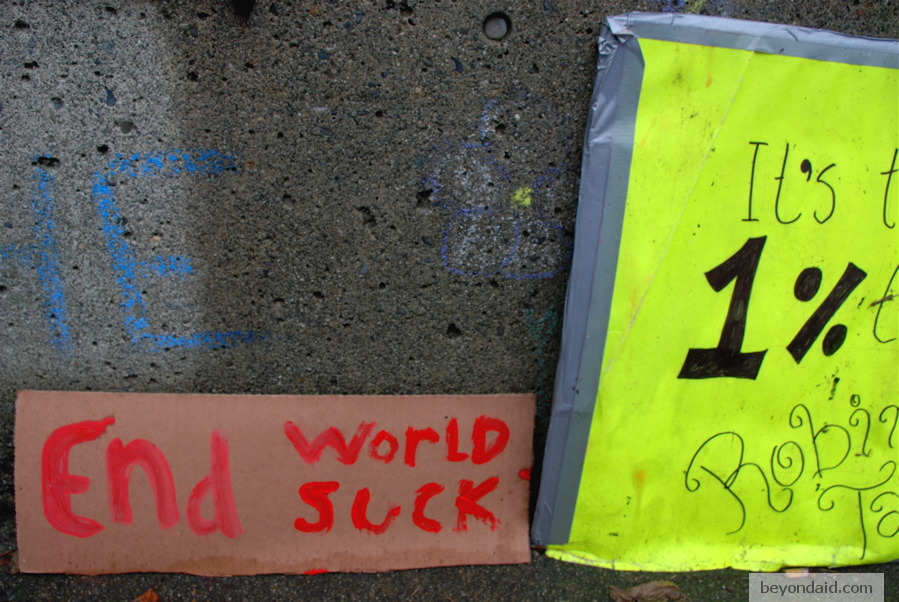
The Overseas Development Institute’s Jonathan Glennie points out that many of Europe’s and America’s Occupy demonstrators are actually part of the global 1% and that the inequality between countries is worse than it is within countries.
“If redistribution at a national level requires a strongly interventionist state, doesn’t that imply that something similar is required globally if we hope to contain global inequality? Such a plan would be laughed at by those who know the inner workings of the UN, and who recognise the nationalist instinct of politicians and voters. It is ironic that as knowledge about and empathy with the rest of the world has increased in the 20th century, through a revolution in communications, so has global inequality. One might have hoped for the opposite.
It is hard to see how global inequality can be contained without a shift in the mindset, cemented by centuries of traditional politics and nationalism, that favours the state you are born in over the world you want to live in.”

Bush and Blair on trial
Princeton University’s Richard Falk writes about a Malaysian tribunal’s non-enforceable conviction of former US president George W. Bush and former British prime minister Tony Blair for crimes against humanity and genocide during the Iraq War.
“The world system of states and institutions was unwilling to look a particular set of facts in the eye, and respond effectively to what many qualified and concerned persons believed to be a gross injustice. In this regard, there was an intense ethical and political motivation behind these civil society initiatives that invoked the authority of law. But do these initiatives really qualify as ‘law’? A response to such a question depends on whether the formal procedures of sovereign states, and their indirect progeny – international institutions – are given a monopoly over the legal administration of justice. I would side with those that believe that people are the ultimate source of legal authority, and have the right to act on their own when governmental procedures, as in these situations, are so inhibited by geopolitics that they fail to address severe violations of international law.”

A human approach to asylum-seekers
The UN High Commissioner for Human Rights Navi Pillay has praised Australia for announcing it will no longer send all undocumented migrants arriving by boat to mandatory detention centres.
“I am pleased to see this latest shift in policy, bringing in individual assessments of asylum seekers for release into the community,” she said. “I welcome these steps towards a more human approach to asylum-seekers in Australia which can only help to strengthen the tolerance and understanding necessary in a modern multicultural society.”

Doing the cartels’ laundry
The Los Angeles Times reports on the virtual impunity with which international banks have helped Mexican drug cartels launder billions of dollars.
“‘Wachovia’s blatant disregard for our banking laws gave international cocaine cartels a virtual carte blanche to finance their operations,” U.S. Atty. Jeffrey H. Sloman said in announcing the case last year, hailed at the time by authorities as one of the most significant in stopping dirty money from contaminating the U.S. financial system.
Wachovia paid the $160 million in what is called a deferred-prosecution agreement; no one went to prison, and the fines represented a tiny fraction of the [$420 billion] the bank had filtered. In court documents cited by the U.S. Drug Enforcement Administration, Wachovia acknowledged serious lapses.”

There will be blood
The Inter Press Service reports on an unfolding investigation in Sweden over allegations petroleum giant Lundin Oil was involved in human rights violations committed in South Sudan during the civil war that preceded independence.
“[Reverend James] Ninrew said the brutal and systematic nature of the government’s operations in advance of the oil industry was obvious to anyone in the area. The government would begin by indiscriminant bombing, driving many from their homes. This would be followed by helicopter gunships flying low in order to attack those that remained.
‘The third step was sending ground troops coming in vehicles and coming on foot to make sure no more people were there,’ said Ninrew.
Soldiers would then establish posts just beyond the area they wanted to control, he said. After that, the machinery and the surveyors would arrive. Once they were done their work, the pattern would be repeated as the oil company expanded into territory falling under its concession.”

The Millennium Villages don’t work
The Center for Global Development’s Michael Clemens writes about a new independent assessment – the first of its kind – of the Millennium Villages Project, which suggests the much-hyped experiment has had little impact on household income despite spending nearly 100 percent of local income per capita.
“While [Tilburg University’s Bernadette] Wanjala and [Radboud University’s Roldan] Muradian find that the project caused a 70% increase in agricultural productivity among the treated households, tending to increase household income, it also caused less diversification of household economic activity into profitable non-farm employment, tending to decrease household income. These countervailing effects are precisely what one might expect from a large and intensive subsidy to agricultural activity. On balance, households that received this large and intensive intervention have no more income today than households that did not receive the intervention.”

Or do they?
Yale University’s Chris Blattman takes issue with many of the statistical methods of the new study and thinks the evidence presented may in fact suggest increases in income, though he is careful to add he does not necessarily buy into the Millennium Villages Project’s basic assumption that “the whole of poverty alleviation is greater than the sum of its parts.”
“My own theory of poverty is actually the opposite: there are diminishing marginal returns to aid in a single village. I believe in the possibility of increasing returns and complementarities, but mainly through broad, national institutional and technological change. I’m personally not convinced real poverty traps exist, or can be overcome, at the household or village level.”

The Aid Distraction

The focus of Beyond Aid has, from the outset, been the ideas and actions of others. But this week is a special one, at least for high-level international talks, as both the Busan aid effectiveness summit and the Durban climate change conference kick off. So to mark these dual events (and because I am a little under the weather), here is an analysis piece I wrote for the Broker Online in early October. It was written with Busan in mind, but I believe its point regarding global democracy applies equally to Durban.

Talk is cheap. Results are what matter. That is the apparent consensus ahead of next month’s aid effectiveness summit in Busan, whose organizers promise “a clear focus on development results,”  while sceptics worry about a lot of rhetoric and little concrete follow-through.

Unfortunately, the most important and most difficult conversation has barely begun.

There are certainly some positive noises in the lead-up to Busan: recognition that aid is just one aspect of development, talk of mutual accountability and commitment to sustainable development. But if these promises are to become more than talking points, greater efficiency and more reliable data will not be enough. In order to create the kind of massive global change they profess to desire, the leaders of the world’s wealthy countries will have to follow their rhetoric to its logical conclusion.

To say that development is more than aid is an understatement. Donors should begin by acknowledging that aid is a potentially useful but relatively insignificant component of development. As things stand, member states of the OECD’s Development Assistance Committee – the driving force behind Busan – contribute just over 0.3 percent of their combined gross national income to development assistance. Even if they all made good on their decades-old promise to increase that amount to 0.7 percent and on their more recent pledge to give recipient countries ownership of the development process, 99.3 percent of their wealth would still be devoted to economic activities that sometimes clash with the interests of the world’s poor.

The mutual accountability being promised must demand more from donor countries than ODA transparency (though that would be nice too); it has to mean a serious analysis of the impacts their self-interest has on those who do not belong to their electorate. Yale philosopher Thomas Pogge argues citizens of wealthy countries, as well as elites around the world, benefit from “a transnational scheme of social institutions under which some persons are regularly, predictably and avoidably denied secure access to the objects of their human rights.” (Thomas Pogge (2002) World Poverty and Human Rights, Polity Press, Cambridge, p. 227.) In his view, these privileged people have a negative duty not to harm the world’s poor that is greater than the positive duty to provide them with aid. Certainly, such thinking is in line with legal codes around the world that punish crimes but do not reward good deeds. Moreover, Pogge believes the time is right for a rethink of the global system, with the financial crisis providing “a great opportunity to showcase and propagate both causal and moral institutional analysis.”

Transfer pricing by OECD-based transnational corporations costing poor countries billions in lost tax revenues each year; the Canadian government refusing to investigate (or withdraw financial and diplomatic support from) Canadian mining companies accused of serious rights abuses overseas; European and American trade negotiators lobbying hard to prevent loosening of intellectual property rules that impede the fight against non-communicable diseases in poor countries… The list is long and there is a whiff of blaming the victim to the claim that poor countries are responsible for their own development. Certainly, their agency is essential; improved conditions are unlikely without sound local and national policies, which have often been lacking in the past. At the same time, poor countries neither have the jurisdiction nor the political influence to rein in transfer pricing or change the international intellectual property regime. As for the role or indifference of host-country governments regarding extractive industry abuses, factors may include asymmetrical diplomatic relations and incentives built into international rules that grant ownership of natural resources to countries, even though a better case could probably be made for local or global ownership.

The point here is not that poor countries are good and rich ones are bad. But foreign policy accountable only to the voters of the home country has extremely limited democratic legitimacy, and the current global system – one that over the last few centuries has been determined to a great extent by countries that today are OECD members – is in many ways bad for those who are poor. While micro-lending or support for institution building may help, they cannot address bigger systemic problems. And yet, the vast majority of the intellectual and practical effort expended on development over the last 60+ years has focused on changing the way people – from farmers to presidents – in poor countries behave and think.

It is time to look at the second half of the equation without losing sight of the first half. It is time for the established, wealthy countries to accept their share of responsibility for poverty in distant lands and to begin handing over their global control. Not to China, India and Brazil but to the 7 billion people of the world.

Of course, ushering in an era of global democracy would be a lengthy undertaking, far exceeding the scope of a three-day summit, however high-level it might be. But Busan does have the power to significantly change development thinking, and the recognition of negative duties would be a huge step in questioning a global order that leaves billions with virtually no voice.

Sound unrealistic? Maybe. Surely though, it is no more so than suggesting competing entities, whether they be corporations or national governments, will spontaneously prioritize cooperation over their own short-term interests. Or maintaining that by giving away a tiny fraction of their wealth, they can counteract the negative impacts of their core activities and a global system designed to further their goals.

Depressingly, sustainable development would be even tougher to achieve than global democracy, as it would also require counteracting generational selfishness. Is it possible to extend democracy in time as well as space?

Difficult, no doubt. And unless we shift the conversation, impossible.

Latest Developments, November 24

In the latest news and analysis…

Water grab
The International Institute for Environment and Development has released a new report warning that the African “land grab” phenomenon also involves water rights, with implications extending far beyond the land being sold.
“‘Companies that acquire land for irrigated farming will want secure water rights, but long-term contractual commitments can jeopardise water access for local farmers,’ says co-author Lorenzo Cotula. ‘This affects not only the people who have customarily used the land that is being leased, but also distant downstream users who can be hundreds of kilometres away and even across an international border.’
The Gibe III dam in Ethiopia will enable irrigation on 150,000 [hectares] of land the Ethiopian government has allocated to investors, but studies suggest this project would lower the level of Kenya’s Lake Turkana – on which half a million Kenyans depend — by eight metres by 2024.”

Intellectual property and health
Intellectual Property Watch reports on a high-level World Trade Organization meeting on how best to balance the demands of trade, intellectual property and public health.
“There were variations in views of the issues of the health, trade and IP officials that echo differences typical across national governments. [World Health Organization head Margaret] Chan was more outspoken about putting health matters ahead of commercial interests, using especially strong language against the tobacco industry, which is lobbying intensively in trade arenas like the WTO to stop national governments from taking actions against tobacco packaging aimed at discouraging smoking. Chan also said that an “elephant in the room” is policy incoherence within governments, where different agencies are working in different directions, and then they expect the international organisations to solve their internal issues.”

Intellectual property and poverty
United Nations Assistant Secretary-General for Economic Development Jomo Kwame Sundaram argues stronger intellectual property rules have “ominous implications” for the world’s poor.
“Affordable and equitable access to existing and new technologies is crucial for human progress and sustainable development in many areas, including food security and climate-change mitigation and adaptation.
The same is true of affordable access to essential medicines, on which progress has been modest. By 2009, such medicines were available in just 42% of poor countries’ public facilities and 64% of private-sector facilities. Meanwhile, median prices in the public sector were 2.7 times the international reference prices and 6.1 times higher in the private sector!”

The price of secrecy
Le Monde reports on Switzerland’s growing success at getting cash-strapped countries to sign agreements that preserve bank secrecy despite G20 pledges to tackle tax havens.
“A number of countries in financial difficulty are in fact negotiating similar deals [to those recently signed by Germany and the UK] with Bern or are preparing to do so, such as Italy and Greece, according to several sources. But the Rubik accords are highly problematic, says a chorus of officials and NGOs. For starters, according to a source that is well acquainted with the file, ‘the text is a way for Switzerland to snuff out European efforts to obtain automatic exchange of financial information, which it absolutely does not want.’ ‘Morally, these deals are tough to swallow because they maintain the anonymity of account holders,’ adds the French government’s point man on the fight against tax havens, François d’Aubert.” [Translated from the French.]

Phoned-in CSR reports
The Guardian reports on a study that suggests companies are not taking environmental reporting seriously.
“The examination of more than 4,000 corporate social responsibility (CSR) reports and company surveys by a team at Leeds University found ‘irrelevant data, unsubstantiated claims, gaps in data and inaccurate figures’ – a finding that will cast serious doubt over the burgeoning sector.
Among the most colourful mistakes and omissions made by some of the world’s biggest corporations were a company whose carbon footprint was four times that for the whole world, and a carmaker and power group which both, entirely legally, managed to excise a huge coal plant from their pollution record.”

Chevron’s rights suspended
Reuters reports Brazil has suspended Chevron’s drilling rights following an offshore spill earlier this month.
“Chevron initially attributed the ‘sheen’ on the sea surface to naturally occurring seepage from the seabed. The company is being investigated by the Federal Police, which noted discrepancies between Chevron’s account of the spill and the government’s.
The Frade leak, while small, is likely to provide more ammunition for the growing worldwide opposition to offshore drilling in the wake of the estimated 4-million-barrel BP Deepwater Horizon spill in the Gulf of Mexico in 2010.”

Nuclear weapons-free zones
Massachusetts Institute of Technology professor emeritus Noam Chomsky argues that despite President Obama’s “rhetorical commitment” to nuclear non-proliferation, America’s actions “are in direct contradiction” to this posture.
“Parenthetically, we may add that US insistence on maintaining nuclear facilities in Diego Garcia undermines the [nuclear weapons-free zone] established by the African Union, just as Washington continues to block a Pacific NWFZ by excluding its Pacific dependencies.”

Linking transparency and procurement
Tax Justice Network guest blogger Matti Ylönen writes about a proposal in Helsinki to link corporate transparency and public procurement, an idea he hopes will spread beyond northern Europe.
“While discussions on binding Country-by-Country reporting standards are steadily gaining momentum in international fora, the city board of Helsinki has decided that it’s time to open another track. After returning the initiative earlier for further preparation, the board is now ready for Helsinki to start the background work on how the City of Helsinki could positively favour companies that report their key financial information openly and on country-by-country basis in public procurement.”

Republic of Lakotah
Al Jazeera asks if Native Americans could have their own country within US borders.
“In 2007, the Lakotah Freedom Delegation – a group of Native Americans led by activist Russell Means – declared sovereignty from the United States and proposed the founding of a new country known as the Republic of Lakotah.
The proposed nation would be based on territory demarcated by an 1851 land agreement made between the U.S. government and Lakotah tribal leaders. The Republic of Lakotah would cover a 200,000-square-kilometre space that is currently claimed by the states of North Dakota, South Dakota, Nebraska, Montana and Wyoming.
The U.S. government does not recognise Lakotah or its representatives, stating that its leaders were not democratically-elected and that members are still subject to U.S. law. Lakotah would be a federation of semi-autonomous tribal groups, and governance would be based on an interpretation of a pre-European indigenous political format.”