Latest Developments, January 18


In the latest news and analysis…

H-2 eligibility
The Associated Press reports that the US government has decided for the first time to include Haiti in a program that would allow some low-skilled workers to obtain temporary visas.
“U.S. Citizen and Immigration Services announced Tuesday that Haiti was among more than 55 countries eligible for the H-2A and H-2B visas.
Both Florida senators and six U.S. representatives from the state last month asked Secretary of State Hillary Rodham Clinton and Homeland Security Secretary Janet Napolitano to extend the visas to Haiti. The Florida delegation said money sent home by Haitians with those visas was vital to the Caribbean country’s ongoing efforts to recover from a catastrophic earthquake in 2010.”

The C word
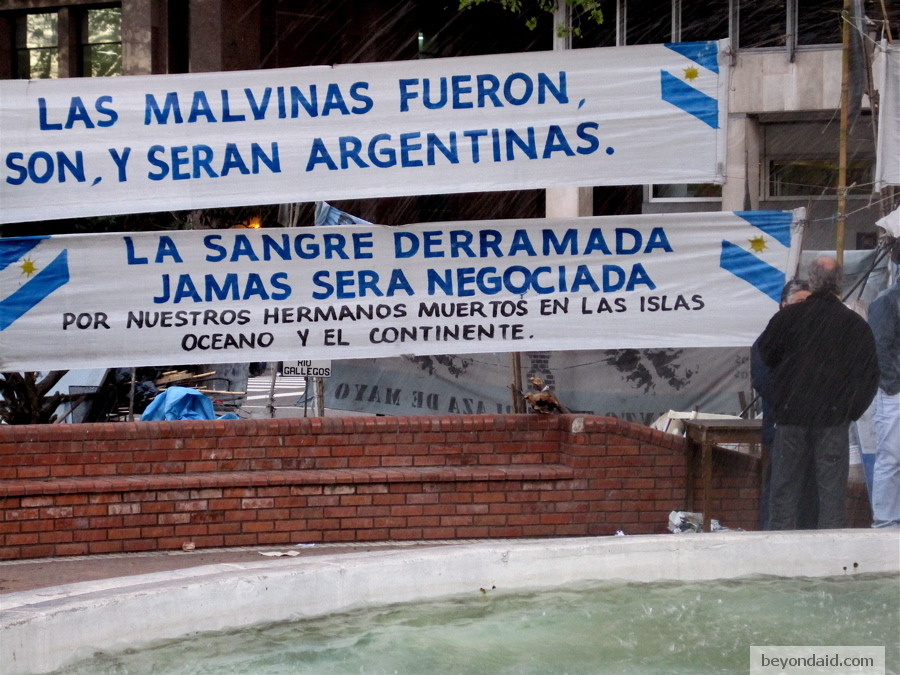
The Guardian reports on the escalating tensions between London and Buenos Aires that saw British Prime Minister David Cameron accuse Argentina of holding a “colonialist attitude” toward the Falkland Islands, a longtime British colony.
“Hector Timerman, [Argentina’s] foreign minister, described Britain as ‘a synonym for colonialism.’ He was quoted by Reuters as saying: ‘Evidently at a time when only scraps of colonialism linger, Great Britain … has decided to rewrite history.’ ”

The war within
Former US secretary of labour Robert Reich argues the current “crisis of capitalism” is the result of a lopsided conflict between consumers and investors on the one hand, and workers and citizens on the other.
“And since most of us occupy all four roles, the real crisis centres on the increasing efficiency by which we as consumers and investors can get great deals, and our declining capacity to be heard as workers and citizens.

As a result, consumers and investors are doing increasingly well but job insecurity is on the rise, inequality is widening, communities are becoming less stable and climate change is worsening. None of this is sustainable over the long term but no one has yet figured out a way to get capitalism back into balance. Blame global finance and worldwide corporations all you want. But save some of your blame for the insatiable consumers and investors inhabiting almost every one of us, who are entirely complicit.”

Irreconcilable differences
The Overseas Development Institute’s Claire Melamed argues the current consensus over bringing development and environment agendas closer together may be short-lived.
“But there is a danger to this approach – exemplified in the call for SDGs to also tackle ‘sustainable consumption and production patterns’.  This gets to the heart of what makes the whole issue of sustainability so politically toxic.  Sustainable consumption patterns would almost certainly mean some people on the planet consuming less so others could consume more.  Similarly on production – if developing countries are going to grow, and if technology doesn’t ride to the rescue, it’s at least possible that ‘sustainable’ might mean the rich world producing less.”

Immoral economy
Columbia University’s Jeffrey Sachs argues there are four ways in which self-interest, which is the very foundation of capitalism, “fails to support the common good.”
“Second, it can easily turn into unacceptable inequality. The reasons are legion: luck; aptitude; inheritance; winner-takes-all-markets; fraud; and perhaps most insidiously, the conversion of wealth into power, in order to gain even greater wealth.
Third, self-interest leaves future generations at the mercy of today’s generation. Environmental unsustainability is a gross inequality of wellbeing across generations rather than across social classes.”

Misguided journey
The University of Ottawa’s Nipa Banerjee gives a harsh assessment of the state of the international development industry in the wake of last month’s summit in Busan.
“The pre-Busan evaluations and Busan discussions clearly reflect a misguided journey of the Western-centric donors who are running the wheels of a self-serving aid industry. While some of the non-traditional non-Eurocentric donors, such as China, Brazil, and India, represented themselves in Busan, they took rather low-profile positions, with none officially joining the OECD’s Development Assistance Committee, in endorsement of the self-reproducing development support industries. Most of these new donors had once been roped into a monstrous global aid industry and well experienced the fruitlessness of spending time in delving into reams of paperwork, policy papers, development programming, and evaluations, nursing the illusions of effective aid.”

Multilateral failures
Writer James Denselow reviews a pair of new books on global revolution, including the latest by Carne Ross whom he describes as a former diplomat “transformed into a thinking man’s neo-anarchist.”
“The nation-state represents an archaic and ill-fitting answer to multifaceted non-localized issues, brought on by the pressures of globalisation and climate change. From flu-epidemics, to the spread of rioting, he carefully plots the ways in which our interconnectedness has led to problems which require global cooperation to solve. Yet the best efforts at multilateral cooperation have yet to deliver the answers. Ross parallels the enormous rhetoric of the 2005 G8’s promise to ‘make poverty history’ with the reality of its ‘utter failure’ to do so with a shortfall in pledges of $20 billion.”

Blue helmet blues
The Inter Press Service speaks to a number of experts about the evolving role of UN peacekeeping and the reputational hits such missions have taken in recent years.
“ ‘In the Congo, the U.N. is not exactly neutral, going after militias on behalf of the government,’ says Sean Maloney, a professor at the Royal Military College in Kingston Ontario.

Maloney told IPS the impartial style of peacekeeping as represented by Canadians serving as U.N. soldiers and keeping armed Greek and Turkish-speaking people at bay in Cyprus in the 1970s was rendered ‘obsolete’ starting in the 1990s.
‘We are going to see more interventions. They will be more coercion-style interventions (like the NATO mission in Afghanistan where Canada had upwards of 3,000 soldiers) that will be siding with one side or another,’ adds Maloney, describing himself as pro-military and ‘libertarian’.”

Latest Developments, January 17

In the latest news and analysis…

Resource nationalism
British consulting group Maplecroft has added “resource nationalism” in some of the world’s poorest countries to the latest edition of its annual Political Risk Atlas, which identifies potential problems around the globe for businesses and investors.
“Potential actions by governments can include nationalising an entire industry. For example, in August 2011, Venezuela’s President Hugo Chavez announced his intention to nationalise the country’s gold industry. Likewise in Guinea in 2010, the state sought a renegotiation of contracts, saying it would become a minority shareholder in all mining contracts. Comparable events have occurred in 2011 in other parts of South America and Africa and are likely to be repeated, especially if a global economic slowdown begins to cut into government tax revenues.”

Fueling hunger
The Center for Global Development’s Kimberly Ann Elliott welcomes the end of billions in US subsidies for biofuels but laments the fact that “advanced biofuels that are not food-based are still not available.”
“For developing countries, that means that corn-based ethanol will remain the major biofuel in the United States, diverting a third or more of the corn crop and keeping upward pressure on food prices. The elimination of the blenders’ credit will do little to change that because, while the subsidy bolstered producer profitability when corn prices spiked in 2008 and again last year, it was not a major factor driving demand for ethanol. The congressional mandate requiring that biofuels be blended into gasoline put a floor under the market, which encouraged investment.  Thus, actual production has exceeded the mandated level in every year because oil prices have been high enough to make ethanol competitive.”

Sins of emission
Mongabay reports on an Atlanta-based company that emits more greenhouse gases than Finland and owns the top three facilities on the US Environmental Protection Agency’s list of the top 100 sources of emissions in the country.
“For its part, Southern Company told the Atlanta Journal-Constitution that their emissions are ‘indicative’ of their power plants ‘being among the nation’s largest generators of electricity,’ adding that, ‘Southern Company complies with all environmental regulations and supports transparency in emissions reporting. The company is a leader in environmental research, development and implementation.’ Southern company serves around 4 million people. In 2014 the corporation is opening a new coal plant in Mississippi that will reportedly capture 60 percent of its greenhouse gas emissions.
According to its records Southern Company spent over $8 million in lobbying the U.S. government last year. A profile of the company on OpenSecrets.org, run by nonpartisan Center for Responsive Politics, reads ‘Southern has been one of the biggest proponents for electricity deregulation” and “gives most of its money to Republicans.’ ”

Re-assigning blame
The New School for Social Research’s Tarak Barkawi is perplexed by the use of the word “inhuman” to describe a video apparently showing US marines urinating on the dead bodies of Taliban fighters in Afghanistan.
“For senior US officials to help purvey accusations of the worst kind against the US military – as inhuman – makes little sense. While offering assurances that they will clean house, they should strongly distance themselves from the notion that this is a peculiarly US issue. Iraqis, Afghans, Americans and others have been mutilating each others’ corpses for some years now.
Such officials ought to remember also that these are the kinds of things that happen in the wars they are themselves directing. As the Japanese officer quoted above remarked, “it is the war that forces us to do the killing”.
For the rest of us in the liberal-minded citizenry, we would do well to recall that wars are initiated and sustained by leaders and governments, and by the powerful interests and passions that back them.
To vent frustration for this situation by easy condemnation of some young enlisted marines is a bit like pissing on corpses.”

Corporate charity
The Overseas Development Institute’s Jonathan Glennie asks if “big company charity” is really better for the poor than “transforming core business practices” would be.
“In Western Union’s case, the big issue is transaction charges. There is a strong case that simply giving money to the poor (especially women) is the best way to help them out of poverty. So, without doubting the good work being done by Western Union, is spending through a foundation more effective than simply reducing the transaction charge and letting poor people purchase the things they know they need, such as better food, drugs or schooling?

Fundamentally, we should be wary of applauding corporates for charitable giving which, generally speaking, is concerned as much with PR as development outcomes, and is essentially funded by the taxpayer or consumer anyway.”

Demanding justice
Oxfam’s Farah Karimi argues “changing the division of power” in the world is necessary to ensure everyone has access to land, food, water and other essential but increasingly scarce resources.
“There is a third challenge, besides increased scarcity and shrinking political space: the current governance gap. The old governance system dominated by Western industrialized countries is in decay, while a new system that reflects the new global power relations isn’t yet functioning. Of course the G20 has emerged– but key issues such as poverty, justice and sustainable development don’t really feature on the G20’s agenda. The power and impact of globally operating companies is growing, enhancing the need for global governance. But the G20 doesn’t at all succeed in addressing vital global challenges or guaranteeing global goods.”

That which shall not be named
Intellectual Property Watch reports on a speech by World Health Organization head Margaret Chan, in which she praised the global body for its “consistent ability” to forge agreements on fair IP rules, though as the article goes on to say, the issue of counterfeit medicines has been particularly problematic.
“Chan did not directly mention the issue of counterfeit and substandard medical products by name, perhaps because of the difficulty in finding acceptable words by which to refer to it. The issue of “substandard/spurious/falsely-labelled/falsified/counterfeit medical products” – as it has been dubbed by member states in an effort to appease all sides – has been controversial at WHO in recent years. But members managed to agree in October on a new mechanism for addressing the issue.”

Latest Developments, January 13

In the latest news and analysis…

Violent hemisphere
The Washington Post reports on a new study suggesting 45 of the world’s 50 most violent cities are located in the Western Hemisphere, many of them caught up in the tension between an insatiable American market and prohibition policies.
“[Honduras’s] San Pedro Sulla tallied 159 homicides per 100,000 residents last year, followed by [Mexico’s] Ciudad Juarez, with 148 killings per 100,000. Both cities are major operational and strategic distribution points along the billion-dollar drug pipeline that funnels narcotics to consumers in the United States.”

Apple opens up
Reuters reports Apple has made public its “closely guarded” list of global suppliers in the face of criticism over perceived indifference to worker abuses.
“The audit conducted by Apple of suppliers found a number of violations, among them breaches in pay, benefits and environmental practices in plants in China, which figured prominently throughout the 500-page report Apple issued.
Other violations unearthed included dumping wastewater onto a neighboring farm, using machines without safeguards, testing workers for pregnancy and falsifying pay records.”

German banks vs. financial transaction tax
Bloomberg reports that Germany’s banks have expressed their opposition to a tax on financial transactions in the euro zone.
“ ‘If a financial-transaction tax cannot be introduced internationally, you have to do without it,’ Hans Reckers, managing director of Germany’s VOeB association of public banks, said in an e-mailed statement today. ‘We firmly oppose the creation of tax haven in the EU.’

The European Commission in September suggested a tax of 0.1 percent on equity and bond transactions and 0.01 percent on derivatives, which it said could raise 55 billion euros ($70 billion) a year. European Union finance ministers are due to discuss the levy in March.”

Diminishing solidarity
Le Monde reports on the contentious debate over whether a financial transaction tax, if one is ever adopted, would have much in common with Robin Hood.
“The NGO Oxfam worries about the change in [French President] Nicolas Sarkozy’s position, noting that he had said at the G20 summit in early November ‘a significant portion, the majority or the totality of the revenue must go to development.’ But he has since changed his mind, according to Oxfam’s Luc Lamprière: ‘His reference to the European Commission directive is a bad sign since it calls for the tax to ‘progressively replace national contributions to the EU budget,’ leaving the idea of financing development and the fight against climate change as a mere footnote.’ ” (Translated from the French)

Rio+20 agenda
The International Institute for Environment and Development’s Emily Benson grades the just-released draft agenda for the Rio+20 summit, finding it stronger on sentiment than specifics.
“Mention is made to ‘innovative instruments of finance’ for building green economies and reference is made to public procurement, fiscal reform, the removal of subsidies that undermine sustainable development, all of which the [Green Economy] Coalition has been promoting. It calls for International Financial Institutions to ‘review their programmatic strategies to ensure the provision of better support to developing countries for the implementation of sustainable development’. This is all encouraging stuff. However, the text steps rather delicately around the question not only of how much the transition is going to cost, but how we are going to leverage additional funds. From our past experience of Rio 1992 we know that governments alone will not be able to pay for the transition so we need to think a lot more creatively about how to leverage additional finance. So, the question we would like to see tackled in the next draft is:  How are we going to kick-start the finance of a green and fair economy in order to create long-term investor confidence?”

Burma beware
The Institute of Development Studies’ Gabriele Köhler argues Myanmar must be wary, as it opens up to the world beyond Asia, of the West’s conquering friendship.
“We can hope that the west’s sudden enthusiasm stems from genuine support for peace and the rights of the population. But in reality, the change in stance probably has at least as much to do with pursuit of their own national interests. For several decades, US and European sanctions have kept western businesses out of Burma, while firms from Thailand, Singapore, India and especially China eagerly exploited the country’s natural gas, hydropower potential and gemstones.
History has shown time and again that popular movements for civil liberties, democracy and human rights are often hijacked by a drive to introduce neoliberal capitalism or prise open a country to foreign investors.”

Carbon fixation
The Land Institute’s Stan Cox argues that current schemes to reduce carbon emissions could actually make it harder for future generations to provide for themselves.
“To value everything in terms of carbon and treat the myriad benefits of ecologically sound agriculture as mere byproducts of climate protection is to invite all kinds of threats to soil and food. Perhaps the most menacing threats are those posed by connecting food and soil more tightly to global capital markets through carbon-trading schemes and tying them more closely to volatile energy markets by putting already fragile soils to work growing biofuels.

Occupying Occupy
Author and blogger Carne Ross warns that the appropriation of Occupy slogans, by mainstream politicians and crockery shops, has begun.
“As the ‘68-ers manifestly failed to do, Occupy must move from words to action, for relying on the platform of words will see the ground cut from under our feet. In contrast to the ease with which they can steal the words of Occupy, the [Newt] Gingrich’s of this world will not be able to appropriate actions consonant with the ideals of Occupy for this would be to enact Occupy’s sought revolution.  And that won’t happen in a century of Sundays.”

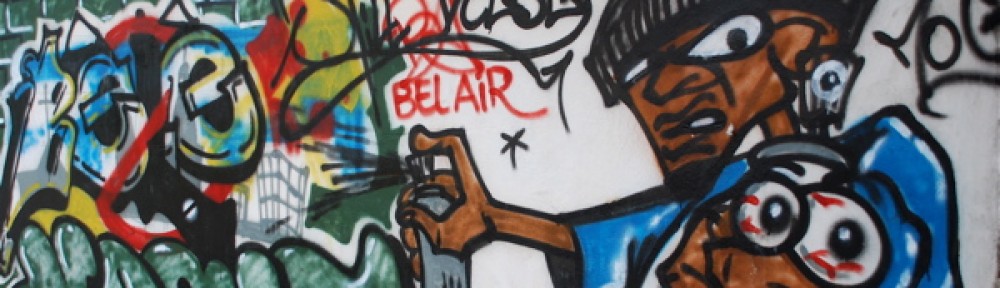
The Walls of Port-au-Prince

The following is a short, unpublished piece I wrote immediately following the earthquake that hit Haiti two years ago today. My theme is walls because of the physical nature of the tragedy, but Port-au-Prince consists as much of music and injustice, resilience and frustration, as of bricks and mortar. May it come back stronger and fairer than it was, and every bit as brilliant.

When I first visited Haiti as a backpacking student eleven Boxing Days ago, my future wife and I arrived by bus after dark and went to bed without having seen the dimly lit capital. Lying awake in the sweltering, airless hotel room, I spent hours listening to the animals scurrying about and relaying their squeaked messages inside the walls that hugged the bed on three sides.

When we awoke to a sunny Sunday morning and went out for a look around, the first thing I remember noticing was how vocal the walls outside were as well. A giant Wu-Tang symbol. “Aristide or death” scrawled in Creole. Layers of stories.

A decade later, I was back in Haiti, as a journalist this time. And again the walls. As my fixer Lolo and I waited for a ride, I commented on how often I had seen the graffitied name of a certain candidate in the upcoming senatorial elections. “He must be really popular,” I said. “Do you think he’s going to win?” “Nah,” he answered dismissively, “he just pays a lot of people to write that stuff.”

Everywhere the walls talked. Pro-Aristide. Anti-Aristide. Pro-government. Anti-government. Moses. Che. Musicians. Gang leaders. Only Satan and the UN peacekeeping mission received universally bad reviews.

So many walls, even where there was no obvious reason for them. “Sometimes the rich buy up land and put up walls without building anything on it,” Lolo said as we drove through the northern outskirts on another sunny Sunday morning. “Just to keep the poor people from using it.”

The walls also kept people and secrets in. Those shopping or just passing through the heart of the city could forget that the national penitentiary’s blue-and-white walls concealed nearly 4,000 men in a space the UN deemed fit for 438. Inside the cells, rough drawings of women, guns and musical instruments did little to distract from the overcrowding and squalor. In the corridors, the walls displayed officially sanctioned murals and slogans. At the entrance of a three-storey ship-like structure out of whose many barred windows dangled the legs of those lacking the seniority for a mattress, “Welcome to Titanic” was splashed in bold red, green and black. Roro Pascal, the gentle-eyed 26 year-old prison artist, told me UN forces had arrested him four years earlier and he was still waiting to see a judge. “What did they bust you for,” I asked. “Murder,” he said and he smiled sheepishly.

The morning after the rains started up, a radio newscaster announced the storm had brought down a cemetery wall, killing a young girl.

Then, a few months after I left, the walls suddenly stopped telling stories and they tried to kill their city.

Latest Developments, January 11

In the latest news and analysis…

Rio+20 leak
The Guardian reports a leaked agenda for June’s Rio+20 conference suggests countries will be called upon to agree to 10 new sustainable development goals but overall, the meeting promises to be much less ambitious than the original earth summit.
“Unlike the 1992 earth summit when over 190 heads of state set in motion several legally binding environment agreements, leaders this time will not be asked to sign any document that would legally commit their countries to meeting any particular targets or timetables. Instead, they will be asked to set their own targets and work voluntarily towards establishing a global green economy which the UN believes will reduce poverty and slow consumption.”

Transforming governance
The Inter Press Service reports on growing calls for radical changes in global governance in order to address issues such as poverty and environmental destruction.
“ ‘We need to have a “constitutional moment” in world politics, akin to the major transformative shift in governance after 1945 that led to the establishment of the United Nations and numerous other international organisations,’ said Frank Biermann of VU University Amsterdam and director of the Earth System Governance Project.

Transforming international governance will be challenging since nation-states are almost entirely concerned with their own short-term interests, [Biermann] acknowledges. However, countries give up some of their power when they join the World Trade Organisation.
‘We ought to be able to do this for the protection of the planet and act as a community of nations,’ he said.”

Guardians of the future
The University of East Anglia’s Rupert Read argues that true democracy must take into account the interests of future generations, and to that end, he proposes the integration of  “guardians” into Britain’s existing parliamentary system.
“The members of this body would be selected by sortition, as is current practice for jury service, in order to ensure independence from present-day party political interests.
The Guardians would have a power of veto over legislation that were likely to have substantial negative effects for society in the future, the right to review major administrative decisions which substantially affected future people and the power to initiate legislation to preserve the basic needs and interests of future people.”

Immigration assistance
The Center for Global Development’s Michael Clemens argues the US, by tweaking its immigration policies, could provide significant assistance to earthquake-ravaged Haiti without spending any money or increasing the number of immigrants coming to its shores.
“First, the administration could reverse the current ban on Haitian participation in the U.S.’s largest employment-based visa program, the H-2 temporary low-skill work visa. All Haitians are currently ineligible to receive these visas. If even a few thousand Haitians at a time participated in that program over the next decade, it would generate more money for Haitian families than the entire U.S. infrastructure reconstruction allocation for Haiti. Fiscal cost: zero. It would even generate net positive U.S. tax revenue. Effect on Americans’ jobs: none. Removing the ban on Haiti would simply allow employers already seeking laborers to draw from Haiti instead of being limited to the 53 currently-eligible countries like Guatemala and Mexico.”

Acting together
Norwegian development and environment minister Erik Solheim argues “poverty is about politics” and its solutions lie beyond aid.
“As Norway’s minister for both the environment and development since 2007, I meet with other countries’ ministers with both portfolios, and it has come as a shock to see how the two groups lead such separate lives. Each has its own important agenda, its own analysis of the challenges ahead, its own strategic plans, and literally its own language. While each recognizes the importance of the other’s agenda, unless they talk and act together, neither group’s goals will be achieved.

We must be careful not to fool ourselves into believing that the MDGs can be achieved through development aid alone. The wider politics of poverty must be placed at the top of the international agenda, along with the three factors most critical to development: climate, conflict, and capital.”

Western corruption
Inuka Kenya Trust’s John Githongo argues rich countries have fallen behind their “developing” counterparts in terms of awareness of and mobilization against high-level corruption.
“We live in an increasingly multipolar world where graft is concerned. It’s the turn of the developing world to watch how the west handles fraud and corruption at the highest levels in their corporate and other sectors. I would like to argue that the organic youth-heavy movements in the west, such as Occupy Wall Street, are part of this shift, except the “c” word isn’t being used – yet. This is a pointer to what I predict the fight against corruption will look like in 2012.”

Social cohesion
Oxfam’s Duncan Green issues a “fuzzword alert” over social cohesion and critiques the treatment given to the term in a new Organisation for Economic Co-operation and Development report.
“Whenever a new idea becomes popular like this, the danger is that instead of looking afresh at what it contributes to our understanding of development, we just recycle our existing set of ideas and say ‘because of complexity/ social cohesion/ climate change, you should do exactly what we’ve being saying all along’. I think the OECD is in danger of going down that road in this report – building social capital, supporting social mobility, and promoting social inclusion are fine, but they were standard demands long before anyone started talking about cohesion. The more interesting question is what we should be doing that’s additional or different because of a social cohesion ‘lens’, and I didn’t find that here.”

Southeast Asian exceptionalism
Alpha International Consulting’s Seth Kaplan uses the example of Southeast Asia to question orthodox thinking on the prerequisites for economic development.
“Indonesia, for instance, reduced poverty from 60 percent in 1970 to 22 percent in 1984. Vietnam reduced it from 58 percent in 1993 to 14 percent in 2008.
Yet, the region does not meet the standard model for economic success, at least as defined by the World Bank and the rest of the Western development community. Governments have historically not been held in check by elections. Corruption is widespread. Governance has rated low on most indicators.”