
Latest Developments, February 26

In the latest news and analysis…

Interpreting corporate personhood
In a New York Times op-ed carrying the headline “Should Corporations Have More Leeway to Kill Than People Do?,” the Center for Constitutional Rights’s Peter Weiss writes about what is at stake in a US Supreme Court case, due to begin this week, pitting Nigerian plaintiffs against oil giant Shell.
“A decision affirming that Shell should go unpunished in the Niger Delta case would leave us with a Supreme Court that seems of two minds: in the words of Justice John Paul Stevens’s dissent from Citizens United, it threatens “to undermine the integrity of elected institutions across the nation” by treating corporations as people to let them make unlimited political contributions, even as it treats corporations as if they are not people to immunize them from prosecution for the most grievous human rights violations.”

Don’t be evil
The Center for Global Development’s Owen Barder argues “we should all be worried” by a new agreement between Google and the World Bank that aims to promote development through sharing geoinformation.
“The problem is the way the data is licensed: once any data goes in to Google Map Maker, it all becomes the property of Google. If governments and citizens choose to use the Google Map Maker platform to contribute their information, then the data will only be available through Google’s own mapping system, and the data will be available under conditions specified by Google. At least, that is what we believe: ironically, given that both the Bank and Google are trying to market themselves as leaders in transparency and openness, they have refused to publish their legal agreement.”

Apple’s excess money
The Associated Press reports that Apple’s CEO Tim Cook believes his company has “more [money] than we need” and may be considering paying dividends to shareholders, a move likely to be unpopular with those concerned over labour conditions in Apple’s supply chain.
“While shareholders waited in a 40-minute line to get inside the meeting at Apple’s Cupertino headquarters, a few protesters carried signs urging the company to ensure that workers building its products in Taiwanese and Chinese factories are paid more and treated humanely. ‘Stop iSweatshop,’ one sign implored. Another stated: ‘iWant an ethical phone.’ No questions about the conditions in Apple’s overseas factories were posed during the meeting.”

Migrant rights
The Ecologist reports on the “exploitation and squalor” endured by African migrants working in Italy to supply oranges for companies such as Coca-Cola.
“Campaigners are now calling on multinational food and drink firms purchasing orange ingredients from the region to help address the problem. Italy’s largest farmers association says it has written to several companies – including Coca Cola, manufacturer of the Fanta orange drink – complaining that prices paid for orange concentrates are unfair, and fostering unpleasant conditions.

There’s thought to be around 50,000 migrants, mainly Africans, a few Eastern Europeans, currently existing like this across Italy.”

46 ideas
SHERPA, a French non-profit focused on economic justice, has released the English version of a report containing 46 proposals “to bring regulation of multinational companies to the top of the political agenda in 2012”.
46 Proposals explains in non-technical terms the mechanisms giving rise to both corporate impunity and citizens’ suspicion of the globalized economy and financial markets. The objective is to contribute to the debate over corporate accountability and suggest concrete solutions. Legal tools are not meant to weigh multinational corporations down, but to help turn CSR into a reality.”

Human rights vs. investment
The American Lawyer’s Michael Goldhaber writes that the long-running legal battle between Ecuadorian plaintiffs and oil-giant Chevron has taken another turn following an international arbitration panel’s call for Ecuador’s government to block a court decision awarding $18 billion in damages.
“However, on February 17 the intermediate Ecuadorian appellate court issued a four-page order… According to Chevron’s translation, the court rejected the arbitrators’ order as offensive to Ecuador’s Constitution as well as to the Inter-American Convention on Human Rights. ‘A simple arbitration award, although it may bind Ecuador, cannot obligate Ecuador’s judges to violate the human rights of our citizens,’ wrote the court. ‘That would not only run counter to the rights guaranteed by our Constitution, but would also violate the most important international obligations assumed by Ecuador in matters of human rights.’

Ecuador may continue to ignore the arbitrators’ declarations if it wishes to risk the consequences for foreign investment.”

The scramble for Somalia
The Guardian reports on concerns that the sudden international interest in Somalia could be a double-edged sword for the country’s inhabitants.
“The promise of stability coupled with the apparent discovery of oil reserves could help to rebuild this poverty-stricken country. But experts warn the west must not pillage the newly found resources of Somalia, or risk massively escalating the conflicts already in the region. Kenyan, Ethiopian and Ugandan soldiers are in Somalia fighting al-Shabaab and each country has vested interests in Somalia’s future. Already a new militia, led by the unlikely-sounding Sheik Atom, has formed around Puntland’s oilfields.”

Arab caricatures
The Council on Foreign Relations’s Ed Husain writes about the worrying tone of  pronouncements made on the Middle East by the leading Republican candidates for the American presidency.
“To date, not a single Republican candidate has spoken warmly of Arabs and congratulated them for seeking freedom and democracy, nor dedicated US support for and solidarity with the Arab uprisings. Instead, they continue to view the Arab world through outmoded lenses. The stirrings in Arab streets are about dignity, freedom, jobs, healthcare, housing and transparent government. But the Republican contenders continue to view the Middle East through four prisms: Israel’s security, Iranian nuclear ambitions, oil supplies to America, and countering terrorism. This mismatch between understanding reality in the region and the misplaced priorities among Republican contenders leads to the gap in knowledge and flawed analysis only too apparent in this debate.”

Latest Developments, February 23


In the latest news and analysis…

Outside solutions
Oxfam’s Barbara Stocking has expressed disappointment over the Somalia conference in London, which UK Prime Minister David Cameron hailed as a “turning point.”
“While we recognise the huge efforts of the UK Government to make the conference a success, what we had hoped for was a recognition that 20 years of internationally imposed solutions have failed. However, what we’ve seen once again are externally driven solutions that haven’t worked, aren’t working and will not work.

What we got was the rhetoric of Somali inclusion but you cannot go forward with a new constitution and elections in such a troubled country without a wide and inclusive political engagement within Somali society.”

Madonna strikes again
The Guardian reports Madonna’s latest school-building scheme in Malawi has run afoul of education officials who say they have not been consulted.
“…John Bisika, Malawi’s national secretary for education, science and technology, told the Guardian: ‘We have had no written or verbal communication. We just read about it in the papers. I don’t understand how she can work like that. For someone to go to the papers and say, ‘I’m building schools’, without telling the government, I find it a strange way of working.’
He added: ‘When will she build these schools? How will we know where these schools are needed? We need to do this in a co-ordinated manner. I wouldn’t just go to the UK and start building schools.
‘We need to be approached and work out where the schools are needed, based on school mapping. If she doesn’t come through us, it will not happen. We can’t just see people building schools. Let’s do it properly.’ ”

Patent reform
Intellectual Property Watch reports that UN talks have moved one step closer to an international agreement concerning genetic resources, although substantial differences remain over “mandatory disclosure of origin in patent applications.”
“The Indian delegate said ‘none of us here’ want to give ‘the impression that we are against the patent system’ but ‘there is a lot of free riding that is going on,’ he said, and the companies are taking traditional knowledge and claiming that it is their own, to the detriment of local communities he said. For the integrity of the patent system it is important that such bad patents are not granted, he added.”

Corruption by another name
The Tax Justice Network reproduces the communiqué released at the inaugural meeting of the High Level Panel on Illicit Financial Flows from Africa.
“Illicit financial outflows constitute a major source of resource leakage from the continent draining foreign exchange reserves, reducing tax collection, dwindling investment inflows, and worsening poverty in Africa. The methods and channels of illicit financial outflows are many and varied including tax havens and secrecy jurisdictions, over-invoicing, under-pricing, and different money laundering strategies. This source of resource outflows is far bigger and higher in terms of scale and magnitude than the normal corruption channels, which are focused upon globally.”

Infantilizing nations
Michael Marder of the University of the Basque Country, Vitoria-Gasteiz sees parallels between European current events and earlier dark chapters in the continent’s history.
“The infantalisation and animalisation of entire nations, for course, is nothing new for Europe that has had a long tradition of portraying itself in terms of the beacon of humanity and that has invariably resorted to the idea of its ‘civilising mission’ throughout it colonial conquests and expansions. Now, almost four decades after the last European countries have withdrawn from the colonies overseas, the same rhetoric is being turned inward, retracing the new political economic continental rift between the North and the South of Europe. Exploitation is the one constant that remains after this shift: exorbitant interest rates and repayment conditions attached to the bailout package will make sure that the debtor countries organise their economies around the need to service their debt for the foreseeable future.”

Price of doing business
Duke University’s Christine Bader asks why more extractive companies are not taking preventive measures to avoid escalation of conflict with host communities.
“[Former UN special representative for business and human rights, John] Ruggie suggests that most companies aren’t yet adding up what he calls those “costs of conflict,” which might be dispersed across security, public relations, legal, and operational budgets, and therefore aren’t motivated to act.
Some companies worry that opening up lines of communication will open the floodgates for specious claims. But a Harvard University study concluded that ‘the mere existence of a quality grievance mechanism can improve a company’s relations with affected stakeholders and thereby reduce grievances, as it signals that the company is ready to be held accountable, to confront, acknowledge and learn from problems.’ ”

Oil opacity
The Economist takes on the extractive industry’s “many objections” to more stringent transparency requirements, such as those contained in America’s Dodd-Frank act.
“But businesspeople struggle to produce examples of how local restrictions on publishing confidential contract details could clash with transparency requirements elsewhere. Contracts in developing countries typically have a clause permitting disclosures that are required by the company’s home country and stock exchange. Nor does greater disclosure seem to hurt competitiveness. In 2011 Angola awarded several new deepwater oil concessions to firms covered by Dodd-Frank. No oil company has so far cited increased openness as a material risk in its [US Securities and Exchange Commission] filings.
The expense has been minimal for the few, such as America’s Newmont Mining, that already provide country-level reporting (none yet breaks the numbers down project-by-project). Exxon says that the new rules would cost $50m. That is a lot of money, to be sure, but only 0.1% of last year’s profits. Companies already collect for internal use the data they are being asked to make public.”

Know thyself
UC Irvine’s Mark LeVine argues that if American and European citizens really want to help their counterparts in countries like Syria, they must first become more knowledgeable about their own countries’ “foreign policy interests and practices.”
“And if they got such knowledge, it would demand a much larger transformation in the political culture and economic structures of their own societies, which have always been intimately tied to support for authoritarianism and corruption abroad.”

Latest Developments, February 22

In the latest news and analysis…

Somalia strikes
The Bureau of Investigative Journalism estimates US military strikes have killed up to 162 people, including as many as 59 civilians, in Somalia since 2007.
“The total number of casualties may be higher.  Some reports simply state ‘many killed’, and other attacks may be unrecorded.

Though the Bureau has striven to untangle confused reporting of western military activity in Somalia, much remains opaque – something the US seems keen to see continue.”

Indigenous walkout
Intellectual Property Watch reports that the International Indigenous Forum has withdrawn from UN talks on rights governing genetic resources and traditional knowledge, a move that “calls into question the legitimacy of the negotiations.”
“As the ‘titleholders, proprietors and ancestral owners of traditional knowledge that is inalienable, nonforfeitable and inherent to the genetic resources that we have conserved and utilized in a sustainable manner within our territories,’ the group feels that ‘the discussion on intellectual property rights and genetic resources should include Indigenous Peoples on equal terms with the States since the work will directly impact our lives, our lands, our territories and resources.’
As a consequence, they said they decided ‘unanimously, to withdraw our active participation in the work developed by this Committee until the States change the rules of procedure to permit our full and equitable participation at all levels of the IGC.’
Under the current rules of procedures, Indigenous Peoples have observer status at the IGC. They can make proposals to the negotiations but those proposals have to be endorsed by at least one delegation to be taken into account.”

Rejecting consensus
Former French prime minister Michel Rocard argues the unrealistic quest for consensus is condemning international negotiations to failure and June’s Rio+20 summit will likely be no exception.
“Of course, there is a chance that the world will recognize its quandary at Rio. If a majority of the countries present dares to declare that demanding consensus is equivalent to enforcing paralysis, and if they insist upon following the voting procedures enshrined in the UN Charter, we could see enormous progress.
Global warming and economic crisis are threatening international security. This alone justifies referring these issues to the UN General Assembly, which, unlike the Security Council, knows no veto power. A strong declaration and a call for binding measures to address these issues would then be possible.”

Unfair fight
Agence France-Presse reports most victims of corporate abuses in Nigeria lack the resources to obtain restitution.
“In October, a Nigerian tribal king filed a lawsuit in a US court on behalf of his people against oil giant Shell, seeking $1 billion in compensation for extensive pollution that sickened the population and damaged their lands.
The plaintiffs said they decided to file the suit in a US court because of Shell’s history of a ‘culture of impunity’ and ‘disregard’ for the Nigerian judicial process.
They note that the Shell has refused to comply with a 2005 order to end gas flaring in the Iwherekan community or to pay a 2006 judgment to pay $1.5 billion to the Ijaw Aborigines for damages caused by decades of pollution.”

Too big to jail
Former IMF chief economist Simon Johnson argues American banks will continue to engage in “fundamental and systemic breaches of the rule of law” until their top executives face real penalties for such behaviour.
“Top bankers want to make a lot of money. They also want to stay out of prison. Political leaders can huff and puff as much as they want, but, without a credible threat of poverty and time behind bars, bankers have no reason to comply with the law.”

War machine
Al Jazeera’s Marwan Bishara writes about the damage caused by “the militarisation of the Arab Spring in Libya” and the sense of inevitability that led up to it.
“In late 2010, France and Britain decided to stage a war game titled Operation: Southern Mistral. It would involve thousands of military personnel and hardware from both countries. The scenario envisioned the two longtime military rivals joining forces for a bombing campaign against an imaginary southern dictator. The simulated war was condoned by a fictitious UN Security Council resolution and was scheduled to begin on March 21 of 2011. Well, the actual bombing of Libya began on March 19. This is surely a coincidence. But it does highlight the French and British mindsets and why no serious diplomatic effort got off the ground. The bombers were already on the runway.”

Immigration doublespeak
CNN.com’s LZ Granderson argues the American discourse around “securing the border” is really about something quite different from homeland defense.
“[National security]’s a part, but the larger truth is that nonwhite people will be the majority in this country by 2040 and this browning of America scares the hell out of a lot of people, particularly some white people. The thinking goes that if the country can deport the Mexicans who are illegally here and stop new ones from coming in, maybe that trend will slow down or even reverse.
That sentiment is at the core of the racial profiling laws started in Arizona and is at the core of the entire illegal immigration conversation. It’s a clumsy attempt to talk about race without mentioning race so as not to appear racist.
But the dialogue is transparent because if it was really about ‘securing the border,’ the facts suggest Canada would be a big part of the conversation and not just an afterthought.”

Interventionary diplomacy
Princeton University’s Richard Falk argues that a group foreigners currently being detained in Egypt do not work for “genuine NGOs” but rather, “informal government organisations” that are “overtly political.”
“In the end, Egypt, along with other countries, is likely to be far better off if it prohibits US IGOs from operating freely within its national territorial space, especially if their supposed mandate is to promote democracy as defined and funded by Washington. This is not to say that Egyptians would not be far better off if the [Supreme Council of the Armed Forces] allowed civilian rule to emerge in the country and acted in a manner respectful of human rights and democratic values.”

Latest Developments, February 21

In the latest news and analysis…

Perpetual growth
The Guardian reports on a new UN-commissioned study that argues the international community needs to take “dramatic action” if it wants to “avert a collapse of civilisation.”
“ ‘The rapidly deteriorating biophysical situation is more than bad enough, but it is barely recognised by a global society infected by the irrational belief that physical economies can grow forever and disregarding the facts that the rich in developed and developing countries get richer and the poor are left behind.
‘The perpetual growth myth … promotes the impossible idea that indiscriminate economic growth is the cure for all the world’s problems, while it is actually the disease that is at the root cause of our unsustainable global practices’, [the authors] say.”

Plundering Somalia
Inter Press Service reports on a new paper criticizing international policy towards Somalia, with one of the authors suggesting this week’s London summit on the country’s future “seeks mainly to rally public opinion around more violence, more intervention, and more counterterrorism options” rather than promoting a holistic approach to problem solving.
“[Global Policy Forum’s James] Paul said the violence-prone naval approach [to halting piracy] has not worked, because it ignores the illegal foreign fishing and toxic waste dumping that is taking place off the Somali coast.
The fishing and dumping provokes the piracy and has led ordinary Somalis to approve the piracy as a legitimate form of national defence.
But powerful members of the Security Council, notably the U.S. and the UK, have blocked any action on fishing and dumping.
‘They pretend that there is no information about the matter, even while their naval fleets are closely monitoring the movement of all ships in Somali waters,’ Paul said. ‘So much for root causes and holistic approaches. Violence is virtually the only option allowed onto the table in London.’ ”

UN responsibility
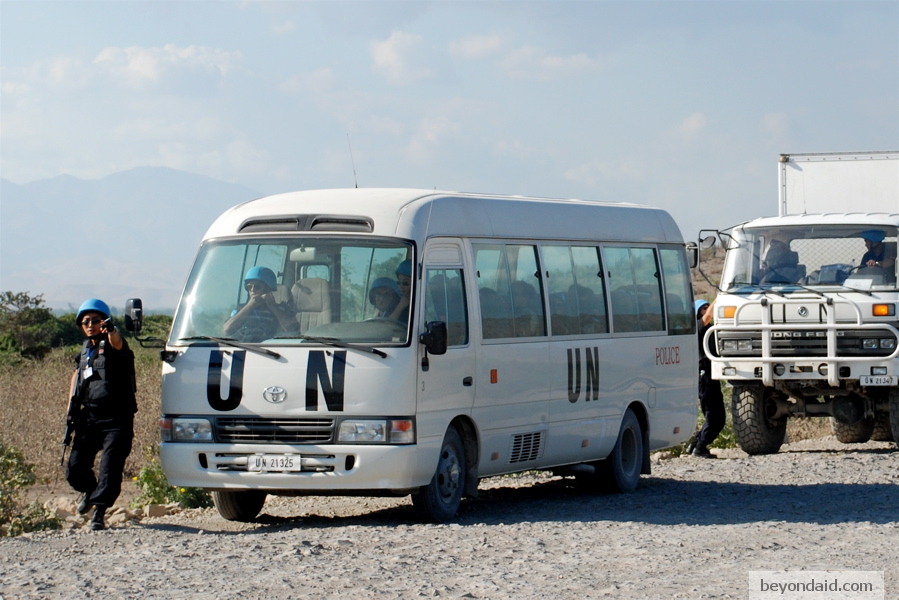
The New Media Advocacy Project’s Abby Goldberg writes about a legal petition that calls on the UN peacekeeping mission in Haiti to compensate and apologize to victims of a deadly cholera outbreak thought to have been caused by UN personnel.
“If the petition is successful, it will be the first case in history in which the UN takes legal responsibility for harm caused by their personnel.

The UN must consider the legal request and how to respond, not only for Haitians, but also for the success of peacekeeping operations globally. This case is about Haiti, but it is also about the UN and a changing world. As one of the lawyers who filed the case said, ‘there is a difference between immunity and impunity. Impunity cannot be tolerated.’ The UN can, and must, do better.”

Emission friction
Oxfam’s Duncan Green is baffled by widespread international opposition to the EU’s plan to charge airlines flying in and out of Europe for their carbon emissions, given that three-quarters of the greenhouse gases taxed would come from European and American carriers.
“The main objection to the EU’s policy is that it applies to air-miles clocked up outside European airspace. But the vast majority of emissions captured by the EU [Emission Trading Scheme] scope are from EU and US operators.  By implication, if India and others genuinely want developed countries to act to cut GHG emissions it would seem against their own interest to try to block the EU ETS, because obviously the EU would never apply it just to its own carriers – so if they were to be successful they’d also prevent us doing something about the large majority of emissions from EU/US carriers.”

Re-inventing the World Bank
Former World Bank executive Ana Palacio says the debate over the US monopoly on the institution’s presidency is “legitimate,” but thinks the organization requires far more significant reforms.
“Just as reconstruction finance gave way to development lending over the course of the Bank’s history, its current focus on banking operations should be reconsidered, as the organization’s main source of added value now lies in its formidable potential as a center of knowledge and a coordinator of international policies.

Today, the international community should look for a World Bank president who is attuned to ordinary people’s growing refusal to tolerate glaring global inequalities, and who understands that development is more than GDP growth. Such a leader, regardless of his or her country of origin, will reinvent the World Bank for the century ahead.”

Universal energy
The Steps Centre’s Rob Byrne and Jim Watson highlight the argument that the world’s poor should not be required to take a low-carbon approach to achieving universal energy access.
“[Practical Action’s Teodoro] Sanchez estimates that half the world’s energy-poor could switch to cooking on sustainable biomass and half to liquefied petroleum gas. Furthermore, half could access electricity from diesel generators while the other half do so from renewable sources. If these plans were implemented, he argues, the increase in global CO2 emissions would be less than 2% above 2005 levels.
If the world takes climate change seriously, this increase could easily be absorbed by cuts in industrialised country emissions and further action to slow emissions growth in the rapidly developing countries (especially China). The cost of this up to 2030 would be about $570bn (including capacity building and institutional costs); less than 3% of the estimated global energy investments needed during the same period.”

Questioning development
And, finally, a piece from last week by the Latin American Center of Social Ecology’s Eduardo Gudynas who argues sustainability will require a profound questioning of the concept of development and a recognition of the rights of nature. 
“The social and environmental crisis is so serious that it is now time to put aside minor adjustments and reforms, and instead address the root causes of resistance to the idea of development. We must adopt an approach whereby the term ‘sustainable development’ no longer requires the suffix ‘development’. The civil society programme in Rio+20 should not focus simply on fixing the superficial problems of development: it is necessary to look for alternatives to the entire body of ideas about development.

If sustainable development strengthens its demands for change, it must abandon the traditional idea of development and thus break with the anthropocentric ethics that are characteristic of Western cultural tradition.”