
Latest Developments, January 20


In the latest news and analysis…

The value of nature
The Guardian reports on a new study that argues some of the world’s poorest people should be paid $500 billion a year for the service they provide by preserving natural habitats.
“Many of the benefits of conservation, so-called ‘ecosystem services’, are invisible – for instance, maintaining wooded land can help to prevent mudslides during heavy rainfall, and provides valuable watersheds that keep rivers healthy and provide clean drinking water, as well as absorbing carbon dioxide from the air. These benefits are not assigned an economic value, however, so that chopping down trees or destroying habitats appears to deliver an instant economic return, when in fact it is leading to economic losses that are only obvious when it is too late.”

Hunger games
The World Development Movement’s Innocent Sithole writes about a new report on the role of European banks and private finance in food speculation and “land grabbing.”
“Our report identifies the biggest culprits in food speculation as Deutsche Bank, Barclays, the Dutch pension fund ABP, the German financial services group Allianz and French banking group BNP Paribas. We have since nominated Barclays for the 2012 Public Eye ‘shame’ awards for its financial speculation in food prices. Barclays is estimated to make up to £340 million a year from speculating in food ‘futures’ markets, making it the biggest UK player in the markets.”

Politics of xenophobia
Yahoo! News reports on the “hard line” taken by Republican presidential hopefuls on both legal and illegal immigration in the lead-up to the South Carolina primary.
“In talking about reducing legal immigration, Santorum–intentionally or not–aligned himself with the group NumbersUSA, which is spending up to $150,000 in South Carolina to run TV ads that criticize the federal government for admitting what the group considers to be too many legal immigrants each year.

Both legal and illegal immigration streams to America have fallen sharply since the recession began in 2008, even as state legislatures have increasingly passed immigration-related laws over the same period.”

Lethal policy
The University of Notre Dame’s Mary Ellen O’Connell argues America’s increasing use of “targeted killings” – a tactic it publicly opposed in the early years of the George W. Bush administration  – runs counter to its stated goal of promoting a “just and sustainable international order where the rights and responsibilities of nations and peoples are upheld, especially the fundamental rights of every human being.”
“The US did not support such killing for fundamental reasons of law and morality. Fundamental principles of law protect the human right to life and due process of law. Unlike torture, which is never permitted, states are permitted to allow designated authorities to carry out the use of lethal force in certain limited situations. In situations of armed conflict hostilities, lawful combatants will not be prosecuted for killing that complies with international humanitarian law. Today, under the international legal definition of armed conflict, the United States is involved in such hostilities in one country only: Afghanistan.
Beyond Afghanistan, any use of lethal force by designated authorities of the United States must follow the normal human rights limits on peacetime resort to lethal force. Authorities may engage in lethal force when necessary to save a human life immediately, if there is no alternative. In other cases, an attempt to arrest is required, followed by a fair trial within a reasonable period.”

Green growth
Oxfam’s Kate Raworth looks into the extent to which G20 countries have succeeded in decoupling economic growth and resource use.
“The vast majority of high-income countries in the G20 have so far provided no evidence that they can make economic growth environmentally sustainable. Of course, most have barely started to put in place the policies required to make it happen – but delay will only make it harder. So what does the G20 evidence show? That absolute decoupling is possible (we’ve seen it!), at least for some of the countries, for some resources, for some of the time. But that’s a far cry from believing that environmentally sustainable GDP growth is possible everywhere, all the time, indefinitely.”

OccupyLSX
The Institute of Development Studies’ Alex Shankland writes about the “subversive ruliness” of Occupy the London Stock Exchange.
“The Occupiers are fully committed to non-violence, but also to using direct action and surprise tactics that may or may not involve breaking the law.
So far, so unruly. But I would argue that paradoxically the real significance of the model of contestation provided by the camp lies not in law-breaking, but in rule-making. Transparent, rule-bound behaviour is absolutely central to the political practices that characterise OccupyLSX. This, in turn, is central to the unique power of the challenge that it poses to the intermingled political and financial interests whose unruly, untransparent and often downright illegal practices have left their disastrous mark both on London and on communities across the world.”

Ecuadorean example
Jawaharlal Nehru University’s Jayati Ghosh argues that in the space of a few short years, Ecuador has gone from a “basket case” to a development example for the world.
“All this may sound too good to be true, and certainly the process of transformation has only just begun. There are bound to be conflicts with those whose profits and power are threatened, as well as other hurdles along the way. But for those who believe that we are not condemned to the gloomy status quo, and that societies can do things differently, what is happening in Ecuador provides inspiration and even guidance. The rest of the world has much to learn from this ongoing radical experiment.”

Fear of debt
Robert Skidelsky, a member of the British House of Lords, argues there are a number of logical flaws to the prevailing thinking that debt reduction through “fiscal consolidation” is necessary for countries to enjoy healthy, sustainable economies.
“Third, the national debt is not a net burden on future generations. Even if it gives rise to future tax liabilities (and some of it will), these will be transfers from taxpayers to bond holders. This may have disagreeable distributional consequences. But trying to reduce it now will be a net burden on future generations: income will be lowered immediately, profits will fall, pension funds will be diminished, investment projects will be canceled or postponed, and houses, hospitals, and schools will not be built. Future generations will be worse off, having been deprived of assets that they might otherwise have had.”

Latest Developments, January 19

In the latest news and analysis…

Politics of inequality
Oxfam’s Caroline Pearce writes about the NGO’s new report that suggests inequality is on the rise in the majority of G20 countries.
“Crucially, what the report does not find is any link between particular stages of development and levels of or changes in inequality, casting doubt on those who argue that inequality is an inevitable stage along the way to development. Rather, inequality is a matter of political choices, and now the onus is on the G20 to make the right ones. According to new data from the new Standardized World Income Inequality Database, just four G20 countries (Korea, Brazil, Mexico and Argentina) have reduced income inequality in the last 20 years (see chart), and some with only modest levels of growth. Even these are not unambiguous success stories: in three, initial inequality was so high that decades’ more progress would still be necessary to bring them to levels seen in, for example, Pakistan, let alone in a country like Sweden. The exception is Korea, which grew to high-income status while reducing already comparatively low levels of income inequality. The others, along with the rest of the G20 club, face serious challenges in living up to G20 promises about ‘inclusive growth’.”

Millennium Consumption Goals
The UK Youth Climate Coalition’s Casper ter Kuile wonders how the world’s power brokers, who are about to hold their annual get-together in Davos, will respond to the new inequality data.
“The data also reveals that unlike the G20, in most low-income countries, inequality is falling, and levels of inequality are converging towards those of the G20. Perhaps time to revisit that idea of Millennium Consumption Goals? Or set up The Spirit Level reading groups in the Swiss mountains?”

Hedge fund human rights
The Independent reports hedge funds holding large amounts of Greek debt are going to try to protect their finances via the European Court of Human Rights.
“The funds have baulked at the idea of negotiating a settlement with the indebted country. Now, in a move likely to anger millions of Greeks facing austerity measures, fund managers are considering a fight against what they believe would be a violation of human rights law, arguing that their rights to property would be infringed by a write-down of Greek debt.”

Aboriginal rights
The Globe and Mail reports a prominent First Nations leader is calling for constitutional clarification on the rights of Canada’s indigenous people in the wake of the recent Attawapiskat crisis that drew attention to water and housing issues in Aboriginal communities.
“Many first nations leaders say the key to resolving all of these matters is an equitable sharing of resource rights, not just on reserves, but across all of their traditional lands. And, for the most part, the provinces and territories have control over those resources, whether it is diamonds in Ontario, oil in Alberta or minerals in Manitoba.”

Economics of place
On the heels of the US government’s announcement that Haitians will now be eligible to apply for temporary H-2 work visas, the Center for Global Development’s Michael Clemens writes about his first encounter with the economic significance of one’s place of birth.
“My interest in labor mobility as a poverty reduction tool dates to my boyhood, when I spent a summer in Mexico. I was astonished to discover that the man who fixed our toilet in Mexico City earned just a small fraction of what a man doing an identical job in the United States would earn. How could that be? How could location matter so much more than talent, effort, or character?”

Credit inequality
PIMCO’s Mohamed El-Erian argues the world economy has “a nasty plumbing problem” which is leading to dangerous inequality in access to credit.
“From every angle, the extremity of this state of affairs – in which those with access to credit do not need it, and those who do cannot get it – is highly problematic. If left unattended, it leads to a gradual, and then accelerated, renewed deleveraging of the economic system, with the highest first-round costs – a longer unemployment and growth crisis – borne disproportionately by those least able to suffer them. In the next round, as the system slowly implodes, even those with healthy balance sheets would be impacted, accelerating their disengagement from a deleveraging world economy.
All of this slows social mobility, tears already-stretched safety nets, worsens inequality, and accentuates genuine concerns about the functioning and sustainability of today’s global economic system.”

Responsible capitalism
Ekklesia’s Jonathan Bartley argues the changes to the economic system being advocated by political leaders fall well short of the “fundamental” reforms that are needed.
“Responsible capitalism is an oxymoron akin to ‘well-mannered war’ or ‘friendly famine’. But to begin to acknowledge that, the values of the system itself must be questioned not just the ethical or regulatory framework in which it operates.”

Horizontal accountability
¥OURWORLD’s Reinier van Hoffen offers his thoughts on how to improve democracy, using as his starting point a recent Beyond Aid article that argued finding serious solutions to global problems such as climate change and world hunger will require a system of democratic governance that transcends states.
“However, he also acknowledges that such a centralization of power will have some repercussions and challenges that he does not dwell on in his article. I want to take it from there and while agreeing with his analysis about the state in its current shape, I have a sense that the solutions are to be found in the opposite direction and not necessarily require a replacement of the political representation model that underpins the state. It rather requires a transformation of it, renewing the social contract it requires to function properly. Firstly the focus should not be on the power structure but rather on the power base. Secondly, the means by which a new form of governance has to come into existence is by a transformation of the current governance structure.”

Latest Developments, January 18


In the latest news and analysis…

H-2 eligibility
The Associated Press reports that the US government has decided for the first time to include Haiti in a program that would allow some low-skilled workers to obtain temporary visas.
“U.S. Citizen and Immigration Services announced Tuesday that Haiti was among more than 55 countries eligible for the H-2A and H-2B visas.
Both Florida senators and six U.S. representatives from the state last month asked Secretary of State Hillary Rodham Clinton and Homeland Security Secretary Janet Napolitano to extend the visas to Haiti. The Florida delegation said money sent home by Haitians with those visas was vital to the Caribbean country’s ongoing efforts to recover from a catastrophic earthquake in 2010.”

The C word
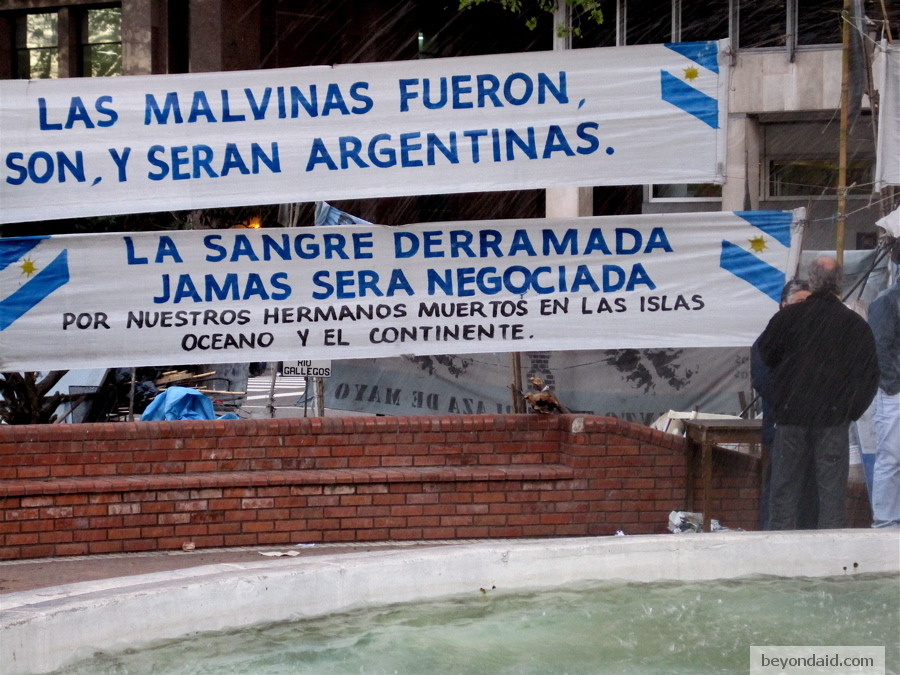
The Guardian reports on the escalating tensions between London and Buenos Aires that saw British Prime Minister David Cameron accuse Argentina of holding a “colonialist attitude” toward the Falkland Islands, a longtime British colony.
“Hector Timerman, [Argentina’s] foreign minister, described Britain as ‘a synonym for colonialism.’ He was quoted by Reuters as saying: ‘Evidently at a time when only scraps of colonialism linger, Great Britain … has decided to rewrite history.’ ”

The war within
Former US secretary of labour Robert Reich argues the current “crisis of capitalism” is the result of a lopsided conflict between consumers and investors on the one hand, and workers and citizens on the other.
“And since most of us occupy all four roles, the real crisis centres on the increasing efficiency by which we as consumers and investors can get great deals, and our declining capacity to be heard as workers and citizens.

As a result, consumers and investors are doing increasingly well but job insecurity is on the rise, inequality is widening, communities are becoming less stable and climate change is worsening. None of this is sustainable over the long term but no one has yet figured out a way to get capitalism back into balance. Blame global finance and worldwide corporations all you want. But save some of your blame for the insatiable consumers and investors inhabiting almost every one of us, who are entirely complicit.”

Irreconcilable differences
The Overseas Development Institute’s Claire Melamed argues the current consensus over bringing development and environment agendas closer together may be short-lived.
“But there is a danger to this approach – exemplified in the call for SDGs to also tackle ‘sustainable consumption and production patterns’.  This gets to the heart of what makes the whole issue of sustainability so politically toxic.  Sustainable consumption patterns would almost certainly mean some people on the planet consuming less so others could consume more.  Similarly on production – if developing countries are going to grow, and if technology doesn’t ride to the rescue, it’s at least possible that ‘sustainable’ might mean the rich world producing less.”

Immoral economy
Columbia University’s Jeffrey Sachs argues there are four ways in which self-interest, which is the very foundation of capitalism, “fails to support the common good.”
“Second, it can easily turn into unacceptable inequality. The reasons are legion: luck; aptitude; inheritance; winner-takes-all-markets; fraud; and perhaps most insidiously, the conversion of wealth into power, in order to gain even greater wealth.
Third, self-interest leaves future generations at the mercy of today’s generation. Environmental unsustainability is a gross inequality of wellbeing across generations rather than across social classes.”

Misguided journey
The University of Ottawa’s Nipa Banerjee gives a harsh assessment of the state of the international development industry in the wake of last month’s summit in Busan.
“The pre-Busan evaluations and Busan discussions clearly reflect a misguided journey of the Western-centric donors who are running the wheels of a self-serving aid industry. While some of the non-traditional non-Eurocentric donors, such as China, Brazil, and India, represented themselves in Busan, they took rather low-profile positions, with none officially joining the OECD’s Development Assistance Committee, in endorsement of the self-reproducing development support industries. Most of these new donors had once been roped into a monstrous global aid industry and well experienced the fruitlessness of spending time in delving into reams of paperwork, policy papers, development programming, and evaluations, nursing the illusions of effective aid.”

Multilateral failures
Writer James Denselow reviews a pair of new books on global revolution, including the latest by Carne Ross whom he describes as a former diplomat “transformed into a thinking man’s neo-anarchist.”
“The nation-state represents an archaic and ill-fitting answer to multifaceted non-localized issues, brought on by the pressures of globalisation and climate change. From flu-epidemics, to the spread of rioting, he carefully plots the ways in which our interconnectedness has led to problems which require global cooperation to solve. Yet the best efforts at multilateral cooperation have yet to deliver the answers. Ross parallels the enormous rhetoric of the 2005 G8’s promise to ‘make poverty history’ with the reality of its ‘utter failure’ to do so with a shortfall in pledges of $20 billion.”

Blue helmet blues
The Inter Press Service speaks to a number of experts about the evolving role of UN peacekeeping and the reputational hits such missions have taken in recent years.
“ ‘In the Congo, the U.N. is not exactly neutral, going after militias on behalf of the government,’ says Sean Maloney, a professor at the Royal Military College in Kingston Ontario.

Maloney told IPS the impartial style of peacekeeping as represented by Canadians serving as U.N. soldiers and keeping armed Greek and Turkish-speaking people at bay in Cyprus in the 1970s was rendered ‘obsolete’ starting in the 1990s.
‘We are going to see more interventions. They will be more coercion-style interventions (like the NATO mission in Afghanistan where Canada had upwards of 3,000 soldiers) that will be siding with one side or another,’ adds Maloney, describing himself as pro-military and ‘libertarian’.”

Latest Developments, January 17

In the latest news and analysis…

Resource nationalism
British consulting group Maplecroft has added “resource nationalism” in some of the world’s poorest countries to the latest edition of its annual Political Risk Atlas, which identifies potential problems around the globe for businesses and investors.
“Potential actions by governments can include nationalising an entire industry. For example, in August 2011, Venezuela’s President Hugo Chavez announced his intention to nationalise the country’s gold industry. Likewise in Guinea in 2010, the state sought a renegotiation of contracts, saying it would become a minority shareholder in all mining contracts. Comparable events have occurred in 2011 in other parts of South America and Africa and are likely to be repeated, especially if a global economic slowdown begins to cut into government tax revenues.”

Fueling hunger
The Center for Global Development’s Kimberly Ann Elliott welcomes the end of billions in US subsidies for biofuels but laments the fact that “advanced biofuels that are not food-based are still not available.”
“For developing countries, that means that corn-based ethanol will remain the major biofuel in the United States, diverting a third or more of the corn crop and keeping upward pressure on food prices. The elimination of the blenders’ credit will do little to change that because, while the subsidy bolstered producer profitability when corn prices spiked in 2008 and again last year, it was not a major factor driving demand for ethanol. The congressional mandate requiring that biofuels be blended into gasoline put a floor under the market, which encouraged investment.  Thus, actual production has exceeded the mandated level in every year because oil prices have been high enough to make ethanol competitive.”

Sins of emission
Mongabay reports on an Atlanta-based company that emits more greenhouse gases than Finland and owns the top three facilities on the US Environmental Protection Agency’s list of the top 100 sources of emissions in the country.
“For its part, Southern Company told the Atlanta Journal-Constitution that their emissions are ‘indicative’ of their power plants ‘being among the nation’s largest generators of electricity,’ adding that, ‘Southern Company complies with all environmental regulations and supports transparency in emissions reporting. The company is a leader in environmental research, development and implementation.’ Southern company serves around 4 million people. In 2014 the corporation is opening a new coal plant in Mississippi that will reportedly capture 60 percent of its greenhouse gas emissions.
According to its records Southern Company spent over $8 million in lobbying the U.S. government last year. A profile of the company on OpenSecrets.org, run by nonpartisan Center for Responsive Politics, reads ‘Southern has been one of the biggest proponents for electricity deregulation” and “gives most of its money to Republicans.’ ”

Re-assigning blame
The New School for Social Research’s Tarak Barkawi is perplexed by the use of the word “inhuman” to describe a video apparently showing US marines urinating on the dead bodies of Taliban fighters in Afghanistan.
“For senior US officials to help purvey accusations of the worst kind against the US military – as inhuman – makes little sense. While offering assurances that they will clean house, they should strongly distance themselves from the notion that this is a peculiarly US issue. Iraqis, Afghans, Americans and others have been mutilating each others’ corpses for some years now.
Such officials ought to remember also that these are the kinds of things that happen in the wars they are themselves directing. As the Japanese officer quoted above remarked, “it is the war that forces us to do the killing”.
For the rest of us in the liberal-minded citizenry, we would do well to recall that wars are initiated and sustained by leaders and governments, and by the powerful interests and passions that back them.
To vent frustration for this situation by easy condemnation of some young enlisted marines is a bit like pissing on corpses.”

Corporate charity
The Overseas Development Institute’s Jonathan Glennie asks if “big company charity” is really better for the poor than “transforming core business practices” would be.
“In Western Union’s case, the big issue is transaction charges. There is a strong case that simply giving money to the poor (especially women) is the best way to help them out of poverty. So, without doubting the good work being done by Western Union, is spending through a foundation more effective than simply reducing the transaction charge and letting poor people purchase the things they know they need, such as better food, drugs or schooling?

Fundamentally, we should be wary of applauding corporates for charitable giving which, generally speaking, is concerned as much with PR as development outcomes, and is essentially funded by the taxpayer or consumer anyway.”

Demanding justice
Oxfam’s Farah Karimi argues “changing the division of power” in the world is necessary to ensure everyone has access to land, food, water and other essential but increasingly scarce resources.
“There is a third challenge, besides increased scarcity and shrinking political space: the current governance gap. The old governance system dominated by Western industrialized countries is in decay, while a new system that reflects the new global power relations isn’t yet functioning. Of course the G20 has emerged– but key issues such as poverty, justice and sustainable development don’t really feature on the G20’s agenda. The power and impact of globally operating companies is growing, enhancing the need for global governance. But the G20 doesn’t at all succeed in addressing vital global challenges or guaranteeing global goods.”

That which shall not be named
Intellectual Property Watch reports on a speech by World Health Organization head Margaret Chan, in which she praised the global body for its “consistent ability” to forge agreements on fair IP rules, though as the article goes on to say, the issue of counterfeit medicines has been particularly problematic.
“Chan did not directly mention the issue of counterfeit and substandard medical products by name, perhaps because of the difficulty in finding acceptable words by which to refer to it. The issue of “substandard/spurious/falsely-labelled/falsified/counterfeit medical products” – as it has been dubbed by member states in an effort to appease all sides – has been controversial at WHO in recent years. But members managed to agree in October on a new mechanism for addressing the issue.”

Latest Developments, January 13

In the latest news and analysis…

Violent hemisphere
The Washington Post reports on a new study suggesting 45 of the world’s 50 most violent cities are located in the Western Hemisphere, many of them caught up in the tension between an insatiable American market and prohibition policies.
“[Honduras’s] San Pedro Sulla tallied 159 homicides per 100,000 residents last year, followed by [Mexico’s] Ciudad Juarez, with 148 killings per 100,000. Both cities are major operational and strategic distribution points along the billion-dollar drug pipeline that funnels narcotics to consumers in the United States.”

Apple opens up
Reuters reports Apple has made public its “closely guarded” list of global suppliers in the face of criticism over perceived indifference to worker abuses.
“The audit conducted by Apple of suppliers found a number of violations, among them breaches in pay, benefits and environmental practices in plants in China, which figured prominently throughout the 500-page report Apple issued.
Other violations unearthed included dumping wastewater onto a neighboring farm, using machines without safeguards, testing workers for pregnancy and falsifying pay records.”

German banks vs. financial transaction tax
Bloomberg reports that Germany’s banks have expressed their opposition to a tax on financial transactions in the euro zone.
“ ‘If a financial-transaction tax cannot be introduced internationally, you have to do without it,’ Hans Reckers, managing director of Germany’s VOeB association of public banks, said in an e-mailed statement today. ‘We firmly oppose the creation of tax haven in the EU.’

The European Commission in September suggested a tax of 0.1 percent on equity and bond transactions and 0.01 percent on derivatives, which it said could raise 55 billion euros ($70 billion) a year. European Union finance ministers are due to discuss the levy in March.”

Diminishing solidarity
Le Monde reports on the contentious debate over whether a financial transaction tax, if one is ever adopted, would have much in common with Robin Hood.
“The NGO Oxfam worries about the change in [French President] Nicolas Sarkozy’s position, noting that he had said at the G20 summit in early November ‘a significant portion, the majority or the totality of the revenue must go to development.’ But he has since changed his mind, according to Oxfam’s Luc Lamprière: ‘His reference to the European Commission directive is a bad sign since it calls for the tax to ‘progressively replace national contributions to the EU budget,’ leaving the idea of financing development and the fight against climate change as a mere footnote.’ ” (Translated from the French)

Rio+20 agenda
The International Institute for Environment and Development’s Emily Benson grades the just-released draft agenda for the Rio+20 summit, finding it stronger on sentiment than specifics.
“Mention is made to ‘innovative instruments of finance’ for building green economies and reference is made to public procurement, fiscal reform, the removal of subsidies that undermine sustainable development, all of which the [Green Economy] Coalition has been promoting. It calls for International Financial Institutions to ‘review their programmatic strategies to ensure the provision of better support to developing countries for the implementation of sustainable development’. This is all encouraging stuff. However, the text steps rather delicately around the question not only of how much the transition is going to cost, but how we are going to leverage additional funds. From our past experience of Rio 1992 we know that governments alone will not be able to pay for the transition so we need to think a lot more creatively about how to leverage additional finance. So, the question we would like to see tackled in the next draft is:  How are we going to kick-start the finance of a green and fair economy in order to create long-term investor confidence?”

Burma beware
The Institute of Development Studies’ Gabriele Köhler argues Myanmar must be wary, as it opens up to the world beyond Asia, of the West’s conquering friendship.
“We can hope that the west’s sudden enthusiasm stems from genuine support for peace and the rights of the population. But in reality, the change in stance probably has at least as much to do with pursuit of their own national interests. For several decades, US and European sanctions have kept western businesses out of Burma, while firms from Thailand, Singapore, India and especially China eagerly exploited the country’s natural gas, hydropower potential and gemstones.
History has shown time and again that popular movements for civil liberties, democracy and human rights are often hijacked by a drive to introduce neoliberal capitalism or prise open a country to foreign investors.”

Carbon fixation
The Land Institute’s Stan Cox argues that current schemes to reduce carbon emissions could actually make it harder for future generations to provide for themselves.
“To value everything in terms of carbon and treat the myriad benefits of ecologically sound agriculture as mere byproducts of climate protection is to invite all kinds of threats to soil and food. Perhaps the most menacing threats are those posed by connecting food and soil more tightly to global capital markets through carbon-trading schemes and tying them more closely to volatile energy markets by putting already fragile soils to work growing biofuels.

Occupying Occupy
Author and blogger Carne Ross warns that the appropriation of Occupy slogans, by mainstream politicians and crockery shops, has begun.
“As the ‘68-ers manifestly failed to do, Occupy must move from words to action, for relying on the platform of words will see the ground cut from under our feet. In contrast to the ease with which they can steal the words of Occupy, the [Newt] Gingrich’s of this world will not be able to appropriate actions consonant with the ideals of Occupy for this would be to enact Occupy’s sought revolution.  And that won’t happen in a century of Sundays.”