
Latest Developments, May 10

In the latest news and analysis…

Symbolic shift
The New York Times reports that US President Barack Obama has said he thinks same-sex marriage should be legal.
“While Mr. Obama’s announcement was significant from a symbolic standpoint, more important as a practical matter were Mr. Obama’s decision not to enforce the marriage act and his successful push in 2010 to repeal the ‘don’t ask, don’t tell’ law that prohibited openly gay men and lesbians from serving in the military. For that reason, gay rights groups had been largely enthusiastic about his re-election campaign while being pragmatically resigned to his not publicly supporting same-sex marriage before the election.
Mr. Obama’s announcement has little substantive impact — as an aide said, ‘It’s not like we’re trying to pass legislation.’ ”

Development triumvirate
The Guardian reports that the UN has appointed British Prime Minister David Cameron, Indonesian President Susilo Bambang Yudhoyono and Liberian President Ellen Johnson Sirleaf to lead efforts on coming up with post-2015 successors to the Millennium Development Goals.
“The three leaders will represent the world’s rich, middle- and low-income countries.

The Overseas Development Institute’s Claire] Melamed said the panel can be expected to restate the existing agenda, considering the failure to reach many of the targets, and discuss growth and employment, areas on which it will be relatively easy to reach agreement.
‘It will be trickier on more social and political issues such as governance and accountability,” she said. “When you reach down into talking about the how rather than how much, I imagine that will be more difficult.’ ”

New bedfellows
The Financial Times reports on the apparent shift “from confrontation to collaboration” in the relationship between NGOs and big business.
“Ironically, the new-found harmony between NGOs and business reflects a less happy reality: that the scale of problems we face – such as food security, water preservation and child labour – are simply too large for any one group or international forum to tackle. ‘The global middle class will grow from 2bn to 5bn in 20 years and lead to huge change in agriculture,’ explains Andy Wales, senior vice-president, sustainable development at SABMiller. ‘There is no way any sector on its own can do that.’
However, Mr Wales and his peers are equally clear that resolving these problems is dictated by self-interest rather than pure altruism.

NGOs are useful bodies to have on board when it comes to a second catalyst: securing raw material supplies – as illustrated by the farmers working with NGOs and SABMiller.”

Illegal bill
Embassy Magazine reports that a UN official has said that certain aspects of the Canadian government’s proposed new refugee policy would be at odds with international law.
“Chief among the parts of the bill worrying to [UNHCR’s Furio] De Angelis was one that lets the government detain an asylum seeker from an ‘irregular arrival,’ such as the boatload of 492 Tamils that arrived on British Columbia’s shores two years ago, for up to a year without review.
That is ‘at variance,’ he said in an interview after his testimony, with part of the UN convention that states that countries, such as Canada, that play by its rules shouldn’t penalize refugees who might enter illegally or restrict their movements unless necessary.
‘UNHCR strongly recommends that the government refrain from introducing a mandatory detention regime for irregular arrivals in relation to refugees and asylum seekers, and that alternatives to detention be explored,” said Mr. De Angelis during his testimony.’ ”

Playing with food
The “casino” that is food speculation must be shut down, acording to Frederick Kaufman, a contributing editor at Harper’s Magazine.
“Commodity markets stand at the base of the $600tn global derivatives business, a generally unregulated miasma of over-the-counter swaps, index fund madness, and Wall Street roulette that ignited the mortgage meltdown, toppled AIG and Lehman Brothers, spurred the global currency crisis, and produced the present sorry state of the global economy, whereby a few chosen hedge fund managers haul in billions of dollars while 1 billion human beings find themselves unable to scrape together enough to eat.

All of which leads to the inevitable conclusion that the only way to stop speculation in food commodities is neither high-level debate nor regulation – how quaint and New Dealish – but criminalisation. Indeed, US senator Maria Cantwell and US congressman Ed Markey are now crafting a bill to make gambling on the world’s food supply illegal.”

Inequality numbers
Oxfam’s Duncan Green reviews (and quotes at length) a paper on inequality by the University of Cambridge’s Gabriel Palma, which contains findings Green considers “extremely important.”
“What [the graph] shows is that the real driver of inequality variations within countries is the richest 10% (and probably only the richest fraction of them). Even the next richest 10% basically gets the same chunk of national income across all countries. Palma puts this down to ‘one of the key characteristics of neo-liberal economic reforms: its ‘winner-takes-all’ proclivity.’ ”

Banned ingredients
Simon Fraser University’s Paul Meyer argues for fundamental changes to the international negotiation process at the heart of nuclear disarmament efforts.
“Not since a couple of weeks in the summer of 1998 has the Conference on Disarmament been able to undertake official work on a fissile material ban. Fourteen years of idleness on this, as all the while certain states continue to add to their stockpiles of fissile material and the nuclear weapons fashioned from them.
It doesn’t take a deep student of diplomatic affairs to discern the link between the consensus-based conference’s inability to agree on a programme of work including a fissile material ban, and the fact that amongst its member states it counts those still actively producing this essential nuclear weapon material.
To be repeating this formula in the face of almost fifteen years of inaction would seem to represent the triumph of hope over experience—or to put it more bluntly, of convenience over commitment.”

Tax cuts
Harvard’s Steven Strauss looks into the “article of faith among conservatives” that lower taxes create wealth for everyone.
“Actually the post World War II American economy provides a nice empirical test of this hypothesis — the maximum marginal income tax rate gradually declined from about 90% to about 35%. Shouldn’t this decline have lead to an explosion of economic growth as our wealth creators were unleashed? Sorry, Sarah Palin… it didn’t.
During the ultra high tax 1950s (top marginal income tax rate of 90%), the United States had some of its best real economic growth (over 4%/year). And, for the decade where we had our lowest marginal income tax rates — we had our worst real economic growth (about 1.5%/year).”

Latest Developments, May 9

In the latest news and analysis…

Thriving havens
The Guardian reports on a new study suggesting the G20’s attempted crackdown on tax havens has “largely failed” so far.
“Despite unprecedented action from political leaders, and a blizzard of bilateral co-operation treaties entered into by offshore centres, deposit data from the Bank of International Settlements (BIS) shows bank accounts in tax havens still held $2.7tn (£1.7tn) last year – about the same amount as in 2007.

However, [the study’s authors, Niels Johannesen and Gabriel Zucman] also noted that those withdrawing deposits around the time of co-operation treaties – possible tax evaders – were frequently shifting their wealth to other, similarly secretive, offshore centres where no such equivalent treaty existed.”

With donors like these…
Inter Press Service reports on a new Center for Economic and Policy Research paper that suggests policies being prescribed by the IMF and other donors could send Jamaica’s economy into a downward spiral.
“Jamaica is currently paying more debt interest than any other country, including those in Europe that have been reeling under the near collapse of the euro. In total, the island owes around 18 billion dollars.
‘Pro-cyclical macroeconomic policies, implemented under the auspices of the IMF, damaged Jamaica’s recent and current economic prospects,’ the report warns.
‘This policy mix risks perpetuating an unsustainable cycle where public spending cuts lead to low growth, exacerbating the public debt burden and eventually leading to further cuts and even lower growth.’ ”

Climate investment
The Financial Times reports on a new initiative that will ask the world’s 1,000 biggest institutional investors to report on their portfolio’s carbon footprint.
“Julian Poulter, executive director of the [Asset Owners’ Disclosure Project], says these investors manage more than $52tn, ‘and of this less than 2 per cent is invested in low carbon assets, while 50-60 per cent is invested in high carbon assets, whether that’s in energy, transport, agriculture, mining or property’.

‘The AODP is the last piece in the puzzle. The [Carbon Disclosure Project] has done a lot to generate a database of emissions and investors signed up to the [UN] Principles for Responsible Investment are demonstrating their intent to invest sustainably,’ Mr Poulter says. ‘What is missing is the driver that will make asset owners implement better investment practices. It is really important that we have some measurement of what the owners are doing.’ ”

Destroyed tapes
The BBC speaks to former senior CIA official Jose Rodriguez about his decision to destroy video documentation of his agency’s “enhanced interrogation techniques.”
Three days after the tapes had been shredded, a CIA memorandum, since released under America’s Freedom of Information Act, reported comments by Jose Rodriguez:
‘As Jose said, the heat from destroying [the tapes] is nothing compared to what it would be if the tapes got into the public domain – he said that out of context they would make us look terrible – it would be devastating to us. All in the room agreed.’
I put this to Rodriguez and he was typically upfront about it.
‘I said that, yes. If you’re waterboarding somebody and they’re naked, of course that was a concern of mine.’

Questionable friends
The Guardian reports on an upcoming parliamentary inquiry into the British government’s “involvement in supporting dubious practices overseas” over the last 40 years.
“The bosses of the world’s biggest multinational defence and oil companies, including BAE Systems and BP, will be asked to account for why hundreds of millions of pounds of government money was used to help military dictators build up their arsenals, and facilitated environmental and human rights abuses across the world.

The inquiry has no legal power to force industry executives or former politicians to provide evidence.”

IP’s uncertain future
Intellectual Property Watch reports that members of the World Intellectual Property Organization are engaged in a struggle to shape the UN agency’s “development orientation.”
On the first day [of WIPO’s Committee on Development and Intellectual Property meeting], an attempt was made again by developing countries to create a permanent agenda item on “IP and development,” which developed countries again resisted on the grounds that it is repetitive with the title of the committee itself. But developing countries’ concern is that broader issues of IP and development do not have a place in a committee that spends most of its time working through specific projects. They have raised this issue for several years.

Medical impartiality
Roehampton University’s Martin Stanton asks how it is that Briton Khalil Dale could have been kidnapped and killed, not in spite of his being a humanitarian worker, but because of it .
“First of all, the US Anti-Terror Law judges the provision of medical aid to ‘terrorists’, or negotiation with ‘terrorists’ to gain access to wounded, starving or destitute civilians, to constitute a major criminal offence. This has actively removed any identifiable ‘neutral’ status for doctors, nurses or allied health professionals in battlefield, conflict or famines zone. You are either for the ‘terrorists’ or against them.

It is alarming indeed to contemplate that troops might open fire on ambulances and hospitals, but it is truly terrifying to observe the covert removal of the basic human right of everyone to receive healthcare, irrespective of their social, religious, financial or political status.”

RIP Poco
Columbia University’s Hamid Dabashi argues the Arab Spring marked the end of postcolonialism.
“These uprisings have already moved beyond race and religion, sects and ideologies, pro- or anti-Western. The term ‘West’ is more meaningless today than ever before – it has lost its potency, and with it the notion, and the condition, we had code-named postcoloniality. The East, the West, the Oriental, the colonial, the postcolonial – they are no more. What we are witnessing unfold in what used to be called ‘the Middle East’ (and beyond) marks the end of postcolonial ideological formations – and that is precisely the principal argument informing the way this book discusses and celebrates the Arab Spring. The postcolonial did not overcome the colonial; it exacerbated it by negation. The Arab Spring has overcome them both.”

Latest Developments, May 8

In the latest news and analysis…

Big deal
Inter Press Service reports that closed-door talks are set to resume around the multilateral Trans-Pacific Partnership – potentially the biggest trade deal ever signed by the US – with major implications for global health.
“While U.S. global health policy has seen significant strengthening over the past five years, passage of the TPP ‘would start rolling this back,’ warns Peter Maybarduk, director of the Access to Medicines Program at Public Citizen, a consumer advocacy group here.
Worldwide over the past 10 years, prices for HIV-related medicines, for instance, have fallen by 99 percent, largely driven by competition from generic drugs. While the fight against generics by large pharmaceutical interests has largely shifted away from the WTO, Maybarduk suggests, the TPP agreement signals the next iteration of that effort.
‘The TPP could well be the worst that we have seen,’ Maybarduk says. ‘Not only does it run contrary to the U.S.’s own pledges on global AIDS work, but the TPP will set the template for the entire Asia- Pacific region. That could have an impact on half of the world’s population.’ ”

Tackling overfishing
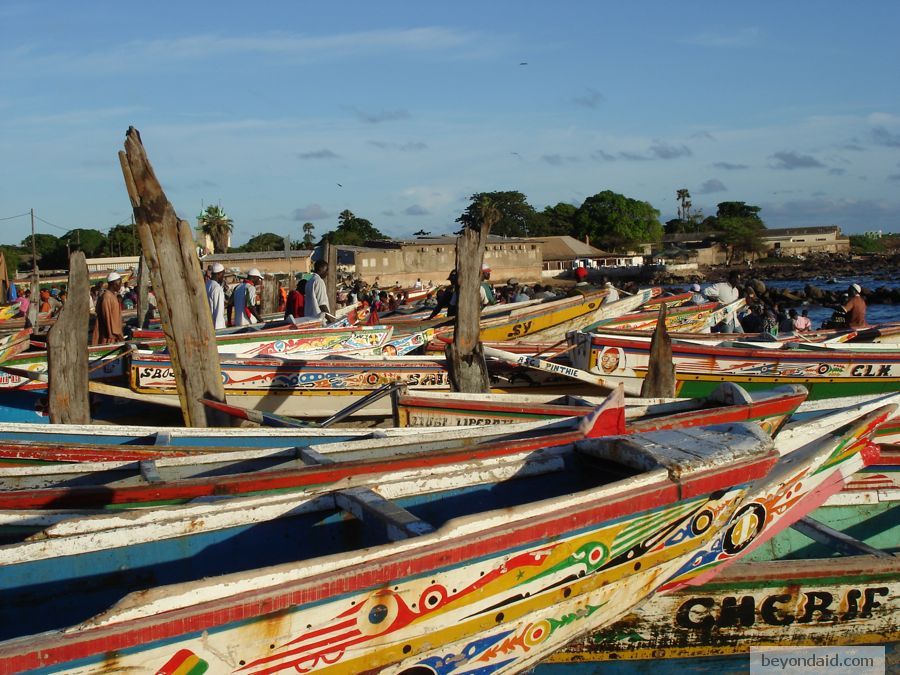
The Guardian reports that Senegal’s new government has revoked the fishing licenses of 29 foreign trawlers.
“Hunger is growing in Senegal and other Sahelian countries, but much of the catch by the foreign fleets ends up in Britain and the EU after being exported from ports like Las Palmas in the Canary Islands. Local fishing industry leaders in Senegal, Cape Verde, Mauritania and elsewhere say catches from inshore fishing have been decimated in the past 10 years because of overfishing. In addition, many other ‘pirate’ trawlers operate illegally in west African waters, further decimating stocks.
‘Senegal’s only resource is the sea,’ said Abdou Karim Sall, president of the Fishermen’s Association of Joal and the Committee of Marine Reserves in West Africa. ‘Unless something changes there will be a catastrophe for livelihoods, employment and food security.’ ”

Financial services hype
Juraj Dobrila University’s Milford Bateman argues that the “financial inclusion agenda” promoted by the World Bank is “nonsense.”
“First, as ever, there is the overarching effort to try to get the poor to uncritically accept the tools the rich have used to acquire their great wealth and become powerful. Finance is one of these tools. By claiming that helping the poor to ‘manage their money better’ will rapidly lead to economic and social benefits, the promoters of the financial inclusion agenda hope the poor will abandon any possible interest in supporting the collective capabilities and initiatives that history shows have massively empowered them. I would include here trade unions, social movements, strongly regulated labour markets, universal healthcare, public sector employment, a ‘developmental state’ and, most of all, the programmed redistribution of wealth and power.”

Islamophobia
The East London Communities Organisation’s Muhammad Abdul Bari writes that Europe’s “counter-jihad movement” poses a serious threat to the continent’s communal harmony.
“It is disheartening that a continent that had learnt many lessons in such a hard way, after the devastation of the two World Wars, and which prides itself in equality and human rights, is allowing itself to be influenced by the forces of intolerance and hate. It is now open season to malign Muslims because of their religious and cultural practices. Yet Muslim immigrants arriving after the war joined in the effort to rebuild the economies of war-torn Europe in the 1950s. In almost every field of life, Muslims have been an integral part of the European tapestry. Muslims are today at home in Europe, have been contributors to its past and are stakeholders in its future.
Yet the language and rhetoric used by the Far Right and the level of political expediency in mainstream European politics is mind boggling. The hate mongers are apparently succeeding in swapping a racist agenda for an Islamophobic one. The lacklustre response from European leaders has paved the way for anti-Muslim bigotry to move closer to the mainstream.”

Bribery’s cost
In a letter to the Wall Street Journal, Global Financial Integrity’s Clark Gascoigne argues that the sort of bribery Wal-Mart is alleged to have committed in Mexico is neither victimless nor unavoidable.
“Environmental regulations exist for many reasons—to protect the health, safety and well-being of the community. If environmental laws were circumvented to build a new Wal-Mart supercenter too close to an important watershed, for example, drinking water could be contaminated and people could become sick or die.

While bribery is pervasive in Mexican society, it is very difficult for small businesses and local residents to escape paying up. They don’t carry the weight needed to change an entire society. However, a major company like Wal-Mart—with the promise of bringing thousands of jobs to local Mexican communities—has the leverage needed to say no to corruption and still conduct business. The company, apparently, chose not to do that.”

Immigration targeting
The Globe and Mail reports on concerns that Canada’s immigration policy is moving away from 50 years of trying to remove race and national origin from the equation.
“Overall it would be a mistake, says [Dalhousie University’s Howard Ramos], to conceive of the uneven outcomes for different immigrant groups as evidence that immigration was failing.
‘Immigrants in Canada have a high degree of integration. This [language] policy doesn’t reflect that success at all. It’s creating a problem where I don’t necessarily think a problem exists,’ he says. ‘The points system was introduced to correct the injustices of focusing on culture and language too heavily. It was a society and a time that was much more ethnocentric – and I don’t think it’s a time we should try and return to.’ ”

Democracy undone
Inter Press Service reports on some of the problems bilateral investment treaties pose for governments wishing to implement sound public policy.
“ ‘Foreign investors may challenge, in an international arbitration process, any change in law and policy to protect the environment and public health, to promote social or cultural goals, or to grapple with financial or economic crises. However, it is impossible to predict the outcome with any precision because each will depend in large part on the composition of the arbitral tribunal deciding the case, which consists of three highly-paid individuals, typically specialized in commercial rather than public law,’ [according to the International Institute for Sustainable Developments Nathalie Bernasconi].

‘A lack of transparency, unpredictability and conflicts of interest have simply become unacceptable. This discontent has led countries like Australia to disfavor investor-state dispute settlement entirely and others to terminate their investment treaties.
‘Watching these developments, countries like Brazil, which never ratified any of its investment treaties, must count themselves lucky,’ she added.”

Latest Developments, May 4

In the latest news and analysis…

80 years
Agence France-Presse reports that the chief prosecutor in the Charles Taylor trial is recommending the former Liberian president, who was found guilty by the Special Court for Sierra Leone in The Hague last week, be sentenced to 80 years in prison.
“The prosecutor said the term would be fair given Taylor’s role in arming and aiding rebels who killed and mutilated thousands in neighbouring Sierra Leone during the 1991-2001 civil war, one of the most brutal conflicts in modern history.

Taylor, Liberia’s president from 1997 to 2003, had dismissed the charges as ‘lies’ and claimed to be the victim of a plot by ‘powerful countries.’ ”

Playing for time
Intellectual Property Watch reports that Switzerland is pushing for the World Health Organization to delay this month’s planned negotiations on a mechanism for funding research and development into diseases that predominantly impact poor people.
“The proposal calls for ‘informal, in-depth consultations with Member States on the appropriateness and feasibility of the recommendations contained in the report, in particular concerning a globally binding instrument on research and development, together with the funding implications of such an instrument.’

The recommendation to proceed to negotiations for a binding instrument on R&D came from an in-depth two-year process under the Consultative Expert Working Group on research and development.”

Rational migration
The UN News Centre reports on the launch of a new study into the impacts of European immigration and border policies on the human rights of migrants.
“The year-long study, which will begin with a three-day trip to Brussels, will examine the EU directives as well as national policies in place with respect to visa regimes and border control, and will assess interception practices on land and sea, detention conditions, returns, and readmission.

‘Although migration to and from the European region is not a new phenomenon, since the 1990s the region has witnessed a sharp increase in migration movements,” [UN Special Rapporteur on the human rights of migrants, François Crépeau] said, calling for the international community “to embrace a new, balanced discourse on migration based on equal rights, non-discrimination and dignity, as well as on reality.’ ”

Extinction woes
Mother Jones reports that a new meta-analysis of recent scientific research suggests that high levels of species extinction are as dangerous as global warming for humans.
“Studies in the past 20 years have demonstrated that more biologically diverse ecosystems are more productive. So there’s growing concern that the very high rates of modern extinctions from habitat loss, overharvesting, pollution, biological invasions, human overpopulation, and other human-caused environmental changes will diminish nature’s ability to provide goods and services important to all life (ours too)… like food, clean water, and a stable climate. ”

Saving independent journalism
On World Press Freedom Day, the Columbia Journalism Review reproduces part of a recent Rebecca MacKinnon talk, in which the Internet freedom activist identifies iPhone apps, social media privacy policies and intellectual property legislation as serious threats to independent journalism and democracy.
“The problem with apps is that they give the companies that run the platforms that deliver content to their devices an opportunity to censor and discriminate against certain content—not only when governments require it, but also for business reasons, or for no clear reason.

News and media companies that do care about the future of journalism and democracy must not turn a blind eye to Apple’s arbitrary censorship. The point is not that they should avoid Apple apps and their relationships with Apple. The point is that since the law and the constitution are apparently useless against private censorship and discrimination, the only way to get Apple to operate in a democracy-compatible manner is if Apple’s customers, business partners, and investors insist on it.”

Colonial borders
Washington State University’s Peter Chilson writes that the current troubles in Mali are traceable, in part, to the arbitrary borders France imposed on its former West African colonies.
“Over the years I’ve spent a lot of time on Koulouba, working in the archive on the palace grounds, which houses Mali’s oldest colonial documents, papers the French failed to destroy or take with them at independence in 1960. In those archives, and others across the region, I figured out that the French left behind no paperwork to legally justify the borders that frame the eight countries of French West Africa, all former colonies, with Mali at the center. There is no evidence that any official, French or African, actually walked the political lines to clearly lay them out at independence. This is a big part of what brings us to this mess, a Mali that has no clear government leadership and whose very shape is now stamped with a question mark.”

A questionable choice
The Overseas Development Institute’s Jonathan Glennie argues that British Prime Minister David Cameron, as the leader of a rich country, is “not very” qualified to take the lead on establishing successors to the Millennium Development Goals.
“To date there is no evidence of any understanding on his part of the problems facing developing countries.
His only credential, and the reason he got the job, is that his government has demonstrated a commitment to aid increases, which are wrongly seen as a proxy for commitment to poverty reduction. Those calling for ever more aid should congratulate themselves that one outcome of their efforts is the leader of a rightwing Conservative-led government which is implementing structural adjustment at home being given a starring role in deciding the future of development for the next 15 years.”

Transnational justice
Al Jazeera asks if justice is really served when transnational corporations reach out-of-court settlements over alleged rights abuses committed abroad.
“Unlikely to get any redress in Peru, the victims sued Monterrico in the UK, with the help of British law firm Leigh Day and Co, alleging that the company had been complicit in the affair.
But though their prospects looked good, the case was settled by Monterrico last year just before it came to trial. It meant the victims did get some compensation – but the wider problems they were fighting to reveal were never aired in open court.
The case is an interesting example of a growing trend. Multinational companies are increasingly likely to respond to legal challenges in this way. The settlement costs can be high but usually they are far less than they would be after a negative verdict. And more importantly it gives the companies – and their lawyers – control of the public debate.”

Latest Developments, May 3

In the latest news and analysis…

Toothless embargoes
Oxfam has released a new report that shows countries under arms embargoes have imported over $2.2 billion in weapons and ammunition since 2000.
“This figure shows the extent to which states have been flagrantly flouting the 26 UN, regional or multilateral arms embargoes in force during this period. Oxfam is calling on the international community to put an end to decades of irresponsible arms deals which devastate people’s lives by agreeing a set of legally binding laws when diplomats meet to draw up a new Arms Trade Treaty in July 2012. Oxfam wants to see the new treaty place strict, unambiguous and legal obligations on states to control the global trade in arms.”

Protecting domestic workers
Human Rights Watch commends Uruguay for becoming the first country to ratify the international Domestic Workers Convention.
“The treaty, which extends core labor rights to an estimated 50 to 100 million domestic workers, will come into legal force when it is ratified by two countries.

The convention requires governments to provide domestic workers with labor protections equivalent to those of other workers, including for working hours, minimum wage coverage, overtime compensation, daily and weekly rest periods, social security, and maternity protection. It also includes specific protections for children, requiring governments to establish a minimum age for domestic work and ensuring that domestic work by children above that age does not interfere with their education.”

$300M allegation
CBC reports that a former executive with Canadian engineering giant SNC-Lavalin has been accused of using shell companies to pay the Gadhafi family more than $300 million.
“CBC has no proof of the substance of the allegations contained in the “poison pen” email, nor any evidence it relates in any way to the allegations [Riadh] Ben Aissa now faces in Switzerland.
Ben Aissa is also the executive who hired Cyndy Vanier, the Canadian consultant who is sitting in a Mexican jail. She is accused of plotting to smuggle Saadi Gadhafi — who had a long history of directing billions of dollars in construction projects to Ben Aissa – out of Libya last fall.

What is clear is that that the December email — amid media reports of Vanier’s arrest — sparked a cascade of internal company audits, revelations of missing millions and three high-profile resignations within the company, including that of Ben Aissa prior to his arrest.”

Military pact
Inter Press Service reports on opposition to a new agreement between the US and the Philippines on increased military cooperation.
“ ‘It is terribly discouraging that the Philippine government cannot figure out a truly healthy relationship with the U.S. – that is, a relationship that allows the Philippines to forge meaningful relationships with America as well as with its neighbours, including China,’ Gina Apostol, the author of a novel on the Philippine elite’s relationship with the U.S. military, told IPS.
‘We are too stuck on our historical relationship with America, even though it has been patently disgraceful and traumatic.’ ”

NGO accountability
The Center for Global Development’s Vijaya Ramachandran and Julie Walz discuss the recently published independent assessment of the US government’s response to Haiti’s 2010 earthquake.
“The report makes passing references to the lack of beneficiary and local involvement, the large number of NGOs operating in the country, and the fact that many organizations came to Haiti with no previous experience in disaster management.  Yet it states that “due to time and resource constraints, we were unable to explore these topics in great detail.”  Also, the report says that “no clear baseline or reporting mechanism was established” for NGOs receiving USAID funding.  These are big issues for the USG – especially if NGOs and private contractors continue to be the main channels through which the money is being disbursed.  The USG must look at various options to increase accountability—from easily-accessible quarterly reports to the standard accounting framework offered by the International Aid Transparency Initiative.”

Cluster bomb bill
Earl Turcotte, who led the Canadian delegation during the negotiation of the Convention on Cluster Munitions, says his country’s proposed legislation concerning the banned weapons is “the worst of any country” that has ratified the treaty.
“The Harper government is seeking exceptions that, among other things, will allow a Canadian commander of a multinational force to authorize or order forces outside the convention to use, acquire, possess, import or export cluster munitions.
As well, Canadian pilots or artillery personnel can use, acquire, possess or move cluster munitions while on secondment or attachment to outside states. Canadian Forces can also transport non-party state cluster munitions on Canadian carriers.
The legislation further proposes blanket exceptions that permit Canadian Forces to, in their words, ‘aid, abet, conspire, counsel and assist non-party State forces’ to carry out or escape from acts prohibited to convention states.”

Gods & consumers
Author Homero Aridjis writes that he was not surprised to hear that Wal-Mart was accused of paying $24 million worth of bribes in Mexico, given the histories of the company and his country.
“Walmart already had a history of controversial behavior in Mexico. Most notably, in November 2004, despite widespread opposition, the company opened a 72,000-square-foot store within the boundaries of the 2,000-year-old city of Teotihuacán, which features the Pyramids of the Sun and the Moon (“the place where men became gods” — or consumers?). Walmart has also built a supermarket on forested land in the resort town of Playa del Carmen, in Quintana Roo — though the permit for the building later turned out to have been granted for another site, on the island of Cozumel. The question now is who allows this, and in exchange for what?”

Legal hype
The University of Virginia’s Brandon Garrett argues that the growing number of companies being prosecuted under the Foreign Corrupt Practices Act does not necessarily mean that corporate accountability is thriving in America.
“Most of these FCPA cases are self-reported by the corporation itself — not uncovered by intrepid police-work. They should not make us think prosecutors now have enough resources to take on major corporations. After all, corporations routinely spend hundreds of millions of dollars on FCPA investigations and defense costs; prosecutors can hardly command such resources. Foreign corporations now pay the largest FCPA fines, and my data from the past decade shows that foreign corporations pay larger fines across a whole range of crimes.”