Latest Developments, June 30

In today’s news…

The US announced yesterday it had conducted a drone attack in Somalia, bringing to at least six the number of countries in which the CIA has conducted unmanned lethal attacks, after Afghanistan, Pakistan, Libya, Iraq and Yemen. A report out last week from the Oxford Research Group looks into the legal black hole of drone strikes. Its lead author recently argued: “It is high time to implement a global casualty recording mechanism which includes civilians so that finally every casualty of every conflict is identified. The law requires it, and drones provide no exemption from that requirement.” American officials declined to answer any questions about the Somali incident.

Transparency International asks what a good code of conduct for the defence industry might look like. Unsurprisingly, it does not look like wiring $9 million to the head of the Jordanian intelligence agency in order to ease the delivery of oil to American forces in Iraq, as new court filings suggest a Florida billionaire may have done in 2007.

Rezaul Karim Chowdhury calls World Bank climate adaptation loans “a form of trickery that will push us deeper into poverty”. The loans, he argues, will compound the hardship caused by climate change by increasing the debt load of countries such as Bangladesh.

A UN expert on foreign debt and human rights suggests Greece’s proposed austerity measures could threaten its citizens’ basic human rights, including the rights to water, food and adequate housing.

African governments look to forge a multilateral agreement aimed at protecting their tax revenues from harmful practices, such as transfer pricing by multinational corporations.

The Economist identifies Argentina, Brazil, Hong Kong, India, Indonesia, Turkey and Vietnam as the emerging markets whose economies are most likely to overheat. Pakistan and South Africa are among the least likely.

Latest Developments, June 29

In today’s news…

Two World Bank economists argue the best way to reduce corruption and ensure Africa benefits from the current commodity boom is for governments to transfer portions of the resulting revenues directly to their citizens. Of course, government corruption is not the only obstacle to translating mineral wealth into societal benefits. After a three-year dispute, Canada’s First Quantum Minerals has just agreed to pay $224 million in tax arrears to Zambia. The Reuters piece says: “According to the World Bank, copper is responsible for 70 to 75 percent of export earnings but the mining industry as a whole only contributes about 10 percent of Zambia’s tax revenue.”

In the wake of last week’s guilty plea by  another Canadian company, Niko Resources, for bribing a Bangladeshi official, Transparency International finds itself in the unusual position of praising Canada…sort of. In the same breath, the organization points out that Canadian law defines prosecutable foreign bribery cases excessively narrowly and calls for the revival of proposed improvements that died in 2009 when the minority government ended the parliamentary session prematurely.

As the US and Switzerland struggle to come to an agreement on dealing with tax avoidance, the Tax Justice Network suggests some Swiss media and banks are too cozy to allow a meaningful public discussion on the impacts of tax evasion. Perhaps a quick trip to Vienna is in order.

As things stand, US sanctions on Sudanese oil exports will not apply to South Sudan when it officially declares independence on July 9. Unless South Sudanese oil exports, which account for 98 percent of the government’s budget, pass north through Sudan. Which is the only way the pipelines run.

Le Monde Diplomatique’s Serge Halimi argues the current debt crisis represents a threat to democracy as much as the economy and asks (in French) if there is an alternative to “shock therapy.” Another article in the same publication provides the example of Ecuador’s 2008 constitution which stipulates public debt must not impact national sovereignty, human rights or environmental protection; public debt can only be incurred to improve infrastructure or to invest in projects that will pay for themselves; public debt refinancing is only an option if the new terms are advantageous to Ecuador; and the nationalization of private debt is prohibited.

The World Bank tweets: “The time to act is now. The world’s poor will suffer first and most from #climatechange. http://t.co/hPuEYUF,” while the UK House of Commons environmental audit committee slams the global lending institution’s energy policies, which may actually be making climate change worse.

Andrea Wechsler argues in Global Policy that “global governance arrangements must reach beyond the limited concept of intellectual property to knowledge as such and, thus, address global knowledge governance.” But a number of civil society organizations worry a new set of principles on Internet policymaking raises “cybersecurity and intellectual property rights to a level of importance that is comparable with internationally recognized individual human rights such as freedom of expression.”

Latest Developments, June 28

In today’s news…

As expected, Christine Lagarde has become the new head of the International Monetary Fund. The position came up for grabs when her predecessor resigned after being charged with sexual assault. But Lagarde may not be above reproach either, as she is currently under investigation for her her involvement in a questionable legal settlement involving 403 million euros in public money.

In the US, the trial of businessmen caught in a sting trying to defraud the people of Gabon is a sign of an increased willingness to crack down on Americans who try to bribe foreign officials. At the same time, an unassuming house in Cheyenne, Wyoming suggests tax havens are not just islands in the Caribbean.

British Prime Minister David Cameron reminds us his government is taking the lead on aid transparency. So far, only 12 governments are signatories to the International Aid Transparency Initiative. Germany is the only other G8 country among them.

Britain also found itself in a minority position when its delegates recently opted not to support a proposed International Labour Organization convention aimed at protecting the rights of domestic workers. Although the motion passed, the US, Canada and the Netherlands made it clear that in spite of their votes of support, they were unlikely to ratify the convention.

Argentina is not the only G20 country struggling to tackle money laundering. Up to $15 billion is laundered annually in Canada. And new statistics show its police only manage to identify a suspect in 18 percent of money laundering cases and prosecutors secure a conviction in just a third of trials in which money laundering is the most serious charge.

A number of civil society organizations have signed an open letter calling for the UN to establish an international tax cooperation body, while Christian Aid’s Julian Boys blasts the International Accounting Standards Board for secrecy he argues harms both the world’s poor and the IASB’s own interests.

Libya says the International Criminal Court arrest warrants issued against Gadhafi and his sons end any possibility of a negotiated settlement to the current conflict, thereby providing additional ammunition for those who argue international justice in its current form may actually harm the cause of peace in Africa.

Despite much fretting in wealthy countries about perceived mass influxes of refugees, a new UN report shows 80 percent of the world’s refugees are in poor countries, with Pakistan, Iran and Syria leading the way. The findings prompted UN High Commissioner for Refugees Antonio Guterres to speak of a “worrying unfairness in the international protection paradigm.”

The Overseas Development Institute’s Jonathan Glennie, a vocal proponent of “beyond aid” thinking, writes about reducing aid dependence rather than reducing aid. The former requires replacing aid money with other sources of revenue. The article draws extensively from a recent talk by a Uganda Revenue Authority official who asks: “Is foreign aid to Africa promoting the strengthening of tax administration or simply having a substitution effect?”


From the vaults: Religion and politics in Senegal

At the risk of deviating slightly from my mandate, I’ve decided to post an unpublished piece I wrote in 2007, shortly after covering Senegal’s last presidential election and one of the country’s major religious pilgrimages. I feel that the burning of a Jehovah’s Witness temple in suburban Dakar (in the very suburb where my narrative begins) over the weekend, as well as the recent controversy over proposed constitutional changes in the run-up to next year’s election, makes the piece timely again and I hope it can give a small insight into Senegal’s complex politico-religious culture.

But please do bear in mind the text is four years old, so the statistics at the very least are out of date. For an update on the interplay of politics and religion in Senegal, read this.
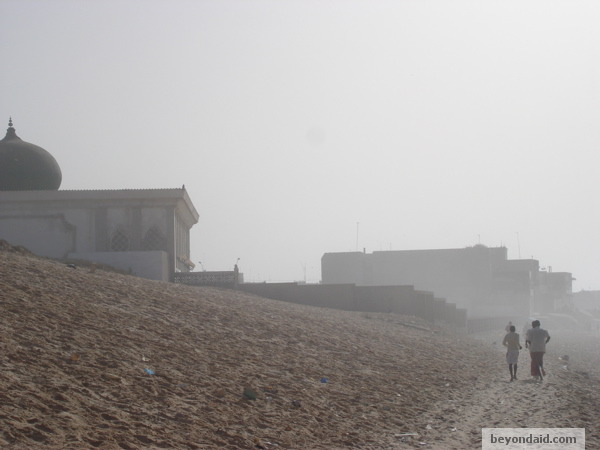
Dakar, Senegal – On the western edge of a city and a continent, a green-domed mausoleum sits just beyond the endless pounding of Atlantic breakers. “Sacred place. No sports allowed,” reads a sign in hand-painted French, staking out a little piece of sand for a 19th Century holy man to rest in peace. On either side of the shrine, teams of young boys chasing footballs mirror the ocean’s ebb and flow. A little further, Western tourists loll about in Speedos and bikinis, partially veiled only by a thin salt mist.

In this West African nation of 12 million, a secular constitution combines with intercommunal marriages and cultural traditions – most notably teranga, or hospitality – to foster tolerance and blur the lines separating the estimated 95-percent majority Muslims from the Christian and animist minorities.

“Everybody pretty much practices their religion without worrying about what others are doing,” said Abass Fall, a 40 year-old teacher, fresh from an annual pilgrimage which draws hundreds of thousands of devotees to the holy city of Tivaouane just northeast of the capital. “And during religious holidays, each community invites the other to join in the festivities.”

Senegal may have its share of problems – it ranks below Sudan, Haiti and Zimbabwe on the UN’s Human Development Index and has an estimated urban unemployment rate of nearly 50 percent – but religion is not a major fault line, according to a Western official in Dakar who spoke on condition of anonymity. While he did not know whether to attribute Senegalese tolerance to the influence of the country’s dominant brand of Islam – an unorthodox form in which charms and icons are widespread and the majority belong to mystical Sufi brotherhoods – or vice versa, he said there was no recent history of religious radicalism or fanaticism.

This apparent absence of radical Islam is good news in intelligence circles increasingly concerned northwestern Africa’s porous borders and vast unpoliced areas are ideal for recruiting and training terrorists. But Senegal’s own brand of Islam produces its own set of challenges.
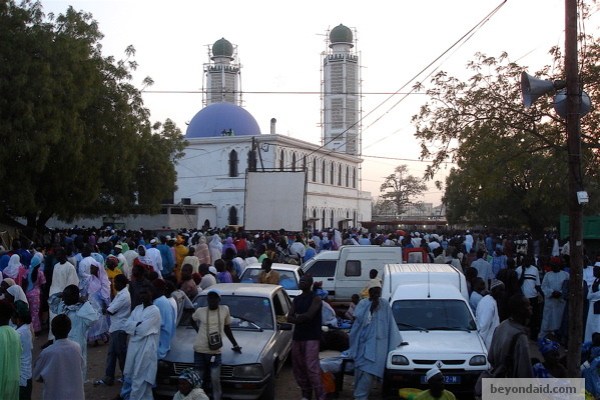
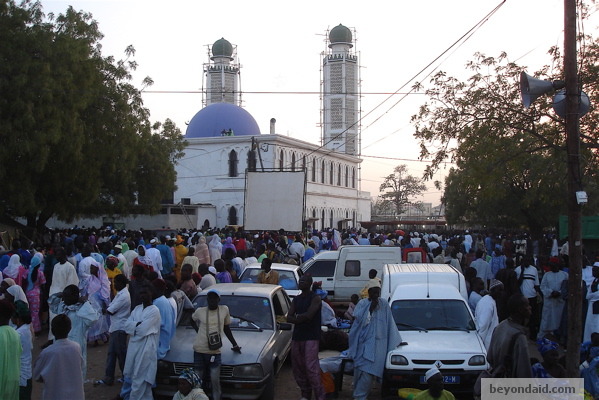
Though a devout member of the Tijani brotherhood, Abdoul Aziz Kébé, a professor of Arabic and Islamic Civilization at Dakar’s Cheikh Anta Diop University, fears the increasing political role of religion in the country may threaten the republican values of equality and legality. He believes Senegal is sliding towards a dangerous situation under President Abdoulaye Wade who was reelected for a five-year term earlier this year. His allegiance and submission to the head of the Mouride brotherhood – the most powerful Senegalese order both politically and economically but second to the Tijani in numbers – is typical of its adherents but when Wade behaves in this way, he is choosing religion over the very constitution that is intended to leave people free to worship as they choose.

“If the president submits to another power,” Kébé said, “he places all Senegalese people under the power of that authority, even if they don’t belong to that brotherhood.”

In the lead-up to last month’s parliamentary elections, a number of media voices condemned Wade’s open patronage of Mouride leaders who have the power to deliver huge numbers of votes to friendly politicians. The country’s much vaunted democracy – Senegal is the only West African nation never to have experienced a military coup – lost some of its lustre due to the opposition’s boycott of the vote. But in Kébé’s view, Wade’s favouring of one brotherhood over the others can have consequences long after election day.

“The impression that one group or another is the chosen people is very dangerous in a republic,” he warned. “It marks everyone else out as the damned.”

Still, it is not just Muslims who feel that Senegalese Islam is for the most part getting things right. Given the country’s demographic realities, Christians benefit from the maintenance of a secular, tolerant society. For now, they do not seem too worried about their lot.

“Fundamentalism gets drowned in Senegal’s culture of openness and respect for others,” said Reverend Gabriel Sarr who leads the congregation at Dakar’s oldest church. But despite the constitution and the fact that Easter Monday is a national holiday and street vendors peddle inflatable Santas and miniature Christmas trees every December, he guards against complacency. “Sometimes a small thing can undo a whole tradition of peace.”
Latest Developments, June 27

In today’s news…

The UN Security Council has voted unanimously to send 4,200 Ethiopian peacekeepers to Sudan’s disputed Abyei region. As a neighbouring country that has been involved in military conflicts with two of its other neighbours – Eritrea and Somalia –  in recent years, Ethiopia is an interesting choice. David Shinn, a former US ambassador to Ethiopia, is not worried but he discusses the Ethiopia-Sudan relationship’s past and future challenges.

The UN Food and Agriculture Organization has just chosen a new head and the International Monetary Fund is about to do the same. The weekend’s FAO vote went against wealthy donor countries preferring a Spanish candidate to the Brazilian who won on the strength of wide support from the Global South. Given the divisions within the FAO and how far the Millennium Development Goal to halve world hunger by 2015 has gone off track, José Graziano da Silva’s job is unlikely to be an easy one. “Along with tackling the linked problem of climate change, delivering global food and nutrition security is the challenge of our time,” former UN secretary general Kofi Annan said over the weekend, as the number of chronically hungry climbs above 1 billion. At the same time, the number of obese people is closing in on 2 billion. Not surprisingly perhaps, new data on diabetes trends over the last three decades are all over the map. Among the big winners with an overall decreased incidence: Poland, Myanmar and Zambia. Among the big losers with increases of more than 60 percent: the US, Papua-New Guinea and Spain.

After the FAO disappointment, the North is expected to fare better in the IMF thanks to that organization’s vote-as-you-pay scheme, in which the US alone holds 17 percent of the votes and Europe close to 50. Tomorrow’s anticipated election of French finance minister Christine Lagarde will continue the exclusive ownership of the IMF leadership Europe has enjoyed since the organization’s inception. Despite growing pressure to relinquish this hold, European leaders have argued that the body’s primary focus is currently the eurozone crisis and its leadership should reflect that fact.

(As an aside, the International Criminal Court’s latest weekly update is out. Apart from an item on a visit from the Dutch foreign minister, the entire issue pertains to Africa. It remains to be seen whether European leaders will follow their IMF logic by pushing for an African to become the next chief prosecutor.)

While the IMF waits for official word of its new leader, it may have lost a customer, as Egypt appears to have decided it does not want a loan after all. And a number of Arab NGOs are accusing donors, such as the IMF and World Bank, of undermining the Arab Spring by imposing excessive conditions on loans.

The IMF’s sister institution, the World Bank, wants to include anti-corruption lessons in the curricula of poor countries. There is no word at present of a complementary initiative to teach rich countries how to tackle the supply side of graft.

In the private sector, Wal-Mart is heading to Africa where it is encountering considerable resistance. And the government of Peru has just revoked the license of Canadian mining company Bear Creek, following protests in which police killed at least five demonstrators. The company whose share prices tumbled on Monday vowed to take action against the government under the Canada-Peru bilateral free trade agreement which passed though the Canadian Parliament in 2009, just days after dozens were killed in protests over planned resource exploitation in the Amazon.

Finally, and appropriately for this first edition of Latest Developments, a plea to make fighting global inequality a priority.