Latest Developments, September 13

In the latest news and analysis…

Spreading strikes
The Guardian reports that South Africa’s mining industry is on the verge of paralysis as labour unrest spreads in the wake of last month’s massacre of striking workers at Lonmin’s Marikana mine:

“The flames have been fanned by Julius Malema, a former youth leader who was expelled from the governing African National Congress for ill discipline this year.

In an interview on South Africa’s Talk Radio 702 on Wednesday, Malema said: ‘We are calling for mine change in South Africa. We want the mines nationalised. We want the workers paid a living wage … and somebody has to listen.
‘Maybe this call has been ridiculed … by the authorities and mining bosses. Now we want to show them that we mean business. We are going to be engaging in very peaceful yet radical and militant action that will hit straight into the pockets of white monopoly capital.’ ”

Dying for PR
The University of KwaZulu-Natal’s Patrick Bond argues that World Bank President Jim Yong Kim’s recent visit to South Africa was an exercise in public relations concerning his institution’s past and present impacts on the country’s people:

“Bank-financed electricity mainly supplied South Africa’s mining houses and smelters, as is still the case (the main customer of the Medupi coal-fired power station currently being built will be BHP Billiton, which consumes more than 10% of the country’s power to smelt aluminium). Then and now, this facilitated South Africa’s notorious migrant labour system, with low pay to migrant workers who succumbed to TB in squalid, single-sex, 16-to-a-room hostels and shacks.
Kim failed to address these historic issues, which are mirrored in his institution’s current portfolio, especially the [International Finance Corporation’s] controversial commitment (approved by former president Paul Wolfowitz in 2007) of $150m in equity/credit lines to Lonmin at the Marikana mine, as well as the $3.75bn for the Medupi plant north of Pretoria, pushed through by his immediate predecessor, Robert Zoellick.
The 34 victims of the Marikana massacre were mainly migrants from Lesotho and the Eastern Cape. Their migrant labour status replicates apartheid, including health vulnerability in disease-ridden shack settlements.”

Boat tragedies
Human Rights Watch’s Judith Sunderland calls out European governments over their failure to prevent migrant deaths at sea, after an estimated 140 people died in the Mediterranean last week:

“The truth is that European Union governments on the Mediterranean rim and the EU as a whole have focused far more effort on border control, including in ways that violate rights, than on preventing deaths at sea.

The EU needs to live up to European values this time around and do its utmost to ensure that those fleeing Syria reach safety and a meaningful chance to apply for asylum. We cannot mourn only the deaths of asylum seekers, though. None of those who perished last week deserved to die, regardless of their nationality or reasons for trying to reach Europe.”

Exploration hiatus
Bloomberg reports that Tanzania’s opposition is calling for “a 10-year moratorium on licensing offshore oil and gas blocks” so that the country has time to implement laws that will ensure it benefits from the exploitation of its natural resources:

“Tanzania, the holder of East Africa’s second-biggest natural-gas resources, in June tripled its estimate of recoverable gas reserves to 28.7 trillion cubic feet. The government postponed its next deep offshore bidding round, originally scheduled to start tomorrow, pending the adoption of a natural gas policy by lawmakers. Parliament may approve the draft document as soon as October.
‘A moratorium will not only allow us to manage our new resources effectively, it will also ensure the welfare of future generations,’ [Shadow Finance Minister Zitto] Kabwe said in an e-mailed statement. It would give time to set up a sovereign development fund, train Tanzanians for jobs in the industry, and make sure oversight bodies are monitoring oil and gas revenues, Kabwe said.”

Trade secrecy
Inter Press service reports on the “unusually tight secrecy” at negotiations for the Trans-Pacific Partnership, which are now in their 14th round:

“Thus, while inklings of the countries’ positions on the varying issues have come to light through brief public statements and leaked documents, the details of how the talks are progressing are known only to the negotiators and the corporations that have been given access to the draft documents.
According to activists, of the 600 advisors that the U.S. negotiators have used surrounding the talks, 84 percent have been corporate interests.
Indeed, not only has there been an ongoing lack of direct civil-society involvement in the TPP process, but progress in the negotiations has been kept secret from even the U.S. Congress. With the start of the 14th round of talks this weekend, a bipartisan letter was sent from Congress to Trade Representative Kirk, insisting “in the strongest terms possible” that Kirk’s office publicise details on what is being discussed, specifically with regards to intellectual property rights.”

Blasé about torture
The Bureau of Investigative Journalism reports on a UN expert’s comments that suggest there has been “a paradigm shift” in the way Western society views torture:

“Speaking at Chatham House on the record last night [Juan] Méndez, UN special rapporteur on torture and other cruel, inhuman and degrading treatment or punishment, bemoaned a change in attitude. ‘We have lost an important asset that we had in the fight against torture: the moral indignation,’ he told the audience. ‘In the last ten years the culture has generated a sense that perhaps torture is inevitable or even necessary.’

The Obama administration reinstated the Code on Military Justice. However, Méndez candidly explained that the decision not to address what happened around the Torture Memos reveals a refusal to accept the US’s obligations under international law.
‘It’s a very disappointing decision,’ he said, ‘you can imagine how frustrating it is for a special rapporteur to go around the world saying we have to investigate, prosecute and punish crimes of torture, when the US doesn’t.’ ”

Multilateral views
UN Dispatch’s Mark Goldberg reports on a recent public opinion study that suggests American attitudes are rather well-disposed toward international cooperation on a range of global issues:

“The survey shows that Americans prefer a cooperative approach to American foreign policy and believe the UN should be a platform for cooperation even when it means the USA must compromise a bit.

Another related part of the polling asks respondents attitudes toward various international treaties to which the USA has not acceded, including the Comprehensive Nuclear Test Ban Treaty, the International Criminal Court, and a post-Kyoto international climate change convention. Guess what? Americans are very supportive of the USA joining all three!”

Latest Developments, September 6

In the latest news and analysis…

Systemic change
In assessing the performance of Britain’s outgoing international development minister, the Overseas Development Institute’s Jonathan Glennie argues that “aid is not very important for development”:

“The aid effectiveness agenda has had some successes in turning the tide of donor arrogance and aligning external funds with domestic endeavours, but its lasting and unfortunate impact has been to divert the world’s attention towards technocratic tinkering and away from what really matters: systemic change.

Better regulation of companies and fairer trade with poorer nations has long since dropped from the agenda in favour of better terms for UK companies and investors. And does anyone remember climate change? Rather than focus on the major issues – sustainable development and poverty reduction – we are exhorted to focus on aid, sold as the generosity of a kind-hearted nation.”

Anti-bribery enforcement
Transparency International has released a new report assessing the commitment of the world’s richest countries to fighting foreign bribery:

“The report assesses the progress of 37 of the 39 countries signed up to the [Organisation for Economic Co-operation and Development (OECD) Anti-Bribery] Convention, placing them in four enforcement categories: Active, Moderate, Little and No enforcement.

Eighteen countries have little or no enforcement at all, having not yet brought any criminal charges for major cross-border corruption by companies. Together these countries represent 10 per cent of world exports. Only seven out of 37 countries are actively enforcing bribery law.”

Land-grab greenwash
A new report by the Oakland Institute looks at a US-owned company’s “strategy to deceive the public into believing that there is logic to cutting down rainforests to make room for palm oil plantations” in Cameroon:

“[SG Sustainable Oils Cameroon] is 100 percent owned by the American company Herakles Farms, an affiliate of Herakles Capital, which is an Africa-focused private investment firm involved in the telecommunications, energy, infrastructure, mining and agro-industrial sectors. The Chairman and CEO of Herakles Farms, Bruce Wrobel, is also the Chairman and Executive Director of All for Africa, a ‘development’ Non-Governmental Organization (NGO).

The expected negative social and environmental impacts of the plantation are numerous, including loss of livelihoods, small returns for local communities, and massive deforestation. The involvement of All for Africa, ostensibly a ‘development’ NGO, is deceptive. While partnering in the development of a plantation that will destroy existing and valuable tropical rainforest, All For Africa’s main stated goal, to plant one million trees for sustainability, does not match up with sustainable development goals.”

Torture revelations
Human Rights Watch has released a report containing new evidence on waterboarding and other forms of torture in CIA prisons, which suggests “just how little the public still knows about what went on in the US secret detention program”:

“The United States played the most extensive role in the abuses, but other countries, notably the United Kingdom, were also involved.

Five former [Libyan Islamist Fighting Group] members told Human Rights Watch that they were detained in US run-prisons in Afghanistan for between eight months and two years. The abuse allegedly included: being chained to walls naked – sometimes while diapered – in pitch dark, windowless cells, for weeks or months at a time; being restrained in painful stress positions for long periods of time, being forced into cramped spaces; being beaten and slammed into walls; being kept inside for nearly five months without the ability to bathe; being denied food and being denied sleep by continuous, deafeningly loud Western music, before being rendered back to Libya. The United States never charged them with crimes.”

Spill fallout
The Associated Press reports that local residents are claiming they have not received adequate help following a toxic spill at a Peruvian mine run by four global corporate giants:

“At least 350 Cajacay residents were sickened by the spill of 45 tons of copper concentrate, a mineral stew of volatile compounds. At least 69 were children.
The mine’s owner, Antamina, has not responded to repeated AP phone and email requests to identify the toxic components of the slurry and details on medical care it is providing for the spill victims. A document obtained by the newspaper La Republica shortly after the spill described the mixture as ‘highly toxic.’

Antamina is the world’s third-largest zinc mine and eighth-biggest producer of copper. It is owned by a consortium including Australia-based BHP Billiton Ltd., Xstrata of Switzerland, Teck-Cominco Ltd. of Canada and Mitsubishi Corp. of Japan.”

Hello to arms
Reuters reports that France may be considering supplying heavy artillery to rebel-held “liberated zones” in Syria:

“European powers have also said they will not supply weapons to lightly-armed Syrian rebels, who have few answers to attacks by Assad’s planes and helicopter gunships. However, the source implied there may be a shift in Paris’ thinking.
‘It’s not simple. There have been transfers of weapons which then ended up in different areas such as in the Sahel so all that means we need to work seriously, build a relationship of trust to see who is who so that then an eventual decision can be taken. It takes time,’ the source said.”

Forests for sale
Global Witness reports that “a quarter of Liberia’s total landmass has been granted to logging companies in just two years”:

“The new logging contracts – termed Private Use Permits – now cover 40 percent of Liberia’s forests and almost half of Liberia’s best intact forests.

Designed to allow private land owners to cut trees on their property, Private Use Permits are being used by companies to avoid Liberia’s carefully-crafted forest laws and regulations. Companies holding these permits are not required to log sustainably and pay little in compensation to either the Liberian Government or the people who own the forests for the right to export valuable tropical timber.”

Puntland guns
The Australian Broadcasting Corporation reports that an Australian citizen with a shady past is helping to set up a large militia force that “fundamentally changes the balance of power in the north-east of Somalia” despite a UN arms embargo:

“[Lafras Luitingh] is using a string of companies registered around the world, but according to UN investigators, Australia plays a central part in their operations.
Australian records show Mr Luitingh registered the company – Australian African Global Investments – in 2006.
It has branches in South Africa, Uganda and other African countries and is involved in logistics, transport and chartering planes and ships.
The Australian company was registered by Taurus Financial Services in Sydney.”

Latest Developments, November 8

In the latest news and analysis…

Cholera compensation
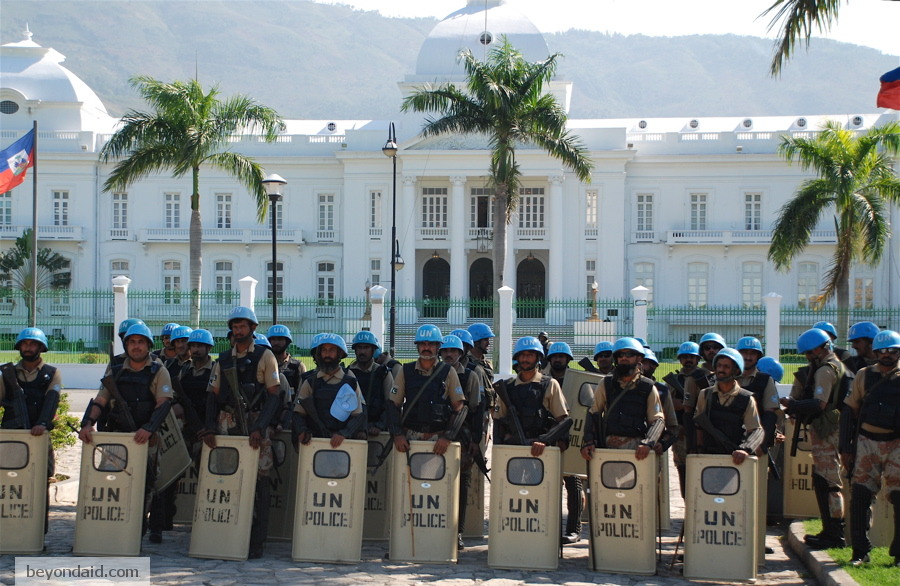
Al Jazeera reports a US-based human rights group is seeking hundreds of millions of dollars in reparations from the UN for those affected by a deadly cholera outbreak in Haiti.
“‘The cholera outbreak is directly attributable to the negligence, gross negligence, recklessness and deliberate indifference for the health and lives of Haiti’s citizens by the United Nations and its subsidiary, the United Nations Stabilization Mission in Haiti (MINUSTAH),’ the petition said.
It said numerous studies, including those by the UN, traced the virus to UN personnel from Nepal.
‘Until MINUSTAH’s actions incited the cholera outbreak, Haiti had not reported a single case of cholera for over 50 years,’ the petition said.”

Development as right
The UN News Centre reports that on the 25th anniversary of the UN Declaration on the Right to Development, some of the organization’s top officials conceded the principle had “languished” in practice.
“‘The fact that almost three billion people live in poverty and that 20 per cent of the world’s people hold 70 per cent of its total income means that we have not kept our promises,’ said High Commissioner for Human Rights Navi Pillay.”

R2P’s uncertain future
Embassy Magazine reports that, while a number of Responsibility to Protect proponents have pointed to the NATO intervention in Libya as a successful implementation of the doctrine, former UN secretary general Kofi Annan argues the “jury is still out.”
“When the council voted to effectively unleash the air power of western countries like the United States, France and Britain against Libyan military infrastructure and equipment, Brazil, China, India and Russia all abstained, sending a “powerful message” that the UN’s top body was divided, said Mr. Annan.
‘Therefore, when you go to implement that resolution, you have to be very careful to stick to that resolution,’ he said.
That powerful message is reverberating in another failed council effort. An Oct. 5 resolution, that would have condemned Syria for the killing of thousands of people the UN says was at the hands of Syrian government authorities, was vetoed by China and Russia under the auspices that it didn’t explicitly rule out another foreign military intervention.”

Open-pit ban
MiningWatch Canada reports the government of a Philippine province has issued a ban on open-pit mining over the objections of Canadian mining company TVI Pacific, which has vowed to take legal action.
“‘The destruction of our land and natural resources through open pit mining is irreversible and the forced displacement of communities contradicts the real meaning of development, or should we ask “development for whom?”’ says Daniel Castillo, Director of the Dipolog Committee on Mining Initiatives, a Church-based support group in Zamboanga del Norte.”

Benefits of conservation
The UN Environment Program’s Achim Steiner makes the economic case for protecting animal species from extinction, using the example of Palau which recently became the first country to declare its waters a shark sanctuary and now earns an estimated eight percent of its GDP through shark-diving tours.
“Nature should never be prized merely for its economic value. But, in a world of competing demands and limited resources, economic considerations can help to tip decisions in favor of conservation rather than degradation. This kind of strategic thinking can help to ensure that the world’s 10,000 migratory species continue their journeys, so that future generations can also marvel at these nomads of the natural world.”

Learning from others
The University of Cambridge’s Tarak Barkawi argues that because we live in “a jingoistic age, when Westerners, Asians and Muslims are all convinced of their own superiority,” new ideas and solutions are impeded by a reluctance to learn from and co-operate with others.
“And so, when we look upon the Arab Spring, we should not interpret it as a matter of Arabs having finally read John Locke and Thomas Jefferson and applied Western ideas. We should look instead for the new ideas, the new possibilities, the new politics created up by the protesters, activists and ordinary people who have made revolution.
We should be cognizant too that the Arab Winter will be a university of counter-revolution, as new forms of repression, of neo-imperialism and of exploitation are developed in response to novel circumstances.”

Othering and torture
The University of Edinburgh’s Tobias Kelly writes about the long-standing Western tradition of viewing torture as something that is only committed by uncivilized “others”, with the result that no British citizen has ever stood trial for the crime of torture.
“The problem is that too much is at stake for the British government to admit its complicity in torture. They will always try and find other words to describe the brutal ill-treatment of detainees. Assault, disobeying orders, dereliction of duty, even murder, but not torture.
Once torture has been used to make the distinction between the civilised and the barbarous, it is just too difficult for the British government to imagine that it stands on the wrong side of that line.”

Durban showdown looming
Democratic Republic of Congo negotiator Tosi Mpanu-Mpanu tells the Independent Online what he is expecting from rich countries at the upcoming climate change conference in Durban, South Africa.
“They seek to tear down the Kyoto Protocol, now or later, and to replace it with a different architecture.
A few have said they will not participate in a second commitment period, despite their legal obligations under the Kyoto Protocol, while others have said the next commitment period should be ‘transitional’ to a new regime.
In other words, they seek to ‘transition’ out of their legally binding obligations under the Kyoto Protocol into a new regime we have not designed yet.
One country seems to prefer an altogether weaker system via a ‘pledge-based’ rather than ‘science-based’ system of emission reductions that applies ‘symmetrically’ to rich and poor countries.
So it is not merely a question of who will remain inside or outside the multilateral process, but, more fundamentally, what that process will be. This is the big question for Durban.”