Latest Developments, April 13

In the latest news and analysis…

Shell’s back
Agence France-Presse reports that oil giant Shell has returned to Nigeria’s “massively polluted” Ogoniland region 20 years after suspending its operations there due to unrest:

“The Anglo-Dutch oil major said the move was not part of an attempt to restart oil production in Ogoniland, describing it instead as a bid to comply with a 2011 UN report that called for one of the world’s biggest ever environmental clean-ups.

The report called for the oil industry and the Nigerian government to contribute $1 billion (762 million euros) to a clean-up fund for the region, adding that restoration could take up to 30 years.”

Fine rhetoric
Euractiv reports that the point person on the EU’s new transparency rules for global resource companies has accused the UK government of trying to water down the legislation during negotiations “despite the government’s public declarations that it supports more disclosure”:

“ ‘There is a general view really that they [Britain] were working very closely with Rio Tinto. Rio Tinto inspired a lot of their original proposal,’ [UK Labour MEP Arlene] McCarthy said of the British government’s negotiating position.
Britain hued closely during the talks on Tuesday to the industry position that companies should only disclose contracts at the government level, even though Prime Minister David Cameron had given a speech about a year ago saying that Britain was committed to the higher transparency standard of project-level reporting – a stance pressed by civil society, McCarthy said.

‘On the one hand, the rhetoric is fine, claiming that you are leading on the issues, but that certainly was not the case when it comes to practical negotiations or influencing other member countries to try and get a better deal. They did not push for anything like that at all,’ she said.”

Execution numbers
Amnesty International has released its annual report on executions and death sentences around the world:

“Only 21 of the world’s countries were recorded as having carried out executions in 2012 – the same number as in 2011, but down from 28 countries a decade earlier in 2003.

The top five executing countries in the world were once again China, Iran, Iraq, Saudi Arabia and USA, with Yemen closely behind.

Amnesty International opposes the death penalty in all cases without exception, regardless of the nature or circumstances of the crime; guilt, innocence or other characteristics of the individual; or the method used by the state to carry out the execution. The death penalty violates the right to life and is the ultimate cruel, inhuman and degrading punishment.”

Ag-gag bills
The New York Times reports that “a dozen or so state legislatures” have proposed or adopted laws that would make it illegal for animal rights activists to videotape instances of cruelty on farms:

“Critics call them ‘Ag-Gag’ bills.
Some of the legislation appears inspired by the American Legislative Exchange Council, a business advocacy group with hundreds of state representatives from farm states as members. The group creates model bills, drafted by lobbyists and lawmakers, that in the past have included such things as ‘stand your ground’ gun laws and tighter voter identification rules.
One of the group’s model bills, ‘The Animal and Ecological Terrorism Act,’ prohibits filming or taking pictures on livestock farms to ‘defame the facility or its owner.’ Violators would be placed on a ‘terrorist registry.’ ”

Expanding war
The Wall Street Journal reports on America’s “escalating drug war across Africa”:

“Over the past two years, the U.S. government has spent about $100 million to expand its drug war into nearly every West African country, the State Department said. [Drug Enforcement Administration] officers are teaching police from Liberia and Cape Verde to board boats, and setting up drug squads in Nigeria and Ghana that would act on U.S. intelligence. The agency has five offices on the continent, with a sixth and seventh planned for Senegal and Morocco.”

Checkered past
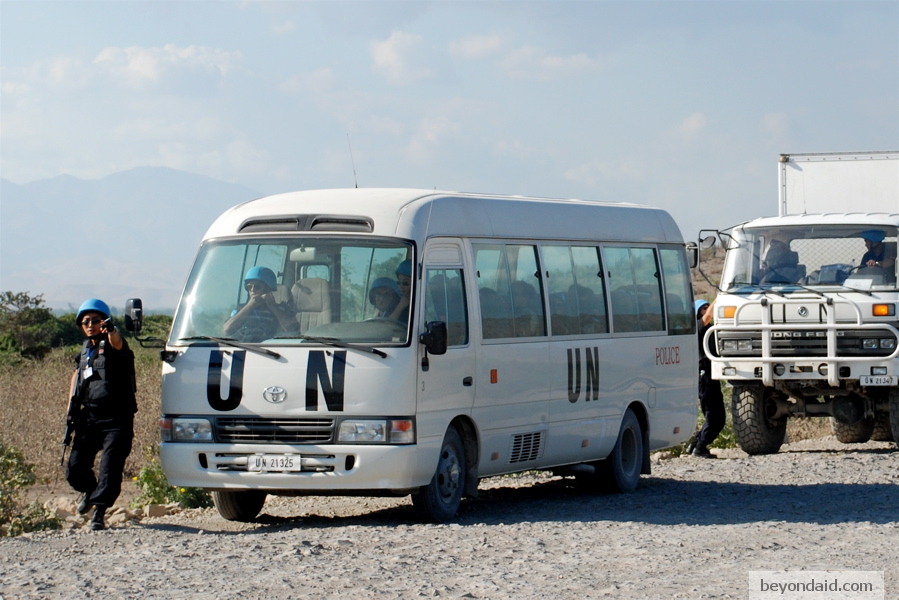
The Associated Press reports that US private military contractor DynCorp, which was previously implicated in sex trafficking and extraordinary rendition, has won a new contract to support the UN peacekeeping mission in Haiti:

“The Falls Church, Virginia-based DynCorp International received the contract from the U.S. State Department’s Bureau of International Narcotics and Law Enforcement Affairs. It will recruit and finance up to 100 officers to join the U.N.’s police unit affiliated with the mission, known as UN Pol, and 10 U.N. correction advisers.

The DynCorp task order has a one-year base period with three, one-year options that carries a total value of $48.6 million.”

Dam disappointment
The Asia Times reports that a World Bank-funded hydroelectric project in Laos may not be the “kinder, gentler” type of dam that was promised:

“After three years of commercial operations and a vigorous public relations campaign, the [Nam Theun 2] dam is now contributing to wider, more intractable problems. These include emerging evidence that resettled villagers have resorted to poaching and illegal logging to sustain their communities as well as reports from the European Union-sponsored Global Climate Change Alliance that Laos has recently become a net emitter of [greenhouse gases] after previously serving as a valuable global carbon sink.”

Carbon equality
Princeton University’s Peter Singer and Tsinghua University’s Teng Fei use the concept of a “carbon Gini coefficient” to assess the fairness of proposed approaches to tackling climate change:

“If it proves too difficult to reach agreement on a substantive equity principle, then an agreement that some carbon Gini coefficients are simply too extreme to be fair could form the basis of a minimum consensus. For example, we can compare the grandfathering principle’s carbon Gini coefficient of 0.7 with the Gini coefficient of the US, which most people regard as highly inegalitarian, and yet is much lower, at about 0.38.
On the other hand, equal per capita annual emissions is based on a principle that at least has a claim to be considered fair, and has a Gini coefficient of less than 0.4. We therefore propose that any fair solution should have a carbon Gini coefficient of 0.0-0.4. Although the choice of a precise number is somewhat arbitrary, this ‘fair range’ should establish the boundaries for those committed to an equitable solution to the problem of climate change.”

Latest Developments, January 11

In the latest news and analysis…

Françafrique lives
91 days after declaring France’s neocolonial relationship with Africa dead, French President François Hollande announced that his country was taking military action in former colony Mali:

“At stake today is the very existence of our ally Mali, the security of its population and that of French citizens. There are 6,000 of them in Mali.
I have, therefore, in the name of France, answered the plea for help from Mali’s president, which has the support of the nations of West Africa. As a result, the French armed forces gave their support this afternoon to Malian units for the fight against these terrorist elements.
This operation will last as long as necessary.” [Translated from the French.]

Deep roots
350.org co-founder Bill McKibben discusses the global significance of the indigenous protest movement that began in Canada last year under the banner #IdleNoMore:

“[First Nations] are, legally and morally, all that stand in the way of Canada’s total exploitation of its vast energy and mineral resources, including the tar sands, the world’s second largest pool of carbon. NASA’s James Hansen has explained that burning that bitumen on top of everything else we’re combusting will mean it’s ‘game over for the climate.’ Which means, in turn, that Canada’s First Nations are in some sense standing guard over the planet.

Corporations and governments have often discounted the power of native communities — because they were poor and scattered in distant places, they could be ignored or bought off. But in fact their lands contain much of the continent’s hydrocarbon wealth — and, happily, much of its wind, solar and geo-thermal resources, as well. The choices that Native people make over the next few years will be crucial to the planet’s future — and #IdleNoMore is an awfully good sign that the people who have spent the longest in this place are now rising artfully and forcefully to its defense.”

Importing cholera
Foreign Policy has published an account, drawn from former Associated Press correspondent Jonathan Katz’s new book, of his investigation into how the UN turned Haiti’s biggest river into an “artery of disease”:

“In two years, more than 7,800 Haitians have died of cholera. One in five people in a nation of roughly 10 million has fallen seriously ill with the disease, while the unusually virulent strain has spread across the Caribbean, into South America, and the United States.
The United Nations has made grandiose, if seemingly empty, promises to fight and eradicate the disease, but refuses to consider its own accountability in starting the epidemic. Aid workers and donor governments have lost a critical opportunity — to demonstrate that they took Haitian lives and welfare as seriously as their own.”

Funding abuses
The Guardian reports that the UK plans to give millions to Ethiopian “special police” accused of human rights violations, including summary executions, in the country’s restive Ogaden region:

“The Guardian has seen an internal Department for International Development document forming part of a tender to train security forces in the Somali region of Ogaden, which lies within Ethiopia, as part of a five-year £13m–15m ‘peace-building’ programme.
The document notes the ‘reputational risks of working alongside actors frequently cited in human rights violation allegations’. DfID insists that the training will be managed by NGOs and private companies with the goal of improving security, professionalism and accountability of the force, but Human Rights Watch has documented countless allegations of human rights abuses.”

Mining maze
Bloomberg reports on the difficult road to compensation faced by thousands of South African ex-miners suffering from silicosis:

“ ‘Whether we are able to bring Anglo American and other parent companies to the table or not will have a significant impact on the size of any final award or settlement,’ [the plaintiff’s lawyer Richard] Spoor said by phone yesterday. ‘The question of the parent company liability is a very difficult area of law because of the principle of limited liability.’

Mergers, acquisitions and delistings over the years have left former workers with nowhere to go to seek compensation, Spoor said. Gold Fields Ltd. was created in 1998 by combining the assets of Gencor and Gold Fields of South Africa Ltd. AngloGold was formed when Anglo American’s South African business bought out minority shareholders of its gold units in 1997.
Anglo American ceded control of AngloGold in April 2004 when the gold miner bought Ghana’s Ashanti Goldfields Ltd., creating AngloGold Ashanti.
Gold companies including AngloGold deny liability.”

Tax-shy telcos
The BBC reports that Indian tax officials have raided a facility belonging to Finnish phone giant Nokia:

“According to some media reports, officials said they were looking to recover tax payments totalling as much as 30bn Indian rupees ($545m; £340m).

The raid on Nokia comes just days after Indian tax officials asked the UK’s Vodafone to pay more than $2bn in back taxes.”

Banning fake vaccines
The Center for Global Development’s Charles Kenny calls on the US government to declare it will never again use public health interventions to gather intelligence, as it famously did in Pakistan where there has been a recent spate of violence against vaccine providers:

“Such a declaration has been proposed in a letter sent to President Obama this Monday signed by the deans of America’s top public health schools.  I suggest this could be modeled on –and inserted into– Executive Order 12333 which mandates that ‘No element of the Intelligence Community shall sponsor, contract for, or conduct research on human subjects except in accordance with guidelines issued by the Department of Health and Human Services,’ and bans engagement in or conspiracy towards assassination and actions intended to influence United States political processes, public opinion, policies, or media.”

Diluting responsibility
The Guardian reports that “opaque supply chains” are part of the reason that Bangladesh’s booming garment industry keeps experiencing deadly factory blazes, the latest of which claimed 111 lives:

“Kalpona Akter, executive director of the Bangladesh Centre for Worker Solidarity, says a convoluted and opaque supply chain is largely to blame for the lack of compliance with international labour standards. ‘Often the factory that gets the order is fully compliant,’ she says. ‘But multiple subcontracts make a mockery of so-called ethical sourcing. When an accident happens, the buyers can simply deny responsibility.’
After the Tazreen blaze, retailers said they had not authorised production at the factory. Walmart and Sears said in separate statements that suppliers had subcontracted production without informing them.”

Latest Developments, November 14

In the latest news and analysis…

Fallout risk
Agence France-Presse reports that a top Mauritanian politician is warning that foreign military intervention in neighbouring Mali could have “devastating” consequences for the wider region:

” ‘This country which has for a long time been seen as a model of democracy is like a volcano about to erupt,’ national assembly president Messaoud Ould Boulkheir said a day after West African leaders gave the green light to sending 3,300 troops to northern Mali to wrest control from the Islamists.
‘If this volcano awakens, it will dump incandescent ashes over its neighbours,’ he told parliament.”

No air strikes
The Associated Press reports that France’s defense minister has said neither his country nor the EU would use military force to help reunite Mali:

“[Jean-Yves] Le Drian, speaking to reporters in Paris, reiterated France’s longstanding stance that it will not send ground forces in support of the planned international effort led by African troops in Mali. But this time, he sought to make clear that that would mean no French attacks from the air either.
‘As for air support, neither Europe nor France will intervene militarily,’ Le Drian told the European American Press Club. ‘When we say no troops on the ground, that means “troops in the air” too … But bringing in information, intelligence is another thing.’
Other officials have indicated that France could use drones to provide surveillance for ground forces from other countries that are deployed to Mali.”

Corruption pays
The Financial Times reports that European oil giants Shell and Eni have come under fire over a $1.1 billion payment they made last year for a deepwater oil concession off Nigeria’s coast:

“Global Witness says that if the multinationals knew the money would be paid to [Malabu Oil & Gas], the deal could test anti-corruption laws in the UK, US and Italy, ‘for the reason that a substantial monetary “reward” ended up being paid to a company controlled by an individual, who had arguably abused his public position to obtain OPL 245 in opaque circumstances during the Abacha dictatorship’.
The deal illustrates why proposed new EU transparency laws must require extractive industry companies to report payments to governments on a project-by-project basis, according to Simon Taylor, director of Global Witness. Details of the OPL 245 settlement would not have been made public were it not for the New York case.”

News wars
The Associated Press reports that the US military is bankrolling a pair of news websites as part of a “propaganda effort” in Somalia and North Africa:

“[sabahionline.com], which launched in February, is slowly attracting readers. The military said that Sabahi averages about 4,000 unique visitors and up to 10,000 articles read per day. The site clearly says under the ‘About’ section that it is run by the U.S. military, but many readers may not go to that link.

The military said there are nine writers who work for Sabahi from Kenya, Tanzania, Djibouti and Somalia. The other site — magharebia.com — concentrates on Libya, Algeria, Morocco and Mauritania.
Africom says the websites are part of a larger project that costs $3 million to pay for reporting, editing, translating, publishing, IT costs and overhead. It believes the project is paying dividends.”

Man-made disaster
The Center for Economic and Policy Research’s Mark Weisbrot calls on the UN to make amends for causing Haiti’s ongoing deadly cholera epidemic:

“There hadn’t been any cholera in Haiti for at least 100 years, if ever, until some UN troops from South Asia dumped human waste into a tributary of the country’s main water supply. Since then, more than 7,600 Haitians have died and over 600,000 have gotten sick.

After the earthquake, there was much talk about ‘building back better’ in Haiti, with disappointing results. The very least that the international community can do is to fix the damage that its members themselves have caused since the earthquake. That means starting right now, with the urgency that any other country would expect in matters of life and death.”

Ending prohibition
The Open Society Foundations’ Kasia Malinowska-Sempruch argues that last week’s votes in favour of legalizing marijuana by two US states “will drive drug-policy debates worldwide”:

“Given that the US is the biggest backer of the international ‘War on Drugs,’ Colorado and Washington voters’ decision is particularly bold. Regulating marijuana – and the initiatives that could soon follow – has the potential to reduce violence at home and abroad, spare young people from undeserved criminal records, and reduce stigma among vulnerable people.”

Eyeing resources
Inter Press Service reports on growing concerns over Canada’s changing relationship with Africa:

“As the Canadian trade minister and his delegation head to West Africa early next year to unearth opportunities in the extractive resource industry and infrastructure sector, the [Canadian Council for International Cooperation] is also continuing to seek the strengthening of Canadian companies’ corporate social responsibility policies, especially in relation to African mining activities.
“This has very rarely been beneficial for African countries,” [the CCIC’s Sylvie] Perras argued. “We say that it creates jobs, or it creates revenue, but when we look at it more closely, it’s not necessarily the case.”
Mineral-heavy countries have not spurred economic development for their local populations, according to a CCIC backgrounder, as high unemployment rates, debt and poverty are widespread in mining communities.”

Questionable priorities
Satirical newspaper The Onion draws on the salacious media treatment of former CIA head David Petraeus’s resignation to question the American public’s news priorities:

“As they scoured the Internet for more juicy details about former CIA director David Petraeus’ affair with biographer Paula Broadwell, Americans were reportedly horrified today upon learning that a protracted, bloody war involving U.S. forces is currently raging in the nation of Afghanistan.

Sources confirmed that after reading a few paragraphs about the brutal war, the nation quickly became distracted by a headline about Elmo puppeteer Kevin Clash’s alleged sexual abuse of a 16-year-old boy.”

Latest Developments, May 25

In the latest news and analysis…

Global leadership failure
Amnesty International has released its 50th annual global human rights report, in which it describes the UN Security Council as “tired, out of step and increasingly unfit for purpose.”
“ ‘Failed leadership has gone global in the last year, with politicians responding to protests with brutality or indifference. Governments must show legitimate leadership and reject injustice by protecting the powerless and restraining the powerful. It is time to put people before corporations and rights before profits,’ said Salil Shetty, Amnesty International Secretary General.

‘The language of human rights is adopted when it serves political or corporate agendas, and shelved
 when inconvenient or standing in the way of profit.’

The UN meeting to agree an Arms Trade Treaty in July will be an acid test for politicians to place rights over self-interest and profit. Without a strong treaty, the UN Security Council’s guardianship of global peace and security seems doomed to failure; its permanent members wielding an absolute veto on any resolution despite being the world’s largest arms suppliers. ”

Indifference in the time of cholera
The Center for Economic and Policy Research reports that the rainy season is causing an intensification of Haiti’s cholera crisis, whose origins lie in UN peacekeepers’ sewage discharge into a source of drinking water.
“The cholera death toll is up to 7,155, with 543,042 infections over 586 days (and no UN apology so far), according to a new ‘cholera counter’ created by advocacy group Just Foreign Policy.

But so far, even this new danger [of an evolving second strain] doesn’t seem to be enough to make fighting cholera in Haiti a cause célèbre. Maybe a viral ‘Kolera 2012’ campaign would do the trick?”

FCPA questions
The Huffington Post reports that two American congressmen are looking into the motives behind the US Chamber of Commerce’s efforts to water down a 35-year-old piece of anti-corruption legislation.
“In a letter to the Chamber released Tuesday, Reps. Henry Waxman (D-Calif.) and Elijah Cummings (D-Md.) — the ranking Democrats on the House Oversight and Government Reform Committee and the House Energy and Commerce Committee, respectively — describe how committee staff looked through the institute’s tax filings and found that 14 of the group’s 55 board members between 2007 and 2010 ‘were affiliated with companies that were reportedly under investigation for violations or had settled allegations that they violated the Foreign Corrupt Practices Act.’

In their letter, the congressmen request information from the Institute for Legal Reform, including any documentation of board discussions about FCPA and ‘documents relating to companies that have provided funds to the Chamber or the ILR for work related specifically to the Foreign Corrupt Practices Act.’ ”

Bribery rising
The Wall Street Journal reports on a new survey that suggests business executives worldwide are increasingly willing to engage in unethical practices.
“Of the more than 1,700 executives polled by Ernst & Young for its annual fraud survey, 15% said they were prepared to make cash payments to win business, up from 9% in the previous survey.

The study found that 47% of the 400 chief financial officers surveyed felt they could justify potentially unethical practices to help business survive during an economic downturn. Those practices included giving cash payments, using entertainment and giving personal gifts to win business. And, 16% of CFO respondents said they did not know that their company can be held liable for the actions of third-party agents.”

Ending slave labour
The Associated Press reports that Brazilian lawmakers have approved a constitutional amendment that will mean those “who force people into slave-like working conditions” will face harsher punishments.
“The amendment allows the government to confiscate without compensation all the property of anyone found to be using slave labor, which is most common on remote farms but also occurs in urban sweatshops in places like Sao Paulo, South America’s largest city.”

Land fever
Reuters AlertNet reports on the growing enthusiasm among foreign-owned companies for setting up industrial palm plantations on Cameroonian land.
“Six foreign-owned companies are currently trying to secure over 1 million hectares (about 2.5 million acres) of land for the production of palm oil in the country’s forested southern zone, according to a coalition of environmental organisations.

In a recent letter addressed to Cameroon’s Prime Minister Philemon Yang, the Coalition of Civil Society Organisations in Cameroon called on the government to reject the projects, which they argue will destroy a critical forested zone linking five national parks and protected areas.
‘In addition to the direct destruction of flora and fauna, these projects will bring hunger and frustration to the local population,’ the coalition argued.”

Stock exchange accountability
British MP Lisa Nandy has explained in parliament a proposed legal amendment that would require UK companies to report on the human rights and sustainable development impacts of their business.
“As some Members may be aware, the [London Stock Exchange] is currently host to a number of companies that have been found guilty of gross violations of human rights, particularly in countries that are in conflict or deemed high risk, yet very few companies have been held properly to account for such actions.

Our amendment would clarify rather than rethink the purpose of the stock exchange, allowing the [Financial Conduct Authority] to take into account an applicant’s respect for human rights and sustainable development, in protecting the integrity and respectability of the exchange. That has been done elsewhere, such as in Hong Kong, and Istanbul, Brazil, Indonesia, Shanghai, Egypt, Korea and South Africa have all taken steps in that direction.”

Defining green
The World Development Movement asks a fundamental question in the lead-up to the Rio+20 Summit: what exactly does the oft-used term “green economy” actually mean?
“However, industrialised countries like the UK, alongside banks and multinational companies, are using the phrase ‘green economy’ as a smokescreen to hide their plan to further privatise the global commons and create new markets in the functions nature provides for free.
Out of this Trojan horse will spring new market-based mechanisms that will allow the financial sector to gain more control of the management of the global commons.
Instead of contributing to sustainable development and economic justice, this corporate green economy would lead to the privatisation of land and nature by multinational companies, taking control of these resources further away from the communities which depend on them.”

Latest Developments, February 21

In the latest news and analysis…

Perpetual growth
The Guardian reports on a new UN-commissioned study that argues the international community needs to take “dramatic action” if it wants to “avert a collapse of civilisation.”
“ ‘The rapidly deteriorating biophysical situation is more than bad enough, but it is barely recognised by a global society infected by the irrational belief that physical economies can grow forever and disregarding the facts that the rich in developed and developing countries get richer and the poor are left behind.
‘The perpetual growth myth … promotes the impossible idea that indiscriminate economic growth is the cure for all the world’s problems, while it is actually the disease that is at the root cause of our unsustainable global practices’, [the authors] say.”

Plundering Somalia
Inter Press Service reports on a new paper criticizing international policy towards Somalia, with one of the authors suggesting this week’s London summit on the country’s future “seeks mainly to rally public opinion around more violence, more intervention, and more counterterrorism options” rather than promoting a holistic approach to problem solving.
“[Global Policy Forum’s James] Paul said the violence-prone naval approach [to halting piracy] has not worked, because it ignores the illegal foreign fishing and toxic waste dumping that is taking place off the Somali coast.
The fishing and dumping provokes the piracy and has led ordinary Somalis to approve the piracy as a legitimate form of national defence.
But powerful members of the Security Council, notably the U.S. and the UK, have blocked any action on fishing and dumping.
‘They pretend that there is no information about the matter, even while their naval fleets are closely monitoring the movement of all ships in Somali waters,’ Paul said. ‘So much for root causes and holistic approaches. Violence is virtually the only option allowed onto the table in London.’ ”

UN responsibility
The New Media Advocacy Project’s Abby Goldberg writes about a legal petition that calls on the UN peacekeeping mission in Haiti to compensate and apologize to victims of a deadly cholera outbreak thought to have been caused by UN personnel.
“If the petition is successful, it will be the first case in history in which the UN takes legal responsibility for harm caused by their personnel.

The UN must consider the legal request and how to respond, not only for Haitians, but also for the success of peacekeeping operations globally. This case is about Haiti, but it is also about the UN and a changing world. As one of the lawyers who filed the case said, ‘there is a difference between immunity and impunity. Impunity cannot be tolerated.’ The UN can, and must, do better.”

Emission friction
Oxfam’s Duncan Green is baffled by widespread international opposition to the EU’s plan to charge airlines flying in and out of Europe for their carbon emissions, given that three-quarters of the greenhouse gases taxed would come from European and American carriers.
“The main objection to the EU’s policy is that it applies to air-miles clocked up outside European airspace. But the vast majority of emissions captured by the EU [Emission Trading Scheme] scope are from EU and US operators.  By implication, if India and others genuinely want developed countries to act to cut GHG emissions it would seem against their own interest to try to block the EU ETS, because obviously the EU would never apply it just to its own carriers – so if they were to be successful they’d also prevent us doing something about the large majority of emissions from EU/US carriers.”

Re-inventing the World Bank
Former World Bank executive Ana Palacio says the debate over the US monopoly on the institution’s presidency is “legitimate,” but thinks the organization requires far more significant reforms.
“Just as reconstruction finance gave way to development lending over the course of the Bank’s history, its current focus on banking operations should be reconsidered, as the organization’s main source of added value now lies in its formidable potential as a center of knowledge and a coordinator of international policies.

Today, the international community should look for a World Bank president who is attuned to ordinary people’s growing refusal to tolerate glaring global inequalities, and who understands that development is more than GDP growth. Such a leader, regardless of his or her country of origin, will reinvent the World Bank for the century ahead.”

Universal energy
The Steps Centre’s Rob Byrne and Jim Watson highlight the argument that the world’s poor should not be required to take a low-carbon approach to achieving universal energy access.
“[Practical Action’s Teodoro] Sanchez estimates that half the world’s energy-poor could switch to cooking on sustainable biomass and half to liquefied petroleum gas. Furthermore, half could access electricity from diesel generators while the other half do so from renewable sources. If these plans were implemented, he argues, the increase in global CO2 emissions would be less than 2% above 2005 levels.
If the world takes climate change seriously, this increase could easily be absorbed by cuts in industrialised country emissions and further action to slow emissions growth in the rapidly developing countries (especially China). The cost of this up to 2030 would be about $570bn (including capacity building and institutional costs); less than 3% of the estimated global energy investments needed during the same period.”

Questioning development
And, finally, a piece from last week by the Latin American Center of Social Ecology’s Eduardo Gudynas who argues sustainability will require a profound questioning of the concept of development and a recognition of the rights of nature. 
“The social and environmental crisis is so serious that it is now time to put aside minor adjustments and reforms, and instead address the root causes of resistance to the idea of development. We must adopt an approach whereby the term ‘sustainable development’ no longer requires the suffix ‘development’. The civil society programme in Rio+20 should not focus simply on fixing the superficial problems of development: it is necessary to look for alternatives to the entire body of ideas about development.

If sustainable development strengthens its demands for change, it must abandon the traditional idea of development and thus break with the anthropocentric ethics that are characteristic of Western cultural tradition.”