
Latest Developments, March 5

In the latest news and analysis…

Justifying targeted killings
Talking Points Memo provides an excerpt of US Attorney General Eric Holder’s speech in which he explains the thinking behind the current administration’s growing habit of eliminating perceived threats extrajudicially.
“Some have called such operations ‘assassinations.’ They are not, and the use of that loaded term is misplaced. Assassinations are unlawful killings. Here, for the reasons I have given, the U.S. government’s use of lethal force in self defense against a leader of al Qaeda or an associated force who presents an imminent threat of violent attack would not be unlawful — and therefore would not violate the Executive Order banning assassination or criminal statutes.

Some have argued that the President is required to get permission from a federal court before taking action against a United States citizen who is a senior operational leader of al Qaeda or associated forces. This is simply not accurate. “Due process” and “judicial process” are not one and the same, particularly when it comes to national security. The Constitution guarantees due process, not judicial process.”

Drones in the Philippines
American University’s Akbar Ahmed and Frankie Martin argue last month’s US drone strike in the southern Philippines – the first in Southeast Asia – has the potential to “further enflame” a conflict that has killed an estimated 120,000 over the past four decades.
“By unleashing the drones, the US has pushed the conflict between centre and periphery in the Philippines in a dangerous direction. If there is one lesson we can learn from half a millennium of history it is this: weapons destroy flesh and blood, but cannot break the spirit of a people motivated by ideas of honour and justice.
Instead, the US and Manila should work with the Muslims of the Philippines to ensure full rights of identity, development, dignity, human rights and self-determination. Only then will the security situation improve and the Moro permitted to live the prosperous and secure lives they have been denied for so long; and only then will the Philippines be able to become the Asian Tiger it aspires to be.”

Kiobel expanded
Bloomberg reports the US Supreme Court has expanded the scope of a human rights and corporate liability case involving Nigerian plaintiffs and oil giant Shell.
“When the justices heard arguments in the Shell case last week, they focused on whether the Alien Tort Statute allowed suits against corporations. Several justices, including Samuel Alito, suggested during the argument that they were more interested in considering contentions that the law can’t be applied overseas.
A ruling on the so-called extraterritoriality issue would potentially impose more sweeping limits on lawsuits, shielding corporate officers as well as the companies themselves.”

Beyond Kiobel
The Castan Centre for Human Rights Law’s Joanna Kyriakakis presents an overview of the issues at play in the Kiobel case, as well as future avenues for corporate liability advocates should the Supreme Court rule in Shell’s favour.
“Comments by plaintiff lawyer, Paul Hoffman, in a panel conversation the day after the hearing indicate that, whatever the outcome in this case, they will continue to pursue corporations implicated in human rights abuses through US judicial avenues. One option already noted would be to litigate individual corporate executives. In many respects, this option may be less appealing to the business world.”

Rich get richer
UC Berkeley’s Emmanuel Saez presents new figures suggesting these are good times for America’s “one percent”.
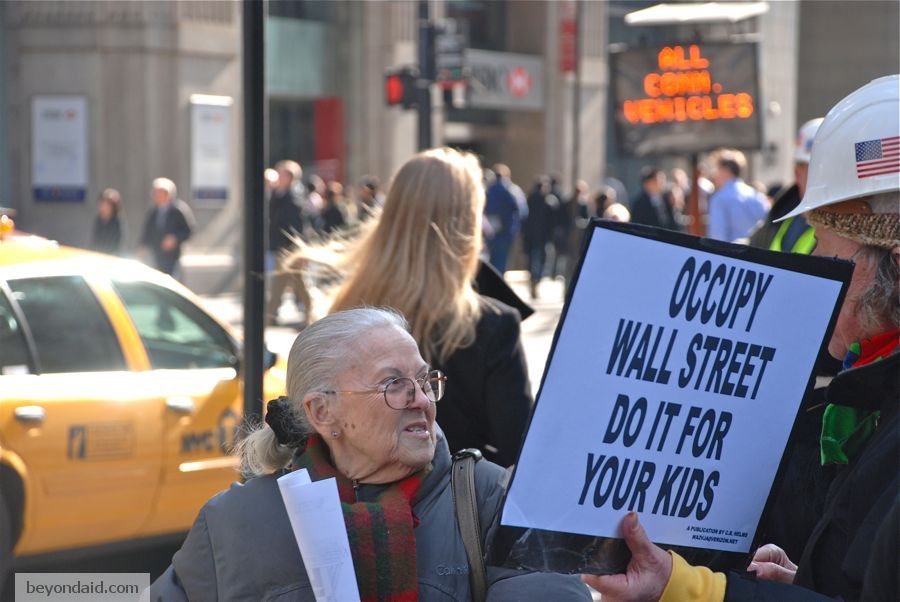
“In 2010, average real income per family grew by 2.3% but the gains were very uneven. Top 1% incomes grew by 11.6% while bottom 99% incomes grew only by 0.2%. Hence, the top 1% captured 93% of the income gains in the first year of recovery. Such an uneven recovery can help explain the recent public demonstrations against inequality. It is likely that this uneven recovery has continued in 2011 as the stock market has continued to recover. National Accounts statistics show that corporate profits and dividends distributed have grown strongly in 2011 while wage and salary accruals have only grown only modestly. Unemployment and non-employment have remained high in 2011.”

In defense of social unrest
In a Q&A with Inter Press Service, former UN Conference on Trade and Development head Rubens Ricupero speaks approvingly of how “dissatisfaction” drives history.
“I hope this movement demanding change will modify not only the internal economies of countries, in the sense of moving away from that market fundamentalism, but that it will also change the institutions that have represented that fundamentalist spirit.
And in order for that to happen, the central role has to be played by people around the world – not only in the (developing) South – who are aware of the problem, that it is not possible to continue with an organisation that foments the growth of inequality.”

World Bank non-leadership
Following close on the heels of Columbia University economist Jeffrey Sachs’s open application to become the next World Bank president, New York University’s William Easterly spells out how he would not run the international financial institution.
“I would not lead the World Bank by perpetuating the technocratic illusion that development is something ‘we’ do to ‘them.’ I would not ignore the rights of ‘them.’ If the New York Times should happen to report on the front page that a World Bank-financed project torched the homes and crops of Ugandan farmers, I would not stonewall the investigation for the next 165 days, 4 hours, 37 minutes, and 20 seconds up to now.”

Development gospel
Aid on the Edge of Chaos’s Ben Ramalingam argues the World Bank must stop being a “Development Church” that promotes economic dogma if its client countries are ever going to be “intellectually in the driver’s seat.”
“[Former World Bank staffer David] Ellerman argues that in the face of these Official Views, adverse opinions and critical reasoning tend to give way to authority, rules and bureaucratic reasoning shaped by the hierarchies within the organisation. Moreover, these Official Views “short-circuit” and bypass the active learning capability of national and local actors, and substitute the authority of external agencies in its place.”
Latest Developments, November 21

In the latest news and analysis…

Chevron spill
Agence France-Presse reports Brazil is fining oil giant Chevron “at least $28 million” over a spill from one of its wells off the coast of Rio de Janeiro state.
“Haroldo Lima, head of the National Oil Agency said Chevron was facing a series of fines that each could be worth $28 million dollars for having given false or incomplete information about the incident. Exactly how many fines will be determined by the investigation, he added.
ANP accused Chevron of having released “false information” in presenting an action plan that called for the use of equipment not currently available in the country and also of having presented edited pictures on the damage, according to Lima.
Meanwhile Environment Minister Izabella Teixeira also said more fines would be imposed if environmental violations were proven.”

Reversal of fortunes
The New York Times reports debt-ridden Portugal is appealing to its former colony Angola – “once a prime source of slaves, then a dumping ground for the mother country’s human rejects and now swimming in oil wealth” – for investment, but not everyone sees a new dawn in relations.
“There is still the colonial mentality in Portugal,” according to anticorruption campaigner Rafael Marques de Morais. “They just want to extract resources and plunder the country. The only difference is this time they didn’t take them by force.”

Plundering the Congo
Reuters reports a British lawmaker believes the Democratic Republic of Congo’s government is selling its mining assets at below-market prices to shell companies located in tax havens.
“[Labour MP Eric] Joyce said the documents showed that four sales of assets in Katanga had officially netted the government just $272 million, instead of $5.8 billion, which he said was the estimated total market value for the assets.
The involvement of off-shore vehicles had made it impossible to track who had in fact benefited from the sale, he added.”

Growth not enough
The Guardian reports on a new Organisation for Economic Co-operation and Development document that warns of the dangers posed by increasing levels of inequality, not only in fast-growing countries such as China and India, but also in 17 of the 34 members of its own rich-country club.
“‘Both poor and middle-class populations are increasingly alienated from the richest in many societies. Stark inequalities persist between groups defined by sex, working status and ethnic origin. Both rising inequalities and their persistently high levels can sow the seeds of future conflict and social unrest,’ says the report. It warns that ‘the emergence of a global elite that is isolated from less fortunate echelons of the societies from which its members originate is an important risk that policymakers must be aware of’.”

Climate cop-out
The Guardian also reports that rich countries have “given up” on the prospect of a new climate change treaty for this decade, even before international negotiations on replacing the expiring Kyoto protocol get underway in South Africa next week.
“The UK, European Union, Japan, US and other rich nations are all now united in opting to put off an agreement and the United Nations also appears to accept this.
Developing countries are furious, and the delay will be fiercely debated at the next round of international climate talks beginning a week on Monday in Durban, South Africa.
The Alliance of Small Island States, which represents some of the countries most at risk from global warming, called moves to delay a new treaty ‘reckless and irresponsible’.”

Africa leading on climate
The head of the UN Environment Programme tells Reuters that Africa is leading the world when it comes to actually implementing clean-energy policies.
“Kenya is currently doubling its energy and electricity generating infrastructure largely using renewables. These are policies that are pioneering, that are innovative,” according to UNEP’s Achim Steiner.

“We see across the continent both a realisation of how threatening climate change really is and also the inevitable necessity that governments have an interest in beginning to put their own development priorities on a different trajectory.”

Dismissing the three Ds
New York Univesity economist Bill Easterly argues the US aid program has been “taken over by national security interests, abetted by delusions of nation-building” and calls for a clear separation between aid and defense departments.
“The misguided mindset across two administrations has been that development is – as Hillary Clinton put it in January 2010 – ‘mutually reinforcing’ to defence. Experience and commonsense suggest the opposite – aid works better where bullets are not flying. As for aid winning hearts and minds in war zones, it hasn’t worked. Not in Pakistan, where despite $3.7bn in economic aid between 2003 and 2009, the US is more unpopular than ever. Not in Afghanistan, where 52% of Afghans said ‘foreign aid organisations are corrupt and are in the country just to get rich’.”

Food imbalances
World Trade Organization head Pascal Lamy argues the trade policies of major food-exporting countries have as much to do with hunger in Africa as the continent’s low yields.
“The burden must not fall on Africa alone. The developed world also has a role to play by curbing the use of trade distorting subsidies which result in food surpluses being dumped on third country markets.
Low levels of African agricultural productivity have kept the continent on the sidelines of global agricultural trade and helped create a situation today in which a handful of countries dominate production and export. In a world of nearly 200 countries, there are only between five and 10 major exporters of cereals.”

Latest Developments, November 15

In the latest news and analysis…

Vulture funds
The Guardian reports there are growing calls for the UK to close a legal loophole that allows so-called vulture funds to use Jersey courts to collect money from poor countries.
“Vulture funds legally buy up worthless debt when countries are at war or suffering from a natural disaster and defaulting on their sovereign debt. Once the country has begun to stabilise, vulture funds cash in their cheap debt deeds, at massively inflated cost to the countries.
In the case before the Jersey court, to be decided next month, FG Hemisphere, run by vulture financier Peter Grossman, is trying to collect $100m from the DRC on a debt that appeared to start out at just $3.3m. The original debt was owed to the former Yugoslav government to build power lines.”

Gibraltar tax ruling
Agence France Presse reports Europe’s highest court has ruled against a tax reform proposed by the UK for its territory of Gibraltar, on the grounds that it would constitute state aid to offshore corporations.
“The system was ‘specifically designed’ so that companies with no real physical presence could avoid taxation because it would be based on the number of employees and the size of business premises occupied in Gibraltar, the court said.
The assessment to levy the tax ‘excludes from the outset any taxation of offshore companies, since they have no employees and also do not occupy business property,’ the court said.”

Growing inequality
Euromonitor has released a new report that suggests global inequality is on the rise – “high net worth individuals” increased their wealth by nearly 10 percent in 2010 – and is likely to continue growing in the years ahead.
“It is possible for governments to help narrow the gap between rich and poor by introducing various redistribution mechanisms, such as social welfare programs, minimum wage legislation, higher taxes for the rich and better educational opportunities for the poor,” according to Euromonitor’s Gina Westbrook. “However, many governments are trying to tackle their growing debt troubles, leaving very little financial room for investing in efforts to ease the plight of the poor.”

Toxic dumping trial
Netherlands-based oil and metals trader Trafigura is back in a Dutch court appealing a million-euro fine for illegally exporting toxic waste that was subsequently dumped in Cote d’Ivoire, while the prosecution is seeking a penalty twice that large, as well as the overturn of acquittals for the city of Amsterdam and the Amsterdam Port Services.
“On July 2, 2006, toxic residues on board the Probo Koala were prevented from being offloaded for treatment in Amsterdam’s port and redirected to Abidjan, where they were dumped on city waste tips.
Trafigura, which denies any link between the waste and subsequent deaths and has an independent experts’ report backing its stance, reached out of court settlements for 33 million euros and 152 million euros in Britain and Ivory Coast that exempted it from legal proceedings.
But a United Nations report published in September 2009, found ‘strong’ evidence blaming the waste for at least 15 deaths and several hospitalisations.
The dumping caused 17 deaths and thousands of cases of poisoning, Ivorian judges said.”

Resource extraction harm reduction
The UN News Centre reports on a new book on exploitation of natural resources in post-conflict settings, which includes advice for the international community whence most extractive industry companies originate.
“The publication stresses four areas where international support can be helpful which include providing help to post-conflict countries so they secure better contracts with companies extracting natural resources, increasing transparency in payments and decision-making, supporting the monitoring of companies extracting natural resources, and encouraging strategic planning using revenues to provide immediate gains to the population.”

Reviving cluster munitions
Human Rights Watch’s Steve Goose says the US is leading the fight against the elimination of cluster munitions in negotiations, currently underway in Geneva, to establish a new draft law that would permit the “continued use, production, trade, and stockpiling” of weapons 111 countries have already agreed to ban outright.
“The [Convention on Certain Conventional Weapons] proposal would also establish a terrible precedent in international humanitarian law, adopting for the first time an instrument with weaker standards after one with stronger standards has already been embraced by most nations. The trend has been for the law to grow progressively stronger, with ever greater protections for civilians.”

Free trade opposition
Al Jazeera’s Patty Culhane blogs about the Asia-Pacific Economic Conference in Hawaii, the proposed Trans-Pacific Partnership and protesters not sold on the benefits of international free trade.
“The bottom line for these protesters is that they feel the expanding global economy means their culture is being replaced, their resources exploited and their natural wealth taken. It is true that tourism here means much of the money made goes back to the giant hotel chains. There are jobs, but is it better to be paid to clean up after tourists, or to work in a field? That isn’t really the question I’m learning. They don’t all necessarily want to go back to what they had, but they want a bigger share of what is here now.”

Arab Spring media spin
The University of Michigan’s Juan Cole contends the Western media’s coverage of the Arab Spring as a purely political protest was tactically motivated.
“If the revolutions in Tunisia, Egypt and Libya were merely about individualistic political rights – about the holding of elections and the guarantee of due process – then they could be depicted as largely irrelevant to politics in the US and Europe, where such norms already prevailed.
If, however, they centred on economic rights (as they certainly did), then clearly the discontents of North African youth when it came to plutocracy, corruption, the curbing of workers’ rights, and persistent unemployment deeply resembled those of their American counterparts.
The global protests of 2011 have been cast in the American media largely as an “Arab Spring” challenging local dictatorships – as though Spain, Chile and Israel do not exist. The constant speculation by pundits and television news anchors in the US about whether “Islam” would benefit from the Arab Spring functioned as an Orientalist way of marking events in North Africa as alien and vaguely menacing, but also as not germane to the day to day concerns of working Americans. The inhabitants of Zuccotti Park in lower Manhattan clearly feel differently.”

Latest Developments, October 13

In the latest news and analysis…

The instability of inequality
New York University economist Nouriel Roubini argues this year’s wave of protests, from Cairo to New York, are the result of the world’s growing economic and political inequality.
“Any economic model that does not properly address inequality will eventually face a crisis of legitimacy. Unless the relative economic roles of the market and the state are rebalanced, the protests of 2011 will become more severe, with social and political instability eventually harming long-term economic growth and welfare.”

Shifting European priorities
Agence France-Presse reports the EU, the world’s biggest donor, has announced changes to its aid program that will shift attention from major emerging nations like China and India toward agriculture and energy in the poorest countries.
“With 75 percent of the world’s poor live in middle-income countries, ActionAid called the changes an ‘alarming shift’ that moves ‘EU aid away from supporting poor people to end poverty and towards promoting economic growth.’
Laura Sullivan, EU development policy expert at ActionAid, said the reform ‘assumes money from economic growth will trickle down to the world’s poor but this has been tried before and it doesn’t work.’”

Band-aid solutions
The Tuvalu Faith Based Youth network’s Redina Auina says emergency assistance for the current water crisis is appreciated but what the Pacific island nation really needs is for rich countries to help over the long term by reducing their emission levels.
“It’s like they are applying one sticking plaster at a time, which is not going to solve the issue. While much more can be done in terms of improving Tuvalu’s water security and water conservation measures, there is not much more the island can do to increase its resilience to climate change.”

A call for humility
Howard Buffett, philanthropist and son of billionaire Warren Buffett, has called for more nuanced and humble thinking when it comes to finding solutions for improved agriculture in Africa.
“Stop thinking that what we know how to do is going to work for somebody else,” Buffett said. “We need to be intelligent enough and humble enough to admit that we don’t know everything and that we certainly don’t know some things in other parts of the world that need to happen.”

Rotten aid
Tales from the Hood’s J. gives the impression the international aid industry is almost (but not quite) completely irredeemable.
“The hardest part of this job is not seeing awful things in the field. It’s not repeatedly witnessing the suffering of others and being able to offer little as a remedy, dealing with corrupt district officials, getting sick, or spending too long away from one’s family too often (hard as those things truly can be). The hardest part of this job is simply dealing with the crushing dumbassery of a system that fundamentally lacks real incentives for getting right what it claims as its core purpose.”

Defending Millennium Villages
In the wake of a recent Guardian piece laying out some of the criticisms levelled at the Millennium Villages Project, Columbia economist Jeffrey Sachs offers a defence of his brainchild.
“Contrary to the loose talk of critics, this project is not throwing “gazillions” of dollars at poverty. The project spent $60 on each villager every year between 2006 and 2011 to build the capital of the community. That prompted further contributions from the government itself and in-kind contributions from the community. This is a replicable and scalable budget model, well within the official development assistance amounts donors have long promised. It’s nonsense to suggest otherwise, or to change the game now this amount has been shown to work so powerfully.”

Unconstitutional IP rules?
US Democratic senator Ron Wyden has challenged the Obama administration’s right to sign the Anti-Counterfeiting Trade Agreement without Congress’s approval.
“Wyden demanded that the administration either declare that ACTA does not create any international obligations for the US and therefore is ‘non-binding,’ or provide a legal rationale to the Congress and the public as to why ACTA should not be considered by Congress.”

Full and unlimited democracy
Author Dan Hind draws on history to suggest the world’s current problems, in rich and poor countries, are due primarily to a lack of democracy.
“In the late 1840s, typhus fever broke out in Upper Silesia, a Prussian province in what is now Poland. The education ministry sent a physician called Rudolf Virchow to investigate. While Virchow identified insanitary working conditions as the immediate cause of the epidemic, he traced its origins to the region’s lack of political liberty. In the absence of free institutions the inhabitants were ‘poor, ignorant and apathetic’. In order to prevent a recurrence of the disease Virchow recommended a remedy that he summarised in a few words: ‘full and unlimited democracy’.”

Latest Developments, August 22

In the latest news and analysis…

The unexpected appearance of a smiling, victory sign-flashing Saif al-Islam Gadhafi after he had supposedly been arrested by rebel forces suggests there may yet be a few twists in the Libyan conflict that has already lasted six months despite roughly 20,000 NATO aerial missions. Nevertheless, with the apparent crumbling of the Gadhafi regime over the last few days, all those nagging questions about Libya’s rebels and what they would do with power may be about to be answered. Beyond concerns about the ability of such disparate groups to work together without the focus provided by a common enemy, the New America Foundation’s Barak Barfi wonders if they have the competencies required for the work that lies ahead: “Short on skilled experts, a post-Qaddafi Libya risks becoming dependent on foreign assistance, much like the Palestinians, who live largely from international aid rather than from their own economic activity.” But as far as Europe is concerned, the business news coming out of Libya is good for now.

As for assessing the NATO mission, the Financial Times reports: “Few, if any, civilian casualties were incurred on the ground; no alliance aircraft or personnel were lost; and the mission saw no flagrant breaches of the remit it received from the UN, which defined the goal of the operation as the protection of civilians on the ground.” But media watchdog Fairness and Accuracy in Reporting has some questions (as does Amnesty International) about reports of civilian deaths, and US congressman Dennis Kucinich argues “the war against Libya has seen countless violations of United Nations security council resolutions (UNSCRs) by Nato and UN member states.”

The Wall Street Journal reports the US Justice Department is getting creative in trying to go after foreign officials who demand bribes, even though the Foreign Corrupt Practices Act is intended for the pursuit of those involved in the supply side of corruption. But lawyers for the ex-governor of the Tourism Authority of Thailand and her daughter are challenging the money laundering charges against their clients: “No court has allowed the making of a payment that is an essential element of the predicate unlawful activity—such as a bribe in bribery case—constitute ‘promotion’ of that same activity.”

Ghana’s Adom News reports tension is growing between Canadian miner Xtra Gold and inhabitants of a community who say their drinking water has been polluted and their lands expropriated, and are threatening to “deal ruthlessly” with the company. Local MP Kwasi Amoako Atta said the company needed to learn how to conduct business in the area: “Even if you have the required documents to back your operations you need to seek clearance from the town leaders, the mere fact that you have the license does not give you the permission to jump into people’s land and start mining.”

The Center for Economic and Policy Research’s Mark Weisbrot has a grim update on the state of reconstruction and resettlement in Haiti’s capital Port-au-Prince: “Nineteen months after the earthquake, almost 600,000 Haitian people are still living in camps, mostly under tents and tarps. Despite the billions of dollars of aid pledged by governments and donors since the earthquake, there are probably less than 50,000 that have been resettled. And for the 600,000 homeless, the strategy seems to be moving in the direction of evictions – without regard as to where they might end up.”

The Center for Global Development’s Michael Clemens presents an economic argument for opening the world’s borders to free movement of people. According to his calculations, taking such a step could increase global GDP by 20-60 percent or tens of trillions of dollars. University of Toronto political scientist Joseph Carens has long called for open borders but he does so on moral grounds: “Citizenship in Western liberal democracies is the modern equivalent of feudal privilege—an inherited status that greatly enhances one’s life chances. Like feudal birthright privileges, restrictive citizenship is hard to justify when one thinks about it closely.”

UN Under Secretary General Philippe Douste-Blazy argues revenues from the tax on financial transactions (re)proposed by the leaders of France and Germany last week should not just go to helping Europe’s struggling economies: “If the crisis is destroying jobs at home, it is destroying lives in the South.” He believes such a “micro-tax” could raise $100-$200 billion a year and would help “globalize solidarity.”

While the Overseas Development Institute’s Jonathan Glennie notes the World Bank “has had a bad couple of decades,” he also believes the it remains important in its ability to raise the profile of certain issues and mobilize governments to take action. But he says it “needs to become a bank for the world, ditching its history of favouring the interests of a few powerful shareholders.” To illustrate his point he takes the example of the debt cancellation campaign which started in the 1980s but did not convince the bank to cancel debts until 2005, “and then only with neoliberal strings attached.” The decades of delay, according to Glennie, were “because the bank is set up to look after the interests of the creditor countries, rather than the debtors, however hard decent officials seek to change that.” Until that changes, he believes the World Bank will be unable “to fulfil its idealistic mandate.”

The Guardian’s George Monbiot writes on the delusions and ravages of perpetual growth: “To sustain the illusion, we have inflicted more damage since 1950 to the planet’s living systems than we achieved in the preceding 100,000 years. The damage will last for centuries; the benefits might not see out the year.” He points to Tim Jackson’s 2009 Prosperity Without Growth as “the beginning of a plan.”