
Latest Developments, February 1


In the latest news and analysis…

Legal letter
The Twittersphere has uncovered, seemingly thanks to the Globe and Mail’s Geoffrey York, a 2011 letter addressed by American law firm McKenna, Long & Aldridge to Senegalese President “His Excellency Maitre Abdoulaye Wade” who is currently facing mass protests over his decision to seek a third term in contravention of the country’s constitution.
“It is indeed an honor to consult with you and to provide representation for The Office of the President with respect to your efforts to seek a third term as President of The Republic of Senegal. I will lead a team of lawyers and professionals at McKenna Long & Aldridge (hereinafter “MLA”) who have been assembled to research and analyze your authority to seek a third term under the Senegalese Constitution and other relevant laws, create a white paper that discusses our conclusions, and develop and implement an agreed upon protocol for sharing these findings with appropriate officials and interested parties in the United States and in The Republic of Senegal.”

Drone suit
The Washington Post reports the American Civil Liberties Union has filed a suit against the US government in order to obtain documents pertaining to its use of drones, though only insofar as they involve the targeted killings of US citizens.
“The lawsuit, filed in the U.S. District Court for the Southern District of New York, charged the Justice and Defense departments and the CIA with illegally failing to respond to requests made in October under the Freedom of Information Act (FOIA). It cited public comments made by President Obama, Defense Secretary Leon E. Panetta and other officials in arguing that the government cannot credibly claim a secrecy defense.

‘The request relates to a topic of vital importance: the power of the U.S. government to kill U.S. citizens without presentation of evidence and without disclosing legal standards that guide decision makers,’ the complaint said.

Mining suit
The Montreal Gazette reports a group of NGOs has asked the Supreme Court of Canada to decide whether a Canadian mining company can be held liable for its alleged involvement in a massacre in the Democratic Republic of Congo eight years ago.
“The group says Anvil Mining Ltd. provided logistical assistance, such as planes, trucks and drivers, to the Congolese military during a rebel uprising in Kilwa, a town near the Dikulushi copper and silver mine the company owned in the Central African country until 2010.
That year, the five-member Canadian Coalition Against Impunity asked the Quebec Superior Court to approve a class-action suit on behalf of relatives of an estimated 100 victims.
Anvil Mining contested the court’s jurisdiction and lost – but that ruling was overturned last week by the Quebec Court of Appeal.”

Coronary capitalism
Harvard University’s Kenneth Rogoff uses the example of the food industry to suggest the “pathological regulatory-political-economic dynamic” of the financial sector is present throughout Western capitalism.
“Highly processed corn-based food products, with lots of chemical additives, are well known to be a major driver of weight gain, but, from a conventional growth-accounting perspective, they are great stuff. Big agriculture gets paid for growing the corn (often subsidized by the government), and the food processors get paid for adding tons of chemicals to create a habit-forming – and thus irresistible – product. Along the way, scientists get paid for finding just the right mix of salt, sugar, and chemicals to make the latest instant food maximally addictive; advertisers get paid for peddling it; and, in the end, the health-care industry makes a fortune treating the disease that inevitably results.”

Colonial plant policy
Jeune Afrique reviews a new book by Serge Volper that explores how colonial powers not only took resources from Africa but also imposed the forced production of cash crops with implications that are being felt to this day.
“But the most effective way to meet certain requirements rested on another form of constraint. ‘The colonial system imposed monedy,’ Volper explains. ‘The prevailing barter system – commodities for manufactured products – evolved when the colonizer introduced taxation. The people then had to work to obtain the money necessary to pay taxes…’ Obviously, the crops that would best feed the population were not on the list of priorities. Based on climate, workforce and land, the different regions under French control were pushed to develop specific crops. Cocao in Côte d’Ivoire, peanuts in Senegal, bananas in Guinea, vanilla in Madagascar. Only cotton production did not meet with success, which did not come until after independence.” (Translated from the French.)

Math problem
ECONorthwest’s Ann Hollingshead explains why a recent Global Financial Integrity report estimating illicit financial outflows from Mexico at $18.7 billion per year – of which $15.3 billion is attributable to transfer mispricing – used a non-traditional method for reaching that figure.
“[Author Dev] Kar does not net out ‘reversals’ or illicit inflows from his estimates. This diverges from more traditional models, where economists do subract illicit inflows from illicit outflows, resulting in a lower ‘net’ estimate of capital flight. But this gives a skewed picture. Illicit inflows [Editor’s note: I changed “outflows” to “inflows” here to correct what I believe is a typo], because they are illegal by definition, are not supplementing the domestic economy in the same way an illicit outflow is detracting from it.

Why should laundered money offset the damage of tax evasion?”

Raising the CSR bar
In light of the ongoing controversy over Dow Chemical’s association with the 2012 London Olympics, the Institute for Human Rights and Business’s Salil Tripathi argues future organizers should extend the ideal of excellence to corporate responsibility by subjecting prospective sponsors to a rigorous screening process.
“It is clear that a quick check of company reputation isn’t adequate. Reputation surveys are notoriously subjective. Nor can the existence of corporate sustainability policies be sufficient: there are many companies that have policies in place which commit them to respect human rights, to act in a responsible manner, to operate in a sustainable way, and to obey the law. And yet, many companies still end up committing or being associated with abuses. The new UN Guiding Principles on business and human rights – which provide the authoritative due diligence steps all companies need to take, including to track and monitor performance – are a promising yardstick to deploy. Companies that can effectively demonstrate they are acting in line with this international framework should in theory pass such a screening.”

Latest Developments, January 30

In the latest news and analysis…

Future worth choosing
The BBC reports on a new UN Global Sustainability Panel document that makes 56 recommendations for a world where the “true costs to people and the environment” drive policy decisions.
“Governments would build the true environmental costs of products into the prices that people pay to purchase them, leading to an economic system that protects natural resources.
Goods would be labelled with information on their environmental impact, enabling consumers to make more informed purchasing decisions.
With UN support, governments would adopt indicators of economic performance that go beyond simple GDP, and measure the sustainability of countries’ economies.
Governments would change the regulation of financial markets to promote longer-term, more stable and sustainable investment.”

Sea traffic
The Stockholm International Peace Research Institute has released a new report that finds 61 percent of “reported cases of sanctions-busting or illicit transfers of arms, drugs, other military equipment and sensitive dual-use goods that could be used in the development of missiles and weapons of mass destruction” over the last two decades have involved ships with ties to EU, NATO or OECD member states.
“It is not surprising that companies based in the world’s richest maritime states and those that have historically played the greatest role in the development of maritime trade own the greater share of ships in the world merchant fleet. However, it is notable that companies subject to the laws of those states with the most developed legal systems, law enforcement, intelligence and foreign policy establishments are nevertheless over-represented among the beneficial owners of ships reported as involved in destabilizing military equipment, dual-use goods and narcotics transfers: the same group of states account for only 54.5 per cent of ships over 1000 [gross tonnes] in the world merchant fleet.”

French FTT
The Telegraph reports France’s embattled president has unilaterally pledged to implement a 0.1 percent financial transaction tax as of August if he is re-elected.
“President Nicolas Sarkozy, who is trailing heavily in the polls ahead of April’s election, said France would go it alone in a bid to “create a shock” and inspire other European countries to follow his lead. That is despite vocal opposition from other EU leaders, not least David Cameron.”

Drone creep
The New York Times reports Iraqi officials are angry that the US is using “surveillance drones” to provide security for its embassy, consulates and personnel.
“It foreshadows a possible expansion of unmanned drone operations into the diplomatic arm of the American government; until now they have been mainly the province of the Pentagon and the Central Intelligence Agency.
American contractors say they have been told that the State Department is considering to field unarmed surveillance drones in the future in a handful of other potentially “high-threat” countries, including Indonesia and Pakistan, and in Afghanistan after the bulk of American troops leave in the next two years. State Department officials say that no decisions have been made beyond the drone operations in Iraq.”

Coward’s war
The Guardian’s George Monbiot argues the growing sophistication of drones allows the governments that use them to “snuff out opposition of any kind, terrorist or democrat” with ease and impunity.
“In October last year, a 16-year-old called Tariq Aziz was travelling through North Waziristan in Pakistan with his 12-year-old cousin, Waheed Khan. Their car was hit by a missile from a US drone. As always, their deaths made them guilty: if we killed them, they must be terrorists. But they weren’t. Tariq was about to start work with the human rights group Reprieve, taking pictures of the aftermath of drone strikes. A mistake? Possibly. But it is also possible that he was murdered out of self-interest. If you have such powers, if you are not held to account by Congress, the media or the American people, why not use them?”

Broken food system
Drought and Famine are both normal and predictable, given a global food system “built on inequality, imbalances and – ultimately – fragility,” according to UN special rapporteur on the right to food Olivier De Schutter.
“The solution is therefore twofold: we must plan adequately for the food crises that emerge within our broken food system, and we must finally acknowledge how broken it is. Only when we are honest about hunger will the world’s most vulnerable populations receive the short-term aid and long-term support that they need.”

Corporate responsibility
Speaking at the Public Eye awards ceremony, where UK finance giant Barclays and Brazilian super-miner Vale were named the worst companies of the year, Columbia University’s Joseph Stiglitz stressed how far we are from a world where the majority of companies behave ethically and sustainably.
“When I look at the finalists for this year’s Public Eye awards, two things immediately strike me. For one, it is remarkable how ubiquitous some of the firms with the most deplorable practices are in contemporary life. This year’s nominees are companies in fields as diverse as finance, energy, mining, and electronics. Even the most socially aware consumer would be hard pressed to avoid buying their products and services, directly or indirectly.

What is needed is not just a recognition of what is wrong with, say, their environmental and labor practices, but systemic improvements—to incentive structures, legal frameworks, and our expectations and demands of corporations, as global citizens.”

Drugs in Africa
Former UN secretary General Kofi Annan argues the growing importance of West Africa as a transit point for the drug trade threatens to undo many of the positive developments of recent years in the region.
“We need to take action now before the grip of the criminal networks linked to the trafficking of illicit drugs tightens into a stranglehold on West African political and economic development. That can only achieved through a strong, well-co-ordinated and integrated effort led by West African states with the strong backing of the international community. In particular, the region needs more help from those countries that are producing and consuming these drugs.”

Colonial fantasies
Africa is a Country’s Sean Jacobs writes about a recent spate of media reports suggesting an upswing in nostalgia for colonial Africa.
“Two days ago, The Guardian (of all publications) put up a travel piece with this introduction: ‘I was alone in the middle of deepest, darkest Congo. Worse still, I was being chased by eight angry tribesmen in two dugout canoes – and they were gaining on me.’ We figured it must be a joke.”

Latest Developments, January 18


In the latest news and analysis…

H-2 eligibility
The Associated Press reports that the US government has decided for the first time to include Haiti in a program that would allow some low-skilled workers to obtain temporary visas.
“U.S. Citizen and Immigration Services announced Tuesday that Haiti was among more than 55 countries eligible for the H-2A and H-2B visas.
Both Florida senators and six U.S. representatives from the state last month asked Secretary of State Hillary Rodham Clinton and Homeland Security Secretary Janet Napolitano to extend the visas to Haiti. The Florida delegation said money sent home by Haitians with those visas was vital to the Caribbean country’s ongoing efforts to recover from a catastrophic earthquake in 2010.”

The C word
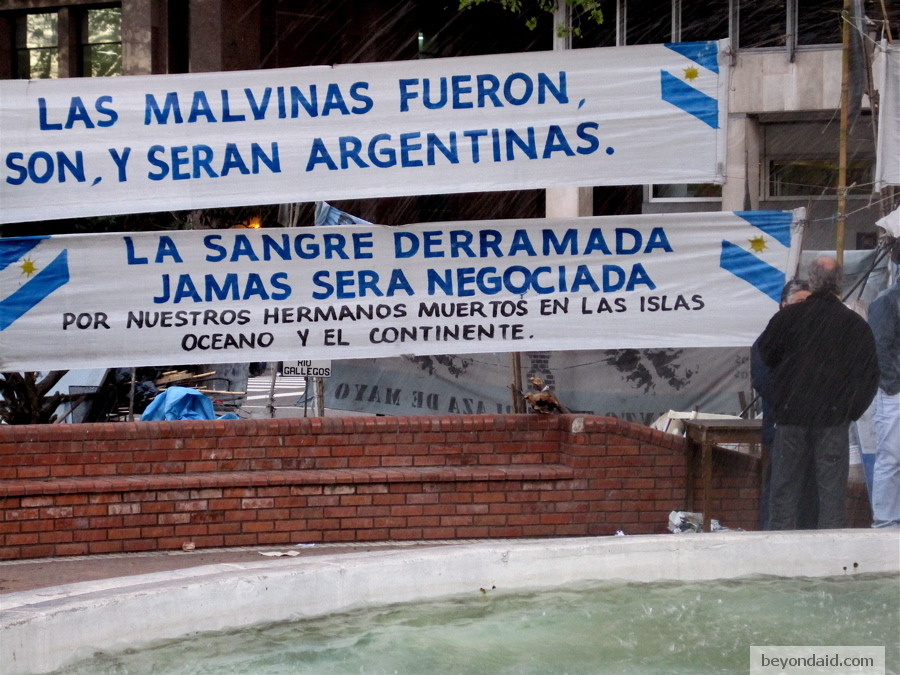
The Guardian reports on the escalating tensions between London and Buenos Aires that saw British Prime Minister David Cameron accuse Argentina of holding a “colonialist attitude” toward the Falkland Islands, a longtime British colony.
“Hector Timerman, [Argentina’s] foreign minister, described Britain as ‘a synonym for colonialism.’ He was quoted by Reuters as saying: ‘Evidently at a time when only scraps of colonialism linger, Great Britain … has decided to rewrite history.’ ”

The war within
Former US secretary of labour Robert Reich argues the current “crisis of capitalism” is the result of a lopsided conflict between consumers and investors on the one hand, and workers and citizens on the other.
“And since most of us occupy all four roles, the real crisis centres on the increasing efficiency by which we as consumers and investors can get great deals, and our declining capacity to be heard as workers and citizens.

As a result, consumers and investors are doing increasingly well but job insecurity is on the rise, inequality is widening, communities are becoming less stable and climate change is worsening. None of this is sustainable over the long term but no one has yet figured out a way to get capitalism back into balance. Blame global finance and worldwide corporations all you want. But save some of your blame for the insatiable consumers and investors inhabiting almost every one of us, who are entirely complicit.”

Irreconcilable differences
The Overseas Development Institute’s Claire Melamed argues the current consensus over bringing development and environment agendas closer together may be short-lived.
“But there is a danger to this approach – exemplified in the call for SDGs to also tackle ‘sustainable consumption and production patterns’.  This gets to the heart of what makes the whole issue of sustainability so politically toxic.  Sustainable consumption patterns would almost certainly mean some people on the planet consuming less so others could consume more.  Similarly on production – if developing countries are going to grow, and if technology doesn’t ride to the rescue, it’s at least possible that ‘sustainable’ might mean the rich world producing less.”

Immoral economy
Columbia University’s Jeffrey Sachs argues there are four ways in which self-interest, which is the very foundation of capitalism, “fails to support the common good.”
“Second, it can easily turn into unacceptable inequality. The reasons are legion: luck; aptitude; inheritance; winner-takes-all-markets; fraud; and perhaps most insidiously, the conversion of wealth into power, in order to gain even greater wealth.
Third, self-interest leaves future generations at the mercy of today’s generation. Environmental unsustainability is a gross inequality of wellbeing across generations rather than across social classes.”

Misguided journey
The University of Ottawa’s Nipa Banerjee gives a harsh assessment of the state of the international development industry in the wake of last month’s summit in Busan.
“The pre-Busan evaluations and Busan discussions clearly reflect a misguided journey of the Western-centric donors who are running the wheels of a self-serving aid industry. While some of the non-traditional non-Eurocentric donors, such as China, Brazil, and India, represented themselves in Busan, they took rather low-profile positions, with none officially joining the OECD’s Development Assistance Committee, in endorsement of the self-reproducing development support industries. Most of these new donors had once been roped into a monstrous global aid industry and well experienced the fruitlessness of spending time in delving into reams of paperwork, policy papers, development programming, and evaluations, nursing the illusions of effective aid.”

Multilateral failures
Writer James Denselow reviews a pair of new books on global revolution, including the latest by Carne Ross whom he describes as a former diplomat “transformed into a thinking man’s neo-anarchist.”
“The nation-state represents an archaic and ill-fitting answer to multifaceted non-localized issues, brought on by the pressures of globalisation and climate change. From flu-epidemics, to the spread of rioting, he carefully plots the ways in which our interconnectedness has led to problems which require global cooperation to solve. Yet the best efforts at multilateral cooperation have yet to deliver the answers. Ross parallels the enormous rhetoric of the 2005 G8’s promise to ‘make poverty history’ with the reality of its ‘utter failure’ to do so with a shortfall in pledges of $20 billion.”

Blue helmet blues
The Inter Press Service speaks to a number of experts about the evolving role of UN peacekeeping and the reputational hits such missions have taken in recent years.
“ ‘In the Congo, the U.N. is not exactly neutral, going after militias on behalf of the government,’ says Sean Maloney, a professor at the Royal Military College in Kingston Ontario.

Maloney told IPS the impartial style of peacekeeping as represented by Canadians serving as U.N. soldiers and keeping armed Greek and Turkish-speaking people at bay in Cyprus in the 1970s was rendered ‘obsolete’ starting in the 1990s.
‘We are going to see more interventions. They will be more coercion-style interventions (like the NATO mission in Afghanistan where Canada had upwards of 3,000 soldiers) that will be siding with one side or another,’ adds Maloney, describing himself as pro-military and ‘libertarian’.”