
Latest Developments, November 30

In the latest news and analysis…

Aid’s latest agenda
The Busan aid effectiveness summit has produced the final version of its outcome document which is chock-full of general promises on the future of “development co-operation.”
“We can and must improve and accelerate our efforts. We commit to modernise, deepen and broaden our co‐operation, involving state and non‐state actors that wish to shape an agenda that has until recently been dominated by a narrower group of development actors. In Busan, we forge a new global development partnership that embraces diversity and recognises the distinct roles that all stakeholders in co‐operation can play to support development.”

Perceived corruption
Transparency International has released the 2011 edition of its Corruption Perceptions Index, a ranking of 183 country/territory public sectors which places New Zealand at the top and Somalia and North Korea tied at the bottom.
“This year we have seen corruption on protestors’ banners be they rich or poor. Whether in a Europe hit by debt crisis or an Arab world starting a new political era, leaders must heed the demands for better government,” according to Transparency International’s Huguette Labelle.

Justice over reconciliation
Al Jazeera reports the International Criminal Court’s planned prosecution of former Ivorian president Laurent Gbagbo is doing little to promote reconciliation in the troubled West African nation.
“As both camps [in Cote d’Ivoire’s recent conflict] traded blame, global human rights groups have warned that any prosecution focused solely on Gbagbo and not those of his rival, Ouattara, could threaten national stability.
Francis Dako, the African co-ordinator at the Coalition for the ICC, urged the court to prosecute both.
‘A decision to go after the defeated president alone at this point is likely to be explosive on the ground,’ he said.”

Development priorities
Bloomberg reports that US-based Newmont Mining has halted construction at a Peruvian gold deposit in response to violence between police and farmers worried the project will threaten their water supply.
“‘We can’t allow Peruvians to be taken hostage by groups that just preach violence,’ Pedro Martinez, president of the National Society of Mining, Petroleum & Energy, told reporters in Lima today. ‘Without peace there will be no development.’
Deputy Environment Minister Jose de Echave resigned yesterday to protest the government’s backing for the project, which seeks to produce 680,000 ounces of gold and 235 million pounds of copper annually.”

Bad faith
The Wall Street Journal reports on a UK parliamentary committee’s condemnation of defense contractor BAE Systems for its behaviour following a $400 million settlement reached over foreign bribery charges.
“BAE settled with the [UK’s Serious Fraud Office] in February 2010 over allegations that it concealed bribes paid in connection with a contract for an air-traffic control system in Tanzania. The defense contractor agreed to give GBP29.5 million back to the Tanzanian people as a part of the settlement, but failed to make payments to the country months after the deal was finalized. The delay prompted the hearing.

‘The way that BAE has handled this whole process has been quite shoddy,’ Committee Chairman Malcolm Bruce said in a news release. ‘Dragging it out this way has needlessly created the impression that BAE was acting in bad faith. The company should have paid up much sooner.’”

Inter-generational thinking
Archbishop Emeritus of Cape Town Desmond Tutu and former Irish president Mary Robinson call on international leaders to begin negotiating a legal agreement on climate change that would go further than the soon-to-be-expired Kyoto Protocol.
“Climate change is a matter of justice. The richest countries caused the problem, but it is the world’s poorest who are already suffering from its effects. In Durban, the international community must commit to righting that wrong.
Political leaders must think inter-generationally. They need to imagine the world of 2050, with its nine billion people, and take the right decisions now to ensure that our children and grandchildren inherit a liveable world.”

Aid power
The International NGO Forum on Indonesian Development’s Don Marut writes about aid dependence and lists some of the pressures he believes underlie its perpetuation in Southeast Asia’s most populous country.
“Second, foreign aid is a way and tool for the developed countries and international financial institutions to control the recipient countries. The House of Representatives heard that there were 63 laws that had been drafted by foreign consultants.
These works are part of foreign aid in the form of technical cooperation or program support, whether they are in the form of loans or grants.
Indonesia is a country with an abundance of natural resources and has a strategic position in terms of global geopolitics.
Developed countries cannot just allow Indonesia to freely use up its resources. Aid is a soft way of controlling the policies of recipient countries, including Indonesia. The more the aid flows, the greater the control the foreign power has.”

Fighting fair
Embassy magazine’s Scott Taylor argues there is a point at which technological inequality in a military context becomes a question of morality.
“Responding to the question of whether NATO could be implicated for potential war crimes in Libya, [Lt.-Gen. Charles] Bouchard insisted his pilots had taken all possible precautions to avoid hitting civilians.
The example he provided was an incident whereby two NATO warplanes circled a Gaddafi loyalist anti-aircraft site for two hours, waiting for a nearby soccer game to end before they attacked.
If your technological advantage over the enemy allows you to hover for two hours with impunity over an air defence system before destroying it at your leisure, that is not really war, it’s murder. If a world champion boxer climbed into the ring against a blind paraplegic in a wheelchair and proceeded to pound the hapless victim to death, we would not consider it a sport.”
Latest Developments, November 21

In the latest news and analysis…

Chevron spill
Agence France-Presse reports Brazil is fining oil giant Chevron “at least $28 million” over a spill from one of its wells off the coast of Rio de Janeiro state.
“Haroldo Lima, head of the National Oil Agency said Chevron was facing a series of fines that each could be worth $28 million dollars for having given false or incomplete information about the incident. Exactly how many fines will be determined by the investigation, he added.
ANP accused Chevron of having released “false information” in presenting an action plan that called for the use of equipment not currently available in the country and also of having presented edited pictures on the damage, according to Lima.
Meanwhile Environment Minister Izabella Teixeira also said more fines would be imposed if environmental violations were proven.”

Reversal of fortunes
The New York Times reports debt-ridden Portugal is appealing to its former colony Angola – “once a prime source of slaves, then a dumping ground for the mother country’s human rejects and now swimming in oil wealth” – for investment, but not everyone sees a new dawn in relations.
“There is still the colonial mentality in Portugal,” according to anticorruption campaigner Rafael Marques de Morais. “They just want to extract resources and plunder the country. The only difference is this time they didn’t take them by force.”

Plundering the Congo
Reuters reports a British lawmaker believes the Democratic Republic of Congo’s government is selling its mining assets at below-market prices to shell companies located in tax havens.
“[Labour MP Eric] Joyce said the documents showed that four sales of assets in Katanga had officially netted the government just $272 million, instead of $5.8 billion, which he said was the estimated total market value for the assets.
The involvement of off-shore vehicles had made it impossible to track who had in fact benefited from the sale, he added.”

Growth not enough
The Guardian reports on a new Organisation for Economic Co-operation and Development document that warns of the dangers posed by increasing levels of inequality, not only in fast-growing countries such as China and India, but also in 17 of the 34 members of its own rich-country club.
“‘Both poor and middle-class populations are increasingly alienated from the richest in many societies. Stark inequalities persist between groups defined by sex, working status and ethnic origin. Both rising inequalities and their persistently high levels can sow the seeds of future conflict and social unrest,’ says the report. It warns that ‘the emergence of a global elite that is isolated from less fortunate echelons of the societies from which its members originate is an important risk that policymakers must be aware of’.”

Climate cop-out
The Guardian also reports that rich countries have “given up” on the prospect of a new climate change treaty for this decade, even before international negotiations on replacing the expiring Kyoto protocol get underway in South Africa next week.
“The UK, European Union, Japan, US and other rich nations are all now united in opting to put off an agreement and the United Nations also appears to accept this.
Developing countries are furious, and the delay will be fiercely debated at the next round of international climate talks beginning a week on Monday in Durban, South Africa.
The Alliance of Small Island States, which represents some of the countries most at risk from global warming, called moves to delay a new treaty ‘reckless and irresponsible’.”

Africa leading on climate
The head of the UN Environment Programme tells Reuters that Africa is leading the world when it comes to actually implementing clean-energy policies.
“Kenya is currently doubling its energy and electricity generating infrastructure largely using renewables. These are policies that are pioneering, that are innovative,” according to UNEP’s Achim Steiner.

“We see across the continent both a realisation of how threatening climate change really is and also the inevitable necessity that governments have an interest in beginning to put their own development priorities on a different trajectory.”

Dismissing the three Ds
New York Univesity economist Bill Easterly argues the US aid program has been “taken over by national security interests, abetted by delusions of nation-building” and calls for a clear separation between aid and defense departments.
“The misguided mindset across two administrations has been that development is – as Hillary Clinton put it in January 2010 – ‘mutually reinforcing’ to defence. Experience and commonsense suggest the opposite – aid works better where bullets are not flying. As for aid winning hearts and minds in war zones, it hasn’t worked. Not in Pakistan, where despite $3.7bn in economic aid between 2003 and 2009, the US is more unpopular than ever. Not in Afghanistan, where 52% of Afghans said ‘foreign aid organisations are corrupt and are in the country just to get rich’.”

Food imbalances
World Trade Organization head Pascal Lamy argues the trade policies of major food-exporting countries have as much to do with hunger in Africa as the continent’s low yields.
“The burden must not fall on Africa alone. The developed world also has a role to play by curbing the use of trade distorting subsidies which result in food surpluses being dumped on third country markets.
Low levels of African agricultural productivity have kept the continent on the sidelines of global agricultural trade and helped create a situation today in which a handful of countries dominate production and export. In a world of nearly 200 countries, there are only between five and 10 major exporters of cereals.”

Latest Developments, November 8

In the latest news and analysis…

Cholera compensation
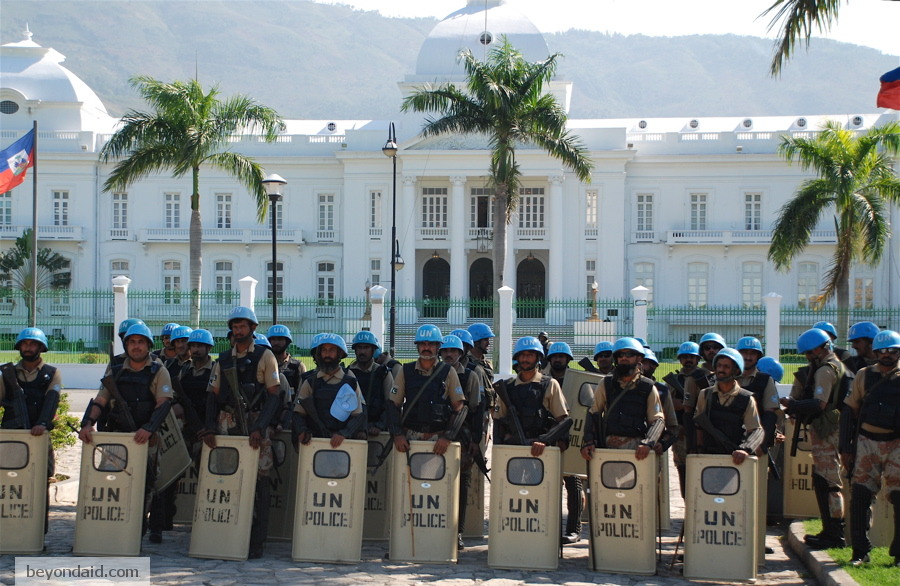
Al Jazeera reports a US-based human rights group is seeking hundreds of millions of dollars in reparations from the UN for those affected by a deadly cholera outbreak in Haiti.
“‘The cholera outbreak is directly attributable to the negligence, gross negligence, recklessness and deliberate indifference for the health and lives of Haiti’s citizens by the United Nations and its subsidiary, the United Nations Stabilization Mission in Haiti (MINUSTAH),’ the petition said.
It said numerous studies, including those by the UN, traced the virus to UN personnel from Nepal.
‘Until MINUSTAH’s actions incited the cholera outbreak, Haiti had not reported a single case of cholera for over 50 years,’ the petition said.”

Development as right
The UN News Centre reports that on the 25th anniversary of the UN Declaration on the Right to Development, some of the organization’s top officials conceded the principle had “languished” in practice.
“‘The fact that almost three billion people live in poverty and that 20 per cent of the world’s people hold 70 per cent of its total income means that we have not kept our promises,’ said High Commissioner for Human Rights Navi Pillay.”

R2P’s uncertain future
Embassy Magazine reports that, while a number of Responsibility to Protect proponents have pointed to the NATO intervention in Libya as a successful implementation of the doctrine, former UN secretary general Kofi Annan argues the “jury is still out.”
“When the council voted to effectively unleash the air power of western countries like the United States, France and Britain against Libyan military infrastructure and equipment, Brazil, China, India and Russia all abstained, sending a “powerful message” that the UN’s top body was divided, said Mr. Annan.
‘Therefore, when you go to implement that resolution, you have to be very careful to stick to that resolution,’ he said.
That powerful message is reverberating in another failed council effort. An Oct. 5 resolution, that would have condemned Syria for the killing of thousands of people the UN says was at the hands of Syrian government authorities, was vetoed by China and Russia under the auspices that it didn’t explicitly rule out another foreign military intervention.”

Open-pit ban
MiningWatch Canada reports the government of a Philippine province has issued a ban on open-pit mining over the objections of Canadian mining company TVI Pacific, which has vowed to take legal action.
“‘The destruction of our land and natural resources through open pit mining is irreversible and the forced displacement of communities contradicts the real meaning of development, or should we ask “development for whom?”’ says Daniel Castillo, Director of the Dipolog Committee on Mining Initiatives, a Church-based support group in Zamboanga del Norte.”

Benefits of conservation
The UN Environment Program’s Achim Steiner makes the economic case for protecting animal species from extinction, using the example of Palau which recently became the first country to declare its waters a shark sanctuary and now earns an estimated eight percent of its GDP through shark-diving tours.
“Nature should never be prized merely for its economic value. But, in a world of competing demands and limited resources, economic considerations can help to tip decisions in favor of conservation rather than degradation. This kind of strategic thinking can help to ensure that the world’s 10,000 migratory species continue their journeys, so that future generations can also marvel at these nomads of the natural world.”

Learning from others
The University of Cambridge’s Tarak Barkawi argues that because we live in “a jingoistic age, when Westerners, Asians and Muslims are all convinced of their own superiority,” new ideas and solutions are impeded by a reluctance to learn from and co-operate with others.
“And so, when we look upon the Arab Spring, we should not interpret it as a matter of Arabs having finally read John Locke and Thomas Jefferson and applied Western ideas. We should look instead for the new ideas, the new possibilities, the new politics created up by the protesters, activists and ordinary people who have made revolution.
We should be cognizant too that the Arab Winter will be a university of counter-revolution, as new forms of repression, of neo-imperialism and of exploitation are developed in response to novel circumstances.”

Othering and torture
The University of Edinburgh’s Tobias Kelly writes about the long-standing Western tradition of viewing torture as something that is only committed by uncivilized “others”, with the result that no British citizen has ever stood trial for the crime of torture.
“The problem is that too much is at stake for the British government to admit its complicity in torture. They will always try and find other words to describe the brutal ill-treatment of detainees. Assault, disobeying orders, dereliction of duty, even murder, but not torture.
Once torture has been used to make the distinction between the civilised and the barbarous, it is just too difficult for the British government to imagine that it stands on the wrong side of that line.”

Durban showdown looming
Democratic Republic of Congo negotiator Tosi Mpanu-Mpanu tells the Independent Online what he is expecting from rich countries at the upcoming climate change conference in Durban, South Africa.
“They seek to tear down the Kyoto Protocol, now or later, and to replace it with a different architecture.
A few have said they will not participate in a second commitment period, despite their legal obligations under the Kyoto Protocol, while others have said the next commitment period should be ‘transitional’ to a new regime.
In other words, they seek to ‘transition’ out of their legally binding obligations under the Kyoto Protocol into a new regime we have not designed yet.
One country seems to prefer an altogether weaker system via a ‘pledge-based’ rather than ‘science-based’ system of emission reductions that applies ‘symmetrically’ to rich and poor countries.
So it is not merely a question of who will remain inside or outside the multilateral process, but, more fundamentally, what that process will be. This is the big question for Durban.”

Latest Developments, October 13

In the latest news and analysis…

The instability of inequality
New York University economist Nouriel Roubini argues this year’s wave of protests, from Cairo to New York, are the result of the world’s growing economic and political inequality.
“Any economic model that does not properly address inequality will eventually face a crisis of legitimacy. Unless the relative economic roles of the market and the state are rebalanced, the protests of 2011 will become more severe, with social and political instability eventually harming long-term economic growth and welfare.”

Shifting European priorities
Agence France-Presse reports the EU, the world’s biggest donor, has announced changes to its aid program that will shift attention from major emerging nations like China and India toward agriculture and energy in the poorest countries.
“With 75 percent of the world’s poor live in middle-income countries, ActionAid called the changes an ‘alarming shift’ that moves ‘EU aid away from supporting poor people to end poverty and towards promoting economic growth.’
Laura Sullivan, EU development policy expert at ActionAid, said the reform ‘assumes money from economic growth will trickle down to the world’s poor but this has been tried before and it doesn’t work.’”

Band-aid solutions
The Tuvalu Faith Based Youth network’s Redina Auina says emergency assistance for the current water crisis is appreciated but what the Pacific island nation really needs is for rich countries to help over the long term by reducing their emission levels.
“It’s like they are applying one sticking plaster at a time, which is not going to solve the issue. While much more can be done in terms of improving Tuvalu’s water security and water conservation measures, there is not much more the island can do to increase its resilience to climate change.”

A call for humility
Howard Buffett, philanthropist and son of billionaire Warren Buffett, has called for more nuanced and humble thinking when it comes to finding solutions for improved agriculture in Africa.
“Stop thinking that what we know how to do is going to work for somebody else,” Buffett said. “We need to be intelligent enough and humble enough to admit that we don’t know everything and that we certainly don’t know some things in other parts of the world that need to happen.”

Rotten aid
Tales from the Hood’s J. gives the impression the international aid industry is almost (but not quite) completely irredeemable.
“The hardest part of this job is not seeing awful things in the field. It’s not repeatedly witnessing the suffering of others and being able to offer little as a remedy, dealing with corrupt district officials, getting sick, or spending too long away from one’s family too often (hard as those things truly can be). The hardest part of this job is simply dealing with the crushing dumbassery of a system that fundamentally lacks real incentives for getting right what it claims as its core purpose.”

Defending Millennium Villages
In the wake of a recent Guardian piece laying out some of the criticisms levelled at the Millennium Villages Project, Columbia economist Jeffrey Sachs offers a defence of his brainchild.
“Contrary to the loose talk of critics, this project is not throwing “gazillions” of dollars at poverty. The project spent $60 on each villager every year between 2006 and 2011 to build the capital of the community. That prompted further contributions from the government itself and in-kind contributions from the community. This is a replicable and scalable budget model, well within the official development assistance amounts donors have long promised. It’s nonsense to suggest otherwise, or to change the game now this amount has been shown to work so powerfully.”

Unconstitutional IP rules?
US Democratic senator Ron Wyden has challenged the Obama administration’s right to sign the Anti-Counterfeiting Trade Agreement without Congress’s approval.
“Wyden demanded that the administration either declare that ACTA does not create any international obligations for the US and therefore is ‘non-binding,’ or provide a legal rationale to the Congress and the public as to why ACTA should not be considered by Congress.”

Full and unlimited democracy
Author Dan Hind draws on history to suggest the world’s current problems, in rich and poor countries, are due primarily to a lack of democracy.
“In the late 1840s, typhus fever broke out in Upper Silesia, a Prussian province in what is now Poland. The education ministry sent a physician called Rudolf Virchow to investigate. While Virchow identified insanitary working conditions as the immediate cause of the epidemic, he traced its origins to the region’s lack of political liberty. In the absence of free institutions the inhabitants were ‘poor, ignorant and apathetic’. In order to prevent a recurrence of the disease Virchow recommended a remedy that he summarised in a few words: ‘full and unlimited democracy’.”

Latest Developments, September 26

In the latest news and analysis…

Waiting for the politicians
Grist reports that 11 major engineering organizations have issued a joint statement saying a lack of political will, rather than technological shortcomings, are standing in the way of an 85-percent cut in global emissions by 2050.
“The statement calls on world leaders to reach a global commitment to emissions reduction and energy efficiency at December’s COP17 climate change talks. Once that commitment is in place and adequately backed up, say the engineers, the technology is there to carry it out.”

Killer profits
The Arms Trade Treaty Monitor has collected statements made last week to the UN General Assembly by the leaders of countries such as Mexico, Nigeria, Ghana and Costa Rica concerning the agreement which should be finalized in 2012.
“It is unjust and inhuman that the profits of the arms industry should decide the deaths of thousands of people,” according President Felipe Calderón of Mexico.

Untapped markets for unmanned aircraft
The Globe and Mail reports worldwide drone sales are expected to double over the next decade but with a sluggish US market, the quest for profits could trump proliferation concerns.
“Both surveillance and armed U.S. drones, which have been widely deployed in Afghanistan and Iraq, have received strong interest from Japan, Australia, Saudi Arabia and nuclear neighbours India and Pakistan, among others.”

Trafficking losses
The Financial Times reports on the Organisation for Economic Cooperation and Development’s growing interest in cracking down on loopholes that enable companies to play one country against another in order avoid paying taxes.
“The OECD last year highlighted its fears about the ability of banks to use losses accumulated since the financial crisis – calculated by the OECD to be worth $700bn – as a tool for aggressive tax planning. Among the concerns is ‘loss trafficking’ – schemes in which losses are sold to other companies to reduce their tax payment. In a report published in August, the OECD also warned about aggressive tax planning concerning the carry-forward of ‘vast’ corporate losses than can be as high as 25 per cent of gross domestic product in some countries.”

G20 and tax dodging
Christian Aid’s David McNair accuses G20 finance and development ministers of “backing away from their commitments to help poor countries collect more of the billions they lose to tax dodgers” at last week’s meeting in Washington.
“If the G20 were serious about harnessing the power of tax against poverty, they would have made a specific commitment to the big solution to tax dodging – financial transparency. Such transparency would make life far harder for companies and individuals hiding wealth in tax havens, not to mention the multinationals that use financial secrecy to dodge billions in tax in poor countries.”

Dodgy oil contracts
A new Global Witness report calling for reforms in Liberia’s oil sector also touches on some questionable behaviour by American oil giant Chevron.
“In 2007, Nigeria’s Oranto Petroleum authorized a bribe to be paid to the Legislature in connection with the passage of at least one of its contracts. In 2010, US company Chevron purchased a 70 % share of the same contracts, despite information about how they were obtained being in the public domain.”

Oversimplifying the economy
University of Toronto historian Michael Bliss suggests the thinking underlying the last few decades of Western economic policy reveal “a naive, self-serving misreading of history” and warns against anyone who suggests “obese and addicted societies” can painlessly right themselves by pushing the right fiscal buttons.
“The danger of listening to the people who oversimplify the past and then oversimplify the present… is that they really can make things worse, especially when they propose to dope us up on more of the same. The longer we avoid accepting complex, unmanageable realities, and the real discomforts involved in convalescence and recovery, the more we risk the long-term future for our children and grandchildren.”

The power of aid
The Guardian reports on the remarkable similarities between the UK’s “centre right development policy,” as described by the man who runs it, Andrew Mitchell, and the development policy of the ostensibly centre left Obama administration.
“Over the past 18 months, the US and the UK have been treading very similar development policy paths. As well as results, both talk about the important role to be played by the private sector, and by science and technology, in bringing about development. And both pepper speeches and announcements with mentions of national interests, security and power. The opening line of the executive summary in the USAid policy framework for 2011 to 2015, published earlier this month, provides a clear example. ‘International development co-operation is a key component of American power, along with diplomacy and defense,’ it reads.”