

In the latest news and analysis…
Global leadership failure
Amnesty International has released its 50th annual global human rights report, in which it describes the UN Security Council as “tired, out of step and increasingly unfit for purpose.”
“ ‘Failed leadership has gone global in the last year, with politicians responding to protests with brutality or indifference. Governments must show legitimate leadership and reject injustice by protecting the powerless and restraining the powerful. It is time to put people before corporations and rights before profits,’ said Salil Shetty, Amnesty International Secretary General.
…
‘The language of human rights is adopted when it serves political or corporate agendas, and shelved
when inconvenient or standing in the way of profit.’
…
The UN meeting to agree an Arms Trade Treaty in July will be an acid test for politicians to place rights over self-interest and profit. Without a strong treaty, the UN Security Council’s guardianship of global peace and security seems doomed to failure; its permanent members wielding an absolute veto on any resolution despite being the world’s largest arms suppliers. ”
Indifference in the time of cholera
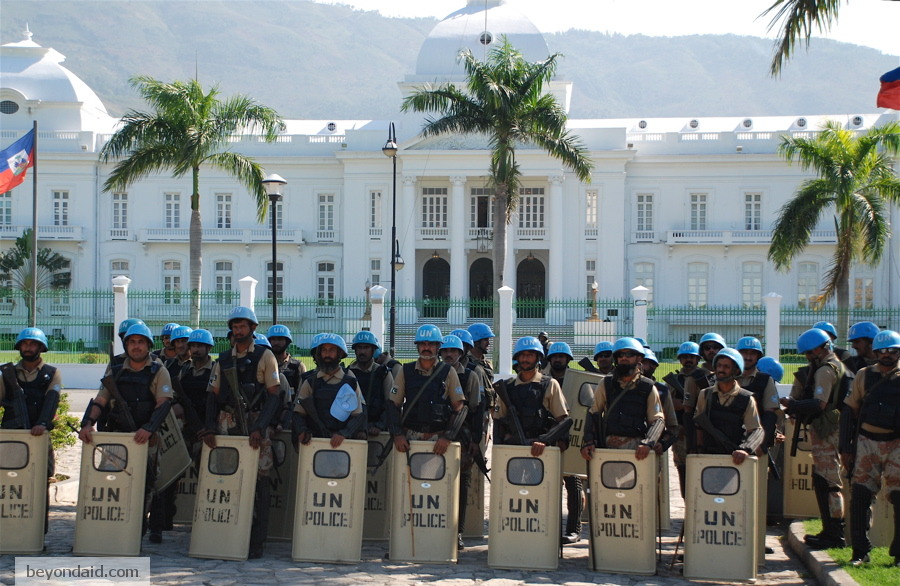
The Center for Economic and Policy Research reports that the rainy season is causing an intensification of Haiti’s cholera crisis, whose origins lie in UN peacekeepers’ sewage discharge into a source of drinking water.
“The cholera death toll is up to 7,155, with 543,042 infections over 586 days (and no UN apology so far), according to a new ‘cholera counter’ created by advocacy group Just Foreign Policy.
…
But so far, even this new danger [of an evolving second strain] doesn’t seem to be enough to make fighting cholera in Haiti a cause célèbre. Maybe a viral ‘Kolera 2012’ campaign would do the trick?”
FCPA questions
The Huffington Post reports that two American congressmen are looking into the motives behind the US Chamber of Commerce’s efforts to water down a 35-year-old piece of anti-corruption legislation.
“In a letter to the Chamber released Tuesday, Reps. Henry Waxman (D-Calif.) and Elijah Cummings (D-Md.) — the ranking Democrats on the House Oversight and Government Reform Committee and the House Energy and Commerce Committee, respectively — describe how committee staff looked through the institute’s tax filings and found that 14 of the group’s 55 board members between 2007 and 2010 ‘were affiliated with companies that were reportedly under investigation for violations or had settled allegations that they violated the Foreign Corrupt Practices Act.’
…
In their letter, the congressmen request information from the Institute for Legal Reform, including any documentation of board discussions about FCPA and ‘documents relating to companies that have provided funds to the Chamber or the ILR for work related specifically to the Foreign Corrupt Practices Act.’ ”
Bribery rising
The Wall Street Journal reports on a new survey that suggests business executives worldwide are increasingly willing to engage in unethical practices.
“Of the more than 1,700 executives polled by Ernst & Young for its annual fraud survey, 15% said they were prepared to make cash payments to win business, up from 9% in the previous survey.
…
The study found that 47% of the 400 chief financial officers surveyed felt they could justify potentially unethical practices to help business survive during an economic downturn. Those practices included giving cash payments, using entertainment and giving personal gifts to win business. And, 16% of CFO respondents said they did not know that their company can be held liable for the actions of third-party agents.”
Ending slave labour
The Associated Press reports that Brazilian lawmakers have approved a constitutional amendment that will mean those “who force people into slave-like working conditions” will face harsher punishments.
“The amendment allows the government to confiscate without compensation all the property of anyone found to be using slave labor, which is most common on remote farms but also occurs in urban sweatshops in places like Sao Paulo, South America’s largest city.”
Land fever
Reuters AlertNet reports on the growing enthusiasm among foreign-owned companies for setting up industrial palm plantations on Cameroonian land.
“Six foreign-owned companies are currently trying to secure over 1 million hectares (about 2.5 million acres) of land for the production of palm oil in the country’s forested southern zone, according to a coalition of environmental organisations.
…
In a recent letter addressed to Cameroon’s Prime Minister Philemon Yang, the Coalition of Civil Society Organisations in Cameroon called on the government to reject the projects, which they argue will destroy a critical forested zone linking five national parks and protected areas.
‘In addition to the direct destruction of flora and fauna, these projects will bring hunger and frustration to the local population,’ the coalition argued.”
Stock exchange accountability
British MP Lisa Nandy has explained in parliament a proposed legal amendment that would require UK companies to report on the human rights and sustainable development impacts of their business.
“As some Members may be aware, the [London Stock Exchange] is currently host to a number of companies that have been found guilty of gross violations of human rights, particularly in countries that are in conflict or deemed high risk, yet very few companies have been held properly to account for such actions.
…
Our amendment would clarify rather than rethink the purpose of the stock exchange, allowing the [Financial Conduct Authority] to take into account an applicant’s respect for human rights and sustainable development, in protecting the integrity and respectability of the exchange. That has been done elsewhere, such as in Hong Kong, and Istanbul, Brazil, Indonesia, Shanghai, Egypt, Korea and South Africa have all taken steps in that direction.”
Defining green
The World Development Movement asks a fundamental question in the lead-up to the Rio+20 Summit: what exactly does the oft-used term “green economy” actually mean?
“However, industrialised countries like the UK, alongside banks and multinational companies, are using the phrase ‘green economy’ as a smokescreen to hide their plan to further privatise the global commons and create new markets in the functions nature provides for free.
Out of this Trojan horse will spring new market-based mechanisms that will allow the financial sector to gain more control of the management of the global commons.
Instead of contributing to sustainable development and economic justice, this corporate green economy would lead to the privatisation of land and nature by multinational companies, taking control of these resources further away from the communities which depend on them.”
 Beyond Aid