Latest Developments, September 24

In the latest news and analysis…

Wage battle
Al Jazeera reports that protests continue in Bangladesh where garment workers are demanding an increase in the monthly minimum wage from $38 to $100:

“Western corporations that rely on Bangladeshi labor to make much of the clothing sold in their stores, including Wal-Mart, Gap and Macy’s, appeared reluctant to comment publicly on the protests — decisions that were criticized by labor-rights activists.
‘If the corporations were to send a clear message that they are willing to pay higher prices to manufacturers so they can pay higher wages to workers, that could have a real influence on negotiations,’ said Liana Foxvog, director of organizing at the International Labor Rights Forum, a U.S.-based group that advocates for workers in countries like Bangladesh.
But that’s unlikely to happen, Foxvog said.”

Serval omission
Le Mamouth blogger Jean-Marc Tanguy writes that the French military “surely forgot”, in its new detailed list of all the ammunition it has fired in Mali, to mention what actually got hit:

“…French soldiers fired 34,000 small-caliber rounds. 58 missiles were also launched, and Caesar howitzers contributed 753 shots. AMX-10RCR tanks chimed in with 80 shots and VBCI infantry fighting vehicles, nicknamed the ‘Saint Bernards of the desert’ spat out 1,250 25mm rounds.
Helicopters reportedly fired 3,500 shells and fighter jets dropped 250 bombs.” [Translated from the French.]

Laundered oil
Reuters reports that “much of the proceeds” from Nigeria’s stolen oil, estimated to cost the country $5 billion a year in lost revenue, are being laundered in the US and UK:

While oil majors like Royal Dutch Shell and Italy’s Eni are often the first to complain about theft, it is unclear how much they are losing from it. A measure of acceptable losses may be keeping them from taking determined preventive action, the [Chatham House] report said. Oil firms do not pay royalties on stolen oil.
‘Nigerian crude oil is being stolen on an industrial scale. Proceeds are laundered through world financial centres and used to buy assets in and outside Nigeria,’ said the 70-page report, entitled ‘Nigeria’s Criminal Crude’.

The report named the United States, Britain, Dubai, Indonesia, India, Singapore and Switzerland as likely money-laundering hotspots, and the United States, Brazil, China, Thailand, Indonesia and the Balkans as the most likely destination for stolen oil.

Looming coup
The New Yorker’s Philip Gourevitch and UN Dispatch’s Mark Goldberg debate via Twitter the proper course of action should Sudanese President Omar al-Bashir, who is wanted by the International Criminal Court, pay a visit to UN headquarters in New York:

Goldberg: “Genocide is a uniquely horrid crime. Arresting Bashir if he comes to NYC should trump other diplomatic considerations ‪http://bit.ly/15953P9”
Gourevitch: “If US were to carry out Sudan coup d’état as you advocate, should the US then be held responsible for consequences in Sudan?”
Goldberg: “The USA would be executing the [UN Security Council’s] will when it referred the case to the ICC.”
Gourevitch: “That avoids my serious question. You call for decapitating regime – do you. Say what happens as result is irrelevant?”
Goldberg: “but yes, I do believe the int’l community bears some responsibility for helping w/ a smooth transition”
Gourevitch: “Right, it’s no simple legal/moral matter. It’s a colossal political act w/colossal political consequences & not so obvious.”

Dropping H-bombs
The Guardian reports on new evidence suggesting that US President John F. Kennedy came much closer to nuking America than any Soviet leader ever did:

“The bombs fell to earth after a B-52 bomber broke up in mid-air, and one of the devices behaved precisely as a nuclear weapon was designed to behave in warfare: its parachute opened, its trigger mechanisms engaged, and only one low-voltage switch prevented untold carnage.
Each bomb carried a payload of 4 megatons – the equivalent of 4 million tons of TNT explosive. Had the device detonated, lethal fallout could have been deposited over Washington, Baltimore, Philadelphia and as far north as New York city – putting millions of lives at risk.”

Cultural divide
Intellectual Property Watch reports on the resumption of UN debate over a possible international agreement on the relationship between intellectual property and “genetic resources, traditional knowledge and folklore”

“This has been a prickly issue, as a majority of developing countries would like to have a binding legal instrument and a number of developed countries have resisted the idea of a binding instrument.

The European Union said it recognises the importance of the work of the committee and ‘looks forward to establishing a work programme’ but with the understanding that any international instrument be non-binding, flexible and sufficiently clear. There is no agreement on the nature of the instrument, the delegate of Lithuania said on behalf of the group.”

Less is more
The Globe and Mail’s Geoffrey York asks if the absence of foreign aid has strengthened democracy in the breakaway republic of Somaliland:

“Somaliland’s government survives on taxation revenue, which, in turn, requires a degree of political accountability and transparency. In contrast, there are 16 countries in sub-Saharan Africa where foreign aid is so massive that it equals more than half of government spending.
‘If these aid levels damage the quality of governance in recipient countries – as Somaliland’s experience suggests they may – then it might be the case that, in the long run, less money may actually do more good,’ [Stanford University’s Nicholas] Eubank wrote in a blog post.”

Resource curse
UN expert on the rights of indigenous peoples James Anaya argues that “economic development”, as conceived by most governments and corporations, leads all too often to the loss of self-determination and culture for those who live off the land:

“In the case of indigenous peoples, their connections to the land invariably have a longer history than the government deciding what to do with the land. According to the Rights and Resources Initiative, ownership of roughly one-half of the global south is contested, directly affecting the lives and livelihoods of over two billion people. This is no surprise, since over sixty percent of the developing world’s forests are administered by governments – who all too often give it away for pennies per hectare, for the sake of ‘quick-fix’ development.”
Latest Developments, September 19

In the latest news and analysis…

French drone strike?
Xinhua quotes an anonymous “security source” as saying a French drone has killed six people in northern Mali, which if true, would be the first-ever drone killings by France:

“The source said that the Algerian army detected the drone, confirming that the strike took place near the border, on the Malian side.
The six combatants killed were allegedly plotting an attack against the military base at Tessalit, controlled since February by French and Chadian forces.” [Translated from the French.]

Welcome mat
Reuters report that on the same day as the alleged French strike, Niger’s foreign minister said he wanted armed drones to operate in his country:

“ ‘I would really welcome armed drones to shoot down drug traffickers, and all those who live from activities linked to drug trafficking. I don’t see why that shouldn’t be possible,’ [Mohamed Bazoum] said.”

Security state
The International Crisis Group has published a new report in which it expresses concern that Niger’s Western allies are pushing “a security strategy that has already shown its limitations elsewhere in the Sahel”:

“ ‘Niger has been included in security strategies that protect it but over which it has little influence’, says Jean-Hervé Jezequel, Crisis Group Sahel Senior Analyst. ‘Encouraged by its allies to upgrade its security apparatus, the Nigerien government has also substantially increased its military expenditure. But such a security focus could lead to a reallocation of resources at the expense of already weak social sectors’.
‘Rather than a security state, the people of Niger need a government that provides services, an economy that creates employment and a reinforced democratic system”, says Jonathan Prentice, Crisis Group’s Chief Policy Officer.”

Incoherent policy
The Guardian reports that a group of NGOs has accused the EU of breaking the law by letting European firms dodge “at least $100bn a year” in taxes owed to poor countries:

“The EU is the only region of the world to have a legally binding commitment to policy coherence for development, set out in the 2009 Lisbon treaty. Under the PCD, the aims of EU development co-operation should not be undermined by other EU policies on climate, trade, energy, agriculture, migration and finance.

On taxes, Concord calls on the European council – the group of EU leaders – to extend the automatic exchange of tax information among European countries to the developing world.”

Massacre cover-up
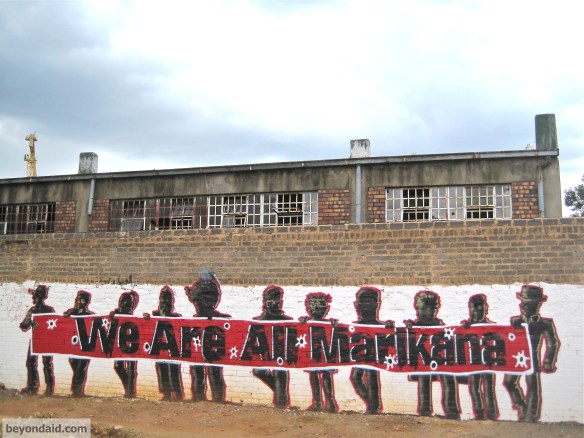
The Associated Press reports that a South African government commission investigating last year’s shooting deaths at the Marikana platinum mine has accused the police of lying:

“In a statement issued Thursday, the Marikana commission said it had to search computer hard drives of officers to discover documents about the 2012 shootings that riveted South Africa and recalled the worst excesses of the apartheid era.
The commission said documents show the police version of events at the platinum mine ‘is in material respects not the truth.’
The statement said the thousands of pages of new evidence include documents the police had previously said did not exist and material which should have been disclosed earlier by police.”

Small consolation
The Inquirer reports that Canada’s Barrick Gold is being accused of offering “crumbs” as compensation for a toxic spill in the Philippines:

“After nearly a decade of battling it out in a United States state court, the province of Marinduque has come close to signing a deal worth $20 million with the mining company that bought the firm being held responsible for unleashing toxic wastes into Marinduque’s Boac River in a case considered to be the country’s worst mining disaster.
The compensation offer of $20 million, however, is way below the $100-million claim for damages that the Marinduque government is demanding from Barrick in a 2006 lawsuit.

The amount, however, would further be reduced to $13.5 million after litigation expenses had been paid.”

Looming divorce
Reuters reports that African leaders will meet next month to discuss the future of the continent’s relationship with the International Criminal Court:

“So far there does not seem to be much support for it, but heads of state from the 54-member African Union (AU) may still discuss the possibility of a pullout by the 34 African signatories to the Rome Statute that created the tribunal.
Last week’s start of the trial of Kenyan Deputy President William Ruto for crimes against humanity – with President Uhuru Kenyatta’s trial due in November – has fuelled a growing backlash against the Hague-based court from some African governments, which see it as a tool of Western powers.
‘The Kenyans have been criss-crossing Africa in search of support for their cause, even before their parliament voted to withdraw from the ICC,’ an AU official told Reuters.
‘An extraordinary summit will now take place to discuss the issue. A complete walk-out of signatories (to the Rome Statute) is certainly a possibility, but other requests maybe made.’”

House of cards
The Associated Press reports that Pope Francis has said he wants the Catholic church to become less fixated on “small-minded rules”:

“But his vision of what the church should be stands out, primarily because it contrasts so sharply with many of the priorities of his immediate predecessors, John Paul II and Benedict XVI. They were both intellectuals for whom doctrine was paramount, an orientation that guided the selection of a generation of bishops and cardinals around the globe.
Francis said the dogmatic and the moral teachings of the church were not all equivalent.
‘The church’s pastoral ministry cannot be obsessed with the transmission of a disjointed multitude of doctrines to be imposed insistently,’ Francis said. ‘We have to find a new balance; otherwise even the moral edifice of the church is likely to fall like a house of cards, losing the freshness and fragrance of the Gospel.’ ”

Latest Developments, September 18

In the latest news and analysis…

Death by GDP
The Zoological Society of London’s Jonathon Baillie argues that America’s improving environment does not mean economic growth is good for biodiversity:

“GDP masquerading as growth has negative implications for biodiversity, as this ‘growth’ only calculates output; or as Joseph Stiglitz, a Nobel Laureate, said: ‘GDP measures only revenues to see how well a firm is doing; far more relevant is the balance sheet, which shows assets and liabilities.’

Some of America’s environmental conditions can be explained by innovation leading to greater efficiency, such as fuel efficiency in cars or more efficient agricultural production. But the majority of the negative impact has simply been exported. The industries that produce the most pollutants have been outsourced to emerging nations that have fewer regulations, in terms of both the environment and labour conditions. Therefore the environmental impact of increased consumption is largely felt beyond the borders of wealthy nations — it is middle- and lower-income nations that experience the majority of environmental degradation and biodiversity loss.

It is self-evident that growth, as currently defined, has a major negative impact upon biodiversity. What needs to change is the definition of growth from a GDP-centric mindset to a balance-sheet approach.”

Toxic legacy
The Associated Press reports that hundreds of Chilean plaintiffs are suing a Swedish mining company for allegedly exporting and dumping toxic waste during the Pinochet era:

“The lawsuit filed with a Swedish district court claims Boliden exported 20,000 tons of mining waste to the Chilean town of Arica in the mid-1980s, despite knowing it was highly toxic and could not be handled safely at the site.
Citizens in a residential area called Polygono claim the waste includes high levels of arsenic, lead and quicksilver, and that it has given them health problems such as cancer, aching bones, breathing difficulties, rashes and miscarriages.”

MINUSTAH misconduct
The Center for Economic and Policy Research reports that an alleged rape by a UN peacekeeper in Haiti is just the latest incident in an alarming pattern of sexual violence:

“In fact, according to the U.N. Conduct and Discipline Unit, there have been 78 allegations of sexual abuse and exploitation by members of MINUSTAH reported in just the last 7 years.
Responding to the latest allegation, the U.N. mission noted that ‘the UN has a zero tolerance policy regarding sexual exploitation and abuse that we, at MINUSTAH, strictly enforce.’ However the U.N. lacks the authority to hold accountable those who are found responsible. Troops stationed in Haiti under the U.N. mission are subject only to the justice system of their home country.

Through the first 8 months of 2013, there had already been 13 allegations. The latest makes 14. While MINUSTAH makes up less than 10 percent of U.N. peacekeeping forces worldwide, the mission has accounted for over 35 percent of all sexual abuse and exploitation allegations against all such U.N. forces in 2013.”

Corrupt companies
Canada.com reports that companies from wealthy, English-speaking countries dominate the World Bank’s newly updated corporate blacklist:

“The World Bank bans companies from participating in aid and development contracts if they ‘have been sanctioned under the Bank’s fraud and corruption policy.’

Companies with head offices listed in Canada, which does not include overseas subsidiaries, comprise 119 names on the World Bank list, the most of any country. The U.S. is second with 44 debarred firms, Indonesia third with 43 and Britain close behind with 40.”

Juggling act
The Financial Times reports on mining industry opposition to South African attempts at ensuring its people “benefit more equitably” from natural resource exploitation:

“ ‘What you can hear from all parts of Africa and elsewhere is that developing countries don’t want an extractive relationship either with the bigger emerging markets or with the developed countries. They want a relationship where there is value addition to the minerals, so that jobs are created, skills are created and technology imparted, and that this contributes to overall social and economic development,’ [South African Finance Minister Pravin Gordhan] told the FT.
The bill, as it stands, aims to do this by allowing the mines minister the discretion to determine the quantity and set the price at which mining companies sell to local industries.”

Visit cancelled
Bloomberg reports that Brazil’s president has called off a scheduled trip to Washington over allegations of US espionage:

“[Dilma Rousseff] said Sept. 6 she was outraged by allegations that the U.S. National Security Agency monitored her e-mail and telephone communications with top aides. The NSA also spied on state-controlled Petroleo Brasileiro SA, according to accusations presented by U.S. journalist Glenn Greenwald based on documents leaked by fugitive security analyst Edward Snowden.

Rousseff’s decision marks the second head of state meeting with Obama that has been canceled because of documents leaked by Snowden.”

Canadian xenophobia
The National Post reports on a new poll revealing the extent of ethnic and religious hatred across Canada:

“About half of Bloc Quebecois and Parti Quebecois supporters think that Muslims and Jews have too much influence in their province, while nearly a third of British Columbians think the same of Sikhs and Asians, a new poll suggests.
While that sentiment is particularly pronounced by separatists and in Quebec in general, the rest of Canada fares little better in the Forum Poll on multiculturalism, with about one-third of Canadians saying Muslims have too much influence in their home province.”

Unmissable opportunity
Global Witness is among 59 NGOs urging the EU to stop European businesses from “fuelling conflict and human rights abuses” through the purchase of natural resources:

“ ‘As the world’s largest trading bloc, and home to many leading global companies trading and manufacturing natural resources, the EU’s leverage over global supply chains is hugely significant,’ said Chantal Daniels of Christian Aid. ‘This is an unmissable opportunity for the EU to bring in strong and effective legislation. If they fail to do so then business will continue as usual and most companies will not check whether their purchases have funded conflict,’ added Zobel Behalal of CCFD-Terre Solidaire.”

Latest Developments, September 17

In the latest news and analysis…

Offense first
The Hill reports that the US, which was already sending weapons to Syria’s rebels, has now also cleared obstacles to sending them defensive equipment:

“The United States is prevented from shipping gas masks and other ‘non-lethal’ protective equipment related to chemical weapons use under mandates in the Arms Export Control Act.
Obama’s announcement effectively eliminates those rules for ‘international organizations… [and] select vetted members of the Syrian opposition, including the Supreme Military Council,’ [National Security Council Spokeswoman Caitlin Hayden] said in a statement Monday.”

Global corporate accountability
Ecuador’s government has announced that nearly 100 countries supported its call for a “binding international instrument” concerning transnational companies and human rights:

“The Declaration led by Ecuador and adopted by the African Group, the Group of Arabic Countries, Pakistan, Kirgizstan, Sri Lanka, Bolivia, Cuba, Nicaragua, Venezuela and Peru, gathers up the concerns of the countries from the South regarding the flagrant human rights violations caused by the operations of transnational corporations, that in many countries, they have left as large debts, large effects on local communities and populations, including many indigenous peoples.

This joint Declaration constitutes a milestone within the Human Rights Council of the UN, since for the moment; Ecuador has been the only country that has defended the idea of generating an international instrument about businesses and human rights. Nevertheless, after a hard work of lobbying carried out by the Ecuadorian delegation in Geneva, it has been possible to add support, especially of countries from the South which demand more equity and responsibility on behalf of the great transnational forces.”

ICC backlash
Reuters reports that the International Criminal Court could lose a big chunk of its membership due to its perceived lack of balance:

“Officials say suggestions are being made in the African Union for a pullout from the Hague court by the 34 African signatories to the Rome Statute that created it.
‘There is a proposal in the African Union, which will likely come in January, for all AU member countries to withdraw from the ICC because the court is seen to be targeting only African leaders,’ Tanzania’s government spokesman Assah Mwambene said.
The walk-out proposal could come even sooner, possibly at an extraordinary AU summit before the year end, following expected criticism of the ICC at the U.N. General Assembly this month.

All 18 cases so far before the ICC are against Africans, in eight countries. Most were either initiated or supported by the governments of those states.”

No number, no list
The Blog of Legal Times reports that the American Civil Liberties Union is challenging the US government’s claim that divulging even the vaguest of information pertaining to drone strikes could threaten national security:

“[Justice Department lawyer Amy] Powell argued that the CIA’s ‘no number, no list’ response—where the government deems exempt from disclosure even the number of pages of any responsive document—is appropriate.
The ACLU lawyers said in their papers that the CIA failed to show why the government should be allowed not to describe the content of any single document.”

Crosses and veils
The Montreal Gazette reports the results of a public opinion poll on Quebec’s proposed “charter of values”, which suggest many of the Canadian province’s inhabitants share their government’s selective interpretation of secularism:

“Two proposals in the package do get large approval. Fifty-four per cent of Quebecers agree that the crucifix should remain over the speaker’s chair of the National Assembly. Thirty-eight per cent disagree.
And a big 90 per cent of Quebecers agree public servants giving services or Quebecers receiving services should do so with their faces uncovered.”

Oil displacement
The Monitor reports on the impacts of oil exploration on land tenure in Uganda:

“The discovery of oil and gas has also caused the appreciation of land value even in rural areas that are now getting transformed into urban centres. The resources have also attracted investors and speculators who are acquiring chunks of land to strategise how to profiteer from the nascent industry. The oil industry has also sparked off a scramble for land that at times has left some communities to be displaced by new landlords that are procuring pieces of land from individuals that were formerly owned communally.”

Miner threat
The Globe and Mail reports that a Canadian company is demanding Romania approve what would be Europe’s largest open-pit gold mine or face a massive lawsuit:

“ ‘If the lower house [of parliament] does reject the project, we will go ahead with formal notification to commence litigation for multiple breaches of international investment treaties for up to $4-billion,’ [Gabriel Resources CEO Jonathan] Henry said in a phone interview. ‘Our case is very strong and we will make it very public that Romania’s effort to attract foreign investment will suffer greatly.’

The Rosia Montana project has been held up by well-organized and well-funded protesters, ranging from local farmers who do not want their properties seized to make way for the enormous mine to billionaires such as George Soros and celebrities such as Vanessa Redgrave, for about 15 years.”

Expendable labour
The Guardian reports that a number of Western clothing brands are being accused of doing too little for the victims of Bangladesh’s deadliest industrial accident:

“The international union IndustriALL has called for brands to contribute $33.5m to those injured and the families of those who died in the accident with a further $41m to come from the Bangladeshi government and factory owners. While all the brands which met in Geneva said they were prepared to put up at least some cash, no agreement was reached on the structure or scale of compensation, partly because 20 brands which were invited did not attend including Walmart, Mango and the Zara owner, Inditex.
Samantha Maher of campaign group Labour Behind the Label, who attended the talks, said: ‘It is almost six months since Rana Plaza collapsed. After all the hand-wringing, workers are still facing a life of desperation when half of those brands whose products they were making have turned their back on them.’”

Latest Developments, September 16

In the latest news and analysis…

Syrian hope
The New York Times editorial board welcomes the new agreement between the US and Russia over Syria’s chemical weapons, while questioning how realistic it is:

“Under the deal’s terms, Syria is required to provide a ‘comprehensive listing’ of its chemical arsenal within a week. That includes the types and quantities of poison gas, and storage, production and research sites. The agreement also requires ‘immediate and unfettered’ access to these sites by international inspectors, with the inspections to be completed by November. Also by November, equipment for mixing and filling munitions with chemical agents must be destroyed. All chemical weapons and related equipment are to be eliminated by the middle of 2014.
The deadlines are necessary to keep the pressure on, but meeting them will not be easy in the middle of a civil war, even if Mr. Assad cooperates. The United States and Russia have worked for 15 years to eliminate their own chemical arms stocks and still have years to go.”

Moving picture
IRIN reports that the International Organization for Migration’s newly released World Migration Report offers a “global snapshot of migrant well-being”:

“Overall, the study found that migrants who moved north gained the most, with North to North migrants faring the best, and South to North migrants also rating their lives as better than their counterparts back home. Migrants in the South fared similarly or worse than if they had not migrated, with long-time South to South migrants considering themselves worse off than both the native-born and their counterparts back home. More than a quarter of South to South migrants struggled to afford food and shelter, even after being in a host country for more than five years.”

French coup
Jeune Afrique reports that a former president of Madagascar has accused France of being behind the 2009 ouster of his successor:

“It is a revelation that, if true, is likely to embarrass Paris. In an interview on the private chanel TV Plus Madagascar, ex-Malagasy president Didier Ratsiraka, 76, said on Sept. 11 that ‘France asked me to help Andry Rajoelina remove Marc Ravalomanana,’ referring to events in early 2009 that led to the overthrow of the ex-Madagascar president.
‘I answered that I am not in favour of coups,’ he added before explaining that he finally accepted after it was explained to him that this was not a coup. ‘We agreed that Marc Ravalomanana would leave power without a blood bath. And after his overthrow, we should undertake an inclusive transition… Andry Rajoelina was on board,’ he said.” [Translated from the French.]

No money, no answers
The Center for Economic Policy Research transcribes an Al Jazeera reporter’s questions to a UN spokesman about the organization’s position on compensating victims of the UN-triggered cholera epidemic in Haiti that has so far killed 8,260 and made 675,000 ill:

“[Al Jazeera’s Sebastian] Walker: But why is the claim not receivable?
[Deputy Spokesperson for the Secretary General Eduardo] Del Buey: Well, it’s not the United Nations practice to discuss in public the details of our responses to claims against the organization.
Walker: So you don’t have to explain yourselves?
Del Buey: No.
Walker: You are saying that not only do they not get compensation but you don’t even have to explain why?
Del Buey: Well, that’s exactly what I said, that’s the United Nations’ policy.”

No deal
Reuters reports that thousands of Nigerian plaintiffs have rejected a “totally derisory and insulting” compensation offer by oil giant Royal Dutch Shell over pollution caused by spills in the Niger Delta:

“Their lawyers said they will now go back to a British court to request a trial timetable.
The legal action is being closely watched by the oil industry and by environmentalists for precedents that could have an impact on other big pollution claims against majors.

A source close to Shell and another source involved in the negotiations told Reuters the company offered total compensation of 7.5 billion naira ($46.3 million).
Leigh Day, the British law firm representing the villagers, said the compensation offer amounted to approximately 1,100 pounds ($1,700) per individual impacted, without giving the number of people it says were affected.”

Outside assistance
The Australian reports that Sri Lankan Defense Secretary Gotabaya Rajapaksa has said the US was “very, very helpful” in the bloody final war against the Tamil Tigers:

“American satellite technology located the ships and enabled the Sri Lankans to hit them. Before that, the Americans had been somewhat ambivalent about the Sri Lankan struggle. They never remotely justified or approved of the Tigers, but nor would they supply weapons to the Sri Lankan forces. Yet throughout the conflict, Sri Lanka got most of its military hardware from Israel and Pakistan, two military allies of the US that would probably have been susceptible to American entreaties not to supply arms.”

GMO creep
The Guardian reports that agribusiness giant Monsanto is under investigation in the US over suspected crop contamination:

“The investigation was ordered after a farmer in Washington state reported that his alfalfa shipments had been rejected for export after testing positive for genetic modification. Results were expected as early as Friday.
If confirmed, it would be the second known case of GM contamination in a major American crop since May, when university scientists confirmed the presence of a banned GM wheat growing in a farmer’s field in Oregon.”

Above the law
Human Rights Watch argues that the World Bank “does not recognize its obligation to respect international human rights law”:

“The absence of a clear commitment not to support activities that will contribute to or exacerbate human rights violations leaves World Bank staff without guidance on how they should approach human rights concerns or what their responsibilities are.

 Introducing a human rights commitment would include carrying out systematic human rights due diligence for every program, first to identify how its lending or other support may contribute to human rights violations and then to figure out constructive ways to avoid or mitigate the human rights risks.”