Latest Developments, June 25

In the latest news and analysis…

Green light for blue helmets
Reuters reports that the UN Security Council has unanimously approved the start of peacekeeping operations in Mali on July 1:

“The 15-member Security Council unanimously approved in April a mandate for the 12,600-member force, to be known as MINUSMA, but its deployment had been subject to a council review on Tuesday of Mali’s security situation. French troops will support the peacekeepers if needed to combat Islamist extremist threats.

Once the U.N. peacekeeping force is deployed, France will continue to handle counterterrorism and peace enforcement operations as needed in Mali, while the U.N. blue helmets will handle traditional peacekeeping duties of policing and trying to ensure new violence does not erupt.”

History dismissed
The New Yorker’s Amy Davidson comments on US Supreme Court Justice Ruth Bader Ginsburg’s description of her colleagues’ “demolition” of the Voting Rights Act as “hubris”:

“Perhaps she’s right; but it could also be said that the majority ruling was built more on resentment of a particularly petulant kind: grudging about the need to remember an unpleasant past and to be mindful of the marginalized; offended by the idea that anyone would consider certain parts of the country more racist than others, or, really, that anyone is particularly racist at all these days.

‘As applied to Shelby County, the VRA’s preclearance requirement is hardly contestable,’ Ginsburg wrote, and the same could be said about Alabama as a whole. Ginsburg quoted an F.B.I. investigation of Alabama legislators who referred to black voters as ‘Aborigines’ and talked about how to keep them from the polls: ‘These conversations occurred not in the 1870’s, or even in the 1960’s, they took place in 2010.’”

Dangerous liaisons
In the wake of last week’s deadly attack on a UN compound in Mogadishu, Inner City Press reports on allegations that the actions of one UN agency operating in Somalia may be putting the organization’s personnel in danger:

“Now Inner City Press has exclusively been provided by whistleblowers with detailed complaints about the UN Mine Action Service’s David Bax, including that he shares both genetic information and physical evidence from bombings with American intelligence services, including through shadow private military contractor Bancroft Global Development.
According to the whistleblowers, this combined with Bax and ‘his’ Denel contractors traveling armed around Mogadishu leads to a perception that they and the UN have taken sides, and helps to make them a target.”

Militarized border
Agence France-Presse reports that US lawmakers are pushing for a military “surge” along the border with Mexico to prevent illegal immigration:

“Twenty thousand new border patrol agents, hundreds of miles of fencing, billions of dollars in drones, radar and sensors: US lawmakers are proposing a militaristic remedy to staunch illegal immigrant flow from Mexico.

In Washington, the ‘border surge’ proposal is already being compared with the ‘surge’ of US war troop reinforcements that president George W. Bush ordered to Iraq in 2007.
‘That military reference makes sense because it is going to militarize hundreds of American communities in the Southwest,’ said veteran Senate Democrat Patrick Leahy.
He sneered that the border security modification ‘reads like a Christmas wish list for Halliburton,’ one of the nation’s largest defense and energy contractors.”

Gulf Intervention
Radio France Internationale reports on the French military presence in the Gulf of Guinea, off Africa’s west coast:

“Since 1990, France has maintained a ship on a near permanent basis in the region as part of Operation Corymb. Currently, the frigate Touche-Tréville is patrolling the area. This ship intervened to assist the oil tanker MT Adour, attacked near the Togolese capital Lomé on the night of Wednesday June 19 to Thursday June 20. Its crew has since been freed. The Navy stresses, however, that ‘Operation Corymb’s mission is to protect French citizens and interests in the region. At this time, this boat is not dedicated to the fight against piracy.’ ”

African debt redux
Columbia University’s Joseph Stiglitz and the United Nations Department of Economic and Social Affairs’ Hamid Rashid ask if the new enthusiasm for sovereign-bond issues in Africa is paving the way for “the world’s next debt crisis“:

“Signs of default stress are already showing. In March 2009 – less than two years after the issue – Congolese bonds were trading for 20 cents on the dollar, pushing the yield to a record high. In January 2011, Côte d’Ivoire became the first country to default on its sovereign debt since Jamaica in January 2010.
In June 2012, Gabon delayed the coupon payment on its $1 billion bond, pending the outcome of a legal dispute, and was on the verge of a default. Should oil and copper prices collapse, Angola, Gabon, Congo, and Zambia may encounter difficulties in servicing their sovereign bonds.

Countries contemplating joining the bandwagon of sovereign-bond issuers would do well to learn the lessons of the all-too-frequent debt crises of the past three decades. Matters may become even worse in the future, because so-called ‘vulture’ funds have learned how to take full advantage of countries in distress. Recent court rulings in the United States have given the vultures the upper hand, and may make debt restructuring even more difficult, while enthusiasm for bailouts is clearly waning.”

GM dispute
The Alliance for Food Sovereignty in Africa’s Million Belay and the African Biodiversity Network’s Ruth Nyambura reject the UK environment minister’s claim that Africa needs genetically modified crops:

“It is a myth that the green revolution has helped poor farmers. By pushing just a few varieties of seed that need fertilisers and pesticides, agribusiness has eroded our indigenous crop diversity. It is not a solution to hunger and malnutrition, but a cause. If northern governments genuinely wish to help African agriculture, they should support the revival of seed-saving practices, to ensure that there is diversity in farmers’ hands.
But GM crops pose an even greater threat to Africa’s greatest wealth. GM companies make it illegal to save seed.”

Growth for some
King’s College London’s Andy Sumner looks into the “winners and losers” of global growth between 1990 and 2010:

“Third, one can say that 15% of global consumption growth from 1990 to 2010 went to the richest 1% of global population. At the other end of the distribution, the 53% under $2 in 1990 benefitted from less than an eighth of that global growth; and the 37% on less than $1.25 a day benefitted by little more than a twentieth of that growth.”

Latest Developments, June 24

In the latest news and analysis…

Rebel arms
Reuters reports that Western and Arab opponents of Syrian President Bashar al-Assad have decided to give “urgent military support” to rebels trying to overthrow him:

“The U.S. administration has responded by saying, for the first time, it would arm rebels, while Gulf sources say Saudi Arabia has accelerated the delivery of advanced weapons to the rebels over the last week.
Ministers from the 11 core members of the Friends of Syria group, agreed ‘to provide urgently all the necessary materiel and equipment to the opposition on the ground,’ according to a statement released at the end of their meeting in Qatar.

French military advisers are already training the rebels to use some of the new equipment in Turkey and Jordan, sources familiar with the training programs said. U.S. forces have been carrying out similar training, rebels say.”

UK spying
The Guardian reports that leaked documents reveal the British government “collects and stores vast quantities” of telephone and internet communications from around the world:

“The sheer scale of the agency’s ambition is reflected in the titles of its two principal components: Mastering the Internet and Global Telecoms Exploitation, aimed at scooping up as much online and telephone traffic as possible. This is all being carried out without any form of public acknowledgement or debate.

The Americans were given guidelines for its use, but were told in legal briefings by [UK Government Communications Headquarters] lawyers: ‘We have a light oversight regime compared with the US’.
When it came to judging the necessity and proportionality of what they were allowed to look for, would-be American users were told it was ‘your call’.”

Banking impasse
Reuters reports that EU finance ministers are struggling to resolve their differences over “who pays for failing banks”:

“The law on rescuing and closing banks in the EU is central to the 27-nation bloc’s banking union, which aims to prevent future financial crises and get the economy out of recession.
It is also a highly controversial element as it will dictate who decides what happens to a failing bank and who is to pay for it, bringing national sensitivities to the fore.

The broader the possibilities of imposing losses on a bank’s shareholders, creditors or even big depositors in the directive that will be discussed by EU finance ministers, the less money the resolution fund would have to contribute to close a bank.”

Global wealth trends
The Globe and Mail reports that a pair of new studies show that the world’s rich are getting richer while workers are left with a smaller piece of the pie:

“The [Global Wealth Report] found that the number of people in the world with more than $1-million to invest soared to a record of 12 million in 2012, a 9.2 per cent increase from 2011. The aggregate wealth of this group hit a new high, too – $46.2-trillion (U.S.) – a 10-per-cent increase from the previous year.
What is particularly striking is that even within this rich group, the very, very rich are doing best of all.

The 2012-13 Global Wage Report by the International Labour Organization, a UN agency, found a world trend of a decreasing workers’ share in the national income.”

Nuclear weakness
The New York Times editorial board argues that the nuclear disarmament proposal made by US President Barack Obama last week “falls short of what is needed in a post-cold-war world”:

“Mr. Obama said nothing about reducing the 11,000 total nuclear weapons that [the US and Russia] keep as backups. He missed an opportunity to remove quickly from ‘hair trigger’ alert at least some of the 1,000 weapons that are ready to fire at a moment’s notice. He reaffirmed support for Senate ratification of the Comprehensive Test Ban Treaty and the start of international negotiations on a treaty that would ban the production of fissile material that fuels warheads, but there is no indication either will happen soon, or ever.”

Shell explosion
The Independent Online reports that, although the investigation has yet to begin, Shell is using its standard explanation for an explosion that led the oil giant to shut a major Nigerian pipeline:

“Environmental campaigners and rights groups accuse Shell of using sabotage by oil thieves as an excuse for oil accidents.
‘Sabotage is a problem in Nigeria, but Shell exaggerates this issue to avoid criticism for its failure to prevent oil spills,’ Amnesty International’s Audrey Gaughran said in a statement on Wednesday.”

Growing force
Voice of America reports that US Africa Command head David Rodriguez wants the US to have a “small footprint” in Africa even as its military presence is being stepped up on the continent:

“The U.S. also has stepped up its intelligence, surveillance and reconnaissance activities, setting up unarmed drone bases in places like Niger.

‘The history of the African nations, the colonialism, all those things are what point to the reasons why we should not go in there in force and everything else, and just use a small footprint with creative and innovative solutions to get high payoff from a small number of people, as well as come in for short periods of time to do exercises, to do operations, to help build that capacity,’ said [U.S. Army General David Rodriguez].”

Corporate consciences
Deutsche Welle reports on concerns that some rules are more equal than others when it comes to regulating international trade:

“For example: the International Labor Organization (ILO), part of the United Nations, has been developing standards for the protection of workers since 1919. But to this day, they are not internationally binding, according to Jakob von Uexküll, founder of the World Future Council and the Right Livelihood Award, widely known as the Alternative Nobel Prize.
‘If somebody tells you: “We are a socially responsible company,” then there is a very simple question: “Would you agree that the rules of the ILO get the same legal status as the rules of the World Trade Organization?”’ said von Uexküll. ‘The answer to that question will tell you everything you need to know about the social responsibility of the company.’ ”

Latest Developments, June 20

In the latest news and analysis…

Grand corruption
Le Monde reports on new allegations concerning millions of dollars said to have been funneled from former Libyan ruler Muammar Gadhafi to ex-French President Nicolas Sarkozy:

“According to Mediapart, two of these offshore companies received, in 2007 and 2008, money from kickbacks on Libyan security contracts linked to the French company Amesys. In his email, Ismail also stresses that the ‘agreement’ to free the detained Bulgarian nurses in 2007 ‘involved Libya’s purchase of a nuclear reactor from [French state-owned] Areva and the supply of Milan missiles to the Libyan army.’ He also says that ‘one of Sarkozy’s primary concerns was to sell the Rafale fighter jet for more than 2 billion euros.’ ” [Translated from the French.]

No arms
Embassy magazine reports that a new poll shows that only a “small, small minority” of Canadians want their government to help arm Syrian rebels:

“Six in 10 adult Canadians, or 60 per cent, said they disagreed that Canada should supply Syrian rebels with military aid, according to a June 18 Forum Research Inc. poll whose results were offered to Embassy.
Roughly one fifth of respondents, or 18 per cent, said they agreed, while roughly one quarter, 22 per cent, said they did not have an opinion.”

Minor casualty
McClatchy reports on the alleged killing of a 10-year-old boy by a US drone, an incident that prompted one local sheikh to ask, “What did Abdulaziz do? Was this child a member of al Qaida?”:

“Some analysts argue that this and other strikes run counter to the administration’s claims of improved targeting. [The boy’s brother, Saleh Hassan Huraydan] might have been a local al Qaida leader, they say, but it’s unclear whether he constituted a ‘continuing and imminent threat to the American people,’ Obama’s definition of a legitimate target.
‘The number of U.S. drone strikes over the past two years suggests that the U.S. is going after many more targets than just the 10 to 15 individuals it says represent imminent threats to U.S. national security. It appears to be going after whomever it can hit whenever it can find them,’ said Gregory Johnsen, the author of ‘The Last Refuge,’ a recent book on al Qaida in Yemen.
‘The new rules that Obama alluded to in his speech last month either aren’t yet in effect in Yemen or are making no difference,’ he added.”

Nuclear pledge
The New York Times reports that American President Barack Obama’s promise this week to reduce his country’s nuclear arsenal and “seek negotiated cuts with Russia to move beyond cold war nuclear postures” is running into skepticism in several camps:

“The proposal to limit American and Russian deployed strategic warheads to about 1,000 each would bring the two countries back to around the levels of 1954, experts said. The president also vowed to work with NATO to reduce the unrestricted smaller tactical nuclear weapons still in Europe and to push the Senate to finally ratify the 17-year-old Comprehensive Test Ban Treaty. Taken together, the moves revived the effort Mr. Obama began in Prague in 2009 to put the world on a path to eventually eliminating nuclear weapons, one of the most idealistic, if hotly disputed, aspirations of his first term.
Yet even as Republicans argued that he was going too far at the risk of national security, his moves represented a more modest step than many arms control advocates had sought.”

Mining aid
The Globe and Mail reports that the minister in charge of the Canadian International Development Agency told a meeting of Canada’s mining industry representatives that he is working to help them take advantage of the “huge opportunities” in poor countries:

“In his comments to the Mining Association of Canada, [Julian] Fantino dismissed criticism of the government’s strategy and praised the Canadian extractive industry’s work. ‘Your industry is a leader, internationally, and we want to help you succeed,’ he said.
Last fall, Canada established the Canadian International Institute for Extractive Industries and Development, which is meant to help developing countries establish policies to better govern their mining sectors. The institute ‘will be your biggest and best ambassador,’ Mr. Fantino told mining representatives on Wednesday, adding that it would draw on Canadian success in the mining industry and share lessons from Canada with other countries.”

Dune mining
Radio France Internationale reports that Senegalese farmers see an Australian company’s plans to mine zircon as bad news:

“A vast mining program was launched three months ago along the Grande Côte. In Casamance, in the country’s south, Australian-based Carnegie Minerals obtained an exploration permit. The company hopes to mine close to 5 million tons of minerals. But it is running into local opposition.” [Translated from the French.]

Too big to exist
The Guardian’s Joris Luyendijk argues that his interviews with hundreds of people working in London’s financial sector have convinced him that the industry is not no much out of control as “beyond control”:

“Before studying bankers I spent many years researching Islam and Muslims. I set out with images in my mind of angry bearded men burning American flags, but as the years went by I became more and more optimistic: beyond the frightening rhetoric and sensationalist television footage, ordinary Muslim people go about their day like all other human beings. The problem of radical Islam is smaller and more containable than Islamophobes believe.
With bankers I have experienced an opposite trajectory. I started with the reassuring images in my mind of well-dressed bankers and their lobbyists; surely at some basic level these people knew what they were doing? But after two years I feel myself becoming deeply pessimistic and genuinely terrified. This system is highly dysfunctional, deeply entrenched, and enormously abusive, both to its own workers and the society it operates in. The problem really is exactly as bad as the ‘banker bashers’ believe.”

Carbon discredited
FERN and Friends of the Earth have released a new report that uses the example of the highly touted N’hambita carbon offset project in Mozambique to argue that the EU should not fund such schemes:

“Sylvain Angerand from Friends of the Earth France explains: ‘A fundamental problem, which this report highlights, is that emissions stay in the atmosphere longer than trees stay standing. This report shows that carbon offsetting has few climate benefits and is a dangerous distraction from the need to cut emissions and reduce consumption.’ ”

Latest Developments, June 19

In the latest news and analysis…

Bleak outlook
The World Bank has published a new climate change report exploring what “temperature increases will look like, degree-by-degree” for some of the world’s poorest people over the next century:

“In Sub-Saharan Africa, the researchers found food security will be the overarching challenge, with dangers from droughts, flooding, and shifts in rainfall.
Between 1.5°C-2°C warming, drought and aridity, will contribute to farmers losing 40-80 percent of cropland conducive to growing maize, millet, and sorghum by the 2030s-2040s, the researchers found.

Loss of snow melt from the Himalayas will reduce the flow of water into the Indus, Ganges and Brahmaputra basins. Together, they threaten to leave hundreds of millions of people without enough water, food, or access to reliable energy.”

US troops in Mali
Sahara Media reports that American soldiers have arrived at the Amchach military base near Tessalit in northern Mali:

“According to sources contacted by Sahara Media, the soldiers’ arrival at this strategic base, which took place over the past two days, has the support of the French military.
These same sources say the US troops will be deployed to various points in northern Mali by month’s end.
According to Sahel watchers, this base had been a point of contention between Paris and Washington, both of whom wanted to set up a military base, though Algeria and Libya objected to foreign troops being stationed near their borders.” [Translated from the French.]

Partial transparency
The Center for Global Development’s Alex Cobham and Owen Barder have mixed feelings about this week’s G8 statement on “tackling financial secrecy”:

“It is disappointing that the G-8 did not agree to compile registries of beneficial ownership of companies and trusts, let alone to make them public. If individuals can own companies anonymously, it is too easy for them to set up shell companies and shelter their income from tax within them. We are confident it will eventually dawn on everyone that the only workable solution is registries of beneficial ownership, and that there is no reason that these should not be public.”

Going beyond aid
The Canadian Council for International Co-operation’s Fraser Reilly-King argues that while “aid alone” will not achieve the Millennium Development Goals or their post-2015 successors, strategies based on leveraging private capital should be viewed with caution :

“With the obsession around growth and the private sector, has come a strong focus on creating an enabling environment for private sector development. The World Bank’s (much criticized) flagship Doing Business Report ranks countries according to the ease of doing business. In practice, while it may encourage countries to streamline heavy bureaucratic processes that choke innovation, this has also led to excessive deregulation, flexibilization of work forces, and attacks on labour rights. For me, it is not about creating an enabling environment to develop the private sector (and stimulate investment), but rather creating an environment that enables the private sector (and investment and civil society and citizens) to contribute to development and poverty eradication. It’s a subtle, but extremely important, difference.”

Truth to power
Humanosphere reports that former Costa Rican president and Nobel laureate Oscar Arias told a US audience “your government is the most dangerous government on Earth”:

“Arias — in town to do a commencement speech for [the University of Washington Bothell], among other speaking events — had plenty of praise for the United States, for the generous and enterprising spirit of Americans.
But he also couldn’t help noting our country’s history of ‘supporting military dictatorships,’ of only doing foreign aid when we can see how it helps us and, as the world’s leading arms dealer and military power, of exporting violence.”

Green façade
The Dominion raises questions about Canadian-based Goldcorp’s attempts to “re-brand” its San Martin mine, which ceased production in 2008, as a Honduran ecotourism site:

“But the reality on the ground is a long way from the stories told in company documents and press releases.
A visit to the site in early 2013 revealed no evidence of a thriving hotel or ecotourism project. Instead, tall fences with barbed wire surrounded a space of land on the hill down from the mine. It cost $20 to enter the area and there were security forces guarding the site.

Residents claim that Goldcorp’s San Martin Foundation should not fall under the definition of ecotourism. Members of the Siria Valley Environmental Committee fear that the site is acting as a placeholder for the mine to re-open in the future once new mining regulations come into place.

Health equality
Durham University’s Clare Bambra makes the case for taking on economic inequality as a way to improve public health:

“Ultimately, more equal societies have better health outcomes. While even the most egalitarian developed countries have health inequalities, all of their citizens are better off and live longer. The poorest and most vulnerable groups in social-democratic countries like Sweden and Norway are far healthier and live longer than their counterparts in neo-liberal countries such as the UK or the US.”

Dodgy accounting
Freedom from Want author Ian Smillie argues that current statistics on extreme poverty do not reflect improving global conditions since the 1980s so much as a big change in the World Bank’s math:

“The problem is that the figures used a decade or so afterwards for 1980, 1985 and 1990 are not the same figures the Bank was using at the time. In its 1980 World Development Report (WDR)—still available on line—the World Bank said that ‘The number of people living in absolute poverty in developing countries (excluding China and other centrally planned economies) is estimated at around 780 million.’ At the time, China had an estimated 360 million destitute people, so the global total was probably about 1.1 billion—the same as today.

Over the past decade, however, the Bank began to tinker with the 1980-1 base. For example, ‘The Bank’s annual statistical report, World Development Indicators 2004 (WDI)… shows a drop in the absolute number of people living on less than $1 a day in all developing countries from 1.5 billion in 1981, to 1.1 billion in 2001.’
Are you following the numbers? The 1981 base had increased to 1.5 billion. And it kept rising thereafter to its current level of 1.9 billion. What remains constant is the 1.1 or 1.2 billion people living in poverty ‘today’ (whether that ‘today’ is 2013, 2004, 2000, 1985 or 1980).”

Latest Developments, June 18

In the latest news and analysis…

G8 promises
The Associated Press reports on the somewhat vague declarations made at the conclusion of the G8 summit in Northern Ireland:

“G-8 leaders also published sweeping goals for tightening the tax rules on globe-trotting corporations that long have exploited loopholes to shift profits into foreign shelters that charge little tax or none. But that initiative, aimed at forcing the Googles and Apples of the world to pay higher taxes, contained only aspirations, no binding commitments.

And Britain itself stands accused of being one of the world’s main links in the tax-avoidance chain. Several of Britain’s own island territories — including Jersey, Guernsey and the British Virgin Islands — serve as shelters and funnel billions each week through the City of London.”

House cleaning
The Scotsman reports that skepticism remains after UK tax havens promised to “produce action plans” on increasing the transparency of corporations’ true owners:

“[British Prime Minister David] Cameron stepped back from making the new registry of company interests public, amid fears that if Britain acted alone, it would put UK companies at a massive disadvantage to foreign competitors.
Meanwhile, leading tax evasion campaigner Richard Murphy warned of the workload.
He said: ‘The UK’s law on companies filing information – with the register of Companies House and [Her Majesty’s Revenue and Customs] – is simply not enforced now. So why on earth do we think this new law will be enforced unless the resources are put into ensuring that it is?’
There were also concerns that the deal with overseas territories would not cover ‘trusts’, which could still be used by firms to hide details.”

Tax-haven school
While the G8 was talking tough about offshore secrecy, the International Monetary Fund announced that it had opened its Africa Training Institute in a tax haven:

“ ‘Today, we are opening a new chapter in capacity-building in sub-Saharan Africa, thanks to the generous financial contribution and logistical support of the Mauritius government—the host country–as well as financial support pledges from the Australian Agency for International Development and the Chinese authorities,’ IMF representative Vitaliy Kramarenko said at the opening session. The Africa Training Institute’s key objective is to contribute to improved macroeconomic and financial policies through high-quality training, which would ultimately support sustainable economic growth and poverty reduction in sub-Saharan Africa.”

Joint spying operations
The Washington Post reports that the UK government appears not to have been the only one involved in spying on G20 officials during 2009 meetings in London:

“At least some of the documents posted on the Guardian’s Web site contained the logos of the [National Security Agency] as well as Canada’s security agency, suggesting that a portion of the activities were part of joint or shared operations. The documents also indicated that the British were passed information from the NSA, which reportedly was conducting an eavesdropping operation on then-Russian President Dmitry Medvedev.”

Fleecing a continent
The Guardian reports that the African Development Bank’s president, Donald Kaberuka, has said his continent is “being ripped off big time”:

“Kaberuka was addressing the perennial question of foreign corporations extracting Africa’s mineral resources at huge profit for shareholders with scant reward for local populations.

Africa loses an estimated $62.2bn (£40bn) in illegal outflows and price manipulation every year, much of it exported by multinationals. The Africa Progress Panel under former UN secretary general Kofi Annan recently highlighted how the Democratic Republic of the Congo lost at least $1.36bn in potential revenues between 2010 and 2012 due to knock-down sales of mining assets to offshore companies.”

Justice delayed
The Age reports that Australian police made the “inexplicable” decision not to investigate allegations that Melbourne-based mining giant BHP Billiton had bribed officials in Cambodia, China and Australia:

“Confidential documents reveal how the [Australian Federal Police] and [the Australian Securities & Investments Commission], with the knowledge of federal officials, mishandled one of the nation’s highest-profile corporate graft cases after US officials referred it to their Australian counterparts in May 2010.
US anti-corruption investigators have been probing BHP Billiton since 2009 – an inquiry that is likely to result in the company receiving a massive fine. But they had told the federal police the bribery allegations were ‘’a matter for Australian authorities’.

It was only recently that a self-initiated internal review led the AFP to reopen the bribery file and initiate a formal investigation.”

Executive wrongdoing
The Standard reports that the vice president of Austria’s central bank has been charged with “overseas graft and money-laundering”:

“Wolfgang Duchatczek, as well as top officials from the Austrian Mint and the central bank’s money-printing subsidiary OeBS, were accused of paying bribes to Azerbaijani and Syrian officials bribes to secure contracts between 2005 and 2011. The bribes amounted to 14-20 percent of the value of the contracts. In total, some 14 million euros made their way to Baku and Damascus via offshore accounts, prosecutors said.”

Offshore database
The International Consortium of Investigative Journalists has announced the launch of a new searchable database containing information from “a cache of 2.5 million leaked offshore files”:

“ICIJ’s Offshore Leaks Database reveals the names behind more than 100,000 secret companies and trusts created by two offshore services firms: Singapore-based Portcullis TrustNet and BVI-based Commonwealth Trust Limited (CTL). TrustNet and CTL’s clients are spread over more than 170 countries and territories.
The Offshore Leaks web app allows readers to explore the relationships between clients, offshore entities and the lawyers, accountants, banks and other intermediaries who help keep these arrangements secret.”

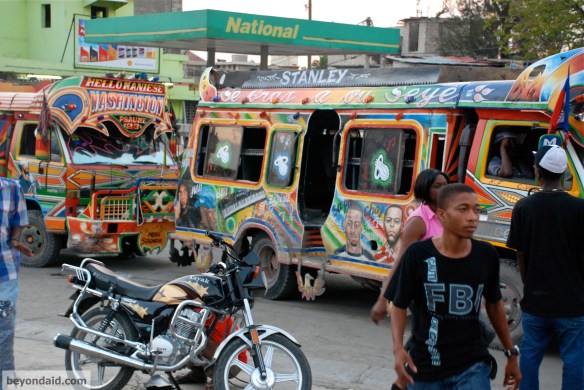
Haiti’s gold
Oxfam’s Keith Slack argues that a looming mining rush could make Haiti’s already considerable problems “even worse”:

“As I’ve written previously, Haiti could take some steps now that could help it avoid some of the worst impacts of the ‘resource curse.’ It must be said, though, that past efforts to build government capacity at the same time a new extractive industry develops, as was the case in Chad, don’t inspire much confidence. If Haiti’s economic development is the primary goal here, and given the country’s multiple governance and environmental challenges (severe water contamination, deforestation, vulnerability to earthquakes and hurricanes among them), there’s a heretical notion to some that should seriously be considered.
Leaving the gold in the ground is an option.”