
Latest Developments, February 21

In the latest news and analysis…

Perpetual growth
The Guardian reports on a new UN-commissioned study that argues the international community needs to take “dramatic action” if it wants to “avert a collapse of civilisation.”
“ ‘The rapidly deteriorating biophysical situation is more than bad enough, but it is barely recognised by a global society infected by the irrational belief that physical economies can grow forever and disregarding the facts that the rich in developed and developing countries get richer and the poor are left behind.
‘The perpetual growth myth … promotes the impossible idea that indiscriminate economic growth is the cure for all the world’s problems, while it is actually the disease that is at the root cause of our unsustainable global practices’, [the authors] say.”

Plundering Somalia
Inter Press Service reports on a new paper criticizing international policy towards Somalia, with one of the authors suggesting this week’s London summit on the country’s future “seeks mainly to rally public opinion around more violence, more intervention, and more counterterrorism options” rather than promoting a holistic approach to problem solving.
“[Global Policy Forum’s James] Paul said the violence-prone naval approach [to halting piracy] has not worked, because it ignores the illegal foreign fishing and toxic waste dumping that is taking place off the Somali coast.
The fishing and dumping provokes the piracy and has led ordinary Somalis to approve the piracy as a legitimate form of national defence.
But powerful members of the Security Council, notably the U.S. and the UK, have blocked any action on fishing and dumping.
‘They pretend that there is no information about the matter, even while their naval fleets are closely monitoring the movement of all ships in Somali waters,’ Paul said. ‘So much for root causes and holistic approaches. Violence is virtually the only option allowed onto the table in London.’ ”

UN responsibility
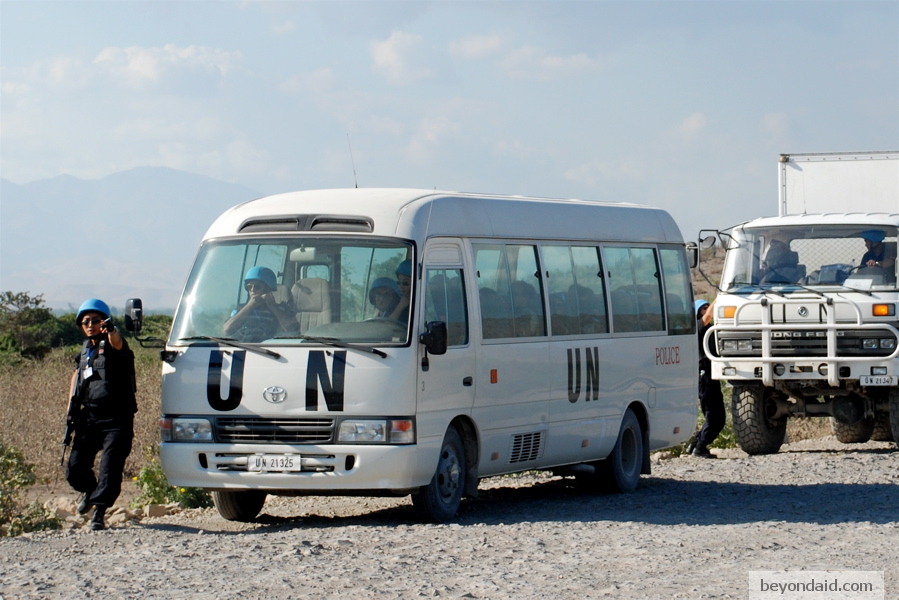
The New Media Advocacy Project’s Abby Goldberg writes about a legal petition that calls on the UN peacekeeping mission in Haiti to compensate and apologize to victims of a deadly cholera outbreak thought to have been caused by UN personnel.
“If the petition is successful, it will be the first case in history in which the UN takes legal responsibility for harm caused by their personnel.

The UN must consider the legal request and how to respond, not only for Haitians, but also for the success of peacekeeping operations globally. This case is about Haiti, but it is also about the UN and a changing world. As one of the lawyers who filed the case said, ‘there is a difference between immunity and impunity. Impunity cannot be tolerated.’ The UN can, and must, do better.”

Emission friction
Oxfam’s Duncan Green is baffled by widespread international opposition to the EU’s plan to charge airlines flying in and out of Europe for their carbon emissions, given that three-quarters of the greenhouse gases taxed would come from European and American carriers.
“The main objection to the EU’s policy is that it applies to air-miles clocked up outside European airspace. But the vast majority of emissions captured by the EU [Emission Trading Scheme] scope are from EU and US operators.  By implication, if India and others genuinely want developed countries to act to cut GHG emissions it would seem against their own interest to try to block the EU ETS, because obviously the EU would never apply it just to its own carriers – so if they were to be successful they’d also prevent us doing something about the large majority of emissions from EU/US carriers.”

Re-inventing the World Bank
Former World Bank executive Ana Palacio says the debate over the US monopoly on the institution’s presidency is “legitimate,” but thinks the organization requires far more significant reforms.
“Just as reconstruction finance gave way to development lending over the course of the Bank’s history, its current focus on banking operations should be reconsidered, as the organization’s main source of added value now lies in its formidable potential as a center of knowledge and a coordinator of international policies.

Today, the international community should look for a World Bank president who is attuned to ordinary people’s growing refusal to tolerate glaring global inequalities, and who understands that development is more than GDP growth. Such a leader, regardless of his or her country of origin, will reinvent the World Bank for the century ahead.”

Universal energy
The Steps Centre’s Rob Byrne and Jim Watson highlight the argument that the world’s poor should not be required to take a low-carbon approach to achieving universal energy access.
“[Practical Action’s Teodoro] Sanchez estimates that half the world’s energy-poor could switch to cooking on sustainable biomass and half to liquefied petroleum gas. Furthermore, half could access electricity from diesel generators while the other half do so from renewable sources. If these plans were implemented, he argues, the increase in global CO2 emissions would be less than 2% above 2005 levels.
If the world takes climate change seriously, this increase could easily be absorbed by cuts in industrialised country emissions and further action to slow emissions growth in the rapidly developing countries (especially China). The cost of this up to 2030 would be about $570bn (including capacity building and institutional costs); less than 3% of the estimated global energy investments needed during the same period.”

Questioning development
And, finally, a piece from last week by the Latin American Center of Social Ecology’s Eduardo Gudynas who argues sustainability will require a profound questioning of the concept of development and a recognition of the rights of nature. 
“The social and environmental crisis is so serious that it is now time to put aside minor adjustments and reforms, and instead address the root causes of resistance to the idea of development. We must adopt an approach whereby the term ‘sustainable development’ no longer requires the suffix ‘development’. The civil society programme in Rio+20 should not focus simply on fixing the superficial problems of development: it is necessary to look for alternatives to the entire body of ideas about development.

If sustainable development strengthens its demands for change, it must abandon the traditional idea of development and thus break with the anthropocentric ethics that are characteristic of Western cultural tradition.”
Latest Developments, February 13

In the latest news and analysis…

Same as the old boss
Foreign Policy’s Michael Cohen writes that if US President Barack Obama has been no more a champion of civil liberties than his predecessor was, Americans are not complaining.
“The results of a recent Washington Post-ABC News poll provide compelling evidence of how little a price Obama has paid for these policies. According to the poll, 70 percent of respondents support the president’s decision to keep Guantanamo Bay open. Indeed, backing for Gitmo is actually higher today than it was in 2003. Among the president’s political base, 53 percent who self-identify as liberal Democrats — and 67 percent of moderate or conservative Democrats — are also supportive.
What about drone strikes? In total, 83 percent of Americans are on-board with the use of drones — a mere 4 percent are strongly opposed.”

Poison Apple
The Guardian reports the Fair Labor Association has begun an independent audit of some of Apple’s Chinese supplier factories in the wake of allegations of worker abuse, though the most notorious of these suppliers has links to many other industry giants as well.
“Foxconn, which makes equipment for a large number of American and Asian companies, including Apple, Amazon, Acer, Asus, Dell, IBM, Hewlett-Packard, Lenovo, Microsoft, Motorola, Netgear, Nokia, Samsung, Sony and Toshiba, has generated huge amounts of attention following claims of poor working conditions in gigantic factories that function like self-contained towns.
In July 2009 a 25-year-old worker committed suicide, reportedly after losing an iPhone prototype, and in 2010 there was a spate of suicides – prompting Foxconn to install nets around the edges of some buildings to prevent people jumping off roofs.”

Living inside the doughnut
Oxfam’s Kate Raworth argues in a new discussion paper that humankind is currently failing to live within “planetary and social boundaries” but could theoretically meet the needs of the poor without further damaging the earth.
“The real source of stress is excessive resource use by roughly the richest 10 percent of people in the world – backed up by the aspirations of a rapidly growing global middle class seeking to emulate those unsustainable lifestyles. Thanks to the extraordinary scale of global inequality, widespread poverty coexists with dangerous planetary stress.

If respecting planetary and social boundaries is the objective, then – in wealthy economies at least – the onus falls on those promoting unlimited GDP growth to show that it can bring humanity within the doughnut. The G20, among others, stand for the vision of ‘inclusive and sustainable economic growth’, but no country has yet shown that it is possible. If unlimited GDP growth is to have a place in doughnut economics, it has a long way to go to prove itself.”

Taking back the banks
The Overseas Development Institute’s Jonathan Glennie argues the current financial crisis presents an opportunity for poor countries to take control of their banks from foreign owners who too often do not operate according to local economic logic.
“…in Africa at least, banking services for rural households and the informal sector (by far the largest part of Africa’s private sector) have generally suffered, according to [the UN Conference on Trade and Development]. ‘These banks lend to larger borrowers such as the public sector, large enterprises and wealthy households. They do not have mechanisms well suited to catering to the needs of small, low-income, and mostly agricultural and rural-based economic agents, despite the fact that these agents constitute the backbone of African economies.’ ”

Peak people
The Globe and Mail’s Doug Saunders considers some of the possible consequences of an aging world where there is “a shift from surplus to scarcity” of working-age people.
“Peak people will be an age when jobs compete for workers rather than vice versa. The cheapest labour will vanish. We’re already seeing this: Because China is aging very fast, its dwindling working-age population is turning down the lowest-paid jobs and pushing up the minimum wage sharply, as well as the once-minimal costs of social services: Stuff from China will stop being cheap, because the Chinese aren’t young.

Peak people will also be an age when countries will be competing for immigrants rather than trying to limit them. Immigration has spared Canada from the worst of aging, but immigrants adopt host-country family sizes very quickly, so they’re a temporary fix. And if their home countries are competing to keep them, then we’ll have a harder time finding young people who want to come.”

The state of nations
Harvard University’s Dani Rodrik argues in favour of strong nation-states as the only plausible source of solutions to current global problems, but he does not entirely rule out the possibility of an alternative future.
“As the philosopher Peter Singer has put it, the communications revolution has spawned a ‘global audience’ that creates the basis for a ‘global ethics.’ If we identify ourselves with the nation, our morality remains national. But, if we increasingly associate ourselves with the world at large, our loyalties will expand, too. Similarly, the Nobel laureate economist Amartya Sen speaks of our ‘multiple identities’ – ethnic, religious, national, local, professional, and political – many of which cross national boundaries.

To be sure, the geography of attachments and identities is not fixed; indeed, it has changed over the course of history. That means that we should not entirely dismiss the likelihood that a true global consciousness will develop in the future, along with transnational political communities.”

Arms philosophies
The Instituto Sou da Paz’s Daniel Mack presents the debate over the future shape of the Arms Trade Treaty – which is being further pre-negotiated this week – as a battle between those who want “a little better than the status quo” and those who seek “to ensure the humanitarian imperative is realized in a major arms regulation agreement”
“It is no wonder that many proponents of an “ATT lite” have heavy arms exports; industry is not usually fond of any sort of regulation to its trade, which more often than not means smaller profit margins. As with alcohol and tobacco, less lethal but also legal, you won’t see industries begging for more restrictions on their international sales.”

Latest Developments, February 12

In the latest news and analysis…

End of cheap drugs?
Unitaid’s Philippe Douste-Blazy and Denis Broun argue the free trade agreement currently being negotiated by India and the EU threatens to end access to cheap medicines for patients in poor countries.
“The medicines-related issues discussed in the FTA are not only a question of public health, but of ethics, justice and reason. The result will either be a win-win situation that will also benefit the poor or a lose-lose proposition that may kill the poor. It would be unthinkable that private interest pressure from European pharmaceutical companies to preserve an obsolete business model could prevail over common sense, common interest and the health of millions of people.”

Open letter to Tim Cook
China Labour Watch’s Li Qiang has written an open letter to Apple CEO Tim Cook, in which he argues the reasons for the poor working conditions in its supplier factories are “deeply rooted in your company’s business model.”
“We believe the most basic cause of the problems at your supplier factories is the low price Apple insists on paying them, leaving next to no room for them to make a profit. The demand for astronomically high production rates at an extremely low price pushes factories to exploit workers, since it is the only way to meet Apple’s production requirements and make its factory owners a profit at the same time.

There is a simple solution for the problems we have observed in Apple’s supply chain, and it doesn’t even involve raising the prices for consumers. Apple needs simply to share a larger proportion of its sizeable profits with the supplier factories it contracts with and, by extension, the people who make its products.”

Anti-drug vaccines
Inter Press Service reports on experimental trials of drug addiction vaccinations going on in Mexico and the US, which although touted as an alternative to the war on drugs, have attracted little interest from pharmaceutical companies.
“After taking office in December 2006, Mexican President Felipe Calderón deployed thousands of soldiers and police to fight drug trafficking in a repressive campaign that has left more than 47,000 dead, according to the latest government figures, although journalists put the death toll at over 50,000.
A preventive clinical approach is therefore an urgent priority, although vaccine development requires financial backing for production on an industrial scale.
‘It’s not a profitable product for the pharmaceutical industry, and the same is true for many other diseases. The state would have to subsidise it. We have already heard more than once that a vaccine is on the way, but then nothing happens,’ said [Dr. Rogelio] Rodríguez, who tried unsuccessfully to introduce his [cocaine and alcohol dependency] treatment in Mexico City prisons – ‘but there were too many conditions and requirements.’ ”

Beer suit
The Associated Press reports that an “American Indian tribe” is suing a handful of major beer makers for knowingly contributing to addiction on a reservation where alcohol is banned.
“The Oglala Sioux Tribe of South Dakota said it is demanding $500 million in damages for the cost of health care, social services and child rehabilitation caused by chronic alcoholism on the reservation, which encompasses some of the nation’s most impoverished counties.

‘You cannot sell 4.9 million 12-ounce cans of beer and wash your hands like Pontius Pilate, and say we’ve got nothing to do with it being smuggled,’ said Tom White, the tribe’s Omaha-based attorney.”

Happy planet
Reuters reports on the results of a new global survey that suggests the world is happier than it was before the financial crisis hit, with people in Indonesia, Mexico and India being the happiest of all.
Perhaps proving that money can’t buy happiness, residents of some of the world biggest economic powers, including the United States, Canada and Britain, fell in the middle of the happiness scale.
‘There is a pattern that suggests that there are many other factors beyond the economy that make people happy, so it does provide one element but it is not the whole story,’ said [Ipsos Global’s John] Wright.

Uneconomics
The University of Oxford’s William Davies argues that although the financial crisis was triggered in part by a system he describes as “a mineshaft crammed with canaries, scarcely any of whom had any inclination or ability to sing,” the resulting fallout has actually increased the power of economics in public life.
“It is time to acknowledge an uncomfortable truth about the public status of economics as an expert discipline: it has grown to be far more powerful as a tool of political rhetoric, blame avoidance and elite strategy than for the empirical representation of economic life. This is damaging to politics, for it enables value judgements and political agendas to be endlessly presented in ‘factual’ terms. But it is equally damaging to economics, which is losing the authority to describe reality in a credible, disinterested, Enlightenment fashion.”

Ecosystem services
The International Institute for Environment and Development’s Kate Munro highlights one of the potential downsides to “making carbon into a commodity.”
“It gives national governments title to the carbon sequestered in a country’s soils and forests for the purposes of trading on international carbon markets, which could pose an additional barrier to the efforts of individuals and poor rural communities to demarcate, and gain title to the land on which their livelihoods depend.”

Word and deed
Oxfam’s Ian Gary rails against the “yawning gap” between what oil companies say and do regarding corporate transparency.
“Many of the same companies praising transparency have been actively lobbying since the law passed to gut implementation by the Securities and Exchange Commission (SEC). The hypocrisy is out there in the open if you know where to look. Senate lobbying disclosure forms show that Chevron, Exxon, Shell, Conoco Phillips, Marathon, Occidental, the American Petroleum Institute (API), and others have been very active in Washington on this provision, targeting not only the SEC, but the House of Representatives, Senate, Department of State, Department of the Intertior, and the National Security Council.
As I wrote last week, API (revenues of more than $198 million in 2009) has now threatened to sue the SEC unless the agency withdraws its proposed rule and starts from scratch to meet big oil’s secrecy wishes rather than the law and Congressional mandate.”

Latest Developments, February 9

In the latest news and analysis…

Accountability deficit
The School of Oriental and African Studies’ Michael Jennings argues there are few consequences for international NGOs that fail to deliver on their humanitarian promises or, in some cases, do actual harm to the people they have pledged to help.
“The question of accountability has often looked to how NGOs answer to donors or to the national governments of countries in which they are operating. From a financial or legal perspective, this makes perfect sense. NGOs should account for the money they spend as contracted agents of donors. And they should, of course, be working within the parameters of national regulatory frameworks and laws (although the fact that NGOs themselves often sit on the committees that draw up such regulatory systems is troubling).

The best NGOs do think about how they can be accountable to the communities and individuals with whom they work. But the issue is too important to be left to self-regulation. Development interventions involve change, and change can result in profoundly negative outcomes for some or many. Unintended as these negative consequences may be, those affected should be afforded a better means to hold to account development actors.”

Mining profits
Bench Marks Foundation’s John Capel writes that calls for increased investment in Africa rarely incorporate a discussion of “how this investment should be undertaken,” a shortcoming the Alternative Mining Indaba seeks to rectify.
“We believe there is a role for independent monitoring and evaluation and a role for community monitoring to hold mining corporations accountable.
But to do so we need independent funds to capacitate communities to engage with mining houses on a level playing field. To back this up we need an independent grievance mechanism, independent of the company, supported by an independent fund contributed to by mining corporations. It must be quick and easy to use, bring redress, be able to hold corporations accountable and must address any adverse impacts on communities.”

Arms control
The Inter Press Service reports on the continuing campaign for stricter controls on international weapons sales ahead of next week’s pre-negotiation meeting regarding the Arms Trade Treaty which is supposed to be finalized later this year.
“ ‘There is more control on the selling of bananas than there is on conventional arms,’ said Zobel Behalal, peace and conflicts advocacy officer for CCFD-Terre Solidare, a French-based Catholic NGO.
‘For us, this is a true scandal because states can do what they want without taking into account the impact on civilian populations,’ he told IPS.”

Immunity lost
Agence France-Presse reports Iraqi officials want to rein in private security contractors whose large number “negatively impacts the security situation in the country.”
“The firms ‘have to understand that … they don’t have free (movement) in the country. They have to follow the instruction, they have to hold the permit, a valid permit, and they are not allowed to violate the Iraqi laws.’
‘They are not exempted as before, and they are not getting any sort of immunity,’ [government spokesman Ali al-Dabbagh] said.
‘We do need them, definitely, we do need them, (and) we are not going to stop them, but definitely, we will limit their work,’ Dabbagh said.”

Living wage
The Phnom Penh Post reports on a push to quadruple the wages of Cambodian garment workers.
“[Asia Floor Wage] coordinator Anannya Bhattacharjee said the $281 calculation was based on a worker’s monthly nutritional needs according to figures obtained from governments and international institutions.
She added that such an increase would rely to some extent on clothing brands and retailers paying more for the finished product.
‘There is enough money in the global supply chain for brands to pay Cambodian manufacturers enough so that garment workers can earn that,’ she said.”

Down the toilet
A new World Wildlife Fund report suggests American consumers are contributing to the destruction of Indonesia’s rain forests by buying certain brands of toilet paper.
“In recent years, APP has greatly expanded into the U.S. tissue market, including through Paseo and Livi tissue products. Oasis Brands, which markets Paseo, announced in 2011 that Paseo had become the fastest-growing brand of toilet paper in the U.S.  Paseo and Livi are also marketed as ‘away-from-home’ products used in public restrooms in restaurants, office buildings, schools and hotels.”

Universal joy
The Center for Global Development’s Charles Kenny responds to Japanese calls to make happiness one of the Rio+20 Sustainable Development Goals with a more American plea to focus on the “right to pursue happiness.”
“Most differences in life satisfaction poll answers are due to inherited characteristics, while less than 3 percent can be explained by socioeconomic status, education, income, marital status, and religious commitment combined.  As I suggest in this CGD Essay, for a society to maximize average happiness poll answers, its most effective course would probably be to put everyone on an antidepressant-ecstasy cocktail and (given the strong genetic component of happiness poll answers) add in chemical sterilization for the naturally unhappy.  Is that really what we want out of a new round of Millennium Development Goals?”

Geography of trade
Drew University’s Fred Curtis and Rutgers’s David Ehrenfeld argue the end of globalization – or at least its considerable reduction – is nigh but they see as many opportunities as problems in the inevitable transition to more localized life.
“It is now critical for economic planners, laypersons and governments to recognise that long-term energy and climate realities will impose limits on the global movement of goods. Trade pacts, like the US-Korea Free Trade Agreement, and business models, like Walmart with its transoceanic supply chains, will make less sense as the foundations of global trade are undermined. This is not the result of either ideology or policy. Only when we accept these realities can we design and rebuild less vulnerable patterns of production and trade throughout the world. Nearly every country has existing examples of sound, regional development that can be used as models.”